Tag: American Workers

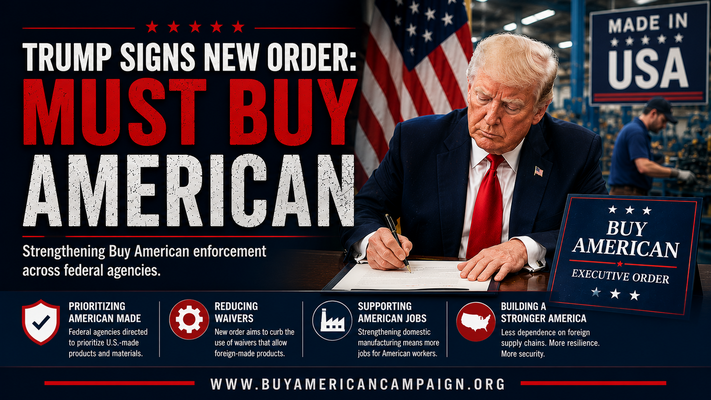
  • Trump Signs New “Buy American” Executive Order Targeting Federal Purchasing Waivers

    Trump Signs New “Buy American” Executive Order Targeting Federal Purchasing Waivers

    Trump signs new Buy American executive order strengthening federal purchasing rules

    The White House has announced a new executive order focused on strengthening enforcement of existing “Buy American” requirements across federal agencies.

    According to the administration, the order is intended to reduce the use of waivers that allow foreign-made products to be purchased for government projects and operations. Federal agencies are being directed to place greater emphasis on domestic sourcing, American factories, and U.S.-based supply chains when making purchasing decisions.

    The move places renewed national attention on a topic that has become increasingly important over the last several years: whether the United States should rely more heavily on domestic manufacturing for critical goods and infrastructure.

    For decades, the federal government has operated under Buy American laws in some form. However, critics have argued that loopholes and waiver systems often weakened those rules in practice, allowing imported products to continue entering government supply chains.

    Browse American-Made Products

    Supporters of stronger Buy American enforcement argue that federal spending should help support American workers, industrial capacity, and domestic production whenever possible. They also point to supply-chain vulnerabilities exposed during recent global disruptions as evidence that the U.S. needs stronger manufacturing resilience.

    Others caution that stricter domestic sourcing requirements can increase project costs or complicate procurement processes, especially in industries where global supply chains remain deeply integrated.

    Join the Buy American Movement

    Regardless of where people fall politically, the executive order highlights how manufacturing and supply-chain policy have become major national issues again after years of being treated as secondary economic concerns.

    The broader debate extends beyond government contracts alone. Questions about domestic production, industrial capacity, national resilience, and economic dependence on overseas manufacturing are increasingly shaping conversations across business, politics, and the economy.

    Whether this executive order leads to major long-term changes remains to be seen. But it clearly signals that Buy American policies are once again moving toward the center of national economic discussion.

    Whenever possible, choose Made in USA.

    If you like what you see and think this post would be of interest to someone, please share
  • When a Factory Closes, a Town Changes Forever

    When a Factory Closes, a Town Changes Forever

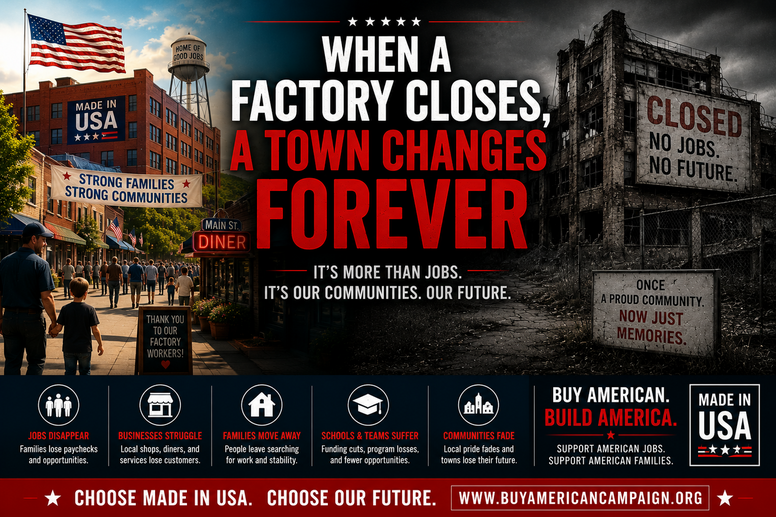
    When a factory closes, an American town changes forever — the human cost of losing manufacturing

    When a factory closes, most people count the jobs.

    300 jobs lost. 800 jobs lost. 2,000 jobs lost.

    The numbers make headlines for a few days, then the country moves on.

    But the real damage spreads much further than that.

    Because when a major factory disappears, it rarely affects only the workers inside the building. Entire communities begin to change around it.

    The local diner loses its breakfast crowd. The hardware store sees fewer customers. The auto shop gets quieter. Youth sports sponsorships disappear. Families move away looking for work. Downtown storefronts slowly empty out.

    And eventually, a town that once felt alive starts feeling like it’s fading.

    America Was Built Around Manufacturing Towns

    For generations, manufacturing jobs helped build stable middle-class communities across America.

    Not just in giant cities — but in small towns and working-class suburbs all over the country.

    Factories created more than paychecks.

    They created:

    • local pride
    • apprenticeship opportunities
    • community identity
    • long-term careers
    • economic stability for families

    Entire neighborhoods grew around mills, plants, machine shops, shipyards, and factories.

    Parents expected their kids could stay nearby, work hard, buy a home, and build a decent life in the same community.

    That stability mattered.

    Outsourcing Changed More Than the Economy

    Over time, many of those jobs moved overseas.

    Companies chased lower labor costs. Factories closed. Production shifted abroad.

    And while consumers often got cheaper products, many communities paid a price that never fully showed up in economic charts.

    Some towns recovered.

    Others never really did.

    You can still drive through parts of America today and immediately see the difference:

    • empty industrial buildings
    • abandoned parking lots
    • faded downtowns
    • neighborhoods that feel stuck in time

    People notice it even if they don’t talk about it directly.

    Browse American-Made Products

    Americans Are Not “Nostalgic” for Caring About This

    One of the strangest things about the outsourcing era is how often people were told not to care.

    If Americans worried about losing factories, they were called nostalgic. If they talked about rebuilding manufacturing, they were told globalization made it impossible. If they wanted stronger domestic production, they were accused of resisting progress.

    But communities are not irrational for wanting stability.

    Families are not irrational for wanting good-paying local jobs.

    And Americans are not irrational for wanting the country to still build things.

    Manufacturing Still Matters

    Not every job will return. Not every town can be rebuilt overnight.

    But manufacturing still matters enormously to the strength of a country.

    Strong industrial capacity supports:

    • local economies
    • supply-chain resilience
    • skilled trades
    • small businesses
    • middle-class wages
    • national security

    And maybe most importantly, it helps communities feel like they still have a future.

    Join the Buy American Movement

    The Bigger Question

    America now faces a choice.

    Do we continue treating manufacturing as something disposable?

    Or do we recognize that when factories disappear, we lose pieces of communities, local identity, and long-term stability along with them?

    Because once enough factories leave, it becomes very hard to rebuild the culture and ecosystem that supported them in the first place.

    And by the time the country realizes what was lost, entire towns may already be gone.

    Whenever possible, choose Made in USA.

    If you like what you see and think this post would be of interest to someone, please share
  • America’s Trade Deficit Just Hit Its Lowest Level Since 2009 — And That Might Signal Something Bigger

    America’s Trade Deficit Just Hit Its Lowest Level Since 2009 — And That Might Signal Something Bigger

    US trade deficit falls to its lowest level since 2009 — a 16-year milestone

    For decades, Americans were told the decline of domestic manufacturing was simply inevitable.

    Factories would move overseas. Imports would keep rising. America would become a service economy while other countries handled production.

    Now, for the first time in years, some of the numbers are starting to move in the opposite direction.

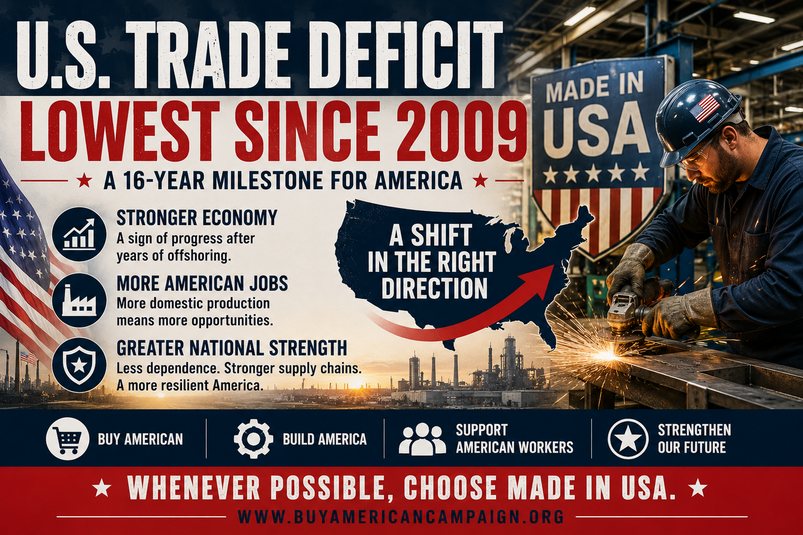
    The U.S. trade deficit has fallen to its lowest level since 2009 — a historic 16-year milestone that many economists did not expect to happen this quickly.

    Even more striking: the goods trade deficit with China has dropped dramatically compared to where it stood just a few years ago.

    And while this does not mean America’s manufacturing problems are suddenly solved, it may signal something much bigger beginning to shift underneath the surface of the economy.

    For Years, America Became Dependent on Imports

    For a long time, the American economy moved in one direction: more imports, more offshoring, and more dependence on foreign manufacturing.

    Entire industries hollowed out. Manufacturing towns struggled. Companies chased cheaper labor overseas while consumers got used to buying imported products for almost everything.

    Many experts argued this was simply the unavoidable future of globalization.

    But recent years have exposed the weaknesses in that model.

    Supply-chain disruptions, geopolitical tensions, shipping bottlenecks, and national security concerns forced both companies and governments to rethink how dependent America had become on overseas production.

    The Numbers Are Starting to Change

    The latest trade data suggests the economy may be entering a different phase.

    The overall U.S. trade deficit has now fallen to levels not seen since 2009, while the goods deficit with China has declined significantly compared to prior years.

    That does not mean America suddenly manufactures everything domestically again. Far from it.

    But it does suggest companies are diversifying supply chains, rebuilding domestic production in some sectors, and reducing at least part of the extreme dependence on foreign manufacturing that defined the last several decades.

    Browse American-Made Products

    Why This Matters Beyond Economics

    Trade deficits are often discussed in abstract economic terms, but the real-world impact is deeply personal for many communities.

    When manufacturing disappears, it is not just factories that vanish. Local suppliers disappear. Apprenticeship pipelines weaken. Small businesses suffer. Entire towns lose part of their economic identity.

    That is why so many Americans care about rebuilding manufacturing even if they never work in a factory themselves.

    Strong industrial capacity creates middle-class jobs, supports local economies, strengthens national resilience, and reduces dependence on unstable foreign supply chains.

    Maybe Americans Were Not Wrong After All

    One of the most interesting parts of this story is how sharply the national conversation has changed.

    For years, people who worried about outsourcing and manufacturing decline were often dismissed as nostalgic or unrealistic.

    Now many of the same corporations and policymakers who once championed global supply chains are suddenly talking about reshoring, industrial policy, domestic production, and supply-chain security.

    That shift did not happen by accident.

    Americans never fully stopped caring about domestic manufacturing. The economy simply reached a point where the consequences of losing too much industrial capacity became impossible to ignore.

    Join the Buy American Movement

    The Bigger Question

    The important question now is whether this trend continues.

    Will America genuinely rebuild more domestic manufacturing capacity over the next decade? Or will companies quietly return to old habits the moment overseas production becomes slightly cheaper again?

    No single economic report answers that question completely.

    But a 16-year low in the trade deficit is still a signal worth paying attention to.

    Because after decades of moving in one direction, America may finally be starting to turn back toward building more things at home again.

    Whenever possible, choose Made in USA.

    If you like what you see and think this post would be of interest to someone, please share
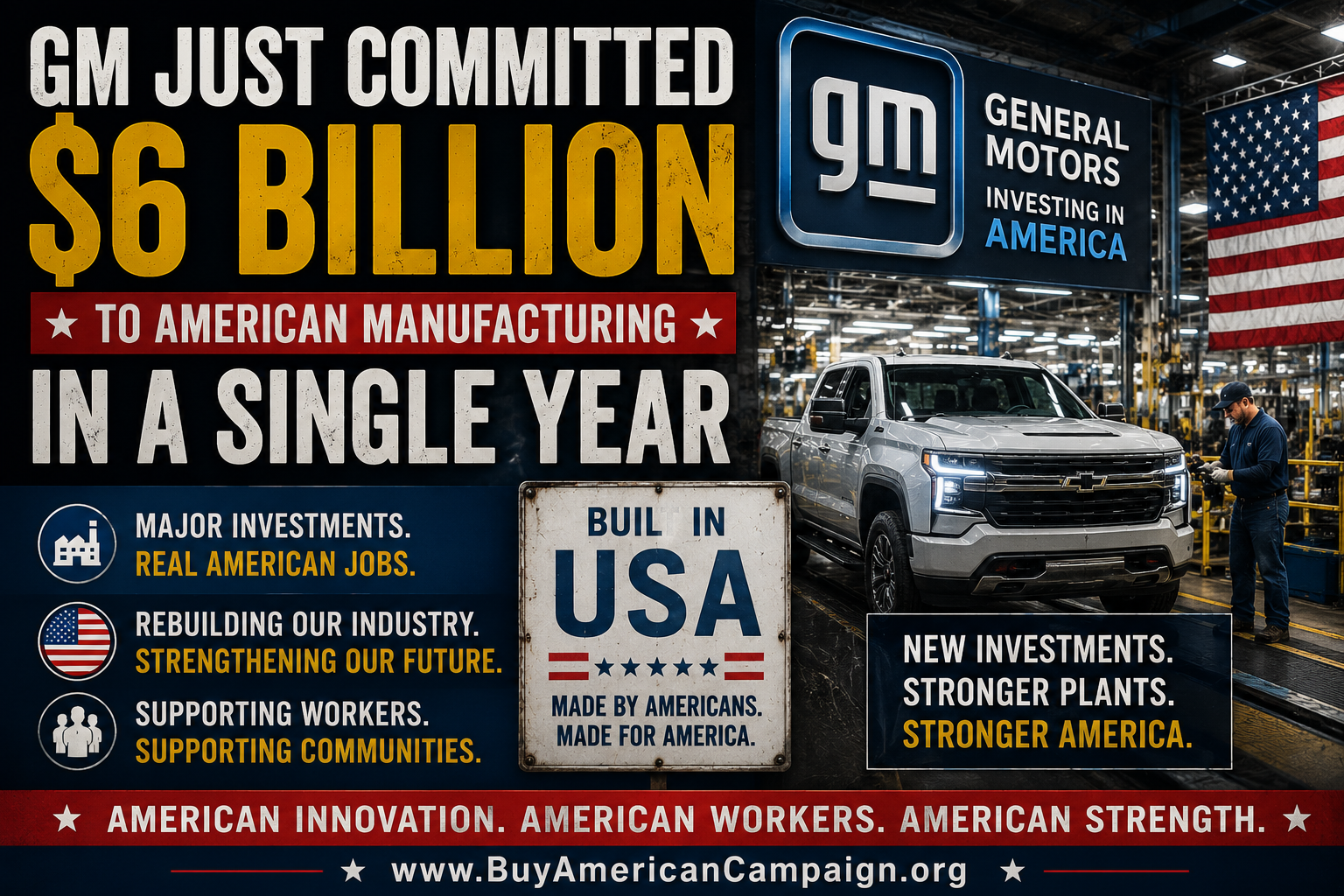
  • GM Just Committed $6 Billion to American Manufacturing — And That Says a Lot About Where the Economy Is Headed

    GM Just Committed $6 Billion to American Manufacturing — And That Says a Lot About Where the Economy Is Headed

    GM commits $6 billion to American manufacturing investment in U.S. plants

    For years, Americans were told manufacturing was fading away.

    The future would belong entirely to software, finance, and imported products. Industrial towns would slowly disappear while the country shifted toward a “post-manufacturing economy.”

    Now suddenly, one of America’s most iconic automakers is doing something that would have sounded almost old-fashioned a decade ago:

    General Motors is pouring roughly $6 billion into American manufacturing operations in a single year.

    That includes new investments across U.S. facilities, major plant upgrades, retooling efforts, and expanded domestic production capacity — particularly throughout the Midwest.

    And whether people realize it or not, this story says something much bigger about where the American economy may be heading next.

    America’s Industrial Giants Are Re-Thinking Manufacturing

    For decades, corporate America chased efficiency above everything else. Manufacturing moved wherever labor was cheapest. Supply chains stretched across the globe. Wall Street rewarded short-term savings over long-term industrial strength.

    Then reality hit.

    COVID exposed fragile supply chains. Geopolitical tensions raised concerns about dependence on foreign production. Consumers became more interested in buying American-made products. And suddenly companies started realizing that domestic manufacturing still matters.

    GM’s investment is one of the clearest examples yet that large American manufacturers are starting to think differently again.

    Not Just Electric Vehicles

    One of the more interesting details in GM’s strategy is that the company is not blindly abandoning traditional vehicle production while chasing electric vehicle headlines.

    In fact, some of the new spending is specifically tied to gas-powered vehicle retooling and continued domestic production as consumer demand shifts more slowly than many executives expected.

    That matters because it suggests something important:

    American manufacturing companies are starting to focus less on political narratives and more on building what customers actually want to buy.

    For many workers and manufacturing communities, that is probably welcome news.

    Browse American-Made Products

    The Midwest Still Matters

    There is also a symbolic side to this story.

    For generations, places like Michigan, Ohio, Indiana, and other parts of the industrial Midwest formed the backbone of American manufacturing power. Entire cities grew around automotive production.

    Then came decades of plant closures, outsourcing, automation shocks, and economic decline across many manufacturing regions.

    That is why major reinvestment stories matter psychologically as much as economically. They represent something Americans have not seen enough of for a long time: industrial confidence.

    Factories expanding instead of shrinking. Production lines growing instead of disappearing. Manufacturing companies betting on America instead of slowly leaving it behind.

    The Bigger Debate

    Of course, not everyone will agree on what this means.

    Some critics will argue that corporations only “rediscover” American manufacturing when subsidies, tariffs, or political pressure make it profitable. Others will point out that many companies spent decades offshoring jobs before suddenly talking about reshoring.

    Those criticisms are not entirely unfair.

    But at the same time, America cannot rebuild industrial strength without major manufacturers actually investing in domestic production again.

    And $6 billion is not symbolic pocket change.

    Join the Buy American Movement

    America Still Knows How to Build

    Stories like this matter because they challenge the idea that America’s manufacturing future is already over.

    The reality is far more complicated.

    The United States still has enormous industrial capacity, engineering talent, infrastructure, and manufacturing experience. The real question is whether the country has the long-term commitment to rebuild and expand it.

    GM’s latest investment suggests at least some major companies believe the answer may still be yes.

    Whenever possible, choose Made in USA.

    If you like what you see and think this post would be of interest to someone, please share
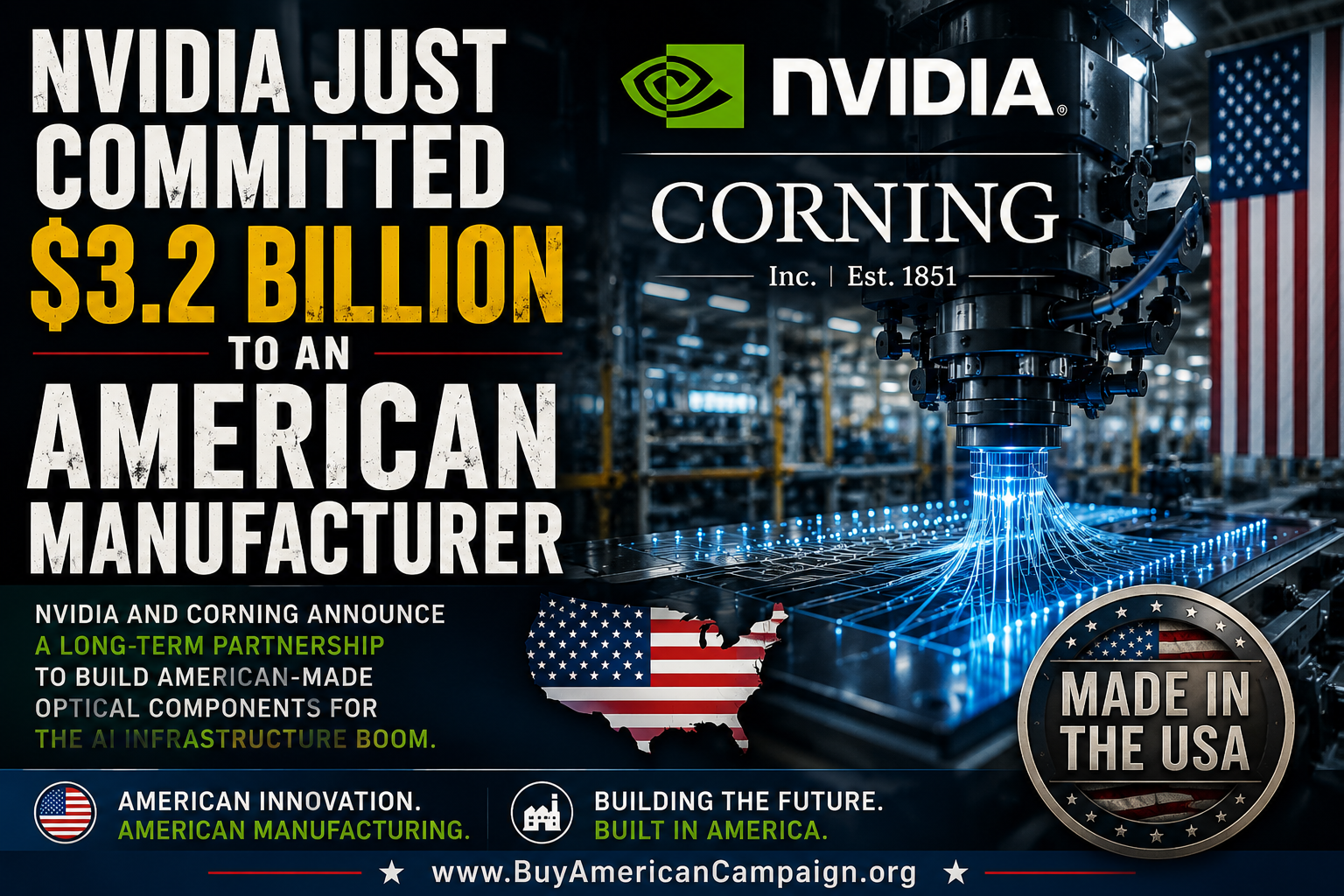
  • Nvidia Just Committed Billions to a 175-Year-Old American Manufacturer

    Nvidia Just Committed Billions to a 175-Year-Old American Manufacturer

    Nvidia partners with Corning on American-made optical infrastructure for AI

    When most people think about artificial intelligence, they picture software, chatbots, and Silicon Valley engineers.

    But here’s the reality almost nobody talks about: AI still depends on factories.

    This week, Nvidia announced a long-term partnership worth up to $3.2 billion with Corning Inc. — the 175-year-old American manufacturer best known for advanced specialty glass and industrial materials.

    The goal is to help build the optical infrastructure powering America’s exploding AI data-center industry.

    In other words: even the future of artificial intelligence still relies on American manufacturing.

    A Tech Giant Betting on an American Industrial Company

    Nvidia has become one of the most valuable companies in the world because of the AI boom. But what makes this story interesting is where some of that money is now flowing.

    Not into another trendy startup.

    Into Corning — a company founded in 1851 that has spent generations manufacturing advanced materials in America.

    That matters because it completely destroys the idea that manufacturing is somehow “old economy” and irrelevant to the future.

    The AI race is not just about software engineers anymore. It is also about factories, industrial capacity, materials science, optical systems, energy infrastructure, and supply chains.

    Browse American-Made Products

    The Future Still Needs American Factories

    For years, America treated manufacturing as something outdated — something the country could outsource while focusing only on finance, software, and services.

    Now suddenly everyone is realizing that advanced technology still depends on physical industrial capability.

    You cannot power massive AI systems without servers. You cannot run servers without optical infrastructure. And you cannot build that infrastructure without manufacturers capable of producing highly specialized components at scale.

    That is why this partnership matters far beyond Nvidia stock headlines.

    It is a reminder that industrial strength still matters — even in the most advanced sectors of the modern economy.

    America Is Quietly Relearning an Old Lesson

    There is also a larger lesson buried inside this story.

    For decades, many corporate leaders treated manufacturing as interchangeable. Build it wherever labor is cheapest. Ship it across the world. Focus only on quarterly margins.

    But supply-chain shocks, geopolitical tensions, and the AI infrastructure race are changing that mindset fast.

    Countries that cannot manufacture critical technologies eventually become dependent on countries that can.

    And that is exactly why stories like this are important.

    Join the Buy American Movement

    Corning Represents Something Bigger

    Corning is not just another supplier. It represents a part of the American industrial base that many people forgot still existed.

    This is a company that survived world wars, recessions, globalization waves, and technological revolutions while continuing to manufacture advanced products in the United States.

    Now one of the world’s biggest AI companies is depending on that manufacturing capability to help build the infrastructure behind the next technological revolution.

    That should tell Americans something important:

    The future will not belong only to countries that invent technology.

    It will belong to countries that can still build things.

    Whenever possible, choose Made in USA.

    If you like what you see and think this post would be of interest to someone, please share
  • Your Grandfather’s Toolbox vs. Yours — What Happened to American Quality?

    Your Grandfather’s Toolbox vs. Yours — What Happened to American Quality?

    Your grandfather's toolbox versus today's disposable imports — what happened to American quality

    Walk into your grandfather’s garage and you’ll probably still find tools that are older than you are.

    Heavy steel wrenches. Old Craftsman sockets. A scarred-up toolbox that has survived decades of work. Maybe an old Stanley tape measure with faded lettering or a drill that somehow still runs perfectly after 40 years.

    Most of it was made in America.

    Now walk through a modern big-box store.

    Plastic packaging. Disposable products. Cheap imports designed to be replaced instead of repaired. Tools that feel lighter, weaker, and somehow temporary before you even open the box.

    Somewhere along the way, America stopped building products to last — and most people barely noticed it happening.

    We Didn’t Just Lose Factories

    People often talk about manufacturing as if it’s only about economics.

    Jobs. Tariffs. Trade deficits. Supply chains.

    But something deeper disappeared too.

    America once had a culture of building things with pride. Products were expected to survive years of real use. Workers took pride in craftsmanship because their names, towns, and reputations were attached to what they made.

    When manufacturing left, some of that mindset left with it.

    The Era of Disposable Everything

    Today, many products are designed around replacement cycles instead of durability.

    Phones that can’t be repaired. Appliances that fail after a few years. Cheap tools that snap under pressure. Furniture made from particle board instead of solid wood.

    Consumers got trained to accept lower quality because the prices looked cheaper upfront.

    But was it actually cheaper?

    Your grandfather bought one toolbox that lasted 40 years.

    Modern consumers buy replacements over and over again.

    Browse American-Made Products

    “Made in USA” Used to Mean Something

    There was a time when “Made in USA” wasn’t just a patriotic slogan. It was shorthand for quality.

    American manufacturing earned that reputation through generations of workers who built products meant to survive real-world use.

    That reputation helped build some of the most trusted brands in the world.

    But over time, many companies realized they could keep the branding while quietly moving production elsewhere.

    The logos stayed the same.

    The commercials stayed the same.

    The factories disappeared.

    Americans Still Have a Choice

    The good news is that American manufacturing is not dead.

    There are still companies building high-quality products here. There are still workers who care deeply about craftsmanship. There are still factories producing tools, boots, cookware, furniture, knives, apparel, and industrial equipment that can last for decades.

    But those companies survive only if Americans actually support them.

    Every purchase sends a signal about the kind of economy we want to have.

    Disposable or durable.

    Imported or American-made.

    Short-term savings or long-term strength.

    Join the Buy American Movement

    Maybe It’s Time to Build Things That Last Again

    America built some of the strongest products and most respected industrial brands the world has ever seen.

    That capability did not disappear because American workers forgot how to build.

    It disappeared because the culture slowly stopped valuing durability, craftsmanship, and domestic production the way it once did.

    Maybe it’s time to change that.

    Whenever possible, choose Made in USA.

    If you like what you see and think this post would be of interest to someone, please share
  • Stanley Black & Decker Is Leaving “Hardware City” — And Americans Should Be Asking Why

    Stanley Black & Decker Is Leaving “Hardware City” — And Americans Should Be Asking Why

    Stanley Black & Decker closes last New Britain Connecticut manufacturing plant

    For generations, New Britain, Connecticut was known as “Hardware City.” The nickname wasn’t marketing fluff. It was earned. Factories filled the city. Workers built tools that ended up in garages, workshops, construction sites, and military supply chains across America. The Stanley name wasn’t just headquartered there — it helped define the identity of the entire town.

    Now that chapter is ending.

    Stanley Black & Decker is shutting down its last manufacturing plant in New Britain, eliminating roughly 300 jobs and effectively ending the company’s manufacturing presence in the very city that made it famous.

    And Americans should probably ask themselves an uncomfortable question: what exactly does “American brand” mean anymore if the manufacturing disappears too?

    The Town That Built the Brand

    Stanley’s roots in New Britain go back nearly 200 years. This was not some temporary warehouse operation or tax-incentive relocation story. This was one of the foundational manufacturing communities of industrial America.

    Entire generations of families worked in these factories. Skilled trades were passed from parents to children. Local restaurants, supply shops, contractors, and small businesses all depended on the manufacturing economy that surrounded companies like Stanley.

    That is why this closure hits differently. It feels symbolic of something much bigger than one plant shutting down.

    The Brand Still Sells American Heritage

    Here’s the part that frustrates many Americans: Stanley Black & Decker still benefits enormously from its American identity. The branding, the history, the legacy, the workshop culture — all of that was built by American factory workers over generations.

    Consumers still associate Stanley with durability, tradesmen, and American craftsmanship. But the manufacturing footprint tied to that reputation keeps shrinking.

    At some point, companies have to decide whether “American heritage” is something they genuinely value or just something they use in advertising campaigns.

    Browse American-Made Products

    Another Warning Sign for American Manufacturing

    This story lands at a strange moment in America.

    Politicians from both parties are suddenly talking about rebuilding domestic manufacturing. Consumers are becoming more interested in buying American-made products. Companies are talking about reshoring supply chains and reducing dependence on overseas production.

    Yet one of America’s most recognizable industrial brands is still walking away from the very manufacturing town most associated with its identity.

    That contradiction is exactly why so many Americans have become skeptical. They keep hearing speeches about rebuilding manufacturing while watching iconic factory towns continue to hollow out in real time.

    The Uncomfortable Consumer Reality

    There is another uncomfortable truth here too: consumers play a role in this.

    Americans say they support domestic manufacturing. They say they care about American jobs. They say they want companies to keep production here.

    But many shoppers still choose the cheapest option available the moment they stand in the aisle or open Amazon.

    Companies notice that behavior. Wall Street notices that behavior too.

    And eventually, communities like New Britain pay the price.

    Join the Buy American Movement

    This Is Why the Buy American Conversation Matters

    The closure of Stanley Black & Decker’s last New Britain plant is not just another business headline. It is a reminder that industrial identity can disappear faster than people think.

    Once factories leave, they rarely come back. The workers scatter. The apprenticeship pipelines disappear. The supporting businesses weaken. And eventually the town that once built things becomes a town that mostly remembers building things.

    That is why stories like this matter.

    Because America cannot keep celebrating manufacturing in speeches while quietly allowing the industrial backbone of entire communities to disappear.

    Whenever possible, choose Made in USA.

    If you like what you see and think this post would be of interest to someone, please share
  • America Just Quietly Became the World’s Pistachio Superpower — And Most People Have No Idea

    America Just Quietly Became the World’s Pistachio Superpower — And Most People Have No Idea

    California pistachio orchard at harvest, American pistachio industry

    Quick test. Without looking it up, name the country that produces the most pistachios in the world. Most Americans say Iran. A few say Turkey. Almost nobody says the right answer — which is the United States, by a wide and growing margin. The American pistachio industry just crossed a milestone that is going to make that gap even bigger: a record 520,000 bearing acres in the 2025 crop, the first time the country has ever pushed past the half-million-acre line.

    That is not a small headline. That is an entirely different planet from where this industry started.

    Fifty years ago, commercial pistachio farming in the United States barely existed. The first serious orchards in California’s Central Valley were planted in the 1970s by farmers who were treated, in their own words, like they were growing moon rocks. Today their grandchildren are running the largest pistachio operation on Earth, and the bag of pistachios sitting on your kitchen counter almost certainly came from a tree that was planted, harvested, processed, and packaged on American soil.

    Half a Million Acres, All American

    The 520,000-bearing-acre milestone matters because of what it represents. “Bearing” acres means trees that are old enough to actually produce a crop. Pistachio trees take seven years before they bear meaningful fruit, and they don’t hit full production until year ten or twelve. So the 520,000 acres harvested in 2025 represent decisions made by American farmers a decade ago to bet on this country, on this crop, on the long horizon.

    Almost all of those acres are in California — concentrated in the Central Valley around Fresno, Madera, Kern, and Tulare counties, with a smaller but growing footprint in Arizona and New Mexico. The American pistachio industry is, in other words, a deeply regional, deeply rural, deeply family-farm story that just happens to be the largest of its kind in the world.

    How America Quietly Pulled This Off

    The U.S. didn’t become the world’s top pistachio producer by accident. It happened because of three things that the country still does very well when it sets its mind to it: agronomy, irrigation engineering, and patient capital.

    American researchers spent decades developing pistachio rootstocks bred specifically for California’s soil and climate. American irrigation companies built drip systems that squeeze every drop of water from increasingly tight allocations. American family farms — many of them third- and fourth-generation operations — were willing to wait the seven-to-ten years it takes for a new orchard to pay back. Add it all up and you get a domestic industry that produced its way past every traditional competitor on the planet.

    Browse American-Made Products

    The Snack Aisle Is a Made-in-USA Win and Nobody Talks About It

    Walk into any American grocery store and look at the pistachio shelf. Wonderful Pistachios. Setton Farms. Trader Joe’s bags. Costco’s two-pound bags. Almost every one of those products was grown, processed, and bagged in the United States. Wonderful alone — the company in the green bag your kids inhale on a road trip — runs the largest pistachio orchard in the world out of California’s Central Valley. The hulling, drying, roasting, and packaging happens at American facilities staffed by American workers.

    It is, frankly, one of the easiest “Made in USA” wins in the entire snack aisle. You don’t have to read the fine print. You don’t have to scan a QR code. You just grab a bag of American pistachios, and the dollars go to a California farmer.

    What Comes Next

    Crossing 520,000 bearing acres isn’t the end of the line. New plantings are still going into the ground every year. Industry forecasts suggest U.S. pistachio production could grow another 30 to 50 percent over the next decade as younger orchards reach full bearing age. Export demand from Asia and Europe is climbing fast — Americans are exporting pistachios to the very countries that used to dominate the industry. That sentence used to be unthinkable. Now it’s a line on the spreadsheet.

    Join the Buy American Movement

    Why This Story Should Matter to You

    We talk a lot about American manufacturing as steel mills, auto plants, and chip fabs. Those stories are important — and they are real. But there is another kind of American manufacturing happening in places most people never think about: an irrigated orchard in Madera County, a hulling plant outside Bakersfield, a packaging line in Fresno. American workers, American farmers, American technology, American product, shipped to American shelves and to forty countries beyond.

    The next time someone tells you America doesn’t make anything anymore, hand them a pistachio.

    Whenever possible, choose Made in USA.

    If you like what you see and think this post would be of interest to someone, please share
  • Novartis Just Locked In Its 7th American Factory — The Biggest U.S. Expansion in the Company’s History

    Novartis Just Locked In Its 7th American Factory — The Biggest U.S. Expansion in the Company’s History

    Novartis American pharmaceutical manufacturing facility

    Reach into your medicine cabinet. Pick up any prescription bottle. Now flip it over and look at the country of origin. There’s a very good chance the active ingredient was made overseas — in India, in China, or somewhere along a supply chain you can’t trace. That has been the uncomfortable reality of American pharmaceutical manufacturing for the last twenty years. Until now.

    This week, Novartis — one of the largest pharmaceutical companies on Earth — officially finalized the location of its seventh and final new U.S. manufacturing and research site. That marks the completion of the largest American expansion in the company’s 130-year history. Seven new facilities. All on U.S. soil. All staffed by American workers. All dedicated to making medicines for Americans, right here at home.

    This is the kind of headline that sounds boring until you understand what it actually fixes.

    Why Pharmaceutical Reshoring Is a National Security Story

    For decades, the United States quietly handed over the production of its most essential medicines — antibiotics, blood pressure drugs, insulin, chemotherapy ingredients — to factories on the other side of the planet. The math made sense to accountants. It made no sense to anyone who lived through the COVID drug shortages, watched cancer patients ration their chemo because a Chinese factory shut down, or stood in a pharmacy aisle in 2024 looking at empty shelves where amoxicillin used to be.

    When the pills aren’t made here, the supply chain isn’t ours. And when the supply chain isn’t ours, neither is the safety net.

    What Novartis is doing — committing seven new American facilities in a single coordinated push — isn’t just a corporate press release. It’s the largest single move toward American drug independence by any pharmaceutical company in a generation.

    Seven Sites. One Goal. American Medicine.

    Novartis announced the broader expansion last year, committing to build out a wave of new U.S. manufacturing and R&D facilities. The seventh site, locked in this week, completes the plan. Each location combines drug production capability with research-and-development work — meaning the company isn’t just bottling pills here, it is doing the science here.

    That distinction matters. Lots of foreign pharma firms operate U.S. distribution centers. Far fewer operate U.S. R&D labs. Novartis is doing both, in the same buildings, in seven locations across the country. That’s how you build a domestic industry — not by importing finished pills, but by importing the entire pipeline that creates them.

    Browse American-Made Products

    The Jobs Behind the Pills

    Pharmaceutical plants are not assembly lines. They are some of the most demanding manufacturing environments on the planet — clean rooms, sterile fill lines, biotech reactors, packaging suites that have to pass FDA inspection on a moment’s notice. The people who staff those facilities are highly skilled, well-paid, and almost impossible to outsource: chemical engineers, microbiologists, quality-control technicians, validation specialists, machine operators trained on equipment that costs more than most houses.

    Each new Novartis site means hundreds of those jobs created or expanded. Not call centers. Not warehouse jobs that disappear in a downturn. Real, durable, technical-trade careers, in American towns, building real American medicine.

    This Is What “Bringing It Home” Actually Looks Like

    Politicians talk about pharmaceutical reshoring constantly. Tariff threats, executive orders, congressional hearings. Most of it is talk. What Novartis just did is the opposite: it is bricks, mortar, payroll, and a ribbon-cutting on the seventh of seven new U.S. facilities. No more announcements left to make. The plan is done. The plants are getting built.

    Join the Buy American Movement

    What It Means for the Bottle in Your Medicine Cabinet

    It will take years for the full effect to filter through to your local pharmacy shelf. New plants don’t ship product overnight; FDA validation alone is a multi-year process. But the long arc is unmistakable. More medicine made here means fewer Americans waiting on a supply chain that runs through Mumbai or Shanghai. It means hospitals that don’t have to ration chemotherapy because a foreign factory caught fire. It means your kid’s antibiotic is on the shelf when she needs it.

    And it means that when you flip over the bottle and look at the country of origin, there’s a growing chance you’re going to see four little letters that mean something: USA.

    Seven sites. One goal. Bringing our medicine back to American soil. That’s a story worth a headline.

    Whenever possible, choose Made in USA.

    If you like what you see and think this post would be of interest to someone, please share
  • America’s First Humanoid Robot Factory Just Opened in California — And It’s Shipping 10,000 Robots This Year

    America’s First Humanoid Robot Factory Just Opened in California — And It’s Shipping 10,000 Robots This Year

    1X NEO humanoid robot factory in Hayward, California

    There’s a 58,000-square-foot building in Hayward, California, where the future is being bolted together one humanoid at a time. Inside, technicians walk between assembly stations where five-foot-six robots called NEO are taking shape — limbs attached, sensors calibrated, software loaded. It’s the first vertically integrated American humanoid robot factory, and as of this week, it’s officially open for business.

    The company behind it, 1X Technologies, says it plans to ship 10,000 NEO robots out of those doors in the next twelve months. Each one designed in the United States. Each one built in the United States. Each one shipped to a real American customer who pre-ordered the robot they want walking around their kitchen.

    That sentence — “shipped to an American customer” — is the part that should make you stop and re-read it. This is not a prototype lab. This is not a Chinese-built robot wearing a U.S. logo. This is a fleet of humanoid robots, manufactured here, sold here, supported here.

    Why “Vertically Integrated” Is a Bigger Deal Than It Sounds

    You hear “Made in America” thrown around a lot. Sometimes it means a Chinese-built product that got its sticker slapped on in Texas. The 1X NEO is the opposite end of that spectrum.

    Vertically integrated means 1X designs and manufactures the actuators, the joints, the control boards, the housings, and the software — virtually everything that goes into a NEO — under its own roof. There is no factory in Shenzhen quietly making the hard parts. There is no shell game with country-of-origin labels. The hands that screw NEO’s torso together work in Hayward, on an American payroll, in an American building.

    That matters because robotics has been one of the most aggressively offshored industries on Earth. China alone produces more industrial robots each year than the rest of the world combined. For a U.S. startup to plant a flag and say “we will build the entire machine here” is, frankly, a dare. And 1X just took that dare.

    The OpenAI Connection Changes Everything

    1X isn’t doing this on its own. The company is backed by OpenAI — yes, the same OpenAI behind ChatGPT — which sees humanoid robots as the natural place AI eventually lives. That partnership puts NEO in a completely different league than the dancing robot videos you might have seen on YouTube.

    NEO is being designed to do laundry. To unload a dishwasher. To carry groceries from the car. The kind of work that ordinary Americans do with their hands every single day. And starting in 2026, that work might be done by a machine your neighbor bought, charged in their garage, and trained over a weekend. Built in California. Powered by American AI.

    Browse American-Made Products

    What 10,000 Robots in One Year Actually Means

    Ten thousand units in year one is not a press-release number. It is a real, hard production target — and it puts 1X among the most ambitious humanoid programs anywhere on the planet. For comparison: most competing robotics startups are still measuring deliveries in the dozens. Tesla’s Optimus has been “coming next year” for several years now.

    If 1X actually ships 10,000 NEO robots over the next twelve months, the United States will have done something every other country has claimed they were going to do first: stand up a working consumer-humanoid-robot industry. On American soil. With American workers. From an American factory. Not next decade. This year.

    The Main Street Story Hidden Inside the Headline

    A 58,000-square-foot facility doesn’t run itself. Production engineers, machinists, electricians, supply-chain managers, software testers, quality-control specialists — every one of those jobs sits in Hayward instead of overseas. And vertical integration creates a ripple effect through the local supply base: machine shops that feed parts to the line, logistics firms that handle outbound shipping, recruiters that staff the floor.

    This is what reshoring actually looks like when it works. Not a press conference. Not a memorandum of understanding. A building, a payroll, and a product that ships.

    Join the Buy American Movement

    Why This Moment Matters Beyond One Factory

    For two decades, the conventional wisdom was that the United States couldn’t compete in advanced electronics manufacturing. Too expensive. Too slow. Too far behind. That wisdom has been losing ground for a while — Intel and TSMC putting up chip fabs in Arizona, GE Appliances bringing dishwashers back to Kentucky, Lockheed Martin expanding aerospace plants from Texas to Florida — but the 1X factory feels like a different kind of moment.

    This isn’t reshoring an old industry. This is starting a brand-new one, on the ground floor, in California instead of Shenzhen. The next decade of humanoid robotics could very plausibly be written by an American company, in an American factory, shipping to American homes. That is a story worth paying attention to.

    And it is only Day One.

    Whenever possible, choose Made in USA.

    If you like what you see and think this post would be of interest to someone, please share