Tag: American Workers

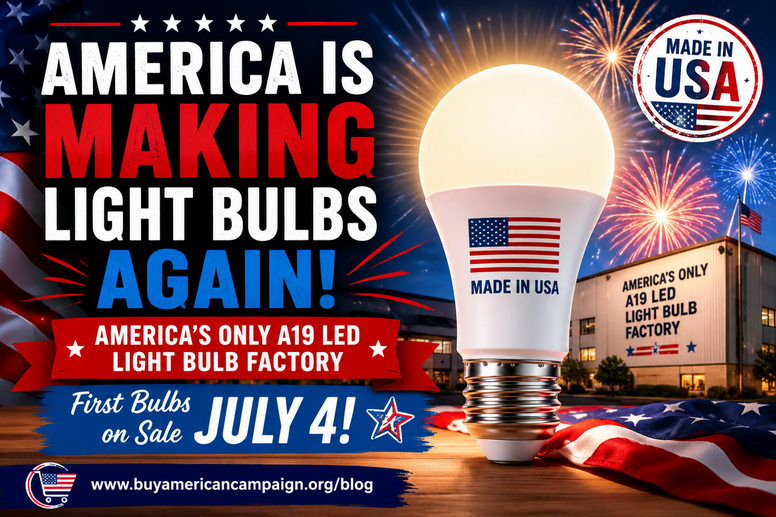
  • On July 4th, America Gets Its Light Bulbs Back

    On July 4th, America Gets Its Light Bulbs Back

    American-made LED light bulbs from GoodBulb in Fargo, North Dakota

    Thomas Edison perfected the light bulb in America. For more than a century, we made them here. Then, one by one, the factories went dark — and by 2020, the last company making LED light bulbs in the United States had shut its doors. If you bought a bulb after that, it came from somewhere else.

    That changed this Independence Day. On July 4th — as the country marked its 250th birthday — a factory in Fargo, North Dakota shipped its first American-made LED light bulbs. The company is called GoodBulb, and it is now believed to be the only place in America manufacturing the A19 bulb, the everyday screw-in bulb that sits in lamps and ceiling fixtures in nearly every home in the country.

    A Product Invented Here, Then Made Everywhere Else

    Tom Enright, GoodBulb’s founder and president, has been in the light-bulb business for 25 years. He had a front-row seat as the major manufacturers packed up and moved overseas, chasing cheaper labor. The last domestic LED bulb line closed in 2020.

    That never sat right with him. The light bulb was invented in America and built here for over a hundred years. So Enright traveled the world to study how it was being done — and what he saw lit a fire.

    “I was standing on the floors of these light bulb factories, and I was just in awe,” he said. “I would see 20, 30 people on a line making light bulbs. And my first thought was… wait, we can do this. I can do this better. Why can’t America do this? Why did we give up on this?”

    Eight Years to Bring the Light Bulb Home

    Wanting to make a bulb in America and actually doing it are two very different things. Plenty of companies tried to bring production back and couldn’t make the economics work against cheap imports. Enright knew that going in — and committed to it anyway.

    GoodBulb spent eight years developing its manufacturing process before a single bulb rolled off the line. That first finished bulb came on June 12, 2026. Within weeks, the Fargo line was fully operational and capable of producing 10,000 light bulbs in a single day.

    Browse American-Made Products

    Why the A19 Bulb Matters So Much

    If “A19” doesn’t mean anything to you, that’s exactly the point — it’s the bulb you never think about. It’s the standard pear-shaped, screw-in bulb that fits the lamps, fixtures, and overhead lights in almost every American household. It is the most common light bulb in the country.

    That’s what makes this milestone bigger than one factory. This isn’t a niche specialty item or a luxury product. It’s something every family buys, over and over, for the life of their home. Having even one American company making it again means the supply chain for an everyday essential no longer runs entirely through overseas factories.

    A July 4th Launch With Real Meaning

    The timing was no accident. Enright lined up GoodBulb’s first sales with July 4th, 2026 — the nation’s 250th anniversary. There’s a certain poetry to it: the product that helped electrify American life, invented by an American, going back on sale as a Made-in-USA product on the country’s biggest birthday.

    It’s the kind of story the Buy American movement exists to celebrate — not a slogan, but a real company, in a real town, putting real people to work making something we all use.

    Join the Buy American Movement

    More Than a Light Bulb

    GoodBulb’s story didn’t start with manufacturing — it started with a scare. Enright says he was inspired to build the company after his young son overcame a health crisis, and he turned that gratitude into a mission to give back.

    The company commits a portion of every sale to providing solar lanterns to families without reliable electricity and to supporting disaster relief around the world. And Enright says he’s just getting started — another American-made bulb is already in development.

    Why This One Matters

    It would have been easy for Enright to keep importing bulbs like everyone else. Instead he bet eight years and a lot of stubbornness on the idea that America can still make the things it invented. On July 4th, that bet started paying off.

    The next time you replace a burned-out bulb, you finally have an American-made option again — and a company worth rooting for behind it.

    Whenever possible, choose Made in USA.

    If you like what you see and think this post would be of interest to someone, please share
  • When a Factory Comes to Town, Does Ownership Matter?

    When a Factory Comes to Town, Does Ownership Matter?

    A new American factory with overseas ownership — does it matter who owns it?

    A new factory is announced. Five hundred jobs. Millions of dollars in investment. Construction crews get to work. Local restaurants get busier. The tax base grows. Families see new opportunities. There’s just one catch: the company isn’t American-owned.

    So here’s the question we want to put to you honestly — is that a win? At Buy American Campaign, we spend a lot of time talking about American manufacturing, American workers, and products made in the USA. But this question is more complicated than it first appears, and it’s worth thinking through together.

    The Case That It’s a Win

    If a factory is built in America, employs American workers, pays American taxes, buys from American suppliers, and helps support an American community, many people would argue that’s exactly the kind of investment we need.

    After all, the paycheck doesn’t care where the CEO lives. The mortgage payment doesn’t care where the corporate headquarters are located. The local diner doesn’t care whether the factory owner is in Detroit, Tokyo, Seoul, Munich, or Beijing. What matters, in this view, is that people are working.

    The Case That Ownership Matters

    Others see it differently. They argue that ownership matters because profits eventually flow somewhere. They worry that America could end up providing the labor while other countries capture the long-term financial benefits — that we become the workshop while the wealth is built elsewhere.

    It’s a fair concern, and it deserves to be taken seriously. True manufacturing independence, they argue, requires both production and ownership — not just jobs on the floor, but control of the enterprise itself.

    Browse American-Made Products

    What If We Say No to Everything?

    But here’s another question worth asking: what happens if we reject every factory investment that comes from overseas? Would those jobs exist at all? Would those communities be better off? Or would we simply be turning away opportunities while waiting for a perfect solution that may never arrive?

    An empty factory creates no jobs. A closed factory helps no community. These are the trade-offs that towns and workers face in the real world, where the choice is often not between a foreign-owned plant and an American-owned one, but between a foreign-owned plant and no plant at all.

    It Was Always About More Than Ownership

    The reality is that American manufacturing has always been about more than ownership structures. It’s about workers. It’s about communities. It’s about whether a young person can build a future without leaving town. It’s about whether Main Street stays alive.

    It’s about whether parents can buy a home, support a family, and send their kids to college. If a factory creates those opportunities, many Americans will call that a success. Others will insist that real independence means owning what we build. Both viewpoints deserve consideration.

    Join the Buy American Movement

    So We’ll Leave You With the Question

    What we know for certain is this: an empty factory creates no jobs, a closed factory helps no community, and a thriving factory — regardless of who owns it — can change lives. Beyond that, reasonable, patriotic Americans can disagree.

    So we’ll leave you with the question. If a factory is built in America, employs American workers, and strengthens an American town, but the company is owned overseas — is it still an American manufacturing success story? Or is there more to the story? Tell us what you think.

    Whenever possible, choose Made in USA.

    If you like what you see and think this post would be of interest to someone, please share
  • Fire Up the Grill: Why Lodge Cast Iron Belongs at Every American Cookout

    Fire Up the Grill: Why Lodge Cast Iron Belongs at Every American Cookout

    Lodge cast iron skillet sizzling on a backyard grill

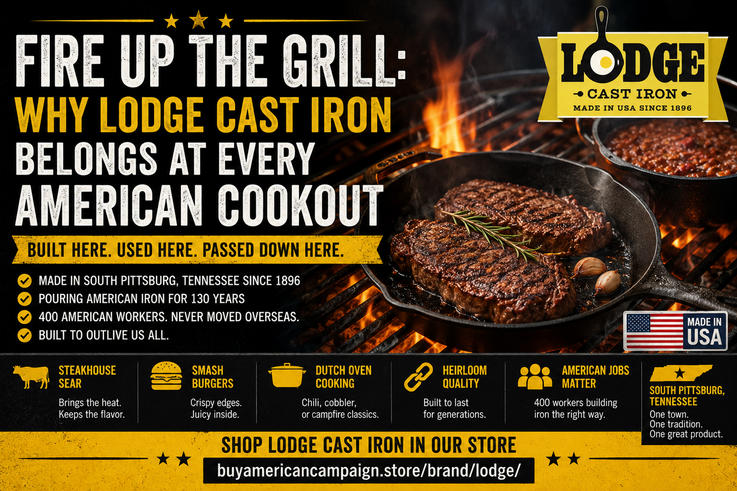
    It’s cookout season. The grill is hot, the cooler is full, and somewhere in America this weekend, a cast iron skillet is sizzling over the flames. There’s a good chance it says one word on the bottom: Lodge. For 130 years, in the same small Tennessee town, Lodge Cast Iron has been pouring American iron into American pans — and it’s still the heavyweight champ of the backyard BBQ.

    This week we’re shining a spotlight on Lodge, because it’s the perfect example of what the Buy American Campaign is all about: a family-owned company that bet on American workers, never moved its foundry overseas, and built one of the most trusted names in the country one skillet at a time. And with the Fourth of July around the corner, there’s no better time to put a piece of it on your grill.

    Why Cast Iron Rules the Cookout

    Ask any pitmaster or backyard griller and they’ll tell you: cast iron belongs at the BBQ. Set a Lodge skillet right on the grill grates and you’ve got the perfect surface for crispy-edged smash burgers, a screaming-hot sear on a steak, or seared scallops and shrimp that would slip right through a regular grate.

    Cast iron holds and radiates heat better than thin grill grates, so it won’t warp and it delivers that deep, even sear that makes cookout food taste like a steakhouse. Throw a cast iron griddle over the burners for breakfast at the campsite, or drop a Dutch oven into the coals for chili, baked beans, or a skillet cobbler for dessert. One pan, dozens of jobs around the fire.

    Browse American-Made Products

    130 Years in South Pittsburg, Tennessee

    The Lodge story starts in 1896, when Joseph Lodge opened a foundry in South Pittsburg, Tennessee. He first called it the Blacklock Foundry, after his friend and minister. In May 1910, a fire burned the foundry to the ground — but just three months later, the company was reborn down the road as the Lodge Cast Iron we know today.

    More than a century later, Lodge is still in South Pittsburg, still family owned, and still America’s largest and oldest manufacturer of cast iron cookware. In a town of roughly 3,100 people, the company employs around 400 workers. That’s not a side note — that’s the backbone of an entire community, sustained by people choosing American-made cookware.

    Built to Last Generations

    Part of what makes Lodge special is that its products are designed to outlive the people who buy them. A well-cared-for cast iron skillet doesn’t wear out — it gets better. The more you cook with it, the more naturally non-stick it becomes. It’s the rare modern purchase that you can genuinely pass down to your kids and grandkids, BBQ after BBQ, summer after summer.

    That durability is the opposite of throwaway culture. When you buy a Lodge skillet, you’re not buying something destined for a landfill in two years. You’re buying one pan, made in Tennessee, that can serve your family for fifty years or more.

    Join the Buy American Movement

    From Skillets to Dutch Ovens and Beyond

    The classic Lodge skillet may be the icon, but the lineup goes far beyond it. Lodge makes seasoned cast iron griddles, grill pans, Dutch ovens, camp cookware, baking pans, and more — exactly the kind of versatile, heavy-duty gear you want for summer. It works on the stovetop, in the oven, on the grill, or over an open campfire.

    Whether you’re searing burgers at a Fourth of July cookout, baking cornbread, or simmering a stew at a campsite, there’s a Lodge piece built for the job — and every piece of traditional cast iron carries the same promise: poured and finished in the USA.

    Shop Lodge for Grilling Season

    If reading this makes you want to add a piece of real American cast iron to your grill before the next cookout, we’ve made it easy. You can browse our selection of Lodge cast iron cookware right in the Buy American Store, where every product is vetted for its Made-in-USA credentials.

    Browse Lodge Cast Iron in the Buy American Store →

    Every skillet you buy does more than cook a great meal. It helps keep 400 people working in a small Tennessee town, supports a 130-year-old American manufacturer, and casts a vote for the kind of country where things are still built to last — right here at home.

    So this summer, when you fire up the grill, make it American iron. With a brand like Lodge, choosing American has never tasted better.

    Whenever possible, choose Made in USA.

    If you like what you see and think this post would be of interest to someone, please share
  • The Factory Whistle Is Blowing Again in Ohio

    The Factory Whistle Is Blowing Again in Ohio

    Shearer's Foods snack factory in the former General Motors plant in Moraine, Ohio

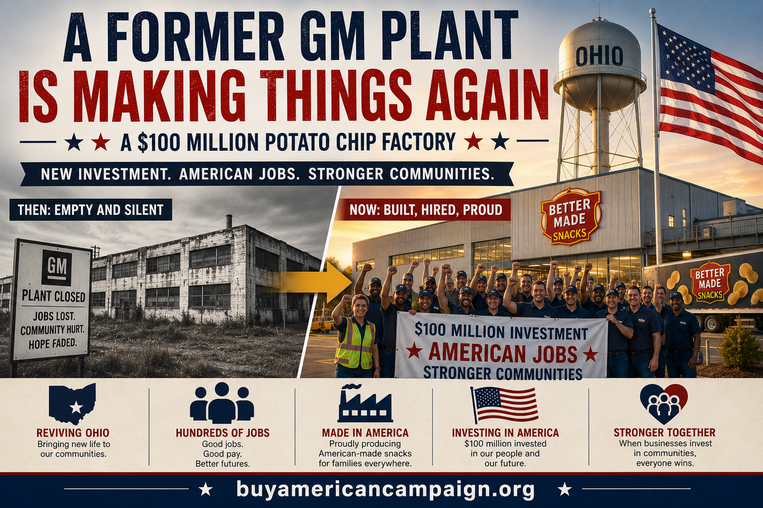
    For years, the old General Motors plant in Moraine, Ohio sat as a monument to everything Americans fear about manufacturing. When GM shut the Moraine Assembly plant down in 2008, thousands of workers lost the jobs that had built their homes, raised their kids, and anchored an entire community. The parking lots emptied. The lights went dark. And a town that had defined itself by what it made was left wondering if it would ever make anything again.

    This month, that question got an answer. The factory is coming back to life — and this time, it’s making potato chips.

    A $100 Million Bet on a Town That Lost Its Plant

    Shearer’s Foods, an Ohio-based snack maker founded in 1974, has invested roughly $100 million to transform part of that former GM plant into a state-of-the-art factory at 4100 Springboro Pike. On June 22, the company held a ribbon-cutting ceremony to mark the moment — the same stretch of concrete that once rolled out SUVs is now being remodeled to turn out potato chips and baked snacks.

    The new plant brings about 250 jobs to Moraine. For a community that watched its biggest employer walk away, those 250 paychecks are far more than a statistic. They’re proof that a town written off as part of the “Rust Belt” can write a new chapter.

    Browse American-Made Products

    From SUVs to Snacks — Same Building, New Life

    There’s something deeply American about this story. The same walls that once echoed with the sound of an auto assembly line are being retooled for a fully automated packaging operation. The work has changed. The product has changed. But the meaning is the same: people are clocking in again where they once clocked out for the last time.

    “We’re excited to celebrate this important milestone in Dayton,” Shearer’s CEO Bill Nictakis said in a statement, pointing to the company’s focus on growth and “creating new opportunities in the communities where we operate.” For Moraine, that opportunity is the difference between an empty shell and a working factory.

    Who Is Shearer’s Foods?

    If you’ve ever grabbed a bag of store-brand chips, there’s a good chance Shearer’s made them. The company is one of North America’s largest makers of salty snacks, employing more than 5,000 people across 17 facilities. Moraine marks its fourth location in Ohio — a deepening commitment to its home state at a time when plenty of companies are still chasing cheaper labor overseas.

    Instead of building somewhere far away, Shearer’s chose to plant its flag in a community that knew exactly what it felt like to lose a factory. That choice matters. It’s the difference between a town that’s a footnote and a town that gets a second act.

    Join the Buy American Movement

    More Than Chips — A Commitment to the Community

    The company didn’t just cut a ribbon and call it a day. Shearer’s partnered with the Dayton Foodbank to co-host a food drive at the grand opening, asking attendees to bring non-perishable items for neighbors in need. It’s a small gesture, but it says something about how a company sees its place in a town: not as a tenant, but as a neighbor.

    That’s the kind of story we love to tell here at the Buy American Campaign. We don’t just care about logos and headquarters. We care about whether American workers have somewhere to go in the morning, whether a community has a heartbeat, and whether the things we buy help keep that heartbeat going.

    The Whistle Blows Again

    Eighteen years ago, the last GM workers walked out of that Moraine plant carrying their toolboxes and their memories, unsure if anyone would ever build anything there again. Today, the lights are back on, the lines are being installed, and a new generation is about to clock in.

    The next time you reach for a bag of chips, take a second to flip it over and see where it was made. Because somewhere in Ohio, a factory that everyone gave up on is humming again — and every American-made snack that rolls off that line is a reminder that comebacks are still possible in this country.

    Whenever possible, choose Made in USA.

    If you like what you see and think this post would be of interest to someone, please share
  • Prime Day is Here

    Prime Day is Here

    Prime Day - support American-made companies

    Here’s Your Chance to Support the Companies Still Building Things in America

    Amazon Prime Day is one of the biggest shopping events of the year. For four days, millions of people will be searching for deals on everything from tools and cookware to clothing, toys, and home goods.

    At Buy American Campaign, we’re looking at Prime Day a little differently. We’re asking a simple question: can we support the companies that are still building things in America?

    The answer is yes.

    Thousands of Companies Are Still Making It in America

    Across the United States, thousands of companies are manufacturing products in American factories, employing American workers, and investing in local communities. Some are household names. Others are family-owned businesses quietly making exceptional products in places like Ohio, Tennessee, Pennsylvania, Wisconsin, and Texas.

    Many of these companies face intense competition from cheaper imports and global supply chains. Yet they continue to invest in American manufacturing because they believe quality, craftsmanship, and local jobs matter.

    Browse American-Made Products

    That’s why Buy American Campaign exists. We’re building a place where consumers can discover these companies, learn their stories, and find products genuinely made in the USA.

    This Prime Day, Shop With Purpose

    This Prime Day, whether you’re shopping for tools, cookware, outdoor gear, clothing, toys, or home products, consider taking a moment to see what’s being made right here at home.

    Because every purchase tells a story. And when you support companies manufacturing in America, you’re supporting more than a product.

    You’re supporting workers. You’re supporting communities. And you’re helping keep American manufacturing alive for the next generation.

    Join the Buy American Movement

    🇺🇸 Explore more than 10,000 American-made products and discover the companies behind them at BuyAmericanCampaign.store.

    Buy American Campaign
    Celebrating the companies, workers, and communities building things in America.

    Whenever possible, choose Made in USA.

    If you like what you see and think this post would be of interest to someone, please share
  • America Is Building the Future of Aviation in North Carolina

    America Is Building the Future of Aviation in North Carolina

    JetZero Z4 blended-wing aircraft factory groundbreaking in Greensboro, North Carolina

    On June 15, 2026, shovels hit the dirt on more than 600 acres outside Greensboro, North Carolina — and with them, a bet that America can do something it hasn’t done in generations: build an all-new commercial airplane, from scratch, on American soil. JetZero, the aerospace startup behind the radical blended-wing Z4 jet, broke ground on its first manufacturing and final assembly campus, an 8-million-square-foot factory that the company says will become the most advanced aircraft plant of its kind anywhere in the world.

    This is exactly the kind of story the Buy American Campaign exists to celebrate. It isn’t about preserving the past. It’s about American workers inventing the future of an entire industry — and choosing to build it here.

    14,500 Jobs and $4.7 Billion in Investment

    The numbers attached to this project are hard to overstate. JetZero’s Greensboro campus is expected to create 14,500 jobs over the next decade, backed by $4.7 billion in investment that will transform the Triad region of North Carolina. State officials confirmed the deal was supported by the largest state-level incentive package ever offered to a startup in any industry.

    Those aren’t warehouse jobs or temporary construction gigs that vanish when the ribbon is cut. These are skilled, long-term manufacturing and engineering positions — the kind of work that builds a middle class and roots it in a community for decades. For a region that has watched textile and furniture plants close over the years, a 14,500-job aerospace campus is a generational turnaround.

    Construction begins immediately, with hiring expected to ramp in phases as the facility comes online over the next ten years.

    Browse American-Made Products

    What Makes the Z4 Different

    The airplane being built in Greensboro doesn’t look like the tube-and-wing jets we’ve all flown in. The Z4 is a blended-wing body, a design where the fuselage and wings merge into one smooth, lifting shape. The result is an aircraft JetZero says will be up to 50 percent more fuel efficient than today’s comparable jets.

    The Z4 is aimed at what the industry calls the “middle market” — routes that are underserved today. It’s designed to carry about 250 passengers on trips of up to 5,000 nautical miles. If it delivers on its promise, it could reshape how airlines think about everything from fuel costs to cabin layout.

    For the first time in a long time, the most talked-about new shape in commercial aviation is being assembled by American hands, in an American factory.

    A Factory Built in the Digital Age

    The Greensboro plant isn’t just big — it’s smart. JetZero is working with Siemens and Deloitte to build the facility on advanced digital and AI-native platforms. Engineers built a complete digital twin of the entire factory before a single slab of concrete was poured, letting them test layouts, work flows, and production lines in a virtual model first.

    That approach, the company says, will make the Greensboro facility the most efficient and adaptable aircraft plant of its kind in the world. It’s a reminder that “Made in America” in 2026 doesn’t mean old machines and faded glory — it means cutting-edge technology paired with skilled American labor.

    Join the Buy American Movement

    Why This Matters for the Buy American Movement

    We talk a lot about bringing manufacturing back to the United States. Usually that means reshoring production that left, or supporting heritage brands that never moved. JetZero is something different and just as important: a brand-new American industry being born here, instead of overseas.

    It would have been easy — maybe even cheaper in the short term — to chase lower costs abroad. Instead, JetZero chose North Carolina, and North Carolina bet big right back. That’s the kind of partnership between industry, workers, and communities that built American manufacturing in the first place.

    The stakes really are huge. If JetZero succeeds, it won’t just employ 14,500 people — it could prove that the next great leaps in aerospace can and should happen on American soil. And every one of those Z4 jets that rolls out of Greensboro will carry the same quiet message we put behind every product we champion: this was made in the USA.

    America isn’t just preserving manufacturing. We’re inventing whole new industries — and building them right here at home.

    Whenever possible, choose Made in USA.

    If you like what you see and think this post would be of interest to someone, please share
  • The Factory That Sent a Man’s Kids to College

    The Factory That Sent a Man’s Kids to College

    A factory worker whose paycheck sent his kids to college

    The factory wasn’t glamorous. It wasn’t exciting. Nobody got rich working there. But it paid for a house. It paid for Little League. It paid for braces. It paid for college. And for one American family — and millions like it — that was everything.

    Every morning before sunrise, he climbed into the same pickup truck and drove to the same factory he’d worked at for nearly thirty years. The work was hard. The shifts were long. The machines were loud. By the end of the day his back hurt, his hands were sore, and his clothes smelled like oil and steel.

    He Wasn’t There for the Work — He Was There for What It Made Possible

    He wasn’t on that line because he loved the work. He was there because he loved what the work made possible. The factory paycheck covered the mortgage. It kept food on the table. It paid for family vacations that seemed small at the time but became cherished memories later.

    When the kids needed new shoes, the factory paid for them. When braces were needed, the factory paid for them. When a daughter wanted piano lessons and a son wanted to play baseball, the factory paid for those too. And when the college acceptance letters finally arrived, that same factory paycheck helped make those dreams possible.

    He Built Something More Valuable Than Wealth

    Nobody called him wealthy. Nobody wrote articles about him. Nobody interviewed him on television. But year after year, he quietly built something more valuable than wealth: opportunity. His children would have chances he never had. They would walk across college stages carrying degrees he never had the opportunity to earn himself.

    And when people congratulated those graduates, few would think about the sacrifices that made it possible — the overtime shifts, the missed lunches, the early mornings, the years spent standing on concrete floors. But their father knew. And deep down, so did they.

    Browse American-Made Products

    Factories Didn’t Just Make Products. They Made Middle-Class Lives.

    For generations, stories like this played out in towns all across America. Factories didn’t just make appliances, cars, machinery, furniture, steel, or tools. They made middle-class lives. They made homeowners. They made taxpayers.

    They made Little League coaches, church volunteers, PTA members, and proud parents sitting in folding chairs at graduation ceremonies. They created pathways for ordinary families to do extraordinary things.

    The Real Story Was Never in a Spreadsheet

    Today, when people talk about manufacturing, they often focus on economics, trade policy, or quarterly numbers. But the real story was never found in a spreadsheet. It was found in family photo albums. In first homes. In graduation pictures. In wedding photos. In the lives built by people whose names most of us will never know.

    The factory didn’t send a man’s kids to college by itself. A hardworking father did that. A determined mother did that. A family did that. But the factory gave them the opportunity — and for millions of American families, that opportunity changed everything.

    Join the Buy American Movement

    Built on Factory Floors, Not Wall Street

    Millions of Americans didn’t build their wealth on Wall Street. They built it on factory floors. And entire generations rose with them. Every time we choose American-made, we help keep that ladder standing for the next family — the next father in a pickup truck, the next kid who gets to walk across a stage.

    That’s what’s really at stake when we talk about bringing manufacturing home. Not just jobs or numbers, but opportunity — the kind that quietly changes the course of a family for generations.

    Whenever possible, choose Made in USA.

    If you like what you see and think this post would be of interest to someone, please share
  • Grandpa Never Called It “Buy American”

    Grandpa Never Called It “Buy American”

    A grandfather's American-made tools, boots, and truck — buying American before it had a name

    My grandfather never talked about trade deficits. He never debated tariffs. He never argued about globalization. He never even used the phrase “Buy American.” He just did. Not because it was a political statement. Not because someone told him to. To him, it was simply normal.

    The tools in his garage were American-made. The boots by the back door were American-made. The refrigerator in the kitchen was American-made. The car in the driveway was built by American workers. He never stood in a store comparing countries of origin — most of the time, there wasn’t much to compare. Things were made here because that’s where things were made.

    He Never Said It — He Just Lived It

    But there was something deeper than habit at work. My grandfather knew people. He knew the man who worked at the furniture plant. He knew the woman who sewed uniforms at the textile mill. He knew the neighbors at the machine shop across town, and the truck drivers who hauled products to market.

    When someone bought a product, they weren’t supporting an abstract economy. They were supporting people they knew — people they saw at church, people whose kids played baseball with their kids, people who lived down the street. Manufacturing wasn’t a statistic. It was the community.

    One Paycheck, a Whole Community

    When the local factory hired more workers, everybody felt it. The diner got busier. The hardware store sold more supplies. The bowling league gained new members. The town grew stronger.

    And when times were hard, people understood something that often gets forgotten today: a paycheck earned in one factory circulated through an entire community. One manufacturing job supported far more than one family — it helped sustain dozens of businesses and hundreds of livelihoods.

    Browse American-Made Products

    He Understood Connections

    My grandfather never talked about supply chains. But he understood connections. He understood that when neighbors prospered, communities prospered. He didn’t need a chart to see that the dollar he spent at a local business came back around to the people he cared about.

    Somewhere along the way, we started treating products like they simply appeared on store shelves by magic. We stopped asking who made them. Where they came from. What communities depended on them. We became disconnected from the people behind the products.

    Why It Feels Different Today

    Maybe that’s why buying American feels different today. What was once ordinary has become a conscious choice. What was once assumed now requires effort. But the reason behind it hasn’t changed.

    It’s still about people. It’s still about families. It’s still about communities. And it’s still about the belief that the work of American hands matters — that the person who built the thing in your kitchen deserves to be remembered.

    Join the Buy American Movement

    Making It Normal Again

    My grandfather never called it “Buy American.” To him, it wasn’t a movement. It wasn’t a campaign. It wasn’t even a slogan. It was simply how a strong community worked.

    Maybe the goal isn’t to make buying American fashionable again. Maybe the goal is to make it normal again — to get back to a place where supporting the people who make things isn’t a statement, but second nature. We can start with the next thing we buy, and the one after that. That’s how a habit, and a community, gets rebuilt.

    Whenever possible, choose Made in USA.

    If you like what you see and think this post would be of interest to someone, please share
  • Harley-Davidson Is Bringing Production Back to America

    Harley-Davidson Is Bringing Production Back to America

    Harley-Davidson motorcycle production returning to American factories in Pennsylvania and Wisconsin

    For generations, Harley-Davidson has been a rolling symbol of American manufacturing pride. Now the most iconic motorcycle brand in the world is making that pride literal again — by bringing production of its Revolution Max platform back home to the United States.

    On June 9, 2026, the Milwaukee-based company announced it will return machining, powertrain assembly, painting, and final vehicle assembly for its Revolution Max motorcycles to Harley facilities in Pennsylvania and Wisconsin. It’s part of a new strategy the company is calling “Back to the Bricks” — and it reverses years of overseas production.

    An American Icon Comes Home

    Harley-Davidson has built motorcycles in America for 123 consecutive years. That legacy was built by generations of employees — many of them union workers — whose skill defined the brand. In recent years, production of the Revolution Max platform for North America had shifted overseas. This announcement brings it back.

    “For more than a century, Harley-Davidson has invested in American manufacturing, skilled workers, and the communities that build our motorcycles,” the company said in its announcement. “Today, we’re proud to announce another step forward by bringing production of the Revolution Max platform for North America back to the United States.”

    What “Back to the Bricks” Actually Means

    The phrase isn’t just marketing. It refers to the physical work coming back to American soil: precision machining, powertrain (engine) assembly, industrial painting, and final vehicle assembly. These are high-skill manufacturing jobs — the kind that anchor local economies and support union livelihoods.

    The work returns to Harley’s historic facilities in Pennsylvania and Wisconsin, including its York, Pennsylvania plant. Harley expects to manufacture over 100,000 motorcycles out of the York facility in 2027 alone.

    Browse American-Made Products

    Which Motorcycles Are Coming Home

    The Revolution Max platform powers Harley’s modern, performance-focused lineup. Three models are covered by the move: the Pan America adventure bike, the Sportster S power-cruiser, and the Nightster. For riders, that means some of Harley’s newest machines will once again roll off American assembly lines.

    The transition is expected to be complete ahead of the start of Model Year 2028 production in 2027. In other words, this isn’t a someday promise — the work is already in motion.

    Why This Matters Now

    Harley credited shifts in U.S. trade policy and the broader global trade environment with creating new opportunities to invest in domestic manufacturing. Under new CEO Artie Starrs, the company says it’s able to lean further into its American manufacturing footprint and build more motorcycles here at home.

    At a time when a lot of people quietly wonder whether American manufacturing can really come back, a brand this recognizable making this kind of statement carries weight. It’s a tangible, visible example — not a chart, but a motorcycle with “Made in USA” behind it.

    Join the Buy American Movement

    More Than Motorcycles

    Bill Davidson — great-grandson of one of the company’s founders and now a Global Brand Ambassador — put the family’s feelings plainly. “My family has spent generations working in this company, and I’ve seen firsthand the pride, craftsmanship, and hard work that go into building Harley-Davidson motorcycles in America,” he said. “Bringing this work back home is another important step in getting back to the bricks.”

    The move is expected to support dozens of additional American manufacturing and union jobs, backed by a network of more than 500 U.S. dealers. It’s a reminder that behind every “where it’s built” decision are real workers and real communities.

    The Bigger Picture

    Harley-Davidson isn’t alone. From steel to solar to semiconductors, companies are increasingly choosing to build in America again. When a brand as woven into American identity as Harley decides to come home, it sends a message that resonates well beyond the showroom floor: America still builds things — and it still does it well.

    So the next time you hear that unmistakable rumble, remember what’s behind it. A 123-year-old American company, skilled union hands, and a decision to keep the work where the story started.

    Whenever possible, choose Made in USA.

    If you like what you see and think this post would be of interest to someone, please share
  • America Is Building the Factory China Doesn’t Want Us To Have

    America Is Building the Factory China Doesn’t Want Us To Have

    USA Rare Earth's $1.2 billion magnet factory breaking America's dependence on China

    For decades, America has depended on China for one of the most important materials in the modern world: rare earth magnets. These small but mighty components power our fighter jets, our electric vehicles, our wind turbines, and the smartphones in our pockets. And for years, one country has controlled the supply. That’s about to change — and China would rather it didn’t.

    USA Rare Earth has announced a $1.2 billion rare earth metal and magnet manufacturing campus in Cherokee County, South Carolina. When it comes online, it will create nearly 500 high-skill, high-wage American jobs — and begin to loosen China’s grip on a supply chain that touches nearly every part of our economy and our national defense.

    The Hidden Backbone of Modern Life

    Most Americans have never heard of neodymium-iron-boron magnets — known as NdFeB — but they’re everywhere. They’re in the guidance systems of missiles and the motors of electric cars. They’re in MRI machines, robotics, semiconductors, AI hardware, aerospace systems, and clean-energy equipment. If it moves, senses, or computes, there’s a good chance a rare earth magnet is involved.

    Here’s the uncomfortable truth: for years, the United States has produced almost none of them. China refines the vast majority of the world’s rare earth materials and dominates magnet production. That gives a foreign government enormous leverage over American industry and American security.

    Breaking China’s Grip

    This is why USA Rare Earth’s announcement matters so much. The new South Carolina campus is designed to handle the entire process on American soil — electrolysis, metallothermic reduction, strip casting, jet milling, dry pressing, sintering, heat treatment, machining, and coating. In plain terms: turning raw materials into finished, defense-grade magnets right here at home.

    At full scale, the facility is expected to produce 6,400 metric tons of NdFeB magnets and 5,000 metric tons of rare earth metals and alloys every year. That’s not a token gesture. That’s a serious step toward a self-reliant American supply chain.

    Browse American-Made Products

    $1.2 Billion and 490 Jobs in the Upstate

    The plant will rise at Bailey Park in Blacksburg, in South Carolina’s Upstate, and is expected to create roughly 490 jobs when it goes online around 2028. These aren’t just any jobs — they’re high-skill, high-wage positions in advanced manufacturing, the kind that build careers and strengthen entire communities.

    For the families of Cherokee County, this is a $1.2 billion vote of confidence in the American worker. For the rest of the country, it’s proof that we can still build hard things — the things that matter most — within our own borders.

    This Is What Independence Looks Like

    There’s a reason this story stirs something deeper than economics. A nation that can’t make its own magnets can’t fully control its own destiny. Every missile, every fighter jet, every power grid that depends on a foreign supplier is a vulnerability. Bringing this production home isn’t just good business — it’s a matter of national independence.

    This is the factory China would rather we never built. And that, more than anything, is why it deserves our attention and our support.

    Join the Buy American Movement

    Why This Matters for Every American

    You may never hold one of these magnets in your hand, but your life is built on them — your security, your technology, your future. When an American company invests $1.2 billion to make them here, it’s reclaiming a piece of our independence that we never should have given away.

    Stories like this remind us what’s possible when America decides to build again. The more we support companies bringing critical manufacturing home, the harder it becomes for any foreign power to hold our economy hostage. That’s a future worth cheering for — and worth backing with every dollar we spend.

    Whenever possible, choose Made in USA.

    If you like what you see and think this post would be of interest to someone, please share