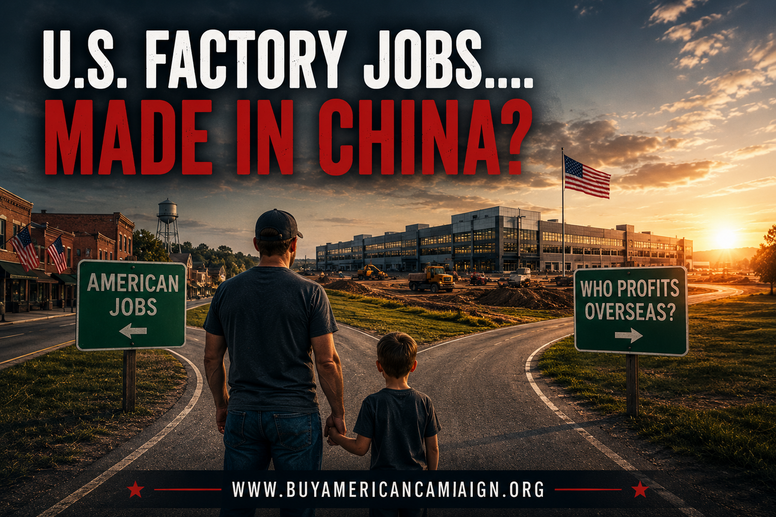
A new factory is announced. Five hundred jobs. Millions of dollars in investment. Construction crews get to work. Local restaurants get busier. The tax base grows. Families see new opportunities. There’s just one catch: the company isn’t American-owned.
So here’s the question we want to put to you honestly — is that a win? At Buy American Campaign, we spend a lot of time talking about American manufacturing, American workers, and products made in the USA. But this question is more complicated than it first appears, and it’s worth thinking through together.
The Case That It’s a Win
If a factory is built in America, employs American workers, pays American taxes, buys from American suppliers, and helps support an American community, many people would argue that’s exactly the kind of investment we need.
After all, the paycheck doesn’t care where the CEO lives. The mortgage payment doesn’t care where the corporate headquarters are located. The local diner doesn’t care whether the factory owner is in Detroit, Tokyo, Seoul, Munich, or Beijing. What matters, in this view, is that people are working.
The Case That Ownership Matters
Others see it differently. They argue that ownership matters because profits eventually flow somewhere. They worry that America could end up providing the labor while other countries capture the long-term financial benefits — that we become the workshop while the wealth is built elsewhere.
It’s a fair concern, and it deserves to be taken seriously. True manufacturing independence, they argue, requires both production and ownership — not just jobs on the floor, but control of the enterprise itself.
What If We Say No to Everything?
But here’s another question worth asking: what happens if we reject every factory investment that comes from overseas? Would those jobs exist at all? Would those communities be better off? Or would we simply be turning away opportunities while waiting for a perfect solution that may never arrive?
An empty factory creates no jobs. A closed factory helps no community. These are the trade-offs that towns and workers face in the real world, where the choice is often not between a foreign-owned plant and an American-owned one, but between a foreign-owned plant and no plant at all.
It Was Always About More Than Ownership
The reality is that American manufacturing has always been about more than ownership structures. It’s about workers. It’s about communities. It’s about whether a young person can build a future without leaving town. It’s about whether Main Street stays alive.
It’s about whether parents can buy a home, support a family, and send their kids to college. If a factory creates those opportunities, many Americans will call that a success. Others will insist that real independence means owning what we build. Both viewpoints deserve consideration.
So We’ll Leave You With the Question
What we know for certain is this: an empty factory creates no jobs, a closed factory helps no community, and a thriving factory — regardless of who owns it — can change lives. Beyond that, reasonable, patriotic Americans can disagree.
So we’ll leave you with the question. If a factory is built in America, employs American workers, and strengthens an American town, but the company is owned overseas — is it still an American manufacturing success story? Or is there more to the story? Tell us what you think.
Whenever possible, choose Made in USA.
| If you like what you see and think this post would be of interest to someone, please share |