Tag: US Manufacturers

  • SEG Solar Opens 4 GW Texas Factory, Adding Up to 800 Jobs

    SEG Solar Opens 4 GW Texas Factory, Adding Up to 800 Jobs

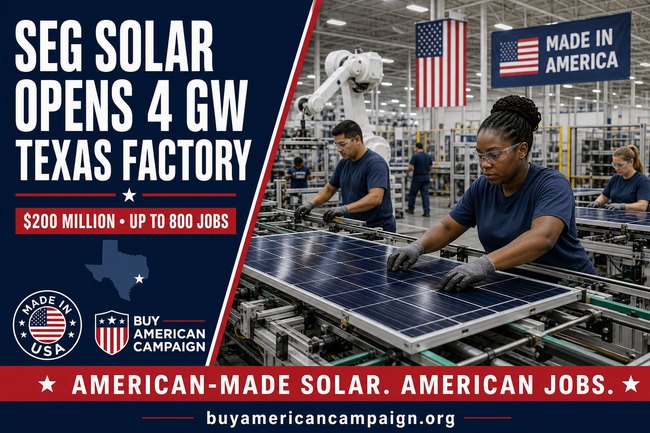
    Workers manufacturing solar panels at SEG Solar's Texas factory

    SEG Solar has opened a new 4-gigawatt solar-panel factory in Tomball, Texas, expanding American manufacturing capacity with an investment of more than $200 million and plans for up to 800 jobs. The August 7 grand opening turned a major expansion promise into an operating facility built to supply solar projects across the United States.

    The nearly 500,000-square-foot plant is SEG Solar’s second U.S. module factory. Together with its first Houston-area operation, it raises the company’s annual domestic module capacity to approximately 6 GWβ€”enough manufacturing scale to matter in a market long dependent on overseas production.

    A 4 GW Texas Solar Factory Moves From Plan to Production

    SEG announced the Tomball project in May and held its grand opening only three months later. Commercial production is expected during the third quarter of 2026, giving the Houston-headquartered company a much larger platform for serving utility, commercial and residential customers.

    The plant is designed for flexibility as solar technology changes. SEG says its production lines can integrate next-generation heterojunction, or HJT, technology, which combines different semiconductor layers to improve panel efficiency and performance.

    Up to 800 American Manufacturing Jobs

    The employment number deserves attention. Up to 800 new jobs could include production operators, maintenance technicians, quality specialists, engineers, logistics workers and supervisors. Those positions create paychecks inside the factory and additional demand for nearby suppliers and local businesses.

    Modern solar manufacturing is highly automated, but it is not workerless. Equipment must be installed, programmed, maintained and improved. Materials have to be tracked, panels inspected and production problems solved by people with practical technical skills.

    Browse American-Made Products

    Why Domestic Solar-Panel Production Matters

    Solar panels are becoming part of America’s essential energy infrastructure. Producing more modules domestically can shorten delivery times, improve traceability and reduce exposure to disruptions that occur when too much of a supply chain is concentrated overseas.

    Domestic manufacturing also keeps more of the value created by new energy projects in American communities. The benefits extend beyond where panels are installed to include the people who assemble, test, package and ship them.

    American-Owned Does Not Mean Every Component Is Domestic

    SEG describes itself as a 100% U.S.-owned manufacturer headquartered in Houston. That is an important distinction, but buyers should still understand the full supply chain. The company assembles modules in Texas while developing upstream ingot and wafer capacity in Indonesia.

    This does not erase the value of American module production. It does show why precise language matters. β€œAmerican-made solar panels” can describe meaningful domestic manufacturing even when some raw materials or components originate elsewhere. The long-term opportunity is to localize more stages of production here.

    Join the Buy American Movement

    A Third Texas Factory Is Already Underway

    SEG is not stopping at 6 GW. The company has broken ground on a third Greater Houston facility planned at approximately 1.15 million square feet, including factory and warehouse space. Construction is projected to finish in March 2027, with commercial production expected in May 2027.

    That third plant would add 4.6 GW of annual capacity and bring SEG’s planned U.S. total to 10.6 GW. It is expected to focus primarily on high-efficiency HJT modules, while SEG is also evaluating American sites for a dedicated solar-cell factory.

    Texas Is Becoming a Manufacturing Center

    The Houston region has long been associated with oil, gas and petrochemicals. Solar manufacturing adds another chapter to that industrial history. The same strengths that support traditional energyβ€”skilled trades, engineering talent, freight networks and large industrial sitesβ€”can also support factories producing newer energy technologies.

    That overlap matters because an energy transition should create durable American work, not simply replace one set of imported products with another. Communities benefit most when investment includes factories, technical training and long-term supplier relationships, not only construction projects.

    Customers Can Strengthen the Domestic Market

    Large developers and commercial buyers influence where manufacturers invest. When purchasers ask where modules are assembled, how components are sourced and what labor supports production, they reward companies that build transparent domestic operations.

    Consumers can ask similar questions when considering rooftop solar. Country-of-origin claims can be complicated, so buyers should request specific information about module assembly and major components. Better questions create stronger incentives for companies to keep moving production closer to home.

    The Bigger Test Is Sustainable Production

    Factory openings generate headlines, but sustained output creates lasting impact. The Tomball plant must ramp safely, meet quality targets, win customer orders and retain its workforce. If it does, the operation can strengthen the case for manufacturing more of America’s energy equipment at home.

    SEG’s expansion is a concrete example of domestic manufacturing responding to real demand. A U.S.-owned company has invested more than $200 million in Texas, opened a major production site and created a path toward hundreds of manufacturing jobs. That is progress worth recognizingβ€”and a reminder that American energy independence also depends on American production capacity.

    Whenever possible, choose Made in USA.

    If you like what you see and think this post would be of interest to someone, please share
  • Foxlink Opens Its First U.S. AI Factory in Fort Worth

    Foxlink Opens Its First U.S. AI Factory in Fort Worth

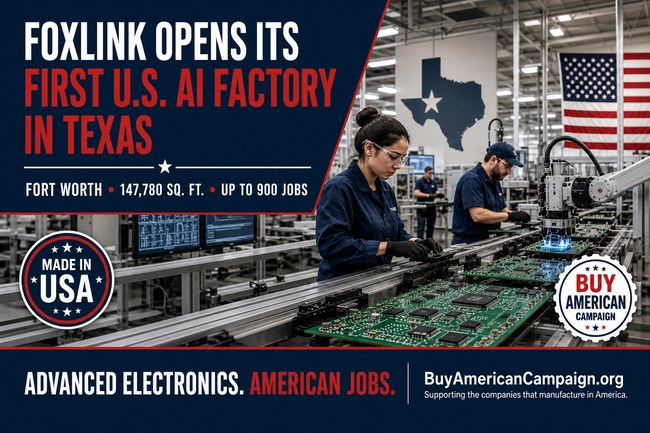
    Foxlink advanced electronics factory in Fort Worth, Texas

    Foxlink has opened its first U.S. AI factory in Fort Worth, Texas, bringing advanced electronics productionβ€”and the potential for roughly 900 jobsβ€”to AllianceTexas. The new operation shows what modern American manufacturing can look like: skilled people working alongside intelligent automation to build critical technology closer to U.S. customers.

    The Taiwanese technology manufacturer officially opened the facility on July 14, 2026. Production is expected to begin in August, turning a 147,780-square-foot building into a North American base for high-precision electronics assembly.

    A New Electronics Factory Starts Production in Texas

    Foxlink selected Alliance Gateway 17 at 4600 Alliance Gateway Freeway for its first North American manufacturing plant. At the opening, the company already had a little more than 50 employees on site, according to local reporting, with the workforce expected to expand as additional customers and production programs come online.

    At full capacity, the facility is projected to support approximately 900 jobs. That is a meaningful number for Fort Worth, but the larger story is the kind of work involved: technically demanding production that has too often been located far from the American companies and consumers who depend on it.

    What Foxlink Will Manufacture in Fort Worth

    The plant will handle printed circuit board assembly, surface-mount technology, final assembly, testing and packaging. These are not cosmetic finishing steps. They are core parts of turning sophisticated components into dependable products ready for customers.

    Foxlink also plans to use AI-driven robotics and intelligent automation throughout the operation. That combination can improve precision, consistency and speed while creating demand for technicians, engineers, equipment specialists, quality professionals and production workers who can keep a highly automated factory running.

    Browse American-Made Products

    Why AllianceTexas Made Sense

    AllianceTexas offers more than available industrial space. The development connects manufacturers to major highways, an intermodal rail facility and Perot Field Fort Worth Alliance Airport. For an electronics producer receiving components and shipping finished goods, that network can reduce delays and make domestic production more competitive.

    Fort Worth also provides access to a large and growing labor market. Foxlink cited the region’s talent, logistics and business environment as reasons for choosing the site. Those practical advantages matter when a company is deciding whether its next factory belongs in the United States.

    Automation and 900 Potential Jobs Can Coexist

    The phrase β€œAI factory” may sound like a building without people. In reality, advanced automation changes the work more than it eliminates the need for workers. Robots can repeat precise motions, but people still install equipment, program systems, solve problems, inspect output, manage materials and improve the process.

    That is why workforce development must be part of the reshoring conversation. Communities that connect manufacturers with technical schools, community colleges and apprenticeship programs give local residents a better chance to qualify for the jobs these investments create.

    Join the Buy American Movement

    An American Manufacturing Winβ€”with an Important Distinction

    Foxlink is a Taiwanese-owned global company, so this is not a story about an American-owned manufacturer. It is still a genuine American manufacturing win because the production, investment and jobs are being placed in Texas. Clear language matters: β€œMade in USA” describes where work happens, not necessarily where a parent company is headquartered.

    Foreign-owned manufacturers employ millions of Americans and can strengthen domestic supply chains when they build here. The goal should be more production capacity on American soil, more opportunities for American workers and more resilience when international shipping or geopolitical events disrupt the flow of essential goods.

    What This Factory Could Mean Beyond Fort Worth

    A single factory will not rebuild the entire electronics supply chain. It can, however, become an anchor. Successful plants attract suppliers, service companies, logistics providers and specialized talent. They also give customers evidence that advanced electronics can be produced competitively in the United States.

    Foxlink’s decision could encourage other manufacturers to examine North Texas and other American regions with strong transportation and workforce networks. Every new operation adds knowledge and capacity that makes the next domestic investment easier.

    The Test Comes Next

    The opening ceremony is the beginning, not the finish line. The real measure will be how quickly production ramps, how many jobs materialize and whether the Fort Worth plant earns additional customer programs. Those results will determine the facility’s long-term impact.

    For now, the direction is encouraging. A global electronics manufacturer chose to put its first North American plant in Texas, begin production in 2026 and build a workforce around advanced manufacturing. That is the kind of concrete investment the Buy American movement should noticeβ€”and the kind consumers can reinforce by choosing products made here whenever possible.

    Whenever possible, choose Made in USA.

    If you like what you see and think this post would be of interest to someone, please share
  • One of America’s Last Aluminum Smelters Is Producing at Full Capacity Again

    One of America’s Last Aluminum Smelters Is Producing at Full Capacity Again

    Molten aluminum production at an American smelter

    When people think about American manufacturing, they usually picture the finished product — a pickup truck, a cast-iron skillet, a can of soda, or an airplane.

    Few people think about the raw materials that make those products possible.

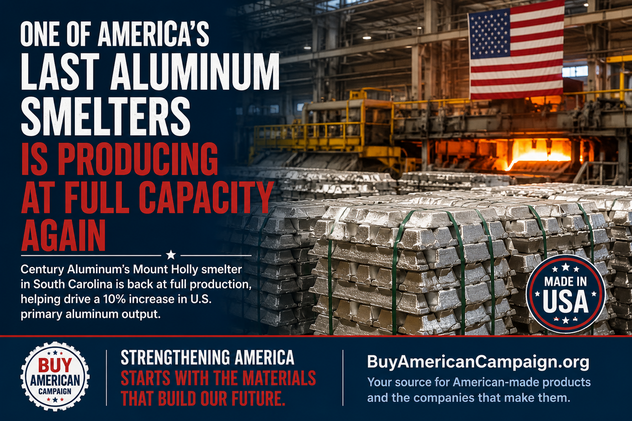
    That is why one announcement from South Carolina deserves far more attention than it has received. Century Aluminum’s Mount Holly smelter is running at full capacity for the first time since 2015, and that single restart is lifting U.S. primary aluminum production by roughly 10 percent.

    Manufacturing does not begin on an assembly line. It begins much earlier — with the materials everything else is built from.

    Why Aluminum Matters

    Aluminum is one of the most important industrial metals in the American economy. It shows up in products Americans use every day:

    • Beverage cans
    • Aluminum foil
    • Cookware
    • Cars and pickup trucks
    • Aircraft
    • Electrical transmission lines
    • Construction materials
    • Boats
    • Military equipment

    Without a reliable domestic supply of primary aluminum, manufacturers become increasingly dependent on imports for the starting material of all of it.

    What Is a Smelter?

    Many people assume aluminum comes straight out of a mine. It does not.

    Bauxite ore has to be refined into alumina first, and the alumina then goes through enormous smelters where electricity separates pure aluminum from oxygen. These plants are among the most energy-intensive industrial facilities in the world.

    They are also extraordinarily expensive to build and very difficult to restart once they have gone cold. That is a large part of why American aluminum-smelting capacity has shrunk so dramatically over the past few decades — and why Mount Holly is now one of only four primary aluminum smelters left operating in the United States.

    A Rare Piece of Good News

    Century Aluminum has brought the idled portion of its Mount Holly plant in Berkeley County, South Carolina back online, returning the facility to 100 percent production for the first time in more than a decade.

    The numbers behind it are concrete. Century invested roughly $50 million in the restart, added about 150 jobs at a plant that now employs more than 600 people, and brought back over 50,000 metric tons of annual capacity. That one restart raises total U.S. primary aluminum output by close to 10 percent.

    U.S. Commerce Secretary Howard Lutnick visited the plant on July 27 to mark the milestone alongside South Carolina officials.

    Browse American-Made Products

    Why This Restart Actually Happened

    It is worth being precise about the cause, because it was not simply a good year for demand.

    Century pointed directly at trade policy. The company titled its own announcement around the benefits of Section 232 tariffs, which were raised to 50 percent on imported aluminum with no exemptions. Those tariffs changed the math on domestic production enough to justify firing the idled potlines back up.

    The second ingredient was electricity. Smelters live or die on power costs, and Mount Holly’s capacity had been constrained for years by its power arrangement. Century and Santee Cooper, the state-owned utility that supplies the plant, extended their contract through 2031 to secure the additional power the restart required. Without that agreement, the tariffs alone would not have been enough.

    The Part That Still Comes From Overseas

    Here is the honest caveat, and it matters if you care about real industrial independence rather than the headline.

    A smelter does not make aluminum out of nothing. It needs alumina, which is refined from bauxite ore — and the United States barely produces either one anymore. American alumina refining capacity has collapsed from nearly 5 million tons in 2000 to roughly 600,000 tons today, concentrated in a single remaining refinery in Gramercy, Louisiana. The country imports more than 75 percent of its bauxite and about 71 percent of its alumina, mostly from Jamaica, Brazil, Guyana, and Australia.

    So Mount Holly running at full tilt is a genuine win for American jobs and American output. It is not yet an American supply chain. The metal is poured here; the raw material largely is not.

    That gap is being worked on. Century has partnered with the startup Brimstone on an effort to build the first domestic mine-to-metal aluminum supply chain, though a full-scale alumina plant is not projected until the 2030s.

    Join the Buy American Movement

    Why Domestic Production Matters

    For a lot of manufacturers, aluminum is not just another commodity line item. It determines whether they have a stable supply during a disruption.

    The past several years have shown how fast global supply chains can seize up — geopolitical conflict, shipping bottlenecks, tariffs, energy shortages. Every ton produced domestically is one more ton an American manufacturer can source without crossing an ocean for it.

    It Is About More Than Beverage Cans

    When people hear aluminum, they think soda cans. The metal does far more work than that.

    The auto industry uses it to cut vehicle weight and improve fuel economy. Aerospace depends on high-strength aluminum alloys. Utilities run aluminum conductors across thousands of miles of transmission line. Defense manufacturers put it in everything from armored vehicles to naval vessels.

    Plenty of the American-made products we feature here — cookware, trailers, tools, outdoor gear — trace back to a healthy domestic aluminum industry whether the buyer realizes it or not.

    Rebuilding Manufacturing Starts at the Beginning

    It is easy to celebrate a new factory that assembles a finished product. It is harder to notice when a raw-material producer quietly restores capacity.

    The second one may matter more. A strong industrial base is not built out of assembly plants alone — it needs steel mills, aluminum smelters, chemical producers, foundries, and the whole unglamorous upstream that feeds them. Without those, even a product assembled in the United States is often made of imported material.

    The Bottom Line

    Mount Holly returning to full production will not solve American aluminum overnight. Four primary smelters is still a thin margin for an economy this size, and the refining side of the industry is thinner still.

    But the direction changed, and it changed for reasons that can be repeated. Every increase in domestic production makes the manufacturing base a little harder to disrupt.

    Sometimes the biggest manufacturing victories are not the products you see on a store shelf. They are the raw materials that make those products possible in the first place.

    Whenever possible, choose Made in USA.

    If you like what you see and think this post would be of interest to someone, please share
  • America Doesn’t Build the Giant Cranes That Keep Our Ports Running

    America Doesn’t Build the Giant Cranes That Keep Our Ports Running

    Giant ship-to-shore container cranes at an American port

    Every day, millions of containers arrive at American ports carrying everything from electronics and clothing to machinery and auto parts. Towering above the ships are the giant cranes that unload them — some of the largest and most complex machines in the world.

    Here is something most Americans do not know: the United States has not built one of these cranes in more than thirty years.

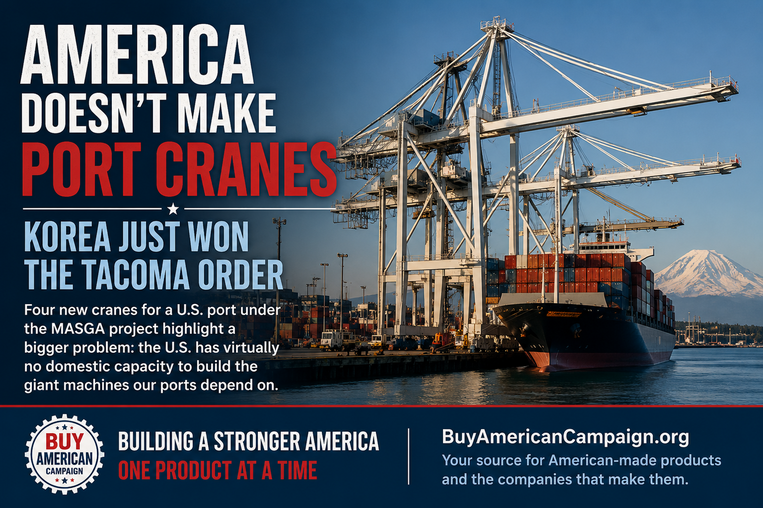
    That reality came into focus again this week when Washington United Terminals in Tacoma awarded a contract for four new cranes to South Korea’s HD Hyundai Samho. The Korean shipbuilder will design, manufacture, transport, install, and commission the equipment as a turnkey project, with delivery scheduled through 2028.

    It is a reminder that while America remains a manufacturing powerhouse in many industries, there are still critical sectors where domestic production has nearly disappeared.

    The Machines That Keep Trade Moving

    Ship-to-shore cranes are engineering marvels. They stand well over 200 feet tall, with booms that reach across the deck of a container ship, and they lift boxes weighing tens of tons with remarkable precision. Modern ports simply cannot operate without them.

    The Tacoma order covers two ship-to-shore quay cranes, which will replace aging units, and two yard cranes that move containers around the terminal. Together they will lift Washington United Terminals’ annual capacity from roughly 590,000 containers to 880,000 and allow the terminal to handle the largest vessels calling on the West Coast.

    When a new crane arrives, it is not just another piece of equipment. It is a decades-long investment in the infrastructure that keeps commerce flowing.

    How America Lost This Industry

    It was not always this way. An American company, PACECO, built the world’s first dedicated ship-to-shore container crane in 1958 and manufactured them in the United States for three decades. Its Gulfport, Mississippi plant closed in 1989. That was the end of domestic production.

    Into that gap stepped China’s state-owned Shanghai Zhenhua Heavy Industries, better known as ZPMC. Today ZPMC holds roughly 70 percent of the global container crane market, and federal estimates put its share of the ship-to-shore cranes operating at U.S. ports at close to 80 percent.

    That dominance did not happen overnight. As American heavy manufacturing declined and Chinese production expanded, U.S. ports bought imported cranes because there were almost no domestic alternatives left to buy.

    Browse American-Made Products

    Why Port Cranes Became a National Security Concern

    In recent years, those purchases became more than an economic question. Modern cranes can be monitored, serviced, and reprogrammed remotely, and federal officials warned that the software and networking built into foreign-made equipment could expose critical infrastructure to interference.

    The response has been substantial. An executive order directed action on maritime cyber threats. The U.S. Coast Guard issued Maritime Security Directive 105-4, requiring operators of Chinese-built ship-to-shore cranes to take specific cyber risk management steps. And federal trade officials imposed tariffs of 100 percent on Chinese ship-to-shore cranes and certain cargo handling equipment.

    But closing the door on one foreign supplier is not the same thing as rebuilding an American industry.

    The Tacoma Order Shows the Gap

    The Tacoma contract illustrates the challenge precisely. With Chinese cranes effectively priced out, the work did not go to an American manufacturer. It went to South Korea.

    There is another detail worth noting. Washington United Terminals is the U.S. arm of HMM, South Korea’s largest shipping line, and four of the eight quay cranes already standing at its Tacoma berth were also built by HD Hyundai Samho — back in 1999. This capability did not slip away last year. It has been gone for a very long time.

    South Korea is one of the few countries left with the industrial base to compete for work this specialized, which is exactly why American ports looking for alternatives keep landing there.

    Join the Buy American Movement

    America Is Trying to Rebuild This Industry — It Is Not There Yet

    The encouraging part of this story is that the effort is real and underway.

    PACECO — the same company that invented the machine in 1958 — announced plans to restart ship-to-shore crane manufacturing in the United States after a thirty-year pause. Konecranes has partnered with American steel suppliers to build up domestic port crane capacity. Federal policy has put real money and real tariffs behind the goal.

    But announcements and finished cranes are two different things. When PACECO won an order in September 2025 for two large Portainer cranes bound for the Port of Long Beach, the machines were built in Japan, using American-made components, and shipped here. The domestic restart has been announced. It has not yet produced an American-built crane.

    That gap between the announcement and the first machine off the line is the honest state of this industry right now.

    Rebuilding an Industry Takes More Than a Factory

    Most conversations about American manufacturing focus on things consumers buy — cars, appliances, clothing, tools. Heavy industrial equipment rarely gets the same attention, even though it is the equipment everything else depends on.

    An industry like this one requires an entire ecosystem: heavy steel fabrication, precision machining, industrial electrical systems, advanced controls and automation, specialized engineering, skilled welders and fabricators, and assembly facilities big enough to build a structure taller than a twenty-story building.

    Once that industrial base disappears, rebuilding it is not as simple as opening a new plant. It takes years of investment, trained workers, a supplier network, and customers willing to place the first orders before the track record exists.

    The Bottom Line

    The Tacoma crane contract is not bad news. South Korea is a trusted ally with world-class manufacturing, the terminal needed the upgrade, and modernizing American ports is essential work.

    But the project points at something larger. America is strengthening domestic manufacturing across many sectors, and in plenty of them that effort is producing new factories and new jobs. In others — like the giant cranes that unload our own imports — the country is still working its way back.

    That is the difference between buying American products and rebuilding American industrial capability. One you can do this afternoon. The other takes a decade and a lot of people deciding it matters.

    Sometimes the biggest manufacturing stories are not about what we make. They are about what we no longer can — and what it will take to change that.

    Whenever possible, choose Made in USA.

    If you like what you see and think this post would be of interest to someone, please share
  • The Best American-Made Flashlights: Maglite, Streamlight & Pelican

    The Best American-Made Flashlights: Maglite, Streamlight & Pelican

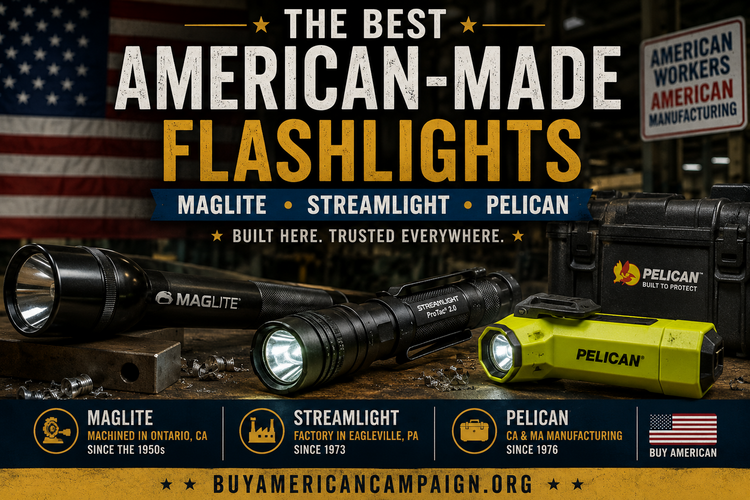
    American-made flashlights from Maglite, Streamlight and PelicanA flashlight is one of the few things you buy hoping you rarely need it β€” and then, when the power goes out or the truck breaks down on a dark shoulder, it becomes the most important object you own. That is exactly why it is worth buying one built by people who put their name on it.

    The good news is that the flashlight aisle is one of the last consumer categories where American manufacturing never really left. While most of the world’s lights are assembled overseas from interchangeable parts, three companies still run real factories on American soil β€” one machining aluminum in Southern California, one running a quarter-million square feet in suburban Philadelphia, one molding cases and building lights in California and Massachusetts.

    If you are searching for the best made in USA flashlight, this guide covers the three brands we can actually verify, what each one does best, and who each one is for. We are not ranking lumens for sport β€” we are ranking companies by what they build, where they build it, and how honest they are about it.

    Honesty matters: not one of these three is 100% American across every SKU. Batteries, bulbs, and electronics move around the globe no matter whose name is on the barrel, and two of these companies openly sell imported lines alongside their domestic ones. We tell you which is which below rather than pretending the gray areas do not exist.

    Best Overall American-Made Flashlight: Maglite

    Maglite is the closest thing this category has to a sure thing. Mag Instrument has machined its flashlights in Ontario, California since Anthony “Tony” Maglica β€” the son of Croatian immigrants β€” started the company in 1955 with a single lathe in a small machine shop. The flashlight that made the name famous arrived in 1979, and more than four decades later the whole line is still cut from solid aircraft-grade aluminum in that same Southern California plant, by more than 800 American workers.

    What separates Maglite from companies that merely finish a product here is vertical integration. Machining, anodizing, and assembly all happen under one roof, and Maglica insisted from the beginning that components be procured domestically rather than shipped in and screwed together. That is a much higher bar than “assembled in USA,” and it is the reason a twenty-year-old Maglite still takes new cells and works.

    The modern lineup has moved well past the incandescent D-cell everyone remembers. The ML300L series delivers real LED output with the same adjustable spot-to-flood twist head, and the Mini Pro and XL models put the same machining quality in a pocketable body. You can browse the current Maglite flashlights in the Buy American Store and see the range for yourself.

    Best For

    • Buyers who want the strongest made-in-USA claim in the category, with no per-model homework
    • Household, glovebox, and emergency-kit lights that will sit unused for years and still work
    • Anyone who values a machined aluminum body and a repairable, serviceable design
    • Gift buying, where “made in California since 1979” is part of the point

    Honest Drawback

    Maglite is not chasing the spec sheet. Tactical brands will sell you more lumens and more programmable modes for the same money, and the classic D-cell bodies are heavy by modern standards. As with any flashlight, consumable parts like batteries and bulbs may be sourced elsewhere β€” what is American-made is the light itself.

    Best for Work and Duty Use: Streamlight

    Streamlight came out of early-1970s engineering work tied to NASA’s space program, where a team built what was then called a handheld “super flashlight.” The company was formally founded in 1973 and put down roots in Eagleville, Pennsylvania, where it still owns and operates a 240,000-square-foot plant employing more than 350 people.

    Fifty years later, Streamlight is what firefighters, electricians, mechanics, and police officers actually carry. The ProTac series is the workhorse β€” genuinely bright, USB-rechargeable in most current versions, and built around a clicky tail switch and programmable modes that you can set once and forget. The Survivor line is purpose-built for firefighters, with a right-angle body that clips to turnout gear. These are tools bought by people whose job depends on them working.

    If you want output and features without leaving American manufacturing entirely behind, the Streamlight work lights in the Buy American Store are where this guide’s value-per-dollar lives.

    Best For

    • Trades, first responders, and anyone who needs a light to survive a job site
    • Buyers who want high lumen output and rechargeable convenience
    • Weapon-mounted and helmet-mounted lighting
    • People willing to check a fact sheet in exchange for more capability per dollar

    Honest Drawback

    Streamlight is mixed-origin, and we say so plainly. Many lights are assembled in the USA at Eagleville β€” some with imported parts β€” while a portion of production is sourced overseas, including from China. Origin varies by SKU. Streamlight does publish the answer: each product’s fact sheet, under the Documentation tab on streamlight.com, discloses that model’s specific origin. Check it before you buy if domestic content is your priority.

    Browse American-Made Products

    Best Light-and-Case System: Pelican

    Pelican was started in 1976 by David and Arline Parker, and it is the rare American company that got famous for the box rather than what goes in it. Its crushproof Protector, Air, Vault, and Storm cases β€” plus the Elite hard coolers β€” are made in the USA at company-owned plants in Torrance, California and South Deerfield, Massachusetts, and MIL-SPEC tested on site.

    The lighting side grew out of the same obsession with sealed, abuse-proof housings. Pelican’s 7000 and 7600 tactical lights and the little 1920 pen light are built to the same submersible, drop-tested standard as the cases, which is why you find them in dive bags, utility trucks, and industrial safety kits rather than in the checkout-lane bin. The 3310 emergency light with photoluminescent housing is a genuinely smart piece of design β€” you can find it in the dark because the shell glows.

    Where Pelican earns its place here is as a system: the light, the case that protects the rest of your kit, and a lifetime guarantee of excellence behind both. Browse the Pelican lights and protective cases in the Buy American Store.

    Best For

    • Wet, dirty, and industrial environments where a light gets dropped and submerged
    • Photographers, divers, and field crews already buying Pelican cases
    • Emergency and safety kits, where the photoluminescent 3310 shines β€” literally
    • Buyers who want a crushproof, US-made case to go with the light

    Honest Drawback

    This is the caveat to read twice. Pelican’s verified American manufacturing covers the hard cases and Elite coolers built in Torrance and South Deerfield. Not every Pelican product is US-made β€” phone cases, soft goods, and some accessories are imported, and the lighting line is not blanket-verified the way the cases are. Buy Pelican for the case with total confidence; for a specific flashlight model, confirm that model’s origin before you check out.

    Featured Flashlights

    One representative light from each brand, with its origin labeled honestly rather than uniformly.

    Streamlight 88085 ProTac HL-X USB 1300-Lumen Tactical LED β—† US plant β€” verify origin by modelShop β†’
    Pelican 7000 Tactical LED Flashlight, Black β—† US case maker β€” verify light origin by modelShop β†’

    Which Flashlight Is Right for You?

    BrandBest ForCompany ProfileShop
    MagliteThe strongest made-in-USA claim; household, truck, and emergency lights built to outlive youView ProfileShop Products
    StreamlightTrades and first responders who need maximum output and rechargeable convenienceView ProfileShop Products
    PelicanWet, rough, industrial use β€” and a crushproof American-made case to carry it inView ProfileShop Products

    Join the Buy American Movement

    Build an American-Made Light Kit

    Most households do not need one perfect flashlight. They need three decent ones in the right places, because the light you cannot reach in the dark is worth nothing. Think in terms of stations rather than a single purchase.

    • The house light β€” a Maglite ML300L D-cell by the breaker panel or under the sink. Long runtime, no charging to forget.
    • The pocket light β€” a Maglite Mini Pro or a compact Streamlight ProTac that lives in a bag, a jacket, or a work belt.
    • The truck light β€” a rechargeable Streamlight ProTac HL-X, mounted where you can find it by feel.
    • The go-bag β€” a Pelican 3310 emergency light in a Pelican case with your documents, batteries, and first-aid kit.

    Built out that way, a kit from these three companies represents about 150 years of combined American manufacturing β€” 1955 in Ontario, California; 1973 in Eagleville, Pennsylvania; 1976 in Torrance, California. Three factories, still running, still hiring, still stamping out parts on this side of the ocean. That is what your money is voting for.

    Ready to Buy American-Made Lighting?

    Browse every flashlight and work light we’ve found from American manufacturers, in one place.

    Shop All American-Made Flashlights β†’

    Explore the brand profiles: Maglite · Streamlight · Pelican

    The Bottom Line

    If you want one flashlight and you want zero homework, buy the Maglite β€” it is machined in California from American parts, and it has been for four decades. If you need serious output for work, buy the Streamlight and take ninety seconds to check the model’s fact sheet. If your gear lives in the mud and the rain, buy Pelican for the case and choose the light with your eyes open. All three keep Americans employed making things, which is more than almost anything else on that shelf can claim.

    Whenever possible, choose Made in USA.

    If you like what you see and think this post would be of interest to someone, please share
  • The Best American-Made Hand Tools

    The Best American-Made Hand Tools

    American-made hand tools

    America still makes world-class hand tools β€” you just have to know where to look. While big-box shelves overflow with imported wrenches and throwaway pliers, a handful of American manufacturers have been forging tools in the same towns for a century or more, backing them with lifetime guarantees and the kind of quality you can hand down to your kids.

    This guide rounds up five of the best American-made hand-tool brands β€” what each one does best, an honest drawback, and exactly where to buy them. Every brand below is verified made in the USA. Where a company also sources globally, we feature only its US-made lines.

    Best Pliers: Channellock

    When people picture a great pair of pliers, they’re usually picturing Channellock’s blue grips. Channellock has been forging tools in Meadville, Pennsylvania since 1886, and its tongue-and-groove pliers are so iconic that “channellocks” became the generic name for the entire category. The jaws are laser-heat-treated to bite and hold, and the company still makes its signature pliers and cutters right here in the U.S.

    For plumbers, electricians, and anyone who wants one tool that will outlast them, a set of Channellock tongue-and-groove pliers is about as close to a lifetime buy as hand tools get.

    Best For

    • Tongue-and-groove & water-pump pliers
    • Electrical and plumbing work
    • Buy-it-for-life shoppers

    The Honest Drawback

    Channellock’s core pliers are US-made, but a few specialty accessories in the broader lineup are sourced elsewhere β€” and you’ll pay more up front than a big-box no-name. For the pliers themselves, that premium buys decades of service.

    Best for Electricians & Trades: Klein Tools

    Klein Tools has been a family business since 1857, and for generations its pliers, screwdrivers, and wire strippers have been the standard in electricians’ pouches. Many of Klein’s most popular hand tools are still made in the USA, forged and assembled to survive daily jobsite abuse.

    If you work with your hands for a living β€” especially in the electrical trades β€” a Klein screwdriver or plier set is the kind of tool you buy once and reach for every single day.

    Best For

    • Electricians & linemen
    • Screwdrivers, pliers & wire strippers
    • Daily professional use

    The Honest Drawback

    Klein’s catalog is enormous, and not every SKU is US-made β€” some accessories and newer lines are imported. Check the label (our store filters to the US-made items), and expect trade-grade pricing.

    Browse American-Made Products

    Best Striking Tools: Estwing

    Estwing has been making hammers in Rockford, Illinois since 1923, and it does something almost no one else does: forges each hammer, hatchet, and pry bar from a single piece of American steel. No welded-on heads to work loose, no glued handles to crack β€” just one solid, nearly indestructible tool with a shock-reduction grip.

    From the leather-gripped claw hammer on a finish carpenter’s belt to a camp hatchet in a truck bed, Estwing’s one-piece tools have earned a cult following for good reason.

    Best For

    • Framing & finish hammers
    • Hatchets, axes & pry bars
    • Buyers who want unbreakable one-piece steel

    The Honest Drawback

    A solid-steel handle is heavier than fiberglass and transmits a little more shock on hard swings, though Estwing’s cushioned grip takes the edge off. For most users that heft is exactly what makes the tool feel bombproof.

    Best Wrenches & Sockets: Wright Tool

    If you’ve never heard of Wright Tool, professional mechanics have. Since 1927 the company has forged wrenches, sockets, and impact sockets in Barberton, Ohio β€” and unlike most of the industry, Wright makes 100% of its tools in the USA from American steel. No offshore lines, no asterisks.

    A Wright impact socket set is the kind of gear you find in serious shops and industrial plants, where a failed socket simply isn’t an option.

    Best For

    • Professional mechanics
    • Impact sockets & combination wrenches
    • Industrial & heavy-duty use

    The Honest Drawback

    Wright doesn’t have the consumer name recognition of Snap-on or Craftsman and sells mostly through industrial channels, so you’ll rarely spot it in a big-box aisle. The tools, though, are as American and as tough as they come.

    Best Complete Sets & Value: TEKTON

    TEKTON is headquartered in Grand Rapids, Michigan, and it has been steadily bringing tool-making back home. A growing share of its pliers, punches, pry bars, and pick sets are now made in the USA and clearly marked as such β€” the brand to reach for when you want to build out a kit without paying boutique prices.

    We feature only TEKTON’s US-made lines β€” the Made-in-USA pliers and punch sets β€” so you can stock a drawer with American tools at a friendly price point.

    Best For

    • Building a hand-tool kit on a budget
    • Punches, pry bars & pliers
    • Value-minded DIYers

    The Honest Drawback

    Not everything TEKTON sells is American-made β€” the company still sources globally β€” so you have to look for the “Made in USA” marking. The good news: our store already filters to those US-made items for you.

    Featured American-Made Hand Tools

    One standout, verified Made-in-USA pick from each brand:

    Which Hand-Tool Brand Is Right for You?

    BrandBest ForCompany ProfileShop
    ChannellockPliers & cuttersView ProfileShop Products
    Klein ToolsElectrical tradesView ProfileShop Products
    EstwingHammers & striking toolsView ProfileShop Products
    Wright ToolWrenches & socketsView ProfileShop Products
    TEKTONBudget-friendly setsView ProfileShop Products

    Join the Buy American Movement

    Ready to Buy American-Made Hand Tools?

    Explore more than 1,200 USA-made hand tools from the brands above and dozens more.

    Shop All American-Made Hand Tools β†’

    Channellock Β· Klein Tools Β· Estwing Β· Wright Tool Β· TEKTON

    The Bottom Line

    You don’t have to settle for disposable imports. Whether it’s Channellock pliers, an Estwing hammer, Klein screwdrivers, Wright sockets, or a set of US-made TEKTON tools, these five brands prove that American hand tools are still among the best in the world β€” built to work hard and last for decades. Buy once, buy American, and hand them down.

    If you like what you see and think this post would be of interest to someone, please share
  • Martin Guitars: America’s Handmade Acoustic, Built in the USA Since 1833

    Martin Guitars: America’s Handmade Acoustic, Built in the USA Since 1833

    Martin guitars made in the USA in Nazareth, Pennsylvania

    Few names in American music carry the weight of Martin. C.F. Martin & Co. has been building acoustic guitars in Nazareth, Pennsylvania since 1833, and its dreadnought body shape became the template that most steel-string guitars still follow today. But here’s the catch a lot of first-time buyers miss: not every guitar with “Martin” on the headstock is made in the USA. This guide walks through which Martins are American-made, how to choose the right one, and where to shop them.

    Which Martin guitars are actually made in the USA

    Martin builds guitars in two places. Its higher-end instruments β€” the Standard Series (like the D-28, D-18, and 000-28), plus the 15, 16, and 17 Series, Modern Deluxe, Authentic, and Custom Shop guitars β€” are made in Nazareth, Pennsylvania. Those are the American-made Martins.

    Martin’s more affordable lines β€” the Road Series, X Series, and the Junior and Little Martin (LX) travel guitars β€” are built at the company’s factory in Navojoa, Mexico. They’re still Martins and still good guitars, but they are not US-made. If buying American is the priority, check the specific model before you buy, and focus on the Standard Series and up. (Martin’s strings, by the way, are made in the USA too.)

    Start with the body shape

    Before series or price, pick a body shape β€” it shapes the sound and feel more than anything else. The Dreadnought (D) is Martin’s signature: big, bold, and loud, the classic flatpicking and bluegrass sound. The Orchestra Model / Auditorium (OM/000) is a touch smaller with a balanced, articulate voice that fingerstyle players love. The Grand Performance (GP) splits the difference with a comfortable, modern feel, and the smaller 0 and 00 shapes are intimate and easy to hold.

    There’s no “best” shape β€” a dreadnought suits a strummer filling a room, while an OM suits a fingerpicker who wants clarity. If you can, play a few before committing.

    Browse American-Made Products

    Understanding the US-made series and price tiers

    Among the American-made Martins, the 15 and 16 Series are the most accessible entry points β€” solid-wood guitars built in Nazareth without the higher-tier appointments. Step up to the Standard Series and you reach the icons: the D-28 (rosewood-and-spruce dreadnought that has backed countless records), the D-18 (mahogany, drier and punchier), and the 000-28 (the fingerstyle favorite).

    Above those sit the Modern Deluxe, Marquis, and Authentic lines β€” vintage-accurate, premium builds for players who want the very best. All are made in the USA. A US-made Martin is a lifetime instrument, and many hold or increase their value, so think of it as a long-term buy rather than a disposable one.

    What to look for

    Prioritize solid wood (top, back, and sides) over laminate β€” the US-made series all use solid tonewoods, which sound better and age better. Decide whether you need onboard electronics for plugging in (many models come in an “E” version). And if a new Standard Series guitar is out of reach, a used American-made Martin is one of the safest buys in the guitar world thanks to Martin’s build quality and consistency.

    Join the Buy American Movement

    Where to buy and learn more

    Martin has kept premium instrument craftsmanship alive in Pennsylvania for nearly two centuries β€” you can read the full Martin Guitar Made-in-USA story on our company profile. When you’re ready to buy, you can shop American-made Martin guitars on our store’s Martin brand page, where we feature the US-made models.

    Buying a US-made Martin means owning a piece of American music history β€” and supporting the skilled luthiers who still build these guitars by hand in Nazareth.

    Whenever possible, choose Made in USA.

    If you like what you see and think this post would be of interest to someone, please share
  • The Most American-Made Cars of 2026 β€” And the Surprise at the Top

    The Most American-Made Cars of 2026 β€” And the Surprise at the Top

    Most American-made cars of 2026

    Every year, Cars.com publishes its American-Made Index β€” a ranking of which vehicles sold in the United States are actually the most American. The 2026 list just landed, timed to the country’s 250th birthday, and it contains a twist that is going to surprise a lot of people.

    The most American-made cars on the road are not all built by American brands.

    The 2026 Most American-Made Cars

    Here is the top 10 for 2026:

    1. Tesla Model 3
    2. Tesla Model Y
    3. Jeep Gladiator β€” built in Ohio
    4. Jeep Grand Cherokee β€” assembled in Detroit
    5. Honda Ridgeline β€” built in Alabama
    6. Honda Odyssey β€” built in Alabama
    7. Lexus TX 350 β€” built in Indiana
    8. Honda Accord β€” built in Ohio
    9. Acura MDX β€” built in Ohio
    10. Honda Passport β€” built in Alabama

    Tesla’s Six-Year Streak

    For the sixth year running, Tesla builds the most American-made vehicle in the country. The Model 3 takes the top spot, with the Model Y right behind it for the second consecutive year.

    With the Model S and Model X discontinued, two Tesla entries fell off the list β€” which opened the door for the Jeep Gladiator to climb from fifth all the way to third. The Detroit-assembled Grand Cherokee followed right behind it in fourth.

    Tesla’s dominance is not an accident. The company builds its vehicles in California and Texas, makes its own batteries and motors domestically, and keeps far more of its supply chain inside U.S. borders than most legacy automakers do. When you control that much of the process at home, you score well on every measure the index cares about.

    Browse American-Made Products

    The Surprise: Six of the Top 10 Are Not American Brands

    American automakers hold the top four positions. After that, the list belongs to Japanese-owned companies.

    Honda alone claims four spots in the top 10 β€” the Ridgeline, Odyssey, Accord, and Passport β€” with the Acura MDX and the Lexus TX 350 filling in two more. Japanese-owned manufacturers account for six of the top 10 and twelve of the top 20.

    Look closer at where those vehicles come from, though, and the picture gets clearer. The Ridgeline, Odyssey, and Passport are built in Alabama. The Accord and MDX are built in Ohio. The Lexus TX 350 is built in Indiana.

    Those are American plants, staffed by American workers, in American towns. The badge on the hood says Honda. The paycheck says Alabama.

    Who Puts the Most Vehicles on the List

    Look past the top 10 and the pattern holds. Across the full index, Toyota places the most vehicles of any automaker with 14, followed closely by Honda with 13. General Motors also lands 13, Ford nine, and Stellantis six.

    Read that again. The two automakers with the deepest American manufacturing footprint on this list, by vehicle count, are Toyota and Honda β€” two Japanese companies that have spent four decades building plants in Kentucky, Ohio, Indiana, Alabama, and Texas, and hiring the people who live there.

    How the Index Actually Works

    This is not a popularity contest. Cars.com ranks vehicles on five specific factors:

    • Where the vehicle is assembled
    • How much of its parts content is American, as measured under the American Automobile Labeling Act
    • U.S. factory employment relative to how many vehicles are produced
    • Where the engine is sourced
    • Where the transmission is sourced

    That fourth measure matters more than people realize. It rewards automakers who actually employ American workers in meaningful numbers, not just companies that bolt together imported parts on U.S. soil and call it domestic.

    Join the Buy American Movement

    What This Means If You Want to Buy American

    Here is the uncomfortable truth this index exposes every single year: the logo on the grille is not the same thing as where a car is built or who built it.

    Plenty of vehicles from storied American brands are assembled in Mexico, Canada, or South Korea. Meanwhile, a Honda Ridgeline coming off a line in Lincoln, Alabama supports American families, American suppliers, and an American town.

    If your goal is to support American workers β€” and that is what this movement is really about β€” then the question is not “is this an American company?” The question is “where was this actually made, and who made it?”

    None of this means American brands are not worth supporting β€” they employ hundreds of thousands of people and anchor entire regions of this country. It means the label alone is not enough information to go on. A Jeep Gladiator out of Toledo and a Honda Ridgeline out of Lincoln are both keeping Americans employed.

    Ask that question before you sign the paperwork. The answer is not always the one you would expect, and it is the only one that puts food on an American table.

    πŸ‡ΊπŸ‡Έ Explore more than 10,000 American-made products and discover the companies behind them at BuyAmericanCampaign.store.

    Whenever possible, choose Made in USA.

    If you like what you see and think this post would be of interest to someone, please share
  • Toyota Brings the Tacoma Home to Texas β€” $3.6 Billion and 2,000 New American Jobs

    Toyota Brings the Tacoma Home to Texas β€” $3.6 Billion and 2,000 New American Jobs

    Toyota Tacoma production comes home to Texas

    Toyota is bringing the Tacoma home.

    The automaker announced a $3.6 billion expansion of its San Antonio manufacturing campus β€” a project that will create roughly 2,000 new jobs and shift production of its popular Tacoma pickup out of Mexico and onto Texas soil. For a movement built on the belief that America can still build things, it is hard to imagine a clearer win.

    The Tacoma Comes Home

    For years, the Tacoma β€” one of the best-selling midsize pickups in the country β€” has been assembled at Toyota’s Baja California plant in Mexico. That is about to change.

    Toyota will build a second vehicle assembly line at its San Antonio campus, and Tacoma production will gradually transition north over the next four years. When it is finished, the Tacoma will roll off the line alongside the Tundra and the Sequoia, in the same Texas plant, built by American workers.

    There is something fitting about that. The Tacoma is a truck people genuinely love β€” the kind that gets handed down to a kid, hauled to job sites for twenty years, and driven into the mountains on weekends. Soon it will be built here.

    A $3.6 Billion Bet on American Workers

    The number is worth sitting with for a second. Three point six billion dollars is not a press release. It is concrete, steel, robotics, and payroll.

    “Toyota’s continued investment in North America is a testament to our confidence in the region’s workforce, innovation and long-term growth potential,” said Ted Ogawa, President and CEO of Toyota Motor North America. “By expanding our San Antonio plant, we are deepening our commitment to American manufacturing, creating meaningful and sustainable jobs.”

    Toyota has been building trucks in San Antonio since construction began in 2003. This expansion brings the company’s total investment in that single site to roughly $8.3 billion. That is not a company testing the water. That is a company putting down roots.

    Browse American-Made Products

    Doubling the Footprint in San Antonio

    The project will add about 2.5 million square feet to the manufacturing campus, effectively doubling the size of the site by 2030.

    When it is complete, Toyota’s San Antonio workforce is expected to grow to roughly 6,000 employees, supported by 23 onsite suppliers. Those direct and indirect jobs are projected to generate an estimated $8.5 billion in economic impact for the region.

    What 2,000 Jobs Actually Mean

    Numbers like “2,000 jobs” can start to sound abstract. They should not. Two thousand jobs is two thousand households with a steady paycheck, health insurance, and a reason to stay in the neighborhood they grew up in.

    Auto assembly work remains some of the best-paying manufacturing employment in the country, and it does not require a four-year degree. And because 23 suppliers operate right on the campus, the ripple runs well past Toyota’s own payroll β€” into the machine shops, logistics firms, and parts makers that live or die on that plant staying busy.

    Join the Buy American Movement

    A Rare Moment of Agreement

    What stands out about this announcement is who showed up to celebrate it.

    “Texas is where the world builds bigger, and Toyota shows it once more with a $3.6 billion expansion in San Antonio that doubles their factory footprint and creates 2,000 new jobs,” said Governor Greg Abbott. San Antonio Mayor Gina Ortiz Jones called it “a significant recognition of the talent our city offers.” Senators John Cornyn and Ted Cruz welcomed the news, and so did State Senator Roland Gutierrez, who called it “tremendous news for our community and for the State of Texas.”

    Republicans and Democrats. State and local. When a project draws praise from every direction at once, it is usually because the benefit is too obvious to argue with. Factory jobs are not a partisan issue. They are a paycheck issue.

    Why This One Matters

    Reshoring usually gets discussed in abstractions β€” supply chains, tariffs, policy frameworks. This is what it actually looks like when it works: a specific truck, a specific plant, a specific city, and a specific number of paychecks that did not exist before.

    Toyota did not have to do this. Building in Mexico was working fine. They chose to bring the Tacoma to Texas because they believe American workers can build it, and because they are betting on this country for the long haul.

    Every time a company decides to build here instead of somewhere else, it is a vote of confidence in American workers β€” and a reminder that the choice to make things in America is still very much on the table.

    The Tacoma is coming home. That is worth celebrating.

    πŸ‡ΊπŸ‡Έ Explore more than 10,000 American-made products and discover the companies behind them at BuyAmericanCampaign.store.

    Whenever possible, choose Made in USA.

    If you like what you see and think this post would be of interest to someone, please share
  • “Made in USA” Should Mean Something β€” and the FTC Just Reminded Everyone Why

    “Made in USA” Should Mean Something β€” and the FTC Just Reminded Everyone Why

    Made in USA should mean something β€” the FTC defends honest American manufacturers

    Three little words carry a lot of weight in this country: Made in USA. Shoppers trust them. Manufacturers earn them. And when a company slaps that label on a product that doesn’t deserve it, everybody honest loses. This week, the Federal Trade Commission reminded the marketplace that the label has to mean something β€” issuing warnings to companies making questionable “Made in USA” claims.

    At the Buy American Campaign, this is the kind of story that goes straight to the heart of why we exist. It isn’t about attacking businesses. It’s about protecting the trust that makes “Made in USA” worth anything at all.

    What the FTC Actually Requires

    Under the FTC’s standard, a product advertised as “Made in USA” without qualification must be “all or virtually all” made in the United States. In plain English: the significant parts, processing, and labor that go into the product need to be American, and the item should contain little to no foreign content.

    That’s a high bar β€” and it’s supposed to be. The FTC’s Made in USA Labeling Rule gives the agency real teeth to pursue companies that use the claim deceptively, including the ability to seek penalties. When the FTC steps in, it’s making sure that businesses which actually invested in domestic manufacturing aren’t undercut by competitors who just print a flag on the box.

    Why This Protects Honest Manufacturers

    Think about what a genuine “Made in USA” product represents. A company chose to run a factory here. It hired American workers, paid American wages, met American safety and environmental standards, and often paid more to do it right. That commitment shows up in the price β€” and it should show up on the label.

    Now imagine a competitor importing nearly everything, doing minimal finishing work stateside, and stamping “Made in USA” on the result. They get the marketing halo without the cost or the commitment. That’s not just unfair to shoppers β€” it’s a direct threat to the honest manufacturers who play by the rules. Enforcement levels the playing field.

    Browse American-Made Products

    Why It Protects Shoppers, Too

    Most people who seek out American-made products are voting with their wallets on purpose. They want to support American jobs, strengthen domestic supply chains, and know that their money is staying closer to home. A misleading label steals that choice. It turns a values-based purchase into a con.

    When the label is trustworthy, everyone benefits: the shopper gets what they paid for, the honest maker gets rewarded, and the whole idea of “buying American” stays credible. Weak enforcement erodes that trust one deceptive product at a time.

    This Is Exactly Why We Verify

    Here’s where it hits home for us. The reason the Buy American Campaign puts in the work to research and verify where products are actually made is simple: the label alone isn’t always enough. Marketing language can be slippery. “Designed in USA,” “Assembled in USA,” “American brand,” and “Made in USA” are not the same thing β€” and the differences matter.

    We dig into where a company actually manufactures, whether its materials are domestic, and how much of the real work happens on American soil. We’re honest about the gray areas, too β€” plenty of good companies are American-owned but source some components globally, and we’d rather tell you the truth than oversell a label. Accuracy is the whole point.

    Join the Buy American Movement

    Made in USA Is a Promise

    At its best, “Made in USA” isn’t a marketing slogan β€” it’s a promise. A promise that American hands built this, that American families were supported by it, and that the buyer’s dollars backed real domestic production. The FTC’s action is a reminder that promises only hold if someone protects them.

    So this isn’t a story about red tape or a company getting in trouble. It’s a story about defending something worth defending. Every time the label is enforced, it gets a little more meaningful β€” and a little more powerful as a force for American jobs.

    If you care about buying American, care about the label being real. Ask questions. Look past the flag graphic to the fine print. And support the companies β€” and the watchdogs β€” working to keep “Made in USA” honest. Because when those three words mean exactly what they say, American manufacturing wins.

    Whenever possible, choose Made in USA.

    If you like what you see and think this post would be of interest to someone, please share