Blog

  • Cheap Goods, Expensive Country

    Cheap Goods, Expensive Country

    American-made work boots and the true cost of cheap goods

    The work boots cost $60 instead of $150.
    The savings are real. You can hold them in your hand.

    The boots that cost $150 were handcrafted in Merrill, Wisconsin. The $60 pair came from the other side of the world. One might save you money today. The other helps ensure someone still has a job making boots tomorrow.

    There’s another difference the price tag doesn’t mention. Many inexpensive imported work boots are difficult or uneconomical to repair, while American-made boots like Thorogood’s Goodyear-welted models can often be resoled and kept in service for years.
    One was built for the next season.
    The other was built for the next generation.

    But there is another bill attached to those boots. You just don’t receive it at the checkout.

    It arrives in a town you’ve never visited, where the factory closed twenty years ago. It shows up in the empty storefront on Main Street, the school that stopped replacing retiring teachers, the diner that no longer serves lunch because the second shift disappeared, and the young people who had to leave because there were no good jobs left to stay for.

    For forty years, we’ve become very good at counting one side of that ledger.
    We’ve almost stopped counting the other.

    The Case for Cheap Imports Is Real

    Before going any further, it’s worth acknowledging something that too often gets ignored.

    The argument for cheap imports is not foolish.

    When manufacturing moved overseas, millions of products became less expensive. Clothes, electronics, furniture, appliances, toys, tools — you name it. Economists have long noted that lower-income families often benefit the most from lower prices because they spend a larger share of their income on everyday goods.

    That’s real.

    If you’re raising a family on a tight budget, saving ninety dollars on a pair of work boots matters.
    No honest conversation should pretend otherwise.

    But that’s only one side of the equation.

    The question isn’t whether the savings exist.
    The question is whether they’re the whole story.

    What the Price Tag Doesn’t Include

    Imagine a factory employing 800 people.

    Most people picture the workers inside the building.
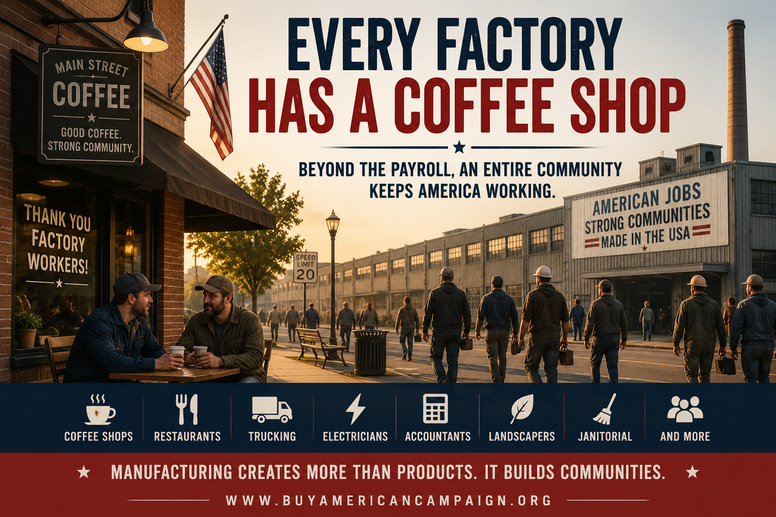
    What they don’t picture are the businesses that depend on those workers.

    The coffee shop where they stop every morning.
    The mechanic who services their trucks.
    The restaurant where they eat lunch.
    The local accounting firm.
    The electrician.
    The machine shop supplying replacement parts.
    The hardware store.
    The barber.
    The dentist.

    Economists call this the manufacturing multiplier. Every manufacturing job supports additional jobs throughout the surrounding community. Researchers debate the exact number, but they agree on the basic point: manufacturing creates far more economic activity than the payroll inside the factory gates.

    When the factory closes, those businesses don’t all disappear overnight.

    They simply become a little quieter.
    Then a little emptier.
    Then one day someone notices another “For Lease” sign in the window.

    A Factory Is More Than Jobs

    Factories don’t just pay workers.

    They pay property taxes.
    They sponsor Little League teams.
    They donate to local charities.
    They support volunteer fire departments.
    Their employees coach youth sports, serve on school boards, attend church, and shop at local businesses.

    A manufacturing plant becomes part of the civic infrastructure of a town.

    Take it away, and the community doesn’t simply lose jobs.
    It loses stability.

    You can’t replace that with a cheaper pair of boots.

    Browse American-Made Products

    The Communities That Never Came Back

    For decades, economists assumed displaced manufacturing workers would simply retrain, relocate, and find better opportunities.

    Many did.
    Many didn’t.

    Research into what became known as the “China Shock” found that communities hit hardest by import competition often struggled for years afterward. Employment fell. Labor-force participation declined. Businesses closed. Population shrank.

    The adjustment that economic theory predicted would be temporary often became permanent.

    Some towns recovered.
    Many never fully did.

    That doesn’t mean trade is bad.
    It means the costs were far greater — and lasted far longer — than many people expected.

    The Things That Didn’t Get Cheaper

    There’s another part of this conversation that rarely gets mentioned.

    Many of the biggest household expenses didn’t become dramatically cheaper because manufacturing moved overseas.

    Housing.
    Healthcare.
    Education.
    Insurance.
    Energy.

    Those continue to consume a growing share of the average family’s income.

    Yes, the television costs less than it did twenty-five years ago.
    The mortgage doesn’t.

    The washing machine might be cheaper.
    College isn’t.

    The savings were real.
    They just weren’t enough to offset everything else.

    Join the Buy American Movement

    We Counted the Savings

    Imagine a family that saves ninety dollars buying imported work boots.

    Good.
    That’s ninety dollars they can spend somewhere else.

    Now imagine another family whose primary wage earner loses a manufacturing job that paid enough to buy a home, raise children, and retire with dignity.

    Those two numbers do not belong in separate conversations.
    They belong on the same ledger.

    One is visible.
    One is hidden.

    We’ve spent decades celebrating the first while treating the second as somebody else’s problem.

    This Isn’t an Argument Against Trade

    America doesn’t need to manufacture everything.
    No serious person argues that.

    Trade has existed for thousands of years and always will.

    Nor is this an argument against other countries succeeding.
    Every nation wants good jobs for its people.
    So do we.

    The real question is whether we’ve become too willing to measure success only by what happens at the cash register.

    A country isn’t just a marketplace.
    It’s also a place where people need opportunities to build careers, support families, and contribute to their communities.

    Those things don’t appear on receipts.
    They’re no less valuable because of it.

    The Full Ledger

    When an American-made product costs a little more, the difference isn’t simply disappearing.

    Part of it pays the machinist.
    Part of it pays the welder.
    Part of it pays the engineer.
    Part of it supports the supplier across town.
    Part of it helps fund the local school, the roads, and the fire department.
    Part of it keeps another American town alive.

    That doesn’t mean every imported product is the wrong choice.
    It simply means the price tag isn’t the whole story.

    For decades, we’ve carefully counted the savings.
    Maybe it’s time we counted what those savings cost.

    Because the cheapest country to buy from isn’t necessarily the cheapest country to become.

    And that’s the number that matters most.

    Related reading: The Cheapest Thing You Buy Is Often the Most Expensive — the same argument, measured at the kitchen table instead of the country.

    Whenever possible, choose Made in USA.

    If you like what you see and think this post would be of interest to someone, please share
  • The Best American-Made Hand Tools

    The Best American-Made Hand Tools

    American-made hand tools

    America still makes world-class hand tools — you just have to know where to look. While big-box shelves overflow with imported wrenches and throwaway pliers, a handful of American manufacturers have been forging tools in the same towns for a century or more, backing them with lifetime guarantees and the kind of quality you can hand down to your kids.

    This guide rounds up five of the best American-made hand-tool brands — what each one does best, an honest drawback, and exactly where to buy them. Every brand below is verified made in the USA. Where a company also sources globally, we feature only its US-made lines.

    Best Pliers: Channellock

    When people picture a great pair of pliers, they’re usually picturing Channellock’s blue grips. Channellock has been forging tools in Meadville, Pennsylvania since 1886, and its tongue-and-groove pliers are so iconic that “channellocks” became the generic name for the entire category. The jaws are laser-heat-treated to bite and hold, and the company still makes its signature pliers and cutters right here in the U.S.

    For plumbers, electricians, and anyone who wants one tool that will outlast them, a set of Channellock tongue-and-groove pliers is about as close to a lifetime buy as hand tools get.

    Best For

    • Tongue-and-groove & water-pump pliers
    • Electrical and plumbing work
    • Buy-it-for-life shoppers

    The Honest Drawback

    Channellock’s core pliers are US-made, but a few specialty accessories in the broader lineup are sourced elsewhere — and you’ll pay more up front than a big-box no-name. For the pliers themselves, that premium buys decades of service.

    Best for Electricians & Trades: Klein Tools

    Klein Tools has been a family business since 1857, and for generations its pliers, screwdrivers, and wire strippers have been the standard in electricians’ pouches. Many of Klein’s most popular hand tools are still made in the USA, forged and assembled to survive daily jobsite abuse.

    If you work with your hands for a living — especially in the electrical trades — a Klein screwdriver or plier set is the kind of tool you buy once and reach for every single day.

    Best For

    • Electricians & linemen
    • Screwdrivers, pliers & wire strippers
    • Daily professional use

    The Honest Drawback

    Klein’s catalog is enormous, and not every SKU is US-made — some accessories and newer lines are imported. Check the label (our store filters to the US-made items), and expect trade-grade pricing.

    Browse American-Made Products

    Best Striking Tools: Estwing

    Estwing has been making hammers in Rockford, Illinois since 1923, and it does something almost no one else does: forges each hammer, hatchet, and pry bar from a single piece of American steel. No welded-on heads to work loose, no glued handles to crack — just one solid, nearly indestructible tool with a shock-reduction grip.

    From the leather-gripped claw hammer on a finish carpenter’s belt to a camp hatchet in a truck bed, Estwing’s one-piece tools have earned a cult following for good reason.

    Best For

    • Framing & finish hammers
    • Hatchets, axes & pry bars
    • Buyers who want unbreakable one-piece steel

    The Honest Drawback

    A solid-steel handle is heavier than fiberglass and transmits a little more shock on hard swings, though Estwing’s cushioned grip takes the edge off. For most users that heft is exactly what makes the tool feel bombproof.

    Best Wrenches & Sockets: Wright Tool

    If you’ve never heard of Wright Tool, professional mechanics have. Since 1927 the company has forged wrenches, sockets, and impact sockets in Barberton, Ohio — and unlike most of the industry, Wright makes 100% of its tools in the USA from American steel. No offshore lines, no asterisks.

    A Wright impact socket set is the kind of gear you find in serious shops and industrial plants, where a failed socket simply isn’t an option.

    Best For

    • Professional mechanics
    • Impact sockets & combination wrenches
    • Industrial & heavy-duty use

    The Honest Drawback

    Wright doesn’t have the consumer name recognition of Snap-on or Craftsman and sells mostly through industrial channels, so you’ll rarely spot it in a big-box aisle. The tools, though, are as American and as tough as they come.

    Best Complete Sets & Value: TEKTON

    TEKTON is headquartered in Grand Rapids, Michigan, and it has been steadily bringing tool-making back home. A growing share of its pliers, punches, pry bars, and pick sets are now made in the USA and clearly marked as such — the brand to reach for when you want to build out a kit without paying boutique prices.

    We feature only TEKTON’s US-made lines — the Made-in-USA pliers and punch sets — so you can stock a drawer with American tools at a friendly price point.

    Best For

    • Building a hand-tool kit on a budget
    • Punches, pry bars & pliers
    • Value-minded DIYers

    The Honest Drawback

    Not everything TEKTON sells is American-made — the company still sources globally — so you have to look for the “Made in USA” marking. The good news: our store already filters to those US-made items for you.

    Featured American-Made Hand Tools

    One standout, verified Made-in-USA pick from each brand:

    Which Hand-Tool Brand Is Right for You?

    BrandBest ForCompany ProfileShop
    ChannellockPliers & cuttersView ProfileShop Products
    Klein ToolsElectrical tradesView ProfileShop Products
    EstwingHammers & striking toolsView ProfileShop Products
    Wright ToolWrenches & socketsView ProfileShop Products
    TEKTONBudget-friendly setsView ProfileShop Products

    Join the Buy American Movement

    Ready to Buy American-Made Hand Tools?

    Explore more than 1,200 USA-made hand tools from the brands above and dozens more.

    Shop All American-Made Hand Tools →

    Channellock · Klein Tools · Estwing · Wright Tool · TEKTON

    The Bottom Line

    You don’t have to settle for disposable imports. Whether it’s Channellock pliers, an Estwing hammer, Klein screwdrivers, Wright sockets, or a set of US-made TEKTON tools, these five brands prove that American hand tools are still among the best in the world — built to work hard and last for decades. Buy once, buy American, and hand them down.

    If you like what you see and think this post would be of interest to someone, please share
  • The Cheapest Thing You Buy Is Often the Most Expensive

    The Cheapest Thing You Buy Is Often the Most Expensive

    American-made hand tools built to last

    The $9 screwdriver that bends the first time you lean on it was never actually cheap. You just paid for it in installments.

    Anyone who has stripped a screw head, rounded off a bolt, or watched a plastic handle crack in the cold knows the feeling. You saved a few dollars at the register, then paid it back with a ruined fastener, a second trip to the store, and an afternoon you are not getting back. That is the quiet arithmetic behind a well-made tool — and one reason American manufacturers that still build for durability deserve a closer look.

    The Math Nobody Does at the Register

    Price is what you pay one time. Cost is what you pay over the life of the thing. They are not the same number, and only one of them is printed on the tag.

    Imagine a $9 screwdriver that needs replacing every eighteen months. Over a decade, you could buy six or seven of them before you count the stripped screws, the return trips, and the work you stopped doing to make them.

    A well-made screwdriver costing three times as much only has to last longer than those replacements to become the cheaper purchase. Nothing about that math is complicated. It is just that the register only ever shows you one of the two numbers.

    A Novelist Explained This Better Than Most Business Textbooks

    In 1993, the British author Terry Pratchett explained this idea in a fantasy novel better than most business textbooks ever have. In Men at Arms, his character Sam Vimes notices that a good pair of leather boots costs fifty dollars and lasts ten years, while cheap boots cost ten dollars and give out after a season or two.

    The man who can afford the good boots spends fifty dollars and has dry feet for a decade. The man who cannot spends twice as much across those same ten years and still has wet feet. It became known as the Sam Vimes “Boots” Theory of Socioeconomic Unfairness.

    Of course, “buy once” only works when someone can afford the higher price upfront — and Pratchett’s real point was that many people cannot. Nobody buys the disposable tool because they failed to do the arithmetic. They buy it because it is what the wallet allows that day. That is exactly why a durable tool at an honest price matters so much: it is the thing that finally lets someone stop paying twice.

    Browse American-Made Products

    What “Made to Last” Actually Looks Like

    Durability is not a marketing word. It is a manufacturing decision, and you can usually see it in how the tool is built.

    Take Estwing. In 1923, a Swedish immigrant named Ernest Estwing began forging hammers in Rockford, Illinois around a single idea: make the head and the handle out of one continuous piece of steel. A hammer built that way cannot come apart at the joint, because there is no joint. The weakest point in the tool was designed out of existence rather than warrantied around.

    More than a century later, the basic design remains unchanged, and the hammers are still made in Rockford. Estwing warrants its all-steel hammers against failure in normal use — a promise that reflects how confidently the company builds them.

    The Companies That Still Build That Way

    Channellock has been making pliers in Meadville, Pennsylvania since 1886 — 140 years this year. The company is still run by the fifth generation of the DeArment family, and more than 350 people in that one small city produce over 75 different sizes and types of pliers. Its made-in-USA pliers, wrenches, snips and drivers carry a limited lifetime warranty against defects in materials and workmanship. A warranty like that signals confidence in how the tool was built.

    Klein Tools has been at it even longer, since 1857, when a German immigrant named Mathias Klein made his first pair of pliers in Chicago. Its manufacturing headquarters now sits on a hundred acres in Mansfield, Texas, where the company forges pliers, wire strippers, screwdrivers and nut drivers. Which brings us back to where we started: there are still American-made screwdrivers built by people with names and hometowns — and built for more than one difficult afternoon.

    Join the Buy American Movement

    The Costs That Never Show Up on the Price Tag

    Cheap tools bill you in currencies the receipt never records. The stripped screw you now have to drill out. The job that stopped while you drove back to the store. The knuckles you opened when a handle let go. The drawer full of dead tools you keep meaning to throw away, and the landfill where they eventually go.

    And one more line item, the one this campaign exists for: the job that was never created here. Every disposable tool was made somewhere, by someone. The one forged in Meadville or Rockford or Mansfield keeps a paycheck in an American town, in a plant that has been there for generations and intends to stay.

    Buy Once, Cry Once

    Tradespeople have a saying for this: buy once, cry once. Pay the honest price up front and be finished with it.

    Nobody is asking you to replace your whole toolbox tomorrow. But the next time something snaps, bends, or strips, replace it with the last one you will ever have to buy. Choose the hammer forged from a single piece of steel. Choose the pliers from the town that has made them for 140 years. Choose the screwdriver that will still be in the drawer when your kids are borrowing it without asking.

    The cheapest thing you buy can become the most expensive. Fortunately, the reverse is often true too.

    Whenever possible, choose Made in USA.

    If you like what you see and think this post would be of interest to someone, please share
  • Martin Guitars: America’s Handmade Acoustic, Built in the USA Since 1833

    Martin Guitars: America’s Handmade Acoustic, Built in the USA Since 1833

    Martin guitars made in the USA in Nazareth, Pennsylvania

    Few names in American music carry the weight of Martin. C.F. Martin & Co. has been building acoustic guitars in Nazareth, Pennsylvania since 1833, and its dreadnought body shape became the template that most steel-string guitars still follow today. But here’s the catch a lot of first-time buyers miss: not every guitar with “Martin” on the headstock is made in the USA. This guide walks through which Martins are American-made, how to choose the right one, and where to shop them.

    Which Martin guitars are actually made in the USA

    Martin builds guitars in two places. Its higher-end instruments — the Standard Series (like the D-28, D-18, and 000-28), plus the 15, 16, and 17 Series, Modern Deluxe, Authentic, and Custom Shop guitars — are made in Nazareth, Pennsylvania. Those are the American-made Martins.

    Martin’s more affordable lines — the Road Series, X Series, and the Junior and Little Martin (LX) travel guitars — are built at the company’s factory in Navojoa, Mexico. They’re still Martins and still good guitars, but they are not US-made. If buying American is the priority, check the specific model before you buy, and focus on the Standard Series and up. (Martin’s strings, by the way, are made in the USA too.)

    Start with the body shape

    Before series or price, pick a body shape — it shapes the sound and feel more than anything else. The Dreadnought (D) is Martin’s signature: big, bold, and loud, the classic flatpicking and bluegrass sound. The Orchestra Model / Auditorium (OM/000) is a touch smaller with a balanced, articulate voice that fingerstyle players love. The Grand Performance (GP) splits the difference with a comfortable, modern feel, and the smaller 0 and 00 shapes are intimate and easy to hold.

    There’s no “best” shape — a dreadnought suits a strummer filling a room, while an OM suits a fingerpicker who wants clarity. If you can, play a few before committing.

    Browse American-Made Products

    Understanding the US-made series and price tiers

    Among the American-made Martins, the 15 and 16 Series are the most accessible entry points — solid-wood guitars built in Nazareth without the higher-tier appointments. Step up to the Standard Series and you reach the icons: the D-28 (rosewood-and-spruce dreadnought that has backed countless records), the D-18 (mahogany, drier and punchier), and the 000-28 (the fingerstyle favorite).

    Above those sit the Modern Deluxe, Marquis, and Authentic lines — vintage-accurate, premium builds for players who want the very best. All are made in the USA. A US-made Martin is a lifetime instrument, and many hold or increase their value, so think of it as a long-term buy rather than a disposable one.

    What to look for

    Prioritize solid wood (top, back, and sides) over laminate — the US-made series all use solid tonewoods, which sound better and age better. Decide whether you need onboard electronics for plugging in (many models come in an “E” version). And if a new Standard Series guitar is out of reach, a used American-made Martin is one of the safest buys in the guitar world thanks to Martin’s build quality and consistency.

    Join the Buy American Movement

    Where to buy and learn more

    Martin has kept premium instrument craftsmanship alive in Pennsylvania for nearly two centuries — you can read the full Martin Guitar Made-in-USA story on our company profile. When you’re ready to buy, you can shop American-made Martin guitars on our store’s Martin brand page, where we feature the US-made models.

    Buying a US-made Martin means owning a piece of American music history — and supporting the skilled luthiers who still build these guitars by hand in Nazareth.

    Whenever possible, choose Made in USA.

    If you like what you see and think this post would be of interest to someone, please share
  • The Most American-Made Cars of 2026 — And the Surprise at the Top

    The Most American-Made Cars of 2026 — And the Surprise at the Top

    Most American-made cars of 2026

    Every year, Cars.com publishes its American-Made Index — a ranking of which vehicles sold in the United States are actually the most American. The 2026 list just landed, timed to the country’s 250th birthday, and it contains a twist that is going to surprise a lot of people.

    The most American-made cars on the road are not all built by American brands.

    The 2026 Most American-Made Cars

    Here is the top 10 for 2026:

    1. Tesla Model 3
    2. Tesla Model Y
    3. Jeep Gladiator — built in Ohio
    4. Jeep Grand Cherokee — assembled in Detroit
    5. Honda Ridgeline — built in Alabama
    6. Honda Odyssey — built in Alabama
    7. Lexus TX 350 — built in Indiana
    8. Honda Accord — built in Ohio
    9. Acura MDX — built in Ohio
    10. Honda Passport — built in Alabama

    Tesla’s Six-Year Streak

    For the sixth year running, Tesla builds the most American-made vehicle in the country. The Model 3 takes the top spot, with the Model Y right behind it for the second consecutive year.

    With the Model S and Model X discontinued, two Tesla entries fell off the list — which opened the door for the Jeep Gladiator to climb from fifth all the way to third. The Detroit-assembled Grand Cherokee followed right behind it in fourth.

    Tesla’s dominance is not an accident. The company builds its vehicles in California and Texas, makes its own batteries and motors domestically, and keeps far more of its supply chain inside U.S. borders than most legacy automakers do. When you control that much of the process at home, you score well on every measure the index cares about.

    Browse American-Made Products

    The Surprise: Six of the Top 10 Are Not American Brands

    American automakers hold the top four positions. After that, the list belongs to Japanese-owned companies.

    Honda alone claims four spots in the top 10 — the Ridgeline, Odyssey, Accord, and Passport — with the Acura MDX and the Lexus TX 350 filling in two more. Japanese-owned manufacturers account for six of the top 10 and twelve of the top 20.

    Look closer at where those vehicles come from, though, and the picture gets clearer. The Ridgeline, Odyssey, and Passport are built in Alabama. The Accord and MDX are built in Ohio. The Lexus TX 350 is built in Indiana.

    Those are American plants, staffed by American workers, in American towns. The badge on the hood says Honda. The paycheck says Alabama.

    Who Puts the Most Vehicles on the List

    Look past the top 10 and the pattern holds. Across the full index, Toyota places the most vehicles of any automaker with 14, followed closely by Honda with 13. General Motors also lands 13, Ford nine, and Stellantis six.

    Read that again. The two automakers with the deepest American manufacturing footprint on this list, by vehicle count, are Toyota and Honda — two Japanese companies that have spent four decades building plants in Kentucky, Ohio, Indiana, Alabama, and Texas, and hiring the people who live there.

    How the Index Actually Works

    This is not a popularity contest. Cars.com ranks vehicles on five specific factors:

    • Where the vehicle is assembled
    • How much of its parts content is American, as measured under the American Automobile Labeling Act
    • U.S. factory employment relative to how many vehicles are produced
    • Where the engine is sourced
    • Where the transmission is sourced

    That fourth measure matters more than people realize. It rewards automakers who actually employ American workers in meaningful numbers, not just companies that bolt together imported parts on U.S. soil and call it domestic.

    Join the Buy American Movement

    What This Means If You Want to Buy American

    Here is the uncomfortable truth this index exposes every single year: the logo on the grille is not the same thing as where a car is built or who built it.

    Plenty of vehicles from storied American brands are assembled in Mexico, Canada, or South Korea. Meanwhile, a Honda Ridgeline coming off a line in Lincoln, Alabama supports American families, American suppliers, and an American town.

    If your goal is to support American workers — and that is what this movement is really about — then the question is not “is this an American company?” The question is “where was this actually made, and who made it?”

    None of this means American brands are not worth supporting — they employ hundreds of thousands of people and anchor entire regions of this country. It means the label alone is not enough information to go on. A Jeep Gladiator out of Toledo and a Honda Ridgeline out of Lincoln are both keeping Americans employed.

    Ask that question before you sign the paperwork. The answer is not always the one you would expect, and it is the only one that puts food on an American table.

    🇺🇸 Explore more than 10,000 American-made products and discover the companies behind them at BuyAmericanCampaign.store.

    Whenever possible, choose Made in USA.

    If you like what you see and think this post would be of interest to someone, please share
  • Toyota Brings the Tacoma Home to Texas — $3.6 Billion and 2,000 New American Jobs

    Toyota Brings the Tacoma Home to Texas — $3.6 Billion and 2,000 New American Jobs

    Toyota Tacoma production comes home to Texas

    Toyota is bringing the Tacoma home.

    The automaker announced a $3.6 billion expansion of its San Antonio manufacturing campus — a project that will create roughly 2,000 new jobs and shift production of its popular Tacoma pickup out of Mexico and onto Texas soil. For a movement built on the belief that America can still build things, it is hard to imagine a clearer win.

    The Tacoma Comes Home

    For years, the Tacoma — one of the best-selling midsize pickups in the country — has been assembled at Toyota’s Baja California plant in Mexico. That is about to change.

    Toyota will build a second vehicle assembly line at its San Antonio campus, and Tacoma production will gradually transition north over the next four years. When it is finished, the Tacoma will roll off the line alongside the Tundra and the Sequoia, in the same Texas plant, built by American workers.

    There is something fitting about that. The Tacoma is a truck people genuinely love — the kind that gets handed down to a kid, hauled to job sites for twenty years, and driven into the mountains on weekends. Soon it will be built here.

    A $3.6 Billion Bet on American Workers

    The number is worth sitting with for a second. Three point six billion dollars is not a press release. It is concrete, steel, robotics, and payroll.

    “Toyota’s continued investment in North America is a testament to our confidence in the region’s workforce, innovation and long-term growth potential,” said Ted Ogawa, President and CEO of Toyota Motor North America. “By expanding our San Antonio plant, we are deepening our commitment to American manufacturing, creating meaningful and sustainable jobs.”

    Toyota has been building trucks in San Antonio since construction began in 2003. This expansion brings the company’s total investment in that single site to roughly $8.3 billion. That is not a company testing the water. That is a company putting down roots.

    Browse American-Made Products

    Doubling the Footprint in San Antonio

    The project will add about 2.5 million square feet to the manufacturing campus, effectively doubling the size of the site by 2030.

    When it is complete, Toyota’s San Antonio workforce is expected to grow to roughly 6,000 employees, supported by 23 onsite suppliers. Those direct and indirect jobs are projected to generate an estimated $8.5 billion in economic impact for the region.

    What 2,000 Jobs Actually Mean

    Numbers like “2,000 jobs” can start to sound abstract. They should not. Two thousand jobs is two thousand households with a steady paycheck, health insurance, and a reason to stay in the neighborhood they grew up in.

    Auto assembly work remains some of the best-paying manufacturing employment in the country, and it does not require a four-year degree. And because 23 suppliers operate right on the campus, the ripple runs well past Toyota’s own payroll — into the machine shops, logistics firms, and parts makers that live or die on that plant staying busy.

    Join the Buy American Movement

    A Rare Moment of Agreement

    What stands out about this announcement is who showed up to celebrate it.

    “Texas is where the world builds bigger, and Toyota shows it once more with a $3.6 billion expansion in San Antonio that doubles their factory footprint and creates 2,000 new jobs,” said Governor Greg Abbott. San Antonio Mayor Gina Ortiz Jones called it “a significant recognition of the talent our city offers.” Senators John Cornyn and Ted Cruz welcomed the news, and so did State Senator Roland Gutierrez, who called it “tremendous news for our community and for the State of Texas.”

    Republicans and Democrats. State and local. When a project draws praise from every direction at once, it is usually because the benefit is too obvious to argue with. Factory jobs are not a partisan issue. They are a paycheck issue.

    Why This One Matters

    Reshoring usually gets discussed in abstractions — supply chains, tariffs, policy frameworks. This is what it actually looks like when it works: a specific truck, a specific plant, a specific city, and a specific number of paychecks that did not exist before.

    Toyota did not have to do this. Building in Mexico was working fine. They chose to bring the Tacoma to Texas because they believe American workers can build it, and because they are betting on this country for the long haul.

    Every time a company decides to build here instead of somewhere else, it is a vote of confidence in American workers — and a reminder that the choice to make things in America is still very much on the table.

    The Tacoma is coming home. That is worth celebrating.

    🇺🇸 Explore more than 10,000 American-made products and discover the companies behind them at BuyAmericanCampaign.store.

    Whenever possible, choose Made in USA.

    If you like what you see and think this post would be of interest to someone, please share
  • The Best American-Made Cookware Brands

    The Best American-Made Cookware Brands

    The best American-made cookware brands — Lodge, FINEX, All-Clad, Vollrath, and Nordic Ware

    If you’re shopping for Made-in-USA cookware, you have more choices than most people realize.

    While many cookware brands have moved production overseas, a number of American manufacturers continue making exceptional pots, pans, skillets, bakeware, and stainless steel cookware right here in the United States. Some have been doing it for well over a century.

    Whether you’re looking for a cast iron skillet that will last generations, professional-grade stainless steel cookware, or bakeware built for everyday use, there are still outstanding American-made cookware brands worth supporting.

    Honesty matters: Some of these companies also sell imported product lines. Throughout this guide, we focus specifically on the cookware that continues to be manufactured in the United States.

    Best American Cast Iron Cookware: Lodge

    When people think of American-made cast iron cookware, Lodge is usually the first name that comes to mind—and for good reason.

    Since 1896, Lodge has been casting skillets, Dutch ovens, griddles, and other cookware in South Pittsburg, Tennessee, making it one of the oldest continuously operating cookware manufacturers in America.

    Lodge’s pre-seasoned cast iron has earned a reputation for exceptional durability, outstanding cooking performance, and remarkable value. A Lodge skillet can last a lifetime with basic care, making it one of the easiest ways to start building a Made-in-USA cookware collection.

    Best For

    • Everyday cast iron cooking
    • Dutch ovens
    • Outdoor cooking
    • First-time cast iron buyers

    Best Premium Cast Iron Cookware: FINEX

    If Lodge is the everyday workhorse, FINEX represents the premium end of American-made cast iron cookware.

    Manufactured in Oregon, FINEX became known for its distinctive octagonal skillets, polished cooking surfaces, and signature spring-coil handles before joining the Lodge family.

    Every pan is designed as an heirloom-quality piece that combines traditional cast iron performance with refined craftsmanship and modern engineering.

    Best For

    • Premium cast iron
    • Serious home cooks
    • Heirloom cookware

    Honest Drawback

    FINEX cookware costs several times more than standard cast iron, making it an investment rather than an entry-level purchase.

    Browse American-Made Products

    Best American Stainless Steel Cookware: All-Clad

    For cooks who prefer stainless steel, All-Clad has long been considered the benchmark for Made-in-USA cookware.

    At its factory in Canonsburg, Pennsylvania, All-Clad bonds layers of stainless steel and aluminum to create cookware that heats evenly, responds quickly to temperature changes, and performs beautifully for decades.

    Professional chefs and serious home cooks alike rely on All-Clad because its bonded construction delivers outstanding performance without sacrificing durability.

    Best For

    • Stainless steel cookware
    • Everyday cooking
    • Lifetime cookware investments

    Honest Drawback

    All-Clad sits firmly in the premium price category, but many owners never need to replace their cookware.

    Best Professional Cookware Made in the USA: Vollrath

    For more than 150 years, Vollrath has manufactured commercial cookware and foodservice equipment in Sheboygan, Wisconsin.

    Unlike consumer-focused cookware brands, Vollrath builds products designed for restaurants, institutional kitchens, and chefs who depend on their equipment every day.

    That same commercial durability makes Vollrath an excellent choice for home cooks who value performance over flashy marketing.

    Best For

    • Commercial-grade cookware
    • Heavy daily use
    • Professional kitchens

    Best American Bakeware: Nordic Ware

    Great cookware isn’t limited to skillets and saucepans.

    Since 1946, Nordic Ware has manufactured bakeware in St. Louis Park, Minnesota, becoming famous for inventing the original Bundt® pan.

    Today the company produces a wide range of American-made baking products, including:

    • Sheet pans
    • Cake pans
    • Muffin pans
    • Cookie sheets
    • Bundt pans

    For many home bakers, Nordic Ware remains the gold standard in Made-in-USA bakeware.

    Best For

    • Baking enthusiasts
    • Sheet pans
    • Cake pans
    • Everyday bakeware

    Featured American-Made Cookware

    Want a place to start? These five verified made-in-USA picks — one from each brand — are a great way to begin building your kitchen.

    Which American-Made Cookware Brand Is Right for You?

    BrandBest ForCompany ProfileShop
    LodgeEveryday cast ironView ProfileShop Products
    FINEXPremium heirloom cast ironView ProfileShop Products
    All-CladStainless steel cookwareView ProfileShop Products
    VollrathCommercial-grade cookwareView ProfileShop Products
    Nordic WareBakewareView ProfileShop Products

    Join the Buy American Movement

    Build an American-Made Kitchen

    One of the best things about these companies is that they complement each other instead of competing directly.

    You can build an entire Made-in-USA cookware collection by choosing:

    • Lodge for cast iron skillets and Dutch ovens
    • FINEX for heirloom-quality cast iron
    • All-Clad for stainless steel cookware
    • Vollrath for commercial-grade pots and pans
    • Nordic Ware for baking sheets, cake pans, and bakeware

    Together, they represent more than 600 years of combined American manufacturing experience, proving that some of the world’s finest cookware is still made here at home.

    Whenever possible, choose cookware that’s genuinely Made in the USA. Supporting American manufacturers helps preserve skilled jobs, strengthens domestic industry, and ensures these companies can continue building products that last for generations.

    Ready to Build an American-Made Kitchen?

    Browse every verified American-made cookware brand we’ve found in one place.

    Shop All American-Made Cookware →

    Explore the brand profiles: Lodge · FINEX · All-Clad · Vollrath · Nordic Ware

    Whenever possible, choose Made in USA.

    If you like what you see and think this post would be of interest to someone, please share
  • “Made in USA” Should Mean Something — and the FTC Just Reminded Everyone Why

    “Made in USA” Should Mean Something — and the FTC Just Reminded Everyone Why

    Made in USA should mean something — the FTC defends honest American manufacturers

    Three little words carry a lot of weight in this country: Made in USA. Shoppers trust them. Manufacturers earn them. And when a company slaps that label on a product that doesn’t deserve it, everybody honest loses. This week, the Federal Trade Commission reminded the marketplace that the label has to mean something — issuing warnings to companies making questionable “Made in USA” claims.

    At the Buy American Campaign, this is the kind of story that goes straight to the heart of why we exist. It isn’t about attacking businesses. It’s about protecting the trust that makes “Made in USA” worth anything at all.

    What the FTC Actually Requires

    Under the FTC’s standard, a product advertised as “Made in USA” without qualification must be “all or virtually all” made in the United States. In plain English: the significant parts, processing, and labor that go into the product need to be American, and the item should contain little to no foreign content.

    That’s a high bar — and it’s supposed to be. The FTC’s Made in USA Labeling Rule gives the agency real teeth to pursue companies that use the claim deceptively, including the ability to seek penalties. When the FTC steps in, it’s making sure that businesses which actually invested in domestic manufacturing aren’t undercut by competitors who just print a flag on the box.

    Why This Protects Honest Manufacturers

    Think about what a genuine “Made in USA” product represents. A company chose to run a factory here. It hired American workers, paid American wages, met American safety and environmental standards, and often paid more to do it right. That commitment shows up in the price — and it should show up on the label.

    Now imagine a competitor importing nearly everything, doing minimal finishing work stateside, and stamping “Made in USA” on the result. They get the marketing halo without the cost or the commitment. That’s not just unfair to shoppers — it’s a direct threat to the honest manufacturers who play by the rules. Enforcement levels the playing field.

    Browse American-Made Products

    Why It Protects Shoppers, Too

    Most people who seek out American-made products are voting with their wallets on purpose. They want to support American jobs, strengthen domestic supply chains, and know that their money is staying closer to home. A misleading label steals that choice. It turns a values-based purchase into a con.

    When the label is trustworthy, everyone benefits: the shopper gets what they paid for, the honest maker gets rewarded, and the whole idea of “buying American” stays credible. Weak enforcement erodes that trust one deceptive product at a time.

    This Is Exactly Why We Verify

    Here’s where it hits home for us. The reason the Buy American Campaign puts in the work to research and verify where products are actually made is simple: the label alone isn’t always enough. Marketing language can be slippery. “Designed in USA,” “Assembled in USA,” “American brand,” and “Made in USA” are not the same thing — and the differences matter.

    We dig into where a company actually manufactures, whether its materials are domestic, and how much of the real work happens on American soil. We’re honest about the gray areas, too — plenty of good companies are American-owned but source some components globally, and we’d rather tell you the truth than oversell a label. Accuracy is the whole point.

    Join the Buy American Movement

    Made in USA Is a Promise

    At its best, “Made in USA” isn’t a marketing slogan — it’s a promise. A promise that American hands built this, that American families were supported by it, and that the buyer’s dollars backed real domestic production. The FTC’s action is a reminder that promises only hold if someone protects them.

    So this isn’t a story about red tape or a company getting in trouble. It’s a story about defending something worth defending. Every time the label is enforced, it gets a little more meaningful — and a little more powerful as a force for American jobs.

    If you care about buying American, care about the label being real. Ask questions. Look past the flag graphic to the fine print. And support the companies — and the watchdogs — working to keep “Made in USA” honest. Because when those three words mean exactly what they say, American manufacturing wins.

    Whenever possible, choose Made in USA.

    If you like what you see and think this post would be of interest to someone, please share
  • The Best Kitchen Knives Still Made in America

    The Best Kitchen Knives Still Made in America

    The best kitchen knives still made in America — Dexter-Russell, Rada, and Lamson

    A good kitchen knife is one of the few tools you’ll use almost every single day. Whether you’re slicing vegetables, carving a roast, or preparing dinner for your family, the right knife makes every task easier.

    Unfortunately, finding kitchen knives made in the USA has become much harder than it used to be. Walk through most department stores today and you’ll find shelves filled with imported cutlery. Some perform well, but very few support American manufacturing or the skilled workers who once made the United States one of the world’s great cutlery producers.

    The good news is that a handful of companies never stopped making exceptional American-made kitchen knives. Some have been forging blades for more than 200 years. Others have built their reputations on lifetime guarantees, professional-grade quality, or outstanding value. If you’re looking for the best American-made kitchen knives, these are the brands worth your attention.

    Best Professional Kitchen Knife Made in the USA: Dexter-Russell

    If you’ve ever watched professional chefs, butchers, or seafood processors at work, there’s a good chance you’ve already seen Dexter-Russell knives in action.

    Founded in 1818, Dexter-Russell is America’s oldest cutlery manufacturer and continues producing knives in Southbridge, Massachusetts.

    Unlike many premium brands aimed primarily at home cooks, Dexter builds tools designed for people who use them all day, every day. Their Sani-Safe and iCut-PRO lines have become industry standards because they’re durable, comfortable, and easy to maintain.

    Professional-grade doesn’t necessarily mean expensive, either. Dexter-Russell offers some of the best values among American-made kitchen knives, making it possible to outfit an entire kitchen without spending a fortune.

    Best For

    • Serious home cooks
    • Professional kitchens
    • Buyers wanting commercial-grade durability

    Honest Drawback

    Dexter-Russell’s catalog includes thousands of products. While its American-made knives are excellent, some accessories are sourced globally. We focus only on the knives manufactured in Massachusetts.

    Browse American-Made Products

    Best Value Made-in-USA Kitchen Knife: Rada Cutlery

    Buying made in USA kitchen knives doesn’t have to mean spending hundreds of dollars.

    For more than 75 years, Rada Cutlery has produced affordable kitchen knives in Waverly, Iowa, earning a loyal following among home cooks who appreciate practical tools at honest prices.

    Rada’s paring knives, tomato slicers, utility knives, and gift sets have become favorites because they deliver impressive performance without premium pricing. Many cost less than imported competitors while still supporting American manufacturing.

    The company is also well known for helping schools, churches, and nonprofits raise money through its fundraising program—a uniquely American business model that has introduced millions of families to its products.

    Best For

    • First kitchens
    • Budget-conscious buyers
    • Everyday cooking

    Honest Drawback

    While Rada manufactures its knives in Iowa, some handle materials and components are sourced both domestically and internationally. The knives themselves are proudly made in the USA.

    Best American-Steel Heirloom Knife: Lamson Vintage Precision

    Lamson has been making cutlery in Massachusetts since 1837 — “one of America’s oldest cutlery companies,” in their own careful phrasing. The company left its original Shelburne Falls mill in 2015 and now runs its factory at 79 Mainline Drive in Westfield, where a Harvard Magazine reporter visited the floor in October 2025 and quoted production manager George Yacoub: “Every single piece is touched by people right here.”

    The line we recommend is Vintage Precision. Lamson states these blades are made from its proprietary USA-made Superior 420HC-LAM high-carbon, high-chromium stainless steel, and are “meticulously honed and fashioned in the USA.” Laser-cut rather than forged, walnut-handled, and priced well below the flagship line — this is the Lamson knife whose American credentials are easiest to stand behind.

    Behind it sits a guarantee most brands won’t put in writing: free repair or replacement, forever, on manufacturing defects — plus Sharp for Life, free factory resharpening for as long as you own the knife, done by the same people who made it.

    Best For

    • A knife you intend to hand down rather than replace
    • Buyers who want American steel, not just American assembly
    • Gifts — the walnut-handled Vintage sets look the part

    Honest Drawback

    Lamson’s flagship Premier Forged line is a different story, and you should know before you buy. Lamson states those blades are forged from 4116 stainless steel from Solingen, Germany, with handles of “exotic imported hardwoods.” The company says they are polished, sharpened and finished at its Massachusetts facility, and lists Country of Origin as USA — but it does not say where the forging itself takes place. That’s not necessarily a bad thing; Solingen is famous for knife steel. But it isn’t the same manufacturing story as Vintage Precision, which is why we point you at the Vintage line instead. We’ll update this guide if Lamson provides additional clarification.

    Also worth knowing: only Noir-handled products are dishwasher safe. Putting the others through a dishwasher voids the lifetime guarantee.

    Lamson — Westfield, Massachusetts

    Making cutlery in Massachusetts since 1837.

    Browse the Vintage Precision line and the rest of the Lamson range in our store.

    Shop Lamson

    Featured American-Made Knives

    Want a place to start? These three verified made-in-USA knives are among the most popular in our store.

    Which American-Made Kitchen Knife Is Right for You?

    BrandBest ForCompany ProfileShop
    Dexter-RussellProfessional kitchensView ProfileShop Products
    Rada CutleryBest valueView ProfileShop Products
    Lamson Vintage PrecisionHeirloom & giftsView ProfileShop Products

    Each company takes a different approach, but all three continue manufacturing kitchen knives in the United States and supporting American workers.

    Join the Buy American Movement

    Why Buying American-Made Kitchen Knives Matters

    When you buy a knife that’s still made in America, you’re doing more than upgrading your kitchen.

    You’re helping preserve skilled manufacturing jobs, supporting companies that continue investing in American factories, and choosing products built to be repaired and used for years instead of replaced every few seasons.

    That’s exactly why we created the Buy American Campaign. We research where products are actually made, separate marketing claims from manufacturing reality, and highlight companies that continue building things here at home.

    Whether you’re looking for a premium heirloom knife, a professional workhorse, or an affordable everyday blade, these three companies prove that some of the best kitchen knives made in America are still being produced by American hands.

    Ready to Buy American-Made Kitchen Knives?

    Browse every verified American-made kitchen knife we’ve found in one place.

    Shop All American-Made Kitchen Knives →

    Explore the brand profiles: Dexter-Russell · Rada Cutlery

    Whenever possible, choose Made in USA.

    If you like what you see and think this post would be of interest to someone, please share
  • America Is Building Airplanes Again — Boeing Fires Up a New 737 Line in Everett

    America Is Building Airplanes Again — Boeing Fires Up a New 737 Line in Everett

    America is building airplanes again — Boeing's new 737 line in Everett, Washington

    America doesn’t just design airplanes — it builds them, by the thousands, in factories full of American workers. This week brought a fresh reminder of that. Boeing has begun moving a brand-new 737 assembly line into operation at its enormous Everett, Washington facility, according to a July 6 report from Reuters, as the company works to significantly ramp up production over the coming year.

    For a country that spent decades hearing that manufacturing was moving overseas for good, that’s a headline worth pausing on. This isn’t a press release about stock prices. It’s about factory capacity, skilled labor, and a long-term bet on making things here.

    A New 737 Line Roars to Life in Everett

    Boeing’s 737 — the workhorse single-aisle jet that carries millions of travelers every year — has long been assembled in Renton, Washington. Standing up an additional line at Everett is a deliberate move to add capacity and push output higher as demand for new aircraft stays strong.

    Getting an aircraft assembly line running is no small thing. It means tooling, trained mechanics, quality inspectors, supply logistics, and thousands of parts arriving in the right sequence. When a line “starts moving,” it’s the physical proof of an enormous amount of American planning, investment, and skilled work coming together.

    The Everett Factory: American Manufacturing on a Massive Scale

    If you want to understand American industrial might, start with the building itself. Boeing’s Everett plant is the largest building in the world by volume — big enough that it has its own weather stories in company lore. For decades it has been the home of iconic wide-body jets like the 747, 767, and 777.

    Tens of thousands of people have built their careers inside that factory: machinists, electricians, engineers, inspectors, logistics crews, and the countless support roles that keep a facility of that size running. Adding a 737 line to the mix means more of that work — and more reason for the surrounding community to feel good about the future.

    Browse American-Made Products

    This Is About Workers, Not Wall Street

    It’s easy to read aviation news as a finance story: order books, share prices, quarterly targets. But the part that matters for the Buy American movement is simpler and more human. A new assembly line means American hands building an American product, on American soil.

    Every jet that rolls out of Everett represents a deep domestic supply chain — the aluminum, the fasteners, the wiring, the seats, the avionics, and the thousands of suppliers across dozens of states that feed a program like the 737. When Boeing ramps up, that ripple runs through communities far beyond Washington State.

    Why Ramping Up Production Matters

    Increasing aircraft production is one of the clearest signals a manufacturer can send about its confidence in the years ahead. You don’t spin up a new line for a short-term blip. You do it because you expect sustained demand and you’re willing to invest in the people and tooling to meet it.

    That kind of long-horizon commitment is exactly what American manufacturing needs more of. Factories aren’t switches you can flip on overnight; they take years of investment, training, and institutional know-how. Protecting and expanding that capability keeps critical skills in this country instead of letting them erode.

    Join the Buy American Movement

    A Signal Worth Celebrating

    Aerospace is one of the few industries where “Made in the USA” still carries global weight. American-built jets fly for airlines all over the world, and every one of them is a moving billboard for what this country can still produce when workers, engineers, and manufacturers pull in the same direction.

    Boeing has had its share of hard headlines in recent years. That’s exactly why a story like this deserves attention: it’s a concrete, forward-looking step — a new line, more capacity, more work for American hands. Progress rarely arrives as a grand announcement. More often it looks like this: a factory floor coming to life, one aircraft at a time.

    At the Buy American Campaign, we celebrate every sign that America is choosing to build. A new 737 line in Everett is a good one. Here’s to more of them.

    Whenever possible, choose Made in USA.

    If you like what you see and think this post would be of interest to someone, please share