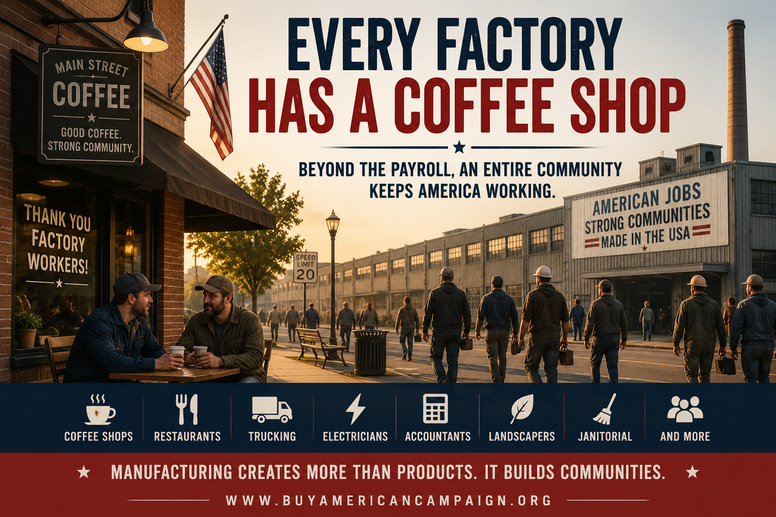
When people think about a factory, they usually picture the people inside it.
The machinists.
The welders.
The forklift drivers.
The engineers.
The people assembling whatever comes off the production line.
They’re right.
But they’re also missing most of the story.
Because every factory has a coffee shop.
Not literally, perhaps. Sometimes it’s a diner. Sometimes it’s a food truck parked across the street. Sometimes it’s the family-owned café that has opened at 5:30 every morning for the last thirty years because the first shift starts at six.
Those businesses don’t appear on the factory payroll.
But they exist because the factory does.
The First Shift Starts Long Before the Factory Does
Drive past a manufacturing plant before sunrise.
The parking lot is filling up.
So is the coffee shop down the road.
The waitress already knows half the customers by name.
The owner knows who takes cream, who drinks it black, and who always grabs an extra breakfast sandwich for the road.
That business wasn’t created by caffeine.
It was created by manufacturing.
One Job Creates Another
Economists have a name for it.
They call it the manufacturing multiplier.
The idea is simple.
A factory doesn’t just employ the people wearing hard hats inside the building. It creates work for countless others who may never set foot on the production floor.
The trucking company hauling steel to the plant.
The local machine shop repairing equipment.
The electrician replacing a failed motor.
The plumber fixing a broken water line.
The accounting firm handling payroll.
The uniform company washing work clothes.
The janitorial crew cleaning the offices.
The landscaper mowing the grounds.
The restaurant serving lunch.
The gas station selling fuel.
The hardware store supplying everything from light bulbs to safety glasses.
One manufacturing job supports many more jobs beyond the factory gates.
That’s why manufacturing has always mattered more than its payroll suggests.

The Day the Parking Lot Empties
When a factory closes, the building usually stays standing.
At first.
The lights go out.
The parking lot empties.
The sign comes down.
From a distance, it looks like one business disappeared.
But that’s not what happened.
The waitress notices fewer breakfast customers.
The trucking company loses a contract.
The electrician gets fewer service calls.
The restaurant cuts back its hours.
The landlord struggles to find new tenants.
The school district collects less in property taxes.
Little League loses a sponsor.
The town doesn’t collapse all at once.
It simply becomes a little quieter.
Then a little emptier.
Then someone wonders why the young people keep leaving.
A Factory Is an Anchor
Manufacturing plants don’t just make products.
They anchor communities.
A factory gives people a reason to buy a home instead of renting.
To coach Little League.
To volunteer at the fire department.
To serve on the school board.
To open a business.
To believe they’ll still be there ten years from now.
That’s how communities are built.
Not overnight.
Over generations.
We Celebrate Ribbon Cuttings. We Forget Everything That Follows.
When a new factory opens, the headlines usually focus on one number.
Five hundred jobs.
One thousand jobs.
Two thousand jobs.
Those numbers matter.
But they’re only the beginning.
Nobody writes the headline six months later:
Local diner hires three more servers.
Or:
Small accounting firm expands because of new manufacturing clients.
Or:
Coffee shop opens a second location near the industrial park.
Those stories don’t make national news.
But together, they’re what economic growth actually looks like.
Buying More Than a Product
Every time you choose an American-made product, you’re doing more than buying what’s in the box.
You’re supporting the truck driver who delivered the raw materials.
The machine operator who shaped them.
The supplier who manufactured the components.
The electrician who keeps the production line running.
The coffee shop owner who unlocks the front door before dawn because the first shift will be stopping in soon.
Most of those people will never know your name.
You’ll probably never know theirs.
But your purchase connects you anyway.
The Coffee Shop Matters Too
It’s easy to look at a factory and see a building.
It’s harder to see the web of businesses and families that depend on it.
Yet that’s where manufacturing leaves its deepest mark.
Not only in the products it makes.
But in the communities it sustains.
People often ask why manufacturing matters.
The answer isn’t only found inside the factory.
Sometimes it’s sitting across the street, pouring coffee at 5:30 in the morning.
Because every factory has a coffee shop.
And every community is stronger when both are busy.
Related reading: Cheap Goods, Expensive Country — what the price tag never shows you.
Whenever possible, choose Made in USA.
| If you like what you see and think this post would be of interest to someone, please share |