Author: Buy American Campaign

  • Stop Telling Young People to Learn a Trade—Show Them a Future

    Stop Telling Young People to Learn a Trade—Show Them a Future

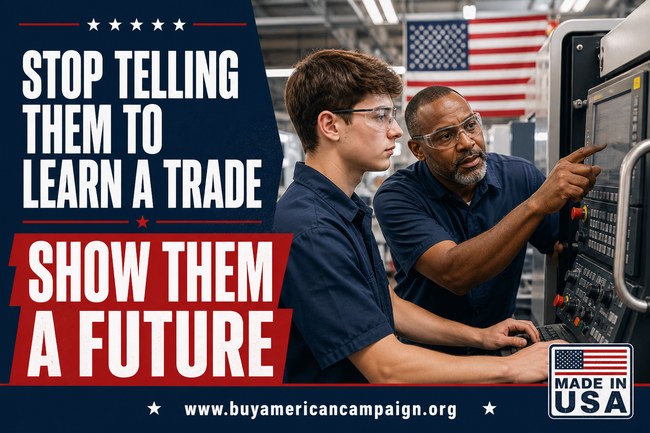
    Young American manufacturing apprentice learning CNC machining from an experienced mentor

    Whenever the manufacturing workforce shortage comes up, someone offers the same solution: young people should learn a trade. The advice is usually delivered as though millions of teenagers simply forgot that factories exist. But if America wants more manufacturing careers for young people, it must do more than lecture them. It must show them a future worth choosing.

    Young Americans did not eliminate high-school shop programs, replace apprenticeships with online applications demanding three years of experience, or allow entry-level wages to fall behind local housing costs. Adults, institutions and employers built that system. Blaming the generation asked to navigate it is convenient, but it does not produce a single machinist.

    The Jobs Are Real, but the Path Is Hard to See

    The need is not imaginary. The Bureau of Labor Statistics projects about 30,400 openings for machinists and tool-and-die makers every year through 2035, largely as experienced workers retire or change occupations. Median 2025 pay was $58,750 for machinists and $64,050 for tool-and-die makers.

    Those occupations make the precision parts, molds and tools behind nearly everything else America hopes to manufacture. Yet ask a typical high-school student how to become a tool-and-die maker, and the answer is far less obvious than the path to a four-year college.

    We Removed the First Rung of the Ladder

    A career becomes believable when a young person can see where it begins. That used to mean a shop class, a summer job, a plant tour, a neighbor who worked at the factory or an employer willing to train a beginner. In too many communities, those points of contact disappeared.

    Then employers began describing a “skills gap” while advertising supposedly entry-level positions that required experience newcomers had no way to acquire. You cannot demand finished workers from a training system nobody is willing to fund.

    Browse American-Made Products

    Manufacturing Careers for Young People Need Proof

    A poster saying “great careers are waiting” is not proof. A paid apprentice standing beside a skilled mentor is proof. A wage schedule showing how competency leads to higher pay is proof. So is a former operator who became a programmer, supervisor or production engineer.

    The National Institute of Standards and Technology describes manufacturing apprenticeships as paid on-the-job learning combined with technical instruction. Its Manufacturing Extension Partnership reports that 91 percent of apprentices remain with the employer that trained them. That is not charity; it is a practical way to build and retain talent.

    Modern Manufacturing Is Not the Career Adults Remember

    Many parents still picture manufacturing as repetitive, dirty work inside a fading plant. Some jobs do remain physically demanding, and employers should be honest about that. But modern machinists also read digital models, program CNC equipment, use computerized measuring systems and work with tolerances smaller than a human hair.

    Automation does not eliminate the need for skill; it changes the skill. Somebody must install the equipment, understand the process, diagnose failures, improve production and decide whether the finished part is right. These careers combine judgment, mathematics, technology and physical results in a way many young people would find deeply satisfying—if they ever saw the work.

    Join the Buy American Movement

    Employers Must Make the Offer Worth Believing

    Respect cannot exist only in recruiting slogans. A manufacturer asking a nineteen-year-old to commit to a difficult craft should offer predictable advancement, useful training, competent supervision and wages that make adult life possible. Loyalty is earned in both directions.

    Companies also need to open their doors. Invite students and parents into clean, operating facilities. Let apprentices explain their work without a public-relations script. Publish the starting wage, the training sequence and what a capable worker can earn after three or five years. Specificity makes a career real.

    Schools Should Restore More Than a Shop Class

    Putting a lathe in a classroom is useful, but the larger goal is to reconnect education with local production. Schools, community colleges and manufacturers should share equipment, instructors and work-based learning opportunities. Students should be able to earn credit, industry credentials and a paycheck along the same path.

    College should remain available to anyone who wants it. But treating every alternative as a consolation prize has harmed students and the country. A young adult who can make a precision aerospace component is not someone who “failed to go to college.” That person possesses a valuable capability America cannot purchase from a motivational speech.

    Stop Scolding and Start Building

    Young people are constantly told to make practical choices. They are watching costs, wages, working conditions and whether an employer appears willing to invest in them. That is practical.

    If America wants the next generation to build aircraft, medical devices, machine tools and energy systems, the invitation must include a visible starting point and a credible destination. Restore the ladder. Pay people while they learn. Show them the technology, the mentors and the lives these careers can support.

    Then we can stop telling young people to learn a trade. They will be able to see the future for themselves.

    Whenever possible, choose Made in USA.

    If you like what you see and think this post would be of interest to someone, please share
  • America Forgot How to Make Things. This 26-Year-Old Founder Is Fixing That.

    America Forgot How to Make Things. This 26-Year-Old Founder Is Fixing That.

    Young American manufacturing founder overseeing a robotic investment casting foundry

    America did not forget how to design aircraft, data centers or advanced energy systems. It forgot how to make many of the unglamorous metal parts that allow those systems to work. At Rangeview’s American foundry in El Segundo, California, 26-year-old founder Cameron Schiller is trying to rebuild that missing capability.

    Rangeview is not creating another app that promises to “disrupt manufacturing.” It is melting metal. Its workers combine investment casting, 3D-printed ceramic molds, robotics and software to produce precision parts for aerospace, defense, energy and advanced technology customers.

    The company’s story is compelling because it begins with something America has spent decades losing: the neighborhood machine shop. Schiller grew up near the former Lockheed Martin Skunk Works in Southern California, surrounded by the remains of an industrial culture that once built astonishing things close to home.

    A Founder Who Wanted to Build Something Physical

    Schiller grew up taking things apart, rebuilding rooms and experimenting with machines. He later won a robotics world championship and studied at the University of California, Berkeley, but the conventional technology path did not hold his attention.

    Rangeview began in a garage in 2020. According to a recent profile by Pirate Wires, the company is now operating inside an aging brick industrial building where molten metal, robotic arms and young engineers share the floor.

    That combination matters. Much of the American technology economy has rewarded people for building software that captures attention or moves information. Rangeview is attracting young technical talent to a harder assignment: moving metal and delivering physical parts.

    Why American Foundries Became a Bottleneck

    Investment casting is an ancient process with modern consequences. Manufacturers form a detailed mold, pour in molten metal and finish the resulting component to precise specifications. The process can create complex turbine, aircraft and industrial parts that are difficult to machine from a solid block.

    Traditional casting often depends on specialized dies and tooling that take months to design, build and qualify. When an older Navy vessel or aircraft needs a replacement part and the original tooling no longer exists, the delay can keep important equipment out of service.

    Browse American-Made Products

    How Rangeview’s American Foundry Works Differently

    Rangeview replaces much of that physical tooling with digital files and 3D-printed ceramic molds. The company says its software-defined process can compress the journey from design to a first finished article from months to weeks.

    Inside the foundry, an ingot is heated to roughly 2,000 degrees and poured by robotic equipment into a custom mold. Automation handles dangerous, repetitive steps while engineers and production workers monitor the process, improve reliability and prepare it for higher-volume manufacturing.

    This is what advanced manufacturing should mean: not a factory without people, but a factory where people use better tools to produce difficult parts safely, consistently and quickly.

    The U.S. Navy Needs Parts That No One Makes Anymore

    In August, Rangeview announced a major U.S. Navy contract to produce maintenance, repair and overhaul replacement parts. The work addresses a basic readiness problem: sophisticated equipment can be sidelined by a relatively small component that has become slow or impossible to source.

    The challenge is larger than one contract. American casting capacity has declined as infrastructure aged, work moved offshore and experienced foundry workers retired without enough younger workers behind them. Rebuilding the capability means preserving knowledge while redesigning the job for a new generation.

    Join the Buy American Movement

    A Factory Can Give a Town More Than Paychecks

    Schiller’s ambition extends beyond a single Southern California facility. He has spoken about building factories across the American plains and becoming part of a real factory town—a place where the company and community grow together.

    That vision is important because manufacturing provides something difficult to measure on a balance sheet. Workers can point to what they made. Families see the plant supporting suppliers, restaurants, schools and skilled careers. A town gains an identity tied to useful work.

    Modern foundries should be cleaner, safer and more technologically capable than the plants of the past. But they can still create the same sense of shared purpose that existed when a community knew exactly what it contributed to the country.

    Reindustrialization Requires Actual Factories

    America has no shortage of manufacturing conferences, strategy papers and software tools. Schiller’s blunt argument is that none of them substitutes for factories that make parts. Reindustrialization ultimately requires furnaces, equipment, materials, trained people and customers willing to place orders.

    Rangeview is still a young company, and scaling a foundry is far more difficult than scaling a website. That is exactly why its effort deserves attention. The country needs founders willing to confront physical constraints instead of treating them as someone else’s problem.

    If Rangeview succeeds, its most important product may not be a particular turbine component or Navy replacement part. It may be proof that a new generation of Americans can learn to make difficult things again—and build communities around that work.

    Whenever possible, choose Made in USA.

    If you like what you see and think this post would be of interest to someone, please share
  • When “Made in USA” Becomes a Reason Not to Buy

    When “Made in USA” Becomes a Reason Not to Buy

    Canadian shopper examining a Made in USA product during a boycott of American products

    The Canadian boycott of American products has turned three familiar words into a warning label for some shoppers: Made in USA. In grocery aisles across Canada, consumers are checking packages, changing brands and sometimes walking away when the only choice is American.

    That should matter to anyone who cares about American manufacturing. The same idea behind the Buy American movement—that ordinary purchases affect real workers—does not stop working when the shopper lives on the other side of the border.

    According to recent reporting by The Guardian, a July Angus Reid survey found that 40 percent of Canadian grocery shoppers were actively checking where products came from. Most of those label-checkers were avoiding U.S. products whenever possible.

    The Canadian Boycott of American Products Is Personal

    This is not simply a government tariff schedule that consumers will never see. Thousands of Canadians have described changing their weekly routines: choosing Canadian-grown food, replacing familiar American brands and reconsidering vacations in the United States.

    The emotional intensity is what makes this different from an ordinary trade dispute. People are using purchases to express frustration with the United States, just as many Americans use purchases to express support for domestic workers.

    Once a household finds a replacement it likes, that lost sale may not return when the headlines fade. Shopping habits harden quickly. Shelf space, distributor relationships and brand loyalty can take years to win back.

    The Label Suddenly Matters

    For decades, many companies treated country-of-origin information like fine print. Now it can determine whether a product reaches the checkout counter. Canadian retailers have responded with shelf labels, signs and displays that make locally produced alternatives easier to identify.

    That is a lesson worth bringing home. American shoppers routinely say they would prefer to support American workers, but locating genuinely domestic products can be unnecessarily difficult. Clear labeling works because it turns a broad economic belief into a decision someone can make in seconds.

    Browse American-Made Products

    American Workers Feel an Overseas Boycott at Home

    Canada is one of the largest customers for American-made goods. When Canadian shoppers stop buying a Wisconsin food product, an Ohio appliance or a Michigan auto part, the economic effect eventually returns to the plant that made it.

    The damage is rarely dramatic enough to appear immediately in a factory announcement. It arrives quietly: a Canadian distributor trims an order, a retailer gives more shelf space to a domestic competitor, or a sales forecast no longer justifies adding a second shift. Those decisions eventually reach machinists, packers, truck drivers and suppliers far from the border.

    Exports help domestic factories run longer production lines, purchase more material and support more jobs than the U.S. market alone might sustain. Losing even a modest share of Canadian demand can be painful for a smaller manufacturer that spent years building distribution there.

    Canada has also announced retaliatory tariffs covering hundreds of American goods, including food, clothing, cosmetics, appliances, paper products and industrial materials. Those duties can make an American product significantly more expensive before a shopper even considers the flag on its package.

    Consumer Patriotism Cuts Both Ways

    There is an uncomfortable truth here: Americans cannot celebrate consumer patriotism at home and dismiss it as meaningless when Canadians practice it. Both movements rest on the same premise. Where people spend their money influences which communities get the work.

    The answer is not to criticize Canadians for checking labels. It is to understand the signal. American manufacturers need competitive products, dependable quality and relationships strong enough to survive political turbulence they did not create.

    Join the Buy American Movement

    What American Manufacturers Can Learn

    First, origin has become part of a product’s identity. Companies should be precise and transparent about what they make in the United States, where the materials come from and how domestic production supports workers.

    Second, manufacturers cannot rely on patriotism alone. A label may earn a first look, but quality, service and value earn the next purchase. The strongest American-made brands give customers practical reasons to remain loyal even when politics changes the mood.

    Finally, the boycott demonstrates how quickly millions of small choices become economic pressure. No single shopper closes a production line. But coordinated demand—or coordinated refusal—can alter inventory decisions throughout a supply chain.

    A Reminder for American Shoppers

    If Canadians can turn country-of-origin checking into a widespread habit, Americans can do the same in support of their own workers. That does not require rejecting every imported product or turning the grocery store into a political battlefield.

    It begins with noticing. Read the label, learn which companies still manufacture here and choose the domestic option when it fits your needs and budget. The Canadian boycott is proof that shoppers are not powerless—and that manufacturers pay attention when enough people make the same choice.

    The larger lesson is not that neighbors must become enemies. It is that consumer trust is valuable, fragile and difficult to rebuild. American companies that employ American workers deserve trade relationships—and informed customers—that recognize what is at stake.

    Whenever possible, choose Made in USA.

    If you like what you see and think this post would be of interest to someone, please share
  • Nobody Ever Says, “I Wish We Still Made Less”

    Nobody Ever Says, “I Wish We Still Made Less”

    A thriving American factory town

    Try a thought experiment.

    Picture a town where a factory just announced it’s hiring 1,000 people.

    The restaurants are packed at lunchtime.
    The coffee shop opens earlier because the first shift starts at six.
    A local contractor hires more workers.
    The hardware store is busier than it’s been in years.
    Young families are buying homes.
    The school is adding classrooms instead of closing them.
    Property values are rising.
    The city is fixing roads instead of postponing repairs.

    Now ask yourself one question.

    Who looks at that town and says, “This is terrible. I wish we still made less.”

    Nobody.

    Because deep down, we already know something we’ve somehow forgotten.

    Manufacturing isn’t nostalgia.
    It’s prosperity.

    We Don’t Celebrate Empty Factories

    People often argue about manufacturing as though it’s some sentimental attachment to the past.

    Old mills.
    Black-and-white photographs.
    Grandpa’s lunchbox.
    Rusty smokestacks.

    But nobody drives past an abandoned factory and thinks,
    “At least imported toasters are cheaper.”

    What they notice is something else.

    The empty parking lot.
    The weeds growing through the pavement.
    The boarded-up storefront across the street.
    The “For Sale” signs that have been there for years.

    Manufacturing isn’t remembered because people are nostalgic.
    It’s remembered because people remember what life was like when the jobs were still there.

    Prosperity Has a Look

    You don’t need an economics degree to recognize a thriving town.
    You know it when you see it.

    The restaurants are full.
    The coffee shop has a line out the door before sunrise.
    Construction crews are building houses instead of demolishing them.
    Kids come back after college because there are careers waiting for them.
    The Little League has enough volunteers.
    The high school doesn’t struggle to keep teachers.
    Main Street has businesses opening instead of closing.

    Nobody describes that place as being “over-industrialized.”
    They call it successful.

    Browse American-Made Products

    Manufacturing Builds Confidence

    There’s something else factories create that never shows up in government statistics.

    Confidence.

    The confidence to buy a home.
    To start a business.
    To raise a family.
    To hire another employee.
    To believe your children might have an even better future than you did.

    Communities don’t thrive because everyone becomes wealthy overnight.
    They thrive because enough people have steady work that they can plan for tomorrow.

    Manufacturing has always been one of the strongest builders of that kind of confidence.

    Every Community Wants One

    Think about the announcements that communities celebrate.

    A new semiconductor plant.
    An aircraft factory.
    A steel mill expanding.
    A battery plant.
    An appliance manufacturer opening another production line.

    Notice what nobody ever celebrates.

    A factory closing.
    A thousand jobs leaving.
    A supplier shutting its doors.
    A community becoming more dependent on products made somewhere else.

    No mayor ever cuts a ribbon for fewer manufacturing jobs.
    No chamber of commerce issues a press release celebrating another empty industrial park.

    When communities compete with one another, what are they trying to attract?

    Factories.

    Not because factories are old-fashioned.
    Because they’re engines of opportunity.

    Join the Buy American Movement

    We Already Know the Answer

    For years we’ve debated whether manufacturing still matters.

    Maybe we’ve been asking the wrong question.

    Instead ask this:

    If a factory announced tomorrow that it was opening in your town, creating 800 good-paying jobs, would anyone complain?

    Would anyone say,
    “I wish they had built it somewhere else.”

    Or would people celebrate?

    Would local businesses prepare for more customers?
    Would young families start looking at houses?
    Would high school graduates think twice before moving away?

    We already know the answer.
    Because we’ve seen it happen.

    More Than What We Make

    Manufacturing isn’t important simply because it produces things.

    It’s important because of what it produces beyond the products.

    Careers.
    Skills.
    Businesses.
    Tax revenue.
    Homeownership.
    Community pride.
    Generational opportunity.

    Those things don’t arrive in shipping containers.
    They grow where people build things together.

    The Question That Answers Itself

    Every time a company announces a new American factory, the headlines are overwhelmingly positive.

    More jobs.
    More investment.
    More opportunity.
    More hope.

    Nobody reads those stories and thinks,
    “This would all be better if we produced less.”

    That’s because manufacturing has never really been about factories.
    It’s about whether a community has the chance to build a future instead of simply consuming one.

    We’ve spent years arguing about where products should be made.
    Perhaps the better question is much simpler.

    If making more things here makes our communities stronger…

    Why would we ever wish to make less?

    Related reading: Every “Made in USA” Label Represents Someone’s Tuesday — the people behind the label.

    Whenever possible, choose Made in USA.

    If you like what you see and think this post would be of interest to someone, please share
  • Every “Made in USA” Label Represents Someone’s Tuesday

    Every “Made in USA” Label Represents Someone’s Tuesday

    An American manufacturing worker on an ordinary Tuesday

    Turn over almost any product in your home.

    Somewhere on the back, in small print, you’ll find a country of origin.

    Most people glance at it for about two seconds.
    Or not at all.

    But every time you see the words “Made in USA,” you’re looking at something much bigger than a manufacturing label.

    You’re looking at somebody’s Tuesday.

    Before You Woke Up

    Long before you picked up that product, somebody else’s day had already begun.

    The lights came on at the factory before sunrise.
    The first shift clocked in.
    Someone unlocked the front door.
    Someone brewed the first pot of coffee.
    Someone started warming up the machines.
    Forklifts began moving pallets across the warehouse floor.
    Delivery trucks backed into loading docks.

    The work had already started hours before you ever saw the finished product.

    The People You’ll Never Meet

    That label isn’t just talking about a factory.
    It’s talking about people.

    The welder making sparks fly across a workbench.
    The machinist holding tolerances measured in thousandths of an inch.
    The woman answering customer service calls.
    The engineer improving next year’s design.
    The maintenance technician fixing a machine before production stops.
    The shipping clerk printing labels.
    The forklift driver loading tomorrow’s deliveries.
    The janitor sweeping the floor after everyone else has gone home.

    Most of them will never appear in an advertisement.
    You’ll never know their names.

    But their fingerprints are on the product you just bought.

    Browse American-Made Products

    Manufacturing Doesn’t Happen by Magic

    Walk into a store and it’s easy to think products simply appear on shelves.

    They don’t.

    Someone designed them.
    Someone sourced the materials.
    Someone cut the steel.
    Someone stitched the fabric.
    Someone molded the plastic.
    Someone inspected the finished product.
    Someone packed it into a box.
    Someone loaded it onto a truck.
    Someone drove that truck across the country.

    Every product is the end of a story that began weeks — or months — earlier.

    The label is simply the last page.

    Ordinary Days Build Extraordinary Things

    There’s nothing glamorous about most manufacturing work.

    It isn’t usually featured in television shows.
    There are no red carpets.
    No standing ovations.

    It’s people showing up.
    Again.
    And again.
    And again.

    Tuesday looks a lot like Monday.
    Wednesday looks a lot like Tuesday.

    Thousands of ordinary workdays eventually become products trusted for generations.

    The Estwing hammer hanging in your garage.
    The Liberty Tabletop flatware on your dinner table.
    The Darn Tough socks in your hiking boots.
    The Lodge skillet your grandchildren will someday cook with.

    Those products weren’t built by extraordinary moments.
    They were built by ordinary Tuesdays.

    Join the Buy American Movement

    The Label Means Someone Got to Stay

    When you choose an American-made product, you’re doing more than supporting a company.

    You’re helping create another Tuesday.

    Another shift.
    Another paycheck.
    Another family dinner paid for by honest work.
    Another mortgage payment made on time.
    Another Little League registration.
    Another college tuition payment.
    Another retirement contribution.

    It’s easy to think of manufacturing as factories.
    It’s really people building lives.

    A Label Worth Looking At

    We’ve trained ourselves to notice price.
    Sometimes we notice the brand.
    Occasionally we notice the warranty.

    Maybe it’s time we spent another second looking at something else.

    That little label.

    Because it isn’t a slogan.
    It isn’t marketing.
    It isn’t politics.

    It’s evidence.

    Evidence that somewhere in America, while most of us were going about our own Tuesday, someone else was welding.
    Or sewing.
    Or machining.
    Or answering phones.
    Or loading trucks.
    Or sweeping the floor before locking the doors for the night.

    They probably never imagined you’d think about them.
    But you should.

    Because every “Made in USA” label represents somebody’s Tuesday.
    And that’s what you’re really bringing home.

    Related reading: Every Factory Has a Coffee Shop — the businesses that exist because a factory does.

    Whenever possible, choose Made in USA.

    If you like what you see and think this post would be of interest to someone, please share
  • Every Factory Has a Coffee Shop

    Every Factory Has a Coffee Shop

    The coffee shop across from an American factory before dawn

    When people think about a factory, they usually picture the people inside it.

    The machinists.
    The welders.
    The forklift drivers.
    The engineers.
    The people assembling whatever comes off the production line.

    They’re right.
    But they’re also missing most of the story.

    Because every factory has a coffee shop.

    Not literally, perhaps. Sometimes it’s a diner. Sometimes it’s a food truck parked across the street. Sometimes it’s the family-owned café that has opened at 5:30 every morning for the last thirty years because the first shift starts at six.

    Those businesses don’t appear on the factory payroll.
    But they exist because the factory does.

    The First Shift Starts Long Before the Factory Does

    Drive past a manufacturing plant before sunrise.

    The parking lot is filling up.
    So is the coffee shop down the road.

    The waitress already knows half the customers by name.
    The owner knows who takes cream, who drinks it black, and who always grabs an extra breakfast sandwich for the road.

    That business wasn’t created by caffeine.
    It was created by manufacturing.

    One Job Creates Another

    Economists have a name for it.
    They call it the manufacturing multiplier.

    The idea is simple.

    A factory doesn’t just employ the people wearing hard hats inside the building. It creates work for countless others who may never set foot on the production floor.

    The trucking company hauling steel to the plant.
    The local machine shop repairing equipment.
    The electrician replacing a failed motor.
    The plumber fixing a broken water line.
    The accounting firm handling payroll.
    The uniform company washing work clothes.
    The janitorial crew cleaning the offices.
    The landscaper mowing the grounds.
    The restaurant serving lunch.
    The gas station selling fuel.
    The hardware store supplying everything from light bulbs to safety glasses.

    One manufacturing job supports many more jobs beyond the factory gates.

    That’s why manufacturing has always mattered more than its payroll suggests.

    Browse American-Made Products

    The Day the Parking Lot Empties

    When a factory closes, the building usually stays standing.
    At first.

    The lights go out.
    The parking lot empties.
    The sign comes down.

    From a distance, it looks like one business disappeared.
    But that’s not what happened.

    The waitress notices fewer breakfast customers.
    The trucking company loses a contract.
    The electrician gets fewer service calls.
    The restaurant cuts back its hours.
    The landlord struggles to find new tenants.
    The school district collects less in property taxes.
    Little League loses a sponsor.

    The town doesn’t collapse all at once.

    It simply becomes a little quieter.
    Then a little emptier.
    Then someone wonders why the young people keep leaving.

    A Factory Is an Anchor

    Manufacturing plants don’t just make products.
    They anchor communities.

    A factory gives people a reason to buy a home instead of renting.
    To coach Little League.
    To volunteer at the fire department.
    To serve on the school board.
    To open a business.
    To believe they’ll still be there ten years from now.

    That’s how communities are built.
    Not overnight.
    Over generations.

    Join the Buy American Movement

    We Celebrate Ribbon Cuttings. We Forget Everything That Follows.

    When a new factory opens, the headlines usually focus on one number.

    Five hundred jobs.
    One thousand jobs.
    Two thousand jobs.

    Those numbers matter.
    But they’re only the beginning.

    Nobody writes the headline six months later:
    Local diner hires three more servers.

    Or:
    Small accounting firm expands because of new manufacturing clients.

    Or:
    Coffee shop opens a second location near the industrial park.

    Those stories don’t make national news.
    But together, they’re what economic growth actually looks like.

    Buying More Than a Product

    Every time you choose an American-made product, you’re doing more than buying what’s in the box.

    You’re supporting the truck driver who delivered the raw materials.
    The machine operator who shaped them.
    The supplier who manufactured the components.
    The electrician who keeps the production line running.
    The coffee shop owner who unlocks the front door before dawn because the first shift will be stopping in soon.

    Most of those people will never know your name.
    You’ll probably never know theirs.

    But your purchase connects you anyway.

    The Coffee Shop Matters Too

    It’s easy to look at a factory and see a building.
    It’s harder to see the web of businesses and families that depend on it.

    Yet that’s where manufacturing leaves its deepest mark.

    Not only in the products it makes.
    But in the communities it sustains.

    People often ask why manufacturing matters.

    The answer isn’t only found inside the factory.
    Sometimes it’s sitting across the street, pouring coffee at 5:30 in the morning.

    Because every factory has a coffee shop.
    And every community is stronger when both are busy.

    Related reading: Cheap Goods, Expensive Country — what the price tag never shows you.

    Whenever possible, choose Made in USA.

    If you like what you see and think this post would be of interest to someone, please share
  • One of America’s Last Aluminum Smelters Is Producing at Full Capacity Again

    One of America’s Last Aluminum Smelters Is Producing at Full Capacity Again

    Molten aluminum production at an American smelter

    When people think about American manufacturing, they usually picture the finished product — a pickup truck, a cast-iron skillet, a can of soda, or an airplane.

    Few people think about the raw materials that make those products possible.

    That is why one announcement from South Carolina deserves far more attention than it has received. Century Aluminum’s Mount Holly smelter is running at full capacity for the first time since 2015, and that single restart is lifting U.S. primary aluminum production by roughly 10 percent.

    Manufacturing does not begin on an assembly line. It begins much earlier — with the materials everything else is built from.

    Why Aluminum Matters

    Aluminum is one of the most important industrial metals in the American economy. It shows up in products Americans use every day:

    • Beverage cans
    • Aluminum foil
    • Cookware
    • Cars and pickup trucks
    • Aircraft
    • Electrical transmission lines
    • Construction materials
    • Boats
    • Military equipment

    Without a reliable domestic supply of primary aluminum, manufacturers become increasingly dependent on imports for the starting material of all of it.

    What Is a Smelter?

    Many people assume aluminum comes straight out of a mine. It does not.

    Bauxite ore has to be refined into alumina first, and the alumina then goes through enormous smelters where electricity separates pure aluminum from oxygen. These plants are among the most energy-intensive industrial facilities in the world.

    They are also extraordinarily expensive to build and very difficult to restart once they have gone cold. That is a large part of why American aluminum-smelting capacity has shrunk so dramatically over the past few decades — and why Mount Holly is now one of only four primary aluminum smelters left operating in the United States.

    A Rare Piece of Good News

    Century Aluminum has brought the idled portion of its Mount Holly plant in Berkeley County, South Carolina back online, returning the facility to 100 percent production for the first time in more than a decade.

    The numbers behind it are concrete. Century invested roughly $50 million in the restart, added about 150 jobs at a plant that now employs more than 600 people, and brought back over 50,000 metric tons of annual capacity. That one restart raises total U.S. primary aluminum output by close to 10 percent.

    U.S. Commerce Secretary Howard Lutnick visited the plant on July 27 to mark the milestone alongside South Carolina officials.

    Browse American-Made Products

    Why This Restart Actually Happened

    It is worth being precise about the cause, because it was not simply a good year for demand.

    Century pointed directly at trade policy. The company titled its own announcement around the benefits of Section 232 tariffs, which were raised to 50 percent on imported aluminum with no exemptions. Those tariffs changed the math on domestic production enough to justify firing the idled potlines back up.

    The second ingredient was electricity. Smelters live or die on power costs, and Mount Holly’s capacity had been constrained for years by its power arrangement. Century and Santee Cooper, the state-owned utility that supplies the plant, extended their contract through 2031 to secure the additional power the restart required. Without that agreement, the tariffs alone would not have been enough.

    The Part That Still Comes From Overseas

    Here is the honest caveat, and it matters if you care about real industrial independence rather than the headline.

    A smelter does not make aluminum out of nothing. It needs alumina, which is refined from bauxite ore — and the United States barely produces either one anymore. American alumina refining capacity has collapsed from nearly 5 million tons in 2000 to roughly 600,000 tons today, concentrated in a single remaining refinery in Gramercy, Louisiana. The country imports more than 75 percent of its bauxite and about 71 percent of its alumina, mostly from Jamaica, Brazil, Guyana, and Australia.

    So Mount Holly running at full tilt is a genuine win for American jobs and American output. It is not yet an American supply chain. The metal is poured here; the raw material largely is not.

    That gap is being worked on. Century has partnered with the startup Brimstone on an effort to build the first domestic mine-to-metal aluminum supply chain, though a full-scale alumina plant is not projected until the 2030s.

    Join the Buy American Movement

    Why Domestic Production Matters

    For a lot of manufacturers, aluminum is not just another commodity line item. It determines whether they have a stable supply during a disruption.

    The past several years have shown how fast global supply chains can seize up — geopolitical conflict, shipping bottlenecks, tariffs, energy shortages. Every ton produced domestically is one more ton an American manufacturer can source without crossing an ocean for it.

    It Is About More Than Beverage Cans

    When people hear aluminum, they think soda cans. The metal does far more work than that.

    The auto industry uses it to cut vehicle weight and improve fuel economy. Aerospace depends on high-strength aluminum alloys. Utilities run aluminum conductors across thousands of miles of transmission line. Defense manufacturers put it in everything from armored vehicles to naval vessels.

    Plenty of the American-made products we feature here — cookware, trailers, tools, outdoor gear — trace back to a healthy domestic aluminum industry whether the buyer realizes it or not.

    Rebuilding Manufacturing Starts at the Beginning

    It is easy to celebrate a new factory that assembles a finished product. It is harder to notice when a raw-material producer quietly restores capacity.

    The second one may matter more. A strong industrial base is not built out of assembly plants alone — it needs steel mills, aluminum smelters, chemical producers, foundries, and the whole unglamorous upstream that feeds them. Without those, even a product assembled in the United States is often made of imported material.

    The Bottom Line

    Mount Holly returning to full production will not solve American aluminum overnight. Four primary smelters is still a thin margin for an economy this size, and the refining side of the industry is thinner still.

    But the direction changed, and it changed for reasons that can be repeated. Every increase in domestic production makes the manufacturing base a little harder to disrupt.

    Sometimes the biggest manufacturing victories are not the products you see on a store shelf. They are the raw materials that make those products possible in the first place.

    Whenever possible, choose Made in USA.

    If you like what you see and think this post would be of interest to someone, please share
  • America Doesn’t Build the Giant Cranes That Keep Our Ports Running

    America Doesn’t Build the Giant Cranes That Keep Our Ports Running

    Giant ship-to-shore container cranes at an American port

    Every day, millions of containers arrive at American ports carrying everything from electronics and clothing to machinery and auto parts. Towering above the ships are the giant cranes that unload them — some of the largest and most complex machines in the world.

    Here is something most Americans do not know: the United States has not built one of these cranes in more than thirty years.

    That reality came into focus again this week when Washington United Terminals in Tacoma awarded a contract for four new cranes to South Korea’s HD Hyundai Samho. The Korean shipbuilder will design, manufacture, transport, install, and commission the equipment as a turnkey project, with delivery scheduled through 2028.

    It is a reminder that while America remains a manufacturing powerhouse in many industries, there are still critical sectors where domestic production has nearly disappeared.

    The Machines That Keep Trade Moving

    Ship-to-shore cranes are engineering marvels. They stand well over 200 feet tall, with booms that reach across the deck of a container ship, and they lift boxes weighing tens of tons with remarkable precision. Modern ports simply cannot operate without them.

    The Tacoma order covers two ship-to-shore quay cranes, which will replace aging units, and two yard cranes that move containers around the terminal. Together they will lift Washington United Terminals’ annual capacity from roughly 590,000 containers to 880,000 and allow the terminal to handle the largest vessels calling on the West Coast.

    When a new crane arrives, it is not just another piece of equipment. It is a decades-long investment in the infrastructure that keeps commerce flowing.

    How America Lost This Industry

    It was not always this way. An American company, PACECO, built the world’s first dedicated ship-to-shore container crane in 1958 and manufactured them in the United States for three decades. Its Gulfport, Mississippi plant closed in 1989. That was the end of domestic production.

    Into that gap stepped China’s state-owned Shanghai Zhenhua Heavy Industries, better known as ZPMC. Today ZPMC holds roughly 70 percent of the global container crane market, and federal estimates put its share of the ship-to-shore cranes operating at U.S. ports at close to 80 percent.

    That dominance did not happen overnight. As American heavy manufacturing declined and Chinese production expanded, U.S. ports bought imported cranes because there were almost no domestic alternatives left to buy.

    Browse American-Made Products

    Why Port Cranes Became a National Security Concern

    In recent years, those purchases became more than an economic question. Modern cranes can be monitored, serviced, and reprogrammed remotely, and federal officials warned that the software and networking built into foreign-made equipment could expose critical infrastructure to interference.

    The response has been substantial. An executive order directed action on maritime cyber threats. The U.S. Coast Guard issued Maritime Security Directive 105-4, requiring operators of Chinese-built ship-to-shore cranes to take specific cyber risk management steps. And federal trade officials imposed tariffs of 100 percent on Chinese ship-to-shore cranes and certain cargo handling equipment.

    But closing the door on one foreign supplier is not the same thing as rebuilding an American industry.

    The Tacoma Order Shows the Gap

    The Tacoma contract illustrates the challenge precisely. With Chinese cranes effectively priced out, the work did not go to an American manufacturer. It went to South Korea.

    There is another detail worth noting. Washington United Terminals is the U.S. arm of HMM, South Korea’s largest shipping line, and four of the eight quay cranes already standing at its Tacoma berth were also built by HD Hyundai Samho — back in 1999. This capability did not slip away last year. It has been gone for a very long time.

    South Korea is one of the few countries left with the industrial base to compete for work this specialized, which is exactly why American ports looking for alternatives keep landing there.

    Join the Buy American Movement

    America Is Trying to Rebuild This Industry — It Is Not There Yet

    The encouraging part of this story is that the effort is real and underway.

    PACECO — the same company that invented the machine in 1958 — announced plans to restart ship-to-shore crane manufacturing in the United States after a thirty-year pause. Konecranes has partnered with American steel suppliers to build up domestic port crane capacity. Federal policy has put real money and real tariffs behind the goal.

    But announcements and finished cranes are two different things. When PACECO won an order in September 2025 for two large Portainer cranes bound for the Port of Long Beach, the machines were built in Japan, using American-made components, and shipped here. The domestic restart has been announced. It has not yet produced an American-built crane.

    That gap between the announcement and the first machine off the line is the honest state of this industry right now.

    Rebuilding an Industry Takes More Than a Factory

    Most conversations about American manufacturing focus on things consumers buy — cars, appliances, clothing, tools. Heavy industrial equipment rarely gets the same attention, even though it is the equipment everything else depends on.

    An industry like this one requires an entire ecosystem: heavy steel fabrication, precision machining, industrial electrical systems, advanced controls and automation, specialized engineering, skilled welders and fabricators, and assembly facilities big enough to build a structure taller than a twenty-story building.

    Once that industrial base disappears, rebuilding it is not as simple as opening a new plant. It takes years of investment, trained workers, a supplier network, and customers willing to place the first orders before the track record exists.

    The Bottom Line

    The Tacoma crane contract is not bad news. South Korea is a trusted ally with world-class manufacturing, the terminal needed the upgrade, and modernizing American ports is essential work.

    But the project points at something larger. America is strengthening domestic manufacturing across many sectors, and in plenty of them that effort is producing new factories and new jobs. In others — like the giant cranes that unload our own imports — the country is still working its way back.

    That is the difference between buying American products and rebuilding American industrial capability. One you can do this afternoon. The other takes a decade and a lot of people deciding it matters.

    Sometimes the biggest manufacturing stories are not about what we make. They are about what we no longer can — and what it will take to change that.

    Whenever possible, choose Made in USA.

    If you like what you see and think this post would be of interest to someone, please share
  • The Best American-Made Flashlights: Maglite, Streamlight & Pelican

    The Best American-Made Flashlights: Maglite, Streamlight & Pelican

    American-made flashlights from Maglite, Streamlight and PelicanA flashlight is one of the few things you buy hoping you rarely need it — and then, when the power goes out or the truck breaks down on a dark shoulder, it becomes the most important object you own. That is exactly why it is worth buying one built by people who put their name on it.

    The good news is that the flashlight aisle is one of the last consumer categories where American manufacturing never really left. While most of the world’s lights are assembled overseas from interchangeable parts, three companies still run real factories on American soil — one machining aluminum in Southern California, one running a quarter-million square feet in suburban Philadelphia, one molding cases and building lights in California and Massachusetts.

    If you are searching for the best made in USA flashlight, this guide covers the three brands we can actually verify, what each one does best, and who each one is for. We are not ranking lumens for sport — we are ranking companies by what they build, where they build it, and how honest they are about it.

    Honesty matters: not one of these three is 100% American across every SKU. Batteries, bulbs, and electronics move around the globe no matter whose name is on the barrel, and two of these companies openly sell imported lines alongside their domestic ones. We tell you which is which below rather than pretending the gray areas do not exist.

    Best Overall American-Made Flashlight: Maglite

    Maglite is the closest thing this category has to a sure thing. Mag Instrument has machined its flashlights in Ontario, California since Anthony “Tony” Maglica — the son of Croatian immigrants — started the company in 1955 with a single lathe in a small machine shop. The flashlight that made the name famous arrived in 1979, and more than four decades later the whole line is still cut from solid aircraft-grade aluminum in that same Southern California plant, by more than 800 American workers.

    What separates Maglite from companies that merely finish a product here is vertical integration. Machining, anodizing, and assembly all happen under one roof, and Maglica insisted from the beginning that components be procured domestically rather than shipped in and screwed together. That is a much higher bar than “assembled in USA,” and it is the reason a twenty-year-old Maglite still takes new cells and works.

    The modern lineup has moved well past the incandescent D-cell everyone remembers. The ML300L series delivers real LED output with the same adjustable spot-to-flood twist head, and the Mini Pro and XL models put the same machining quality in a pocketable body. You can browse the current Maglite flashlights in the Buy American Store and see the range for yourself.

    Best For

    • Buyers who want the strongest made-in-USA claim in the category, with no per-model homework
    • Household, glovebox, and emergency-kit lights that will sit unused for years and still work
    • Anyone who values a machined aluminum body and a repairable, serviceable design
    • Gift buying, where “made in California since 1979” is part of the point

    Honest Drawback

    Maglite is not chasing the spec sheet. Tactical brands will sell you more lumens and more programmable modes for the same money, and the classic D-cell bodies are heavy by modern standards. As with any flashlight, consumable parts like batteries and bulbs may be sourced elsewhere — what is American-made is the light itself.

    Best for Work and Duty Use: Streamlight

    Streamlight came out of early-1970s engineering work tied to NASA’s space program, where a team built what was then called a handheld “super flashlight.” The company was formally founded in 1973 and put down roots in Eagleville, Pennsylvania, where it still owns and operates a 240,000-square-foot plant employing more than 350 people.

    Fifty years later, Streamlight is what firefighters, electricians, mechanics, and police officers actually carry. The ProTac series is the workhorse — genuinely bright, USB-rechargeable in most current versions, and built around a clicky tail switch and programmable modes that you can set once and forget. The Survivor line is purpose-built for firefighters, with a right-angle body that clips to turnout gear. These are tools bought by people whose job depends on them working.

    If you want output and features without leaving American manufacturing entirely behind, the Streamlight work lights in the Buy American Store are where this guide’s value-per-dollar lives.

    Best For

    • Trades, first responders, and anyone who needs a light to survive a job site
    • Buyers who want high lumen output and rechargeable convenience
    • Weapon-mounted and helmet-mounted lighting
    • People willing to check a fact sheet in exchange for more capability per dollar

    Honest Drawback

    Streamlight is mixed-origin, and we say so plainly. Many lights are assembled in the USA at Eagleville — some with imported parts — while a portion of production is sourced overseas, including from China. Origin varies by SKU. Streamlight does publish the answer: each product’s fact sheet, under the Documentation tab on streamlight.com, discloses that model’s specific origin. Check it before you buy if domestic content is your priority.

    Browse American-Made Products

    Best Light-and-Case System: Pelican

    Pelican was started in 1976 by David and Arline Parker, and it is the rare American company that got famous for the box rather than what goes in it. Its crushproof Protector, Air, Vault, and Storm cases — plus the Elite hard coolers — are made in the USA at company-owned plants in Torrance, California and South Deerfield, Massachusetts, and MIL-SPEC tested on site.

    The lighting side grew out of the same obsession with sealed, abuse-proof housings. Pelican’s 7000 and 7600 tactical lights and the little 1920 pen light are built to the same submersible, drop-tested standard as the cases, which is why you find them in dive bags, utility trucks, and industrial safety kits rather than in the checkout-lane bin. The 3310 emergency light with photoluminescent housing is a genuinely smart piece of design — you can find it in the dark because the shell glows.

    Where Pelican earns its place here is as a system: the light, the case that protects the rest of your kit, and a lifetime guarantee of excellence behind both. Browse the Pelican lights and protective cases in the Buy American Store.

    Best For

    • Wet, dirty, and industrial environments where a light gets dropped and submerged
    • Photographers, divers, and field crews already buying Pelican cases
    • Emergency and safety kits, where the photoluminescent 3310 shines — literally
    • Buyers who want a crushproof, US-made case to go with the light

    Honest Drawback

    This is the caveat to read twice. Pelican’s verified American manufacturing covers the hard cases and Elite coolers built in Torrance and South Deerfield. Not every Pelican product is US-made — phone cases, soft goods, and some accessories are imported, and the lighting line is not blanket-verified the way the cases are. Buy Pelican for the case with total confidence; for a specific flashlight model, confirm that model’s origin before you check out.

    Featured Flashlights

    One representative light from each brand, with its origin labeled honestly rather than uniformly.

    Which Flashlight Is Right for You?

    BrandBest ForCompany ProfileShop
    MagliteThe strongest made-in-USA claim; household, truck, and emergency lights built to outlive youView ProfileShop Products
    StreamlightTrades and first responders who need maximum output and rechargeable convenienceView ProfileShop Products
    PelicanWet, rough, industrial use — and a crushproof American-made case to carry it inView ProfileShop Products

    Join the Buy American Movement

    Build an American-Made Light Kit

    Most households do not need one perfect flashlight. They need three decent ones in the right places, because the light you cannot reach in the dark is worth nothing. Think in terms of stations rather than a single purchase.

    • The house light — a Maglite ML300L D-cell by the breaker panel or under the sink. Long runtime, no charging to forget.
    • The pocket light — a Maglite Mini Pro or a compact Streamlight ProTac that lives in a bag, a jacket, or a work belt.
    • The truck light — a rechargeable Streamlight ProTac HL-X, mounted where you can find it by feel.
    • The go-bag — a Pelican 3310 emergency light in a Pelican case with your documents, batteries, and first-aid kit.

    Built out that way, a kit from these three companies represents about 150 years of combined American manufacturing — 1955 in Ontario, California; 1973 in Eagleville, Pennsylvania; 1976 in Torrance, California. Three factories, still running, still hiring, still stamping out parts on this side of the ocean. That is what your money is voting for.

    Ready to Buy American-Made Lighting?

    Browse every flashlight and work light we’ve found from American manufacturers, in one place.

    Shop All American-Made Flashlights →

    Explore the brand profiles: Maglite · Streamlight · Pelican

    The Bottom Line

    If you want one flashlight and you want zero homework, buy the Maglite — it is machined in California from American parts, and it has been for four decades. If you need serious output for work, buy the Streamlight and take ninety seconds to check the model’s fact sheet. If your gear lives in the mud and the rain, buy Pelican for the case and choose the light with your eyes open. All three keep Americans employed making things, which is more than almost anything else on that shelf can claim.

    Whenever possible, choose Made in USA.

    If you like what you see and think this post would be of interest to someone, please share
  • Cheap Goods, Expensive Country

    Cheap Goods, Expensive Country

    American-made work boots and the true cost of cheap goods

    The work boots cost $60 instead of $150.
    The savings are real. You can hold them in your hand.

    The boots that cost $150 were handcrafted in Merrill, Wisconsin. The $60 pair came from the other side of the world. One might save you money today. The other helps ensure someone still has a job making boots tomorrow.

    There’s another difference the price tag doesn’t mention. Many inexpensive imported work boots are difficult or uneconomical to repair, while American-made boots like Thorogood’s Goodyear-welted models can often be resoled and kept in service for years.
    One was built for the next season.
    The other was built for the next generation.

    But there is another bill attached to those boots. You just don’t receive it at the checkout.

    It arrives in a town you’ve never visited, where the factory closed twenty years ago. It shows up in the empty storefront on Main Street, the school that stopped replacing retiring teachers, the diner that no longer serves lunch because the second shift disappeared, and the young people who had to leave because there were no good jobs left to stay for.

    For forty years, we’ve become very good at counting one side of that ledger.
    We’ve almost stopped counting the other.

    The Case for Cheap Imports Is Real

    Before going any further, it’s worth acknowledging something that too often gets ignored.

    The argument for cheap imports is not foolish.

    When manufacturing moved overseas, millions of products became less expensive. Clothes, electronics, furniture, appliances, toys, tools — you name it. Economists have long noted that lower-income families often benefit the most from lower prices because they spend a larger share of their income on everyday goods.

    That’s real.

    If you’re raising a family on a tight budget, saving ninety dollars on a pair of work boots matters.
    No honest conversation should pretend otherwise.

    But that’s only one side of the equation.

    The question isn’t whether the savings exist.
    The question is whether they’re the whole story.

    What the Price Tag Doesn’t Include

    Imagine a factory employing 800 people.

    Most people picture the workers inside the building.
    What they don’t picture are the businesses that depend on those workers.

    The coffee shop where they stop every morning.
    The mechanic who services their trucks.
    The restaurant where they eat lunch.
    The local accounting firm.
    The electrician.
    The machine shop supplying replacement parts.
    The hardware store.
    The barber.
    The dentist.

    Economists call this the manufacturing multiplier. Every manufacturing job supports additional jobs throughout the surrounding community. Researchers debate the exact number, but they agree on the basic point: manufacturing creates far more economic activity than the payroll inside the factory gates.

    When the factory closes, those businesses don’t all disappear overnight.

    They simply become a little quieter.
    Then a little emptier.
    Then one day someone notices another “For Lease” sign in the window.

    A Factory Is More Than Jobs

    Factories don’t just pay workers.

    They pay property taxes.
    They sponsor Little League teams.
    They donate to local charities.
    They support volunteer fire departments.
    Their employees coach youth sports, serve on school boards, attend church, and shop at local businesses.

    A manufacturing plant becomes part of the civic infrastructure of a town.

    Take it away, and the community doesn’t simply lose jobs.
    It loses stability.

    You can’t replace that with a cheaper pair of boots.

    Browse American-Made Products

    The Communities That Never Came Back

    For decades, economists assumed displaced manufacturing workers would simply retrain, relocate, and find better opportunities.

    Many did.
    Many didn’t.

    Research into what became known as the “China Shock” found that communities hit hardest by import competition often struggled for years afterward. Employment fell. Labor-force participation declined. Businesses closed. Population shrank.

    The adjustment that economic theory predicted would be temporary often became permanent.

    Some towns recovered.
    Many never fully did.

    That doesn’t mean trade is bad.
    It means the costs were far greater — and lasted far longer — than many people expected.

    The Things That Didn’t Get Cheaper

    There’s another part of this conversation that rarely gets mentioned.

    Many of the biggest household expenses didn’t become dramatically cheaper because manufacturing moved overseas.

    Housing.
    Healthcare.
    Education.
    Insurance.
    Energy.

    Those continue to consume a growing share of the average family’s income.

    Yes, the television costs less than it did twenty-five years ago.
    The mortgage doesn’t.

    The washing machine might be cheaper.
    College isn’t.

    The savings were real.
    They just weren’t enough to offset everything else.

    Join the Buy American Movement

    We Counted the Savings

    Imagine a family that saves ninety dollars buying imported work boots.

    Good.
    That’s ninety dollars they can spend somewhere else.

    Now imagine another family whose primary wage earner loses a manufacturing job that paid enough to buy a home, raise children, and retire with dignity.

    Those two numbers do not belong in separate conversations.
    They belong on the same ledger.

    One is visible.
    One is hidden.

    We’ve spent decades celebrating the first while treating the second as somebody else’s problem.

    This Isn’t an Argument Against Trade

    America doesn’t need to manufacture everything.
    No serious person argues that.

    Trade has existed for thousands of years and always will.

    Nor is this an argument against other countries succeeding.
    Every nation wants good jobs for its people.
    So do we.

    The real question is whether we’ve become too willing to measure success only by what happens at the cash register.

    A country isn’t just a marketplace.
    It’s also a place where people need opportunities to build careers, support families, and contribute to their communities.

    Those things don’t appear on receipts.
    They’re no less valuable because of it.

    The Full Ledger

    When an American-made product costs a little more, the difference isn’t simply disappearing.

    Part of it pays the machinist.
    Part of it pays the welder.
    Part of it pays the engineer.
    Part of it supports the supplier across town.
    Part of it helps fund the local school, the roads, and the fire department.
    Part of it keeps another American town alive.

    That doesn’t mean every imported product is the wrong choice.
    It simply means the price tag isn’t the whole story.

    For decades, we’ve carefully counted the savings.
    Maybe it’s time we counted what those savings cost.

    Because the cheapest country to buy from isn’t necessarily the cheapest country to become.

    And that’s the number that matters most.

    Related reading: The Cheapest Thing You Buy Is Often the Most Expensive — the same argument, measured at the kitchen table instead of the country.

    Whenever possible, choose Made in USA.

    If you like what you see and think this post would be of interest to someone, please share