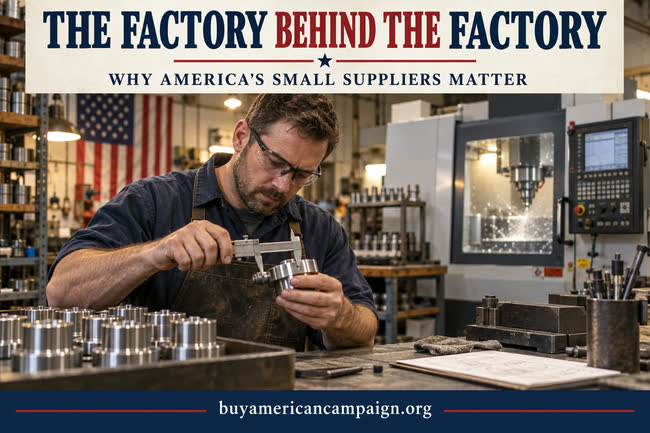
A factory can fill the skyline, but the part that keeps it running may come from a shop small enough to miss from the highway. That is the side of American manufacturing we rarely see: a machinist measuring a component, a toolmaker correcting a worn fixture, or a fabricator solving a problem before the next shift begins. Small American manufacturers are often the factory behind the factory.
When a major company announces a new plant, the cameras focus on the building and the jobs inside it. Fair enough. But a production line also depends on components, tooling, maintenance, packaging, and specialized knowledge. Some of those capabilities are supplied by other U.S. businesses. If we want the headline factory to endure, we should care about the network that helps it deliver.
Small American Manufacturers Are Part of the Product
Picture a metal part that must fit within a tight tolerance. A large manufacturer may design the finished product, but a smaller shop might machine that part, inspect it, and adjust the process after a test run. Another business could build the fixture that holds it in place. Still another might supply a coating or specialized container. The consumer sees one product; the work behind it crosses several doors.
Those businesses are not interchangeable names on a spreadsheet. A supplier learns how a customer’s equipment behaves, which measurements matter, and how to respond when a drawing changes. The relationship is built through trial runs, corrections, deadlines, and trust. A purchase order can move quickly. Recreating the experience behind it usually cannot.
A Real Example of the Network at Work
Consider Netzer Metalworks in Maryland. The company works in sheet-metal fabrication, CNC machining, finishing, welding, and assembly. When it needed qualified suppliers for a prototype effort, Maryland’s Manufacturing Extension Partnership helped it use a supplier marketplace and make direct introductions. According to a NIST account of the project, Netzer connected with eight potential suppliers within one week.
Potential is the important word. Eight introductions are not eight signed contracts, and the story does not prove that every need can be met nearby. It does show what industrial capacity looks like in practice: a manufacturer identifies a specific capability gap, people who know the region help search for a fit, and businesses begin the work of testing whether they can build together.
The Hidden Value of Being Able to Find Each Other
The federal Manufacturing Extension Partnership runs a supplier-scouting service to identify U.S. manufacturers with particular technical and production capabilities and connect them with prospective customers. Its existence makes a simple point: domestic capacity is useful only if buyers can discover it, verify that it fits the job, and place real orders.
That discovery takes more than a “Made in USA” wish. A buyer may need a certain material, volume, tolerance, certification, or delivery schedule. A small shop may be excellent at one of those things and unable to meet another. Honest matching is stronger than vague promises that any American shop can make anything tomorrow.
Why Capacity Takes Time to Rebuild
A machine can be purchased. A capable shop is harder to assemble. It needs workers who understand the process, supervisors who can teach, reliable equipment, quality checks, and customers willing to keep ordering while the business improves. When an order stream disappears, those people and habits may scatter. Rebuilding them later costs more than finding an empty floor and plugging in a machine.
That is why a big plant investment should prompt a second question: what happens beyond the plant gate? Are domestic suppliers being considered for work they can actually perform? Can smaller firms get the information and time needed to qualify? Is there a path for apprentices to learn the less visible trades—machining, tooling, maintenance, and inspection—that keep production dependable?
What a Customer Can—and Cannot—Do
Consumers do not choose a factory’s entire supply chain. An American-made final product can contain imported inputs, and a familiar American brand can sell products made elsewhere. We should not blur those distinctions. But when a manufacturer can substantiate where a product is made, choosing that product helps create demand for production here. Sustained demand gives manufacturers a reason to maintain skills, equipment, and supplier relationships.
The practical step is to ask better questions. Check the origin of the specific product, not just the brand’s address. Look for clear manufacturing-location information. When it is missing, ask the company. A credible answer is more valuable than a flag printed on a package. No single purchase rebuilds an industrial base, but repeated, informed demand matters to the businesses deciding where to invest.
Notice the Factory Behind the Factory
We should celebrate the ribbon cutting at a major plant. We should also notice the small shop that makes a difficult part correctly, the supplier that earns another customer’s trust, and the worker who teaches someone else how to hold a tolerance. American manufacturing is not one building. It is a set of capabilities that people build together and keep alive through real work.
The next time a factory announcement makes the news, look beyond the gate. Ask who will supply it, who will repair its tools, and whether smaller American manufacturers will have a fair chance to contribute. That is how a headline investment becomes a durable manufacturing future.
Whenever possible, choose Made in USA.
| If you like what you see and think this post would be of interest to someone, please share |