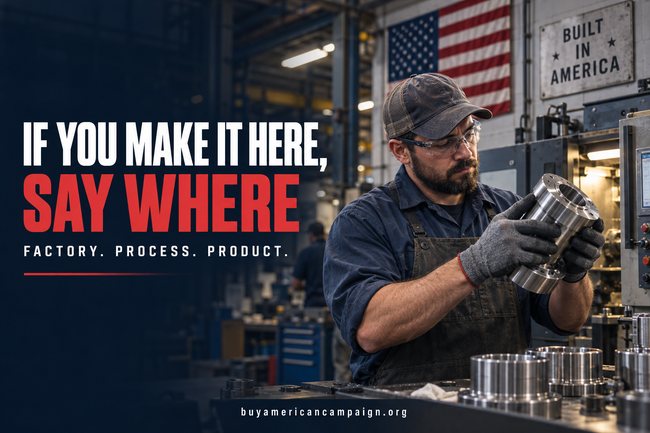
American manufacturers often ask shoppers to care where products are made. That is a fair request. But if companies want customers to choose domestic production, they must make American manufacturing transparency easy: name the factory, describe the work, identify the product, and explain any limits on the claim.
A flag beside a product photo is not enough. Neither is an American-sounding brand name, a headquarters address, or a sentence about being “proudly based” in the United States. Those details may be true, but they do not answer the shopper’s actual question: where was this particular thing made?
The Factory Should Not Be a Secret
When a company manufactures in America, the factory is part of the product’s value. A buyer should be able to learn whether a skillet was poured in Tennessee, a pair of socks was knitted in Vermont, or a tool was forged in Illinois without opening six browser tabs and studying the fine print.
The best manufacturers are wonderfully specific. They show the building, name the town, explain the process, and introduce the people who do the work. That information does more than decorate an About page. It gives customers something concrete to support and something competitors cannot easily imitate.
An American Company Is Not Automatically an American-Made Product
Many familiar brands are headquartered in the United States while manufacturing some or all of their products elsewhere. Other companies operate American factories but also sell imported lines. Neither arrangement should be hidden behind a general corporate story.
The Federal Trade Commission says an unqualified Made in USA claim means a product is “all or virtually all” made domestically. Final assembly and all significant processing must occur here, and foreign content must be negligible. The FTC also warns companies not to imply that an entire product line is American-made when only some products qualify.
Good American Manufacturing Transparency Is Product-Level
A company does not need to publish a technical dossier for every item. It does need a clear origin statement where people shop. “Made in USA” is useful when the product meets that standard. “Assembled in Ohio with domestic and imported components” is useful when that is the honest description. “Designed in California” may describe valuable American work, but it should never be presented as a substitute for manufacturing origin.
Specificity is not a weakness. A qualified claim can be more credible than an exaggerated one because it respects the customer’s intelligence. Tell us which models are domestic, which process happens here, and where the exceptions begin. If sourcing changes, update the page instead of leaving yesterday’s claim attached to today’s product.
Show the Work, Not Just the Flag
American manufacturing has stories worth telling: machinists holding tight tolerances, sewers turning rolls of fabric into finished gear, mold technicians keeping production lines running, and quality inspectors catching problems before a product ships. Those stories make the origin claim understandable.
They also make the claim accountable. A company that identifies its plant and process gives customers, journalists, retailers, and employees a factual statement that can be checked. That is healthier than marketing built from stock factory footage, patriotic colors, and careful wording that never quite says where the product was made.
Retailers Should Make Origin Searchable
Manufacturers are not the only ones responsible. Retailers routinely let shoppers filter by color, size, rating, delivery date, and dozens of minor features while burying country of origin in inconsistent product descriptions. If origin information matters enough to appear on packaging, it matters enough to become a structured, searchable field online.
That change would reward honest companies. A manufacturer investing in domestic workers, equipment, and suppliers should not be placed in the same search bucket as a seller that adds a flag to an imported product. Clear filters would allow the market to see whether shoppers truly value American production—and allow shoppers to act on that preference without turning every purchase into detective work.
Trust Is a Competitive Advantage
Some companies may hesitate to be specific because their supply chains are complicated. That is exactly why specificity matters. Complexity is understandable; vagueness is frustrating. Customers can accept that a domestic product contains an imported zipper, electronic component, or raw material when the company explains the limitation plainly.
Trust grows when a claim survives inspection. It grows when the product page matches the packaging, the factory story matches the actual model, and customer service can answer a direct origin question without retreating into slogans. In a crowded market, that kind of credibility is not merely compliance. It is an advantage.
If You Make It Here, Say Where
American manufacturing should be visible at the moment a customer decides what to buy. Name the town. Show the factory. Explain the process. Identify the qualifying products. State imported content honestly. Give people enough information to choose with confidence.
Companies that really make things here have earned the right to say so. They should not whisper it in a buried FAQ, and they should not dilute it with vague claims that anyone can copy. The strongest Made in USA message is also the simplest: this product, made by these people, in this place.
Source: Federal Trade Commission, Complying with the Made in USA Standard.
Whenever possible, choose Made in USA.
| If you like what you see and think this post would be of interest to someone, please share |