Tag: Buy American

  • If You Make It Here, Say Where

    If You Make It Here, Say Where

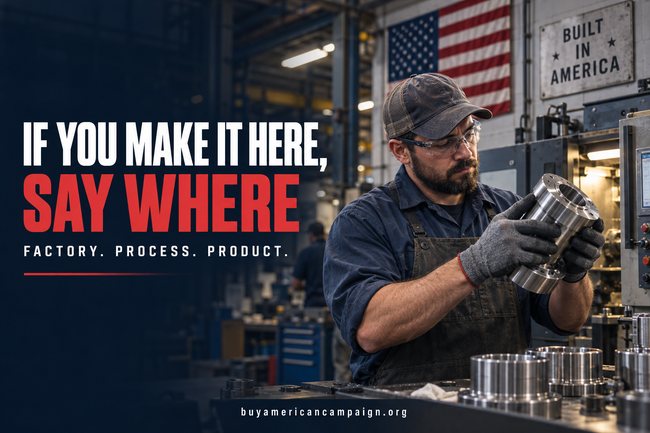
    American machinist inspecting a component in a U.S. factory for an article about American manufacturing transparency

    American manufacturers often ask shoppers to care where products are made. That is a fair request. But if companies want customers to choose domestic production, they must make American manufacturing transparency easy: name the factory, describe the work, identify the product, and explain any limits on the claim.

    A flag beside a product photo is not enough. Neither is an American-sounding brand name, a headquarters address, or a sentence about being “proudly based” in the United States. Those details may be true, but they do not answer the shopper’s actual question: where was this particular thing made?

    The Factory Should Not Be a Secret

    When a company manufactures in America, the factory is part of the product’s value. A buyer should be able to learn whether a skillet was poured in Tennessee, a pair of socks was knitted in Vermont, or a tool was forged in Illinois without opening six browser tabs and studying the fine print.

    The best manufacturers are wonderfully specific. They show the building, name the town, explain the process, and introduce the people who do the work. That information does more than decorate an About page. It gives customers something concrete to support and something competitors cannot easily imitate.

    An American Company Is Not Automatically an American-Made Product

    Many familiar brands are headquartered in the United States while manufacturing some or all of their products elsewhere. Other companies operate American factories but also sell imported lines. Neither arrangement should be hidden behind a general corporate story.

    The Federal Trade Commission says an unqualified Made in USA claim means a product is “all or virtually all” made domestically. Final assembly and all significant processing must occur here, and foreign content must be negligible. The FTC also warns companies not to imply that an entire product line is American-made when only some products qualify.

    Browse American-Made Products

    Good American Manufacturing Transparency Is Product-Level

    A company does not need to publish a technical dossier for every item. It does need a clear origin statement where people shop. “Made in USA” is useful when the product meets that standard. “Assembled in Ohio with domestic and imported components” is useful when that is the honest description. “Designed in California” may describe valuable American work, but it should never be presented as a substitute for manufacturing origin.

    Specificity is not a weakness. A qualified claim can be more credible than an exaggerated one because it respects the customer’s intelligence. Tell us which models are domestic, which process happens here, and where the exceptions begin. If sourcing changes, update the page instead of leaving yesterday’s claim attached to today’s product.

    Show the Work, Not Just the Flag

    American manufacturing has stories worth telling: machinists holding tight tolerances, sewers turning rolls of fabric into finished gear, mold technicians keeping production lines running, and quality inspectors catching problems before a product ships. Those stories make the origin claim understandable.

    They also make the claim accountable. A company that identifies its plant and process gives customers, journalists, retailers, and employees a factual statement that can be checked. That is healthier than marketing built from stock factory footage, patriotic colors, and careful wording that never quite says where the product was made.

    Join the Buy American Movement

    Retailers Should Make Origin Searchable

    Manufacturers are not the only ones responsible. Retailers routinely let shoppers filter by color, size, rating, delivery date, and dozens of minor features while burying country of origin in inconsistent product descriptions. If origin information matters enough to appear on packaging, it matters enough to become a structured, searchable field online.

    That change would reward honest companies. A manufacturer investing in domestic workers, equipment, and suppliers should not be placed in the same search bucket as a seller that adds a flag to an imported product. Clear filters would allow the market to see whether shoppers truly value American production—and allow shoppers to act on that preference without turning every purchase into detective work.

    Trust Is a Competitive Advantage

    Some companies may hesitate to be specific because their supply chains are complicated. That is exactly why specificity matters. Complexity is understandable; vagueness is frustrating. Customers can accept that a domestic product contains an imported zipper, electronic component, or raw material when the company explains the limitation plainly.

    Trust grows when a claim survives inspection. It grows when the product page matches the packaging, the factory story matches the actual model, and customer service can answer a direct origin question without retreating into slogans. In a crowded market, that kind of credibility is not merely compliance. It is an advantage.

    If You Make It Here, Say Where

    American manufacturing should be visible at the moment a customer decides what to buy. Name the town. Show the factory. Explain the process. Identify the qualifying products. State imported content honestly. Give people enough information to choose with confidence.

    Companies that really make things here have earned the right to say so. They should not whisper it in a buried FAQ, and they should not dilute it with vague claims that anyone can copy. The strongest Made in USA message is also the simplest: this product, made by these people, in this place.

    Source: Federal Trade Commission, Complying with the Made in USA Standard.

    Whenever possible, choose Made in USA.

    If you like what you see and think this post would be of interest to someone, please share
  • America Added 16,000 Manufacturing Jobs. Let’s Keep It Going.

    America Added 16,000 Manufacturing Jobs. Let’s Keep It Going.

    American manufacturing workers on a modern factory floor representing growth in U.S. manufacturing jobs

    Good economic news can feel abstract until it reaches a factory floor. In August, it did. The U.S. Bureau of Labor Statistics reported that manufacturing employment increased by 16,000 jobs during the month and stood 58,000 jobs above its recent low in December 2025. Those are paychecks, apprenticeships, production lines, and families with a little more certainty.

    One encouraging report does not erase decades of lost capacity, and it does not guarantee that the trend will continue. But the increase in American manufacturing jobs is worth recognizing—and worth reinforcing through the choices companies, governments, and consumers make next.

    The Growth Reached the Industries That Build Things

    The August gains were not confined to a statistical catchall. Machinery manufacturing added approximately 6,000 jobs, and fabricated-metal-products manufacturing added another 6,000. These are industries that make the equipment, structures, components, and tools that allow the rest of the economy to function.

    The Institute for Supply Management offered another encouraging signal. Its Manufacturing PMI registered 54.6% in August, marking an eighth consecutive month of expansion. New orders, production, and employment were all growing, although at a slower rate than in July. Twelve of the eighteen manufacturing industries surveyed reported production growth.

    One Factory Job Reaches Far Beyond the Factory

    A manufacturing job does not exist alone. A factory purchases materials, machinery, maintenance, electricity, packaging, software, trucking, insurance, accounting, and countless other services. Its workers buy homes, groceries, vehicles, school supplies, and meals in the surrounding community.

    The National Association of Manufacturers summarizes that ripple effect this way: “for every one worker in manufacturing, 5 workers are added in the overall U.S. economy,” including indirect and induced impacts. Put carefully, that means one manufacturing worker is associated with five jobs across the economy in total—not five jobs inside the same plant.

    Browse American-Made Products

    Why Manufacturing Has Such a Large Community Impact

    Manufacturing has deep supply chains. A restaurant primarily sells the labor and ingredients within that restaurant. A factory may depend on dozens or hundreds of suppliers before a finished product ships. When production grows, orders move through machine shops, material processors, component makers, warehouses, and transportation firms.

    Manufacturing also creates transferable skills. Welders, machinists, technicians, engineers, toolmakers, quality specialists, and production supervisors accumulate knowledge that can support other employers and new companies. Once a region loses that network, recreating it takes far more than reopening an empty building.

    The Jobs Create Paths, Not Just Paychecks

    A healthy manufacturing sector also gives people more than one route into the middle class. Some positions require engineering degrees, while others begin with community-college programs, apprenticeships, industry certifications, or training provided on the job. That range matters for young people who want skilled careers without assuming that a four-year degree is the only respectable path.

    When a plant grows steadily, an entry-level production worker can become a technician, team leader, programmer, inspector, or supervisor. The resulting experience stays in the community. It can help an existing supplier expand, attract another employer, or give a future entrepreneur the practical knowledge to start a manufacturing business of their own.

    Consumers Have a Role in Keeping the Momentum Going

    Large investments and public policy matter, but factories ultimately need customers. A production line cannot remain open because people say they support American workers; it remains open because enough people buy what those workers make.

    That does not mean every household can replace every purchase with a domestic alternative overnight. It means checking the label, verifying the specific product, and choosing Made in USA when a suitable option fits the need and budget. Repeated purchases send a demand signal that retailers and manufacturers can measure.

    Join the Buy American Movement

    Buy the Product, Preserve the Capability

    When an American-made product earns a place in a shopping cart, the effect reaches beyond the final assembly worker. It helps sustain the supplier making a component, the driver moving the shipment, the technician servicing the machinery, and the local businesses serving the workforce.

    Consumer demand also gives companies a reason to invest. Strong domestic sales can justify another shift, a new machine, an apprenticeship program, or the decision to source a component closer to home. Weak demand sends the opposite message, no matter how often executives hear that reshoring sounds good.

    Sixteen Thousand Jobs Should Be a Beginning

    The August report is a welcome sign: 16,000 more manufacturing jobs in one month, 58,000 since December, and eight months of expanding factory activity. The honest response is neither to declare victory nor dismiss it as too small. It is to recognize momentum and ask how to keep it moving.

    America keeps this good thing going by training workers, investing in productive factories, maintaining dependable energy and infrastructure, and buying the products those factories make. Every verified Made in USA purchase is a small decision, but millions of small decisions become orders—and orders become jobs.

    Sources: U.S. Bureau of Labor Statistics, August 2026 Employment Situation; Institute for Supply Management, August 2026 Manufacturing PMI; and National Association of Manufacturers, Facts About Manufacturing.

    Whenever possible, choose Made in USA.

    If you like what you see and think this post would be of interest to someone, please share
  • America Needs More Electricity. Our Grid Has to Catch Up.

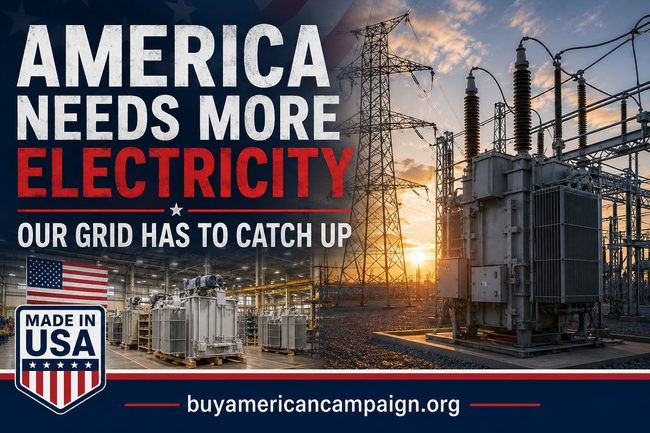
    America Needs More Electricity. Our Grid Has to Catch Up.

    American electrical substation and domestic transformer manufacturing representing investment in the U.S. power grid

    Whether someone welcomes electric vehicles and enormous data centers or wishes they would slow down, one fact is difficult to argue with: American life in 2026 requires more electricity. Homes are adding devices, factories are expanding, computing demand is climbing, and more parts of transportation and industry are connecting to the grid. American power grid investment is no longer a distant policy debate. It is basic preparation for the way the country already lives.

    The problem is that demand is growing faster than some of the equipment needed to serve it. The Department of Energy says U.S. electricity load has risen close to 3% annually since 2023 after nearly two decades of relatively flat demand. At the same time, transformers, circuit breakers, power electronics, and substation components face limited domestic capacity, imported-material dependencies, and long production schedules.

    The Transformer Wait Is Already Measured in Years

    A transformer is not the glamorous part of a new factory, neighborhood, or data center, but none of those projects can operate without one. Transformers adjust voltage so electricity can travel across long distances and then safely reach the machinery, businesses, and homes that use it.

    DOE reports that distribution-transformer lead times rose from three to six months in 2019 to 12 to 30 months in 2023, the latest complete data available. Its newer grid-supply-chain assessment says some critical equipment now takes two years or longer, while transformer prices have risen four to nine times in five years. Large specialized units can take even longer.

    More Demand Is Coming From Every Direction

    Data centers receive much of the attention because artificial-intelligence computing consumes tremendous amounts of power. Electric vehicles add another source of demand. But the story is broader than either one. Semiconductor plants, battery factories, hospitals, warehouses, housing developments, advanced manufacturing, and the reshoring of existing industries all need dependable connections.

    That is why this should not become another argument in which Americans are told to choose one technology and blame another. Reliable electricity is shared infrastructure. A stronger grid serves the family charging a car, the machinist running a CNC mill, the farmer operating irrigation equipment, and the local hospital keeping critical systems online.

    Browse American-Made Products

    American Power Grid Investment Must Include American Factories

    Building more transmission lines matters, but wires alone are not enough. The country also needs the physical equipment that controls, protects, and distributes power. Domestic manufacturers are investing in transformers, breakers, high-voltage cable, and related components, yet years-long queues show how much capacity still has to be added.

    Manufacturing these products in the United States does more than shorten a shipping route. It preserves specialized engineering, electrical-steel processing, winding, testing, repair, and heavy-transport capabilities. It also reduces the risk that a foreign disruption leaves utilities competing for the same limited supply of essential equipment.

    Standardization Can Help Factories Build Faster

    Investment should not mean spending without reform. DOE has identified more than 80,000 distribution-transformer varieties used across the country. Utilities have legitimate local requirements, but excessive customization makes it harder for manufacturers to build common models efficiently, hold practical inventories, and move equipment quickly when emergencies strike.

    Common configurations, a stronger refurbishment network, more domestic material capacity, and long-term purchasing commitments would give manufacturers the confidence to add machinery and train workers. Those changes are less dramatic than announcing a new power plant, but they can determine whether that plant—or the factory beside it—actually connects on schedule.

    Join the Buy American Movement

    The Cost of Waiting Will Not Stay Hidden

    When grid equipment costs more or arrives late, the consequences eventually reach households. Utilities pay more, projects stall, businesses delay hiring, and communities wait longer for housing and commercial development. Reliability also suffers when aging equipment must remain in service because replacements are unavailable.

    America does not need to predict every future technology correctly to make a sound decision today. Electricity use is rising. The equipment supply chain is strained. The grid is aging. Those three realities make a compelling case for sustained investment regardless of anyone’s politics or preferences about EVs, data centers, or individual energy sources.

    Build the Grid the Next Generation Will Need

    The best time to expand transformer capacity and modernize the grid was before lead times stretched into years. The next-best time is now. America should invest in transmission, local distribution, maintenance, resilience, and the domestic factories that manufacture the hardware behind all of it.

    More electricity demand is coming. We can meet it with an increasingly fragile patchwork, or we can build a stronger American grid with equipment made by American workers. The second choice requires patience and capital, but it also leaves the country more productive, more secure, and better prepared for whatever comes next.

    Sources: U.S. Department of Energy, Strengthening America’s Grid Supply Chain; DOE Supply Chain and Market Analysis; and National Laboratory of the Rockies transformer analysis.

    Whenever possible, choose Made in USA.

    If you like what you see and think this post would be of interest to someone, please share
  • Germany Is a Warning: America Can’t Take Its Auto Industry for Granted

    Germany Is a Warning: America Can’t Take Its Auto Industry for Granted

    Germany is a warning about protecting American auto manufacturing jobs

    Germany is a warning to America: even one of the world’s most celebrated manufacturing powers cannot assume its industrial strength will last forever. Volkswagen’s latest restructuring plan shows how quickly market pressure, excess capacity and stronger foreign competition can place factories and livelihoods at risk.

    Volkswagen’s supervisory board has approved a plan calling for another adjustment of roughly 50,000 positions worldwide by 2030. That comes in addition to approximately 50,000 reductions already underway across Volkswagen Group operations, bringing the combined restructuring discussed by the company to around 100,000 positions.

    That does not mean 100,000 German workers will suddenly receive layoff notices. Many of the earlier reductions are intended to occur through attrition, early retirement and other voluntary measures. But the scale still tells us something important: manufacturing leadership is never permanent.

    Volkswagen faces a historic restructuring

    Volkswagen employs roughly 650,000 people globally and owns some of Europe’s best-known automotive brands, including Audi, Porsche, Škoda and SEAT. Yet the group reported a 30 percent decline in after-tax earnings during the first half of 2026 as sales weakened in China and competitive pressure intensified.

    The company says it has about 500,000 vehicles of excess annual production capacity in Europe. Its newly approved plan also places the future production role of four German plants—Emden, Zwickau, Hanover and Neckarsulm—under scrutiny while possible alternative uses are evaluated.

    This follows an earlier agreement to reduce technical production capacity at Volkswagen’s German plants by approximately 734,000 vehicles. That agreement also called for more than 35,000 socially responsible workforce reductions at German locations by 2030.

    Chinese automakers are changing the market

    Volkswagen’s challenges have more than one cause. Tariffs, high costs, Europe’s weaker vehicle market, slow decision-making and the expensive transition to electric vehicles all matter. Still, the rise of Chinese automakers is an unmistakable part of the story.

    Chinese companies have become faster, more sophisticated and more competitive, especially in electric vehicles. Volkswagen has lost substantial ground in China, once one of its strongest markets, while Chinese brands have expanded their presence across Europe.

    Browse American-Made Products

    Germany is a warning, not a prediction

    International manufacturers captured a record 47 percent of Germany’s new-car market in August 2026. That figure includes companies from many countries, not only China, but it illustrates how quickly the competitive landscape is changing inside the home market of Volkswagen, BMW and Mercedes-Benz.

    Germany remains an automotive powerhouse. Its manufacturers still possess world-class engineering, valuable brands, advanced suppliers and a highly skilled workforce. The lesson is not that Germany has already lost its auto industry. The lesson is that history and reputation alone cannot protect an industry.

    America should pay attention. We have watched domestic production disappear from other industries after buyers, companies and policymakers assumed the supply chain would always be there. Once factories close, the machines, supplier networks and skilled jobs are extraordinarily difficult to rebuild.

    Look beyond the badge on the grille

    Buying an American-made vehicle is not as simple as choosing an American-sounding brand. Toyota builds vehicles in Kentucky. Honda manufactures in Ohio, Alabama and Indiana. BMW operates its major plant in South Carolina, while Mercedes-Benz builds vehicles in Alabama.

    Ford, General Motors, Tesla and other manufacturers also employ thousands of Americans across domestic assembly and component plants. At the same time, not every vehicle wearing a familiar American badge is assembled in the United States.

    The badge matters less to an American assembly worker than the location of the factory. Before purchasing a vehicle, check the final assembly point, the origin of major components and the information on the federally required window label.

    Join the Buy American Movement

    American factories need American customers

    Fair trade and sound industrial policy matter. The United States should defend its industries from market-distorting subsidies, protect critical supply chains and create an environment where companies can afford to invest and produce here.

    Government policy, however, cannot do everything. Consumers send an economic signal with every major purchase. When we choose vehicles assembled by American workers, we support far more than one factory job. We help sustain parts suppliers, logistics companies, toolmakers, restaurants, schools and communities.

    The economic value of an assembly plant reaches far beyond the vehicles leaving its doors. Each plant supports networks of steel, glass, electronics, seating, tires, transportation and maintenance suppliers. A purchase made at a dealership can help determine whether those supplier relationships keep growing in American towns or migrate elsewhere. That is why final assembly and domestic content deserve more attention than advertising slogans.

    Germany’s experience should not become America’s future. A nation does not keep a manufacturing base simply because it has always had one. It keeps that base by remaining competitive, investing in workers and making deliberate choices about what it buys.

    Before buying your next car or truck, ask one straightforward question: Where was it built? If we want Americans to keep making things, Americans must keep buying the things Americans make.

    Whenever possible, choose Made in USA.

    If you like what you see and think this post would be of interest to someone, please share
  • Stop Telling Young People to Learn a Trade—Show Them a Future

    Stop Telling Young People to Learn a Trade—Show Them a Future

    Young American manufacturing apprentice learning CNC machining from an experienced mentor

    Whenever the manufacturing workforce shortage comes up, someone offers the same solution: young people should learn a trade. The advice is usually delivered as though millions of teenagers simply forgot that factories exist. But if America wants more manufacturing careers for young people, it must do more than lecture them. It must show them a future worth choosing.

    Young Americans did not eliminate high-school shop programs, replace apprenticeships with online applications demanding three years of experience, or allow entry-level wages to fall behind local housing costs. Adults, institutions and employers built that system. Blaming the generation asked to navigate it is convenient, but it does not produce a single machinist.

    The Jobs Are Real, but the Path Is Hard to See

    The need is not imaginary. The Bureau of Labor Statistics projects about 30,400 openings for machinists and tool-and-die makers every year through 2035, largely as experienced workers retire or change occupations. Median 2025 pay was $58,750 for machinists and $64,050 for tool-and-die makers.

    Those occupations make the precision parts, molds and tools behind nearly everything else America hopes to manufacture. Yet ask a typical high-school student how to become a tool-and-die maker, and the answer is far less obvious than the path to a four-year college.

    We Removed the First Rung of the Ladder

    A career becomes believable when a young person can see where it begins. That used to mean a shop class, a summer job, a plant tour, a neighbor who worked at the factory or an employer willing to train a beginner. In too many communities, those points of contact disappeared.

    Then employers began describing a “skills gap” while advertising supposedly entry-level positions that required experience newcomers had no way to acquire. You cannot demand finished workers from a training system nobody is willing to fund.

    Browse American-Made Products

    Manufacturing Careers for Young People Need Proof

    A poster saying “great careers are waiting” is not proof. A paid apprentice standing beside a skilled mentor is proof. A wage schedule showing how competency leads to higher pay is proof. So is a former operator who became a programmer, supervisor or production engineer.

    The National Institute of Standards and Technology describes manufacturing apprenticeships as paid on-the-job learning combined with technical instruction. Its Manufacturing Extension Partnership reports that 91 percent of apprentices remain with the employer that trained them. That is not charity; it is a practical way to build and retain talent.

    Modern Manufacturing Is Not the Career Adults Remember

    Many parents still picture manufacturing as repetitive, dirty work inside a fading plant. Some jobs do remain physically demanding, and employers should be honest about that. But modern machinists also read digital models, program CNC equipment, use computerized measuring systems and work with tolerances smaller than a human hair.

    Automation does not eliminate the need for skill; it changes the skill. Somebody must install the equipment, understand the process, diagnose failures, improve production and decide whether the finished part is right. These careers combine judgment, mathematics, technology and physical results in a way many young people would find deeply satisfying—if they ever saw the work.

    Join the Buy American Movement

    Employers Must Make the Offer Worth Believing

    Respect cannot exist only in recruiting slogans. A manufacturer asking a nineteen-year-old to commit to a difficult craft should offer predictable advancement, useful training, competent supervision and wages that make adult life possible. Loyalty is earned in both directions.

    Companies also need to open their doors. Invite students and parents into clean, operating facilities. Let apprentices explain their work without a public-relations script. Publish the starting wage, the training sequence and what a capable worker can earn after three or five years. Specificity makes a career real.

    Schools Should Restore More Than a Shop Class

    Putting a lathe in a classroom is useful, but the larger goal is to reconnect education with local production. Schools, community colleges and manufacturers should share equipment, instructors and work-based learning opportunities. Students should be able to earn credit, industry credentials and a paycheck along the same path.

    College should remain available to anyone who wants it. But treating every alternative as a consolation prize has harmed students and the country. A young adult who can make a precision aerospace component is not someone who “failed to go to college.” That person possesses a valuable capability America cannot purchase from a motivational speech.

    Stop Scolding and Start Building

    Young people are constantly told to make practical choices. They are watching costs, wages, working conditions and whether an employer appears willing to invest in them. That is practical.

    If America wants the next generation to build aircraft, medical devices, machine tools and energy systems, the invitation must include a visible starting point and a credible destination. Restore the ladder. Pay people while they learn. Show them the technology, the mentors and the lives these careers can support.

    Then we can stop telling young people to learn a trade. They will be able to see the future for themselves.

    Whenever possible, choose Made in USA.

    If you like what you see and think this post would be of interest to someone, please share
  • America Forgot How to Make Things. This 26-Year-Old Founder Is Fixing That.

    America Forgot How to Make Things. This 26-Year-Old Founder Is Fixing That.

    Young American manufacturing founder overseeing a robotic investment casting foundry

    America did not forget how to design aircraft, data centers or advanced energy systems. It forgot how to make many of the unglamorous metal parts that allow those systems to work. At Rangeview’s American foundry in El Segundo, California, 26-year-old founder Cameron Schiller is trying to rebuild that missing capability.

    Rangeview is not creating another app that promises to “disrupt manufacturing.” It is melting metal. Its workers combine investment casting, 3D-printed ceramic molds, robotics and software to produce precision parts for aerospace, defense, energy and advanced technology customers.

    The company’s story is compelling because it begins with something America has spent decades losing: the neighborhood machine shop. Schiller grew up near the former Lockheed Martin Skunk Works in Southern California, surrounded by the remains of an industrial culture that once built astonishing things close to home.

    A Founder Who Wanted to Build Something Physical

    Schiller grew up taking things apart, rebuilding rooms and experimenting with machines. He later won a robotics world championship and studied at the University of California, Berkeley, but the conventional technology path did not hold his attention.

    Rangeview began in a garage in 2020. According to a recent profile by Pirate Wires, the company is now operating inside an aging brick industrial building where molten metal, robotic arms and young engineers share the floor.

    That combination matters. Much of the American technology economy has rewarded people for building software that captures attention or moves information. Rangeview is attracting young technical talent to a harder assignment: moving metal and delivering physical parts.

    Why American Foundries Became a Bottleneck

    Investment casting is an ancient process with modern consequences. Manufacturers form a detailed mold, pour in molten metal and finish the resulting component to precise specifications. The process can create complex turbine, aircraft and industrial parts that are difficult to machine from a solid block.

    Traditional casting often depends on specialized dies and tooling that take months to design, build and qualify. When an older Navy vessel or aircraft needs a replacement part and the original tooling no longer exists, the delay can keep important equipment out of service.

    Browse American-Made Products

    How Rangeview’s American Foundry Works Differently

    Rangeview replaces much of that physical tooling with digital files and 3D-printed ceramic molds. The company says its software-defined process can compress the journey from design to a first finished article from months to weeks.

    Inside the foundry, an ingot is heated to roughly 2,000 degrees and poured by robotic equipment into a custom mold. Automation handles dangerous, repetitive steps while engineers and production workers monitor the process, improve reliability and prepare it for higher-volume manufacturing.

    This is what advanced manufacturing should mean: not a factory without people, but a factory where people use better tools to produce difficult parts safely, consistently and quickly.

    The U.S. Navy Needs Parts That No One Makes Anymore

    In August, Rangeview announced a major U.S. Navy contract to produce maintenance, repair and overhaul replacement parts. The work addresses a basic readiness problem: sophisticated equipment can be sidelined by a relatively small component that has become slow or impossible to source.

    The challenge is larger than one contract. American casting capacity has declined as infrastructure aged, work moved offshore and experienced foundry workers retired without enough younger workers behind them. Rebuilding the capability means preserving knowledge while redesigning the job for a new generation.

    Join the Buy American Movement

    A Factory Can Give a Town More Than Paychecks

    Schiller’s ambition extends beyond a single Southern California facility. He has spoken about building factories across the American plains and becoming part of a real factory town—a place where the company and community grow together.

    That vision is important because manufacturing provides something difficult to measure on a balance sheet. Workers can point to what they made. Families see the plant supporting suppliers, restaurants, schools and skilled careers. A town gains an identity tied to useful work.

    Modern foundries should be cleaner, safer and more technologically capable than the plants of the past. But they can still create the same sense of shared purpose that existed when a community knew exactly what it contributed to the country.

    Reindustrialization Requires Actual Factories

    America has no shortage of manufacturing conferences, strategy papers and software tools. Schiller’s blunt argument is that none of them substitutes for factories that make parts. Reindustrialization ultimately requires furnaces, equipment, materials, trained people and customers willing to place orders.

    Rangeview is still a young company, and scaling a foundry is far more difficult than scaling a website. That is exactly why its effort deserves attention. The country needs founders willing to confront physical constraints instead of treating them as someone else’s problem.

    If Rangeview succeeds, its most important product may not be a particular turbine component or Navy replacement part. It may be proof that a new generation of Americans can learn to make difficult things again—and build communities around that work.

    Whenever possible, choose Made in USA.

    If you like what you see and think this post would be of interest to someone, please share
  • When “Made in USA” Becomes a Reason Not to Buy

    When “Made in USA” Becomes a Reason Not to Buy

    Canadian shopper examining a Made in USA product during a boycott of American products

    The Canadian boycott of American products has turned three familiar words into a warning label for some shoppers: Made in USA. In grocery aisles across Canada, consumers are checking packages, changing brands and sometimes walking away when the only choice is American.

    That should matter to anyone who cares about American manufacturing. The same idea behind the Buy American movement—that ordinary purchases affect real workers—does not stop working when the shopper lives on the other side of the border.

    According to recent reporting by The Guardian, a July Angus Reid survey found that 40 percent of Canadian grocery shoppers were actively checking where products came from. Most of those label-checkers were avoiding U.S. products whenever possible.

    The Canadian Boycott of American Products Is Personal

    This is not simply a government tariff schedule that consumers will never see. Thousands of Canadians have described changing their weekly routines: choosing Canadian-grown food, replacing familiar American brands and reconsidering vacations in the United States.

    The emotional intensity is what makes this different from an ordinary trade dispute. People are using purchases to express frustration with the United States, just as many Americans use purchases to express support for domestic workers.

    Once a household finds a replacement it likes, that lost sale may not return when the headlines fade. Shopping habits harden quickly. Shelf space, distributor relationships and brand loyalty can take years to win back.

    The Label Suddenly Matters

    For decades, many companies treated country-of-origin information like fine print. Now it can determine whether a product reaches the checkout counter. Canadian retailers have responded with shelf labels, signs and displays that make locally produced alternatives easier to identify.

    That is a lesson worth bringing home. American shoppers routinely say they would prefer to support American workers, but locating genuinely domestic products can be unnecessarily difficult. Clear labeling works because it turns a broad economic belief into a decision someone can make in seconds.

    Browse American-Made Products

    American Workers Feel an Overseas Boycott at Home

    Canada is one of the largest customers for American-made goods. When Canadian shoppers stop buying a Wisconsin food product, an Ohio appliance or a Michigan auto part, the economic effect eventually returns to the plant that made it.

    The damage is rarely dramatic enough to appear immediately in a factory announcement. It arrives quietly: a Canadian distributor trims an order, a retailer gives more shelf space to a domestic competitor, or a sales forecast no longer justifies adding a second shift. Those decisions eventually reach machinists, packers, truck drivers and suppliers far from the border.

    Exports help domestic factories run longer production lines, purchase more material and support more jobs than the U.S. market alone might sustain. Losing even a modest share of Canadian demand can be painful for a smaller manufacturer that spent years building distribution there.

    Canada has also announced retaliatory tariffs covering hundreds of American goods, including food, clothing, cosmetics, appliances, paper products and industrial materials. Those duties can make an American product significantly more expensive before a shopper even considers the flag on its package.

    Consumer Patriotism Cuts Both Ways

    There is an uncomfortable truth here: Americans cannot celebrate consumer patriotism at home and dismiss it as meaningless when Canadians practice it. Both movements rest on the same premise. Where people spend their money influences which communities get the work.

    The answer is not to criticize Canadians for checking labels. It is to understand the signal. American manufacturers need competitive products, dependable quality and relationships strong enough to survive political turbulence they did not create.

    Join the Buy American Movement

    What American Manufacturers Can Learn

    First, origin has become part of a product’s identity. Companies should be precise and transparent about what they make in the United States, where the materials come from and how domestic production supports workers.

    Second, manufacturers cannot rely on patriotism alone. A label may earn a first look, but quality, service and value earn the next purchase. The strongest American-made brands give customers practical reasons to remain loyal even when politics changes the mood.

    Finally, the boycott demonstrates how quickly millions of small choices become economic pressure. No single shopper closes a production line. But coordinated demand—or coordinated refusal—can alter inventory decisions throughout a supply chain.

    A Reminder for American Shoppers

    If Canadians can turn country-of-origin checking into a widespread habit, Americans can do the same in support of their own workers. That does not require rejecting every imported product or turning the grocery store into a political battlefield.

    It begins with noticing. Read the label, learn which companies still manufacture here and choose the domestic option when it fits your needs and budget. The Canadian boycott is proof that shoppers are not powerless—and that manufacturers pay attention when enough people make the same choice.

    The larger lesson is not that neighbors must become enemies. It is that consumer trust is valuable, fragile and difficult to rebuild. American companies that employ American workers deserve trade relationships—and informed customers—that recognize what is at stake.

    Whenever possible, choose Made in USA.

    If you like what you see and think this post would be of interest to someone, please share
  • Dan River Mills: When a Factory Was a Town

    Dan River Mills: When a Factory Was a Town

    Historical reconstruction of workers and looms at Dan River Mills

    For generations in Danville, Virginia, Dan River Mills was more than a factory. It was where parents met, where children expected to work, where paychecks filled local stores and where the rhythm of looms helped set the rhythm of an entire town.

    At its wartime peak, Dan River employed about 14,000 people in a city of roughly 40,000. The numbers are remarkable, but they only hint at the mill’s reach. A factory that large did not sit beside the community. It shaped the community.

    A Mill Built Beside the Dan River

    The story began in 1882, when six local men established Riverside Cotton Mills on the banks of the Dan River. Four mills rose during the company’s first decade, powered by a region eager to turn Southern cotton into finished American cloth.

    Riverside merged with the Dan River Power and Manufacturing Company in 1909. By then, annual cloth production had climbed from about 2 million yards in 1884 to more than 78 million yards. Sheetings, ginghams and chambrays carried Danville’s work far beyond Virginia.

    When the Factory Became the Community

    Like many Southern textile companies, Dan River built housing to attract and retain workers. The mill village of Schoolfield included homes, churches, recreation and the everyday relationships that grow when thousands of families share the same employer.

    Company-town life was never simple. Conditions could be harsh, and workers fought difficult battles over wages and control of their jobs. Major strikes in 1930 and 1951 ended in defeat. Still, residents remembered the closeness of a place where work and community were inseparable.

    Browse American-Made Products

    Fourteen Thousand Workers During World War II

    Military orders pushed the mills into extraordinary production during World War II. By 1942, Dan River operated twelve weaving and spinning mills along with dyeing, bleaching, finishing and power plants. Nearly half a million spindles fed the largest textile operation in the region.

    The mill’s 14,000 workers represented more than one out of every three people living in Danville—not merely one out of every three workers. After the war, civilian demand kept the company growing. Acquisitions lifted companywide employment above 18,000 by 1956.

    What a Manufacturing Paycheck Multiplies Into

    Every mill job supported more than the person standing at a loom. Wages paid grocers, mechanics, barbers and builders. The company needed suppliers, rail service, maintenance and transportation. Schools and public services depended on an economy anchored by productive work.

    That multiplier is easy to overlook when a factory is reduced to an employment number. In a manufacturing town, the plant’s health becomes visible in storefronts, home values, civic groups and children’s expectations about whether they can build a future close to family.

    Join the Buy American Movement

    The Long Retreat of American Textiles

    Imported textiles began taking market share from American manufacturers in the 1960s. Dan River initially answered with technology and investment, trying to produce more efficiently while keeping its domestic operations competitive.

    By the 1990s and early 2000s, imports from Latin America and Asia were arriving in volumes the domestic industry could not withstand. Employment declined, facilities closed and Dan River entered Chapter 11 bankruptcy reorganization in March 2004.

    The Final Jobs Went Overseas

    Dan River emerged from bankruptcy, but survival was brief. In 2006, an Indian company purchased the business, closed the main mill and transferred the remaining work overseas. Encyclopedia Virginia records the final move as the loss of hundreds of remaining jobs; historical accounts differ on whether the last transfer involved roughly 500 or as many as 1,100 positions.

    The exact final count does not change the outcome. A company that had manufactured American textiles for more than a century no longer made its products in the United States. The brand survived. The production community did not.

    Danville Had to Become Something Else

    The physical landscape changed too. The familiar smokestacks came down in 2008. Former mill property sat vacant or moved toward new uses while Danville worked to rebuild an economy once dominated by textiles and tobacco.

    Today, the former White Mill has become Dan River Falls, a mixed-use redevelopment with residential, office and commercial space. Schoolfield is receiving new investment, and Danville has earned recognition for its comeback. That reinvention deserves respect.

    Redevelopment Is Not the Same as Production

    A restored building can preserve history and create valuable new activity. It cannot recreate the industrial ecosystem that once trained generations, supported suppliers and shipped tangible goods across the country. A casino, apartment or office may reuse a site, but it does different economic work.

    Dan River Mills is not an argument that every old factory should have remained unchanged forever. It is a warning about treating productive capacity as disposable. Once machinery, skills, supplier networks and customer relationships disappear, rebuilding them is far harder than closing a gate.

    Remember the People Behind the Label

    For consumers, Dan River’s story gives a familiar label a human scale. “Made in USA” was thousands of people in Danville reporting for shifts, learning trades, raising families and spending wages in the place they called home.

    We cannot reverse every closure. We can decide that the next factory matters before it becomes a memory. Choosing American-made products, asking retailers where goods are produced and supporting companies that invest here are modest acts—but they help keep today’s manufacturing towns from becoming tomorrow’s historical exhibits.

    Whenever possible, choose Made in USA.

    If you like what you see and think this post would be of interest to someone, please share
  • World’s Largest Electric Aircraft Makes Historic First Flight in New York

    World’s Largest Electric Aircraft Makes Historic First Flight in New York

    Made in USA Heart Aerospace X1 electric aircraft taking off in Plattsburgh, New York

    The world’s largest electric aircraft has completed its first flight, and this milestone aircraft was made in the USA. Heart Aerospace’s full-scale X1 demonstrator lifted off from Plattsburgh International Airport in upstate New York on August 12, 2026, turning years of American engineering, manufacturing, ground tests, and regulatory work into 27 minutes of battery-powered flight.

    The aircraft climbed to 1,100 feet while its electric propulsion system delivered more than one megawatt of power. Heart says the electricity used during the flight cost about $5. That figure does not make the X1 a finished airliner, but it gives the aviation industry a striking glimpse of what electric propulsion could eventually mean for regional travel.

    A 25,000-Pound Aircraft Leaves the Ground

    The X1 is not a small experimental plane. It has a 106-foot wingspan, stretches 76 feet from nose to tail, and weighed more than 25,000 pounds at takeoff. That scale is why Heart describes it as the largest battery-electric aircraft ever flown.

    The first mission was deliberately controlled. Conducted under an FAA Special Airworthiness Certificate in the Experimental Category, the test included taxi, takeoff, climb, maneuvering, and landing. The point was not to set a speed or altitude record. It was to begin learning how a clean-sheet electric aircraft of this size behaves in the air.

    Built and Tested in the United States

    Heart Aerospace is headquartered in California, and the X1 program now connects several pieces of American aviation infrastructure. The demonstrator flew from Plattsburgh, New York, after more than a year of collaboration with the FAA. Heart is also developing its first pre-production ES-30 at a pilot manufacturing facility in Los Angeles.

    That matters beyond one airplane. New aircraft programs require engineers, technicians, software specialists, test pilots, suppliers, and manufacturing teams. If hybrid-electric regional aviation reaches commercial service, the industrial opportunity will be measured not only in aircraft sold but in the skilled work required to build, certify, maintain, and improve them.

    Browse American-Made Products

    The World’s Largest Electric Aircraft Is a Testbed

    The X1 itself is not the passenger aircraft Heart plans to sell. It is a technology demonstrator built to validate electric propulsion, aerodynamics, flight controls, structural behavior, battery systems, and the procedures needed to operate an electrified aircraft safely.

    Heart’s commercial goal is the ES-30, a 30-passenger regional aircraft with both electric and hybrid capability. The company lists a planned all-electric range of 125 miles and an extended hybrid range of 500 miles, with a targeted 30-minute charging time. Type certification is currently targeted for 2031, and a pre-production aircraft is expected to begin flight testing in 2028.

    Why Regional Aviation Is the Starting Point

    Batteries still carry far less usable energy per pound than aviation fuel, which makes long-distance electric flight especially difficult. Short regional routes offer a more realistic place to begin. Aircraft can return to charging infrastructure frequently, and many trips connect smaller communities that have lost convenient air service.

    Heart says the ES-30 could reduce operating costs for regional airlines by more than 40 percent. That remains a company projection, not a result proven in commercial service. Still, the X1’s first flight puts real hardware behind the idea and gives engineers flight data that computer models and ground tests cannot fully provide.

    Join the Buy American Movement

    Big Commitments, Bigger Work Ahead

    United Airlines, Air Canada, and JSX are among the carriers that have expressed interest in the ES-30. Heart reports $9.4 billion in customer commitments. Those commitments signal demand, but they do not erase the difficult path between a demonstrator’s first flight and a certified aircraft carrying paying passengers.

    The next several years will involve repeated flight testing, design changes, production development, and close regulatory scrutiny. Range, battery life, charging infrastructure, weight, reliability, and economics all have to work together. Aviation rewards careful progress, and the safest reading of this milestone is not that electric air travel has arrived—it is that one of its largest experiments is finally airborne.

    A First Flight Worth Watching

    Twenty-seven minutes at 1,100 feet may sound modest next to a conventional airline route. For a newly built 25,000-pound battery-electric aircraft, it is a serious engineering milestone. The X1 took a concept that existed in drawings, simulations, and ground tests and proved that it could take off, maneuver, and land under its own electric power.

    The most encouraging part of the story is not the $5 electricity bill by itself. It is the American engineering and manufacturing ecosystem forming around a new kind of regional aircraft. If Heart can turn what it learns from X1 into a safe and economical ES-30, this first flight could be remembered as an early step toward rebuilding short-haul aviation closer to home.

    That possibility deserves both enthusiasm and patience. Commercial aviation changes slowly because safety has to come first. The X1 has now supplied the proof that matters at this stage: a large battery-electric aircraft designed around new systems can leave an American runway, complete its planned test profile, and return safely with useful data for the next flight.

    Sources: Yahoo Tech/InsideEVs and Heart Aerospace.

    Whenever possible, choose Made in USA.

    If you like what you see and think this post would be of interest to someone, please share
  • Buying American Isn’t All or Nothing

    Buying American Isn’t All or Nothing

    Shopper comparing American-made and imported products

    Buying American isn’t all or nothing. Yet that is exactly how the choice is often presented: either every item in your home must be made in the USA, or your effort does not count. That impossible standard discourages people who genuinely want to support American workers but still live with budgets, limited options and complicated supply chains.

    A better approach is simpler: make the better choice when a practical American-made option is available. One purchase will not rebuild an industry by itself, but millions of ordinary purchasing decisions can change what retailers stock and where companies invest.

    The Perfect Shopper Does Not Exist

    Most of us own imported phones, appliances, clothing and tools. Some products have few domestic alternatives. Others carry prices that do not fit every household budget. Pretending those realities do not exist turns a useful movement into a purity test.

    The goal should not be to shame someone for the imported products already in a kitchen drawer or garage. The goal is to help that person notice the next opportunity—to choose an American-made pan, pair of work boots, garden hose or bag of pet food when the quality and price make sense.

    Start With What You Buy Repeatedly

    The easiest place to begin is with products purchased again and again. Paper goods, cleaning supplies, food, personal-care products and basic household items create recurring demand. Switching even one regular purchase can support domestic production dozens of times over several years.

    These choices are often less intimidating than replacing an expensive appliance or vehicle. They also build the habit of checking labels, reading company information and asking where a product was actually manufactured.

    Browse American-Made Products

    Choose the Categories That Matter to You

    No household can research everything. Pick two or three categories that match your priorities. A tradesperson might focus on tools and workwear. A parent might start with food, toys or school supplies. Someone furnishing a home might pay closer attention to cookware, mattresses and furniture.

    Concentrating your effort makes the process manageable. It also allows you to learn which claims are meaningful, which companies manufacture domestically and which products merely use patriotic branding while production happens elsewhere.

    Price Matters—and So Does Value

    American-made products sometimes cost more upfront because domestic manufacturers operate under different wage, safety and environmental standards. That price difference is real, and nobody should be judged for choosing what a family can afford.

    When the budget allows, compare value rather than price alone. A durable product that can be repaired or kept for years may cost less over time than several cheaper replacements. Warranty service, replacement parts and dependable customer support also belong in the calculation.

    Join the Buy American Movement

    Ask Better Questions Instead of Demanding Perfection

    “Made in USA” can describe products with different levels of domestic content, and many supply chains cross borders. Consumers should ask where final manufacturing occurs, where major components originate and whether a company is transparent about the answer.

    A product assembled here from some imported parts can still create meaningful American work. It may not represent the strongest possible domestic supply chain, but it can be a step in the right direction. Honest progress deserves recognition alongside continued pressure to localize more production.

    Availability Is Part of the Problem

    Consumers cannot buy products they cannot find. American manufacturers and retailers share responsibility for making origin information visible, maintaining useful inventories and explaining why domestic production may offer better quality or service.

    When a suitable American-made option is unavailable, buying the product you need is not a betrayal of the movement. It is information. Ask the retailer to carry an alternative, contact the brand and keep the category in mind the next time you shop.

    Small Signals Become Market Demand

    Retailers track what sells. Manufacturers watch customer requests, reviews and search behavior. When enough shoppers look for American-made choices, businesses gain a reason to expand production, add a domestic product line or make country-of-origin information easier to find.

    That signal can be strengthened by telling companies why you made a purchase. A short email, product review or social-media comment lets a manufacturer know that domestic production influenced the decision.

    Progress Is a Better Standard Than Purity

    Buying American is not a contest to see who can eliminate every imported item. It is a practical effort to direct more demand toward people who make things here. Someone who changes five purchases this year has done more for domestic manufacturing than someone who gives up because changing fifty felt impossible.

    Look for the label. Check the company. Choose the American-made option when it fits your needs and budget. Then do it again when the next opportunity appears. Better choices, repeated over time, are how habits change—and how markets follow.

    Whenever possible, choose Made in USA.

    If you like what you see and think this post would be of interest to someone, please share