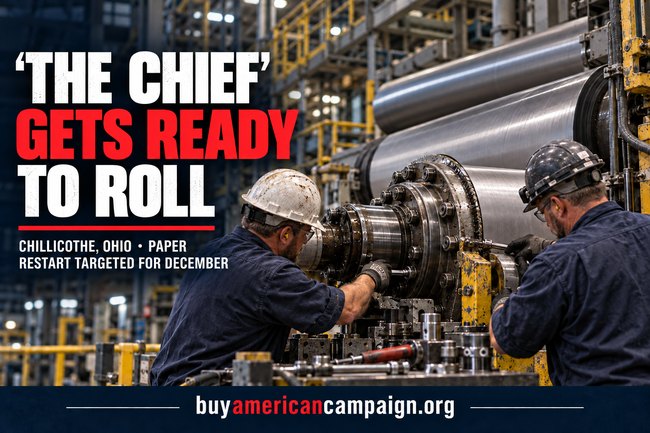
In Chillicothe, Ohio, a paper machine nicknamed “The Chief” has a second chance. It has not made its comeback yet: the plant’s new owner says workers are preparing it for a December restart. But after a mill closure that shook the community, the work already underway matters. This is the story of how paper manufacturing may return to Chillicothe—and why a restart takes more than turning a switch.
U.S. Paper Mill Company says 13 current employees have been assigned to revive Paper Machine 12. The company has begun hiring for paper production and is prioritizing some people who worked at the mill before its former owner, Pixelle Specialty Solutions, closed it in August 2025. Local reporting says 10 paper-production workers have been hired so far. That is a beginning, not proof that the machine is already running.
What It Takes to Restart Paper Manufacturing in Chillicothe
A paper mill is not an appliance left unplugged for a year. Equipment must be inspected, prepared and operated by people who know its rhythms. At Chillicothe, the new owner is focusing first on one machine—The Chief—with a stated goal of making paper by December. That narrower target gives the story its proper scale: a specific production line being prepared, not an entire former operation already restored.
U.S. Paper Mill acquired the site in October 2025. Since then, the property has become a workplace for several activities rather than paper alone. The company says more than 180 people currently work onsite across those operations. They should not be counted as 180 newly hired paper workers, just as a December production target should not be described as completed output.
That distinction is important precisely because the possibilities are significant. The company estimates that as many as 350 employees could be added for paper operations over the next year. Those jobs depend on plans and potential business turning into sustained production; they are not an announced hiring total already achieved.
The People Who Know the Machine
When a longtime factory closes, a town loses more than paychecks. It risks losing the accumulated knowledge of how a particular machine behaves, how its output is judged and how problems are solved before a shift falls behind. Calling experienced workers back recognizes that a production restart depends on skill that cannot be delivered in a crate.
That does not mean every former employee can or will return. In Spectrum News’ reporting, former mill worker Paul Harris—who spent more than four decades there—said he would consider an offer, depending in part on the pay. Since the closure, he has devoted time to a nonprofit cultural-center project. His choice is a reminder that workers have built lives after the shutdown, and a new operator has to earn their return.

A Comeback That Still Has to Be Earned
The old Pixelle closure affected hundreds of families. A single machine’s planned restart cannot immediately replace everything that disappeared. Nor should a projected job figure obscure questions that matter to prospective employees: What work will be available, what will it pay and will it last? The Chillicothe Ross Chamber of Commerce has cautioned that the strength of the recovery will depend in part on the quality of the jobs.
There is another change at the property. Glove manufacturing is already operating there, according to local reporting, while other uses have been proposed. A site with more than one kind of work may be less dependent on a single market, but proposals are not operating businesses. The story worth watching is what actually gets made, by whom, and on what timetable.
For paper production, the near-term test is clear: The Chief must run and make saleable paper. The next test is whether orders support continued shifts and whether hiring reaches beyond the first group of workers. Both tests are more meaningful than a ceremonial promise of revival.
Why This Existing Factory Matters
Much of the conversation about American manufacturing begins with the announcement of a new plant. Chillicothe offers a different view. Buildings, industrial infrastructure and a community of people who know the work already exist. The question is whether a new owner can put them to productive use again.
That is not a smaller ambition. Recommissioning a machine and reconnecting experienced workers to production can preserve capabilities a region might otherwise struggle to rebuild. The value is not simply the paper coming off the line; it is the practical know-how, maintenance judgment, supplier relationships and confidence that a working mill can sustain.
Watch the December Milestone
Chillicothe has reason to welcome the effort and reason to measure it carefully. The company has identified a machine, assigned people to prepare it and begun recruiting. The scheduled restart is still ahead, and the larger hiring estimate remains conditional. Those facts can coexist: this is credible progress without a finished comeback.
If The Chief begins producing paper in December, the achievement will belong to the people who made an existing factory useful again. If production then grows into durable jobs, Chillicothe will have an even stronger story to tell. American manufacturing needs new factories, but it also needs the skill and persistence to bring valuable old ones back to work.
Sources: U.S. Paper Mill Company announcement (September 23, 2026); Spectrum News 1 reporting (September 24, 2026).
Whenever possible, choose Made in USA.
| If you like what you see and think this post would be of interest to someone, please share |