Tag: American consumers

  • Buying American Isn’t All or Nothing

    Buying American Isn’t All or Nothing

    Shopper comparing American-made and imported products

    Buying American isn’t all or nothing. Yet that is exactly how the choice is often presented: either every item in your home must be made in the USA, or your effort does not count. That impossible standard discourages people who genuinely want to support American workers but still live with budgets, limited options and complicated supply chains.

    A better approach is simpler: make the better choice when a practical American-made option is available. One purchase will not rebuild an industry by itself, but millions of ordinary purchasing decisions can change what retailers stock and where companies invest.

    The Perfect Shopper Does Not Exist

    Most of us own imported phones, appliances, clothing and tools. Some products have few domestic alternatives. Others carry prices that do not fit every household budget. Pretending those realities do not exist turns a useful movement into a purity test.

    The goal should not be to shame someone for the imported products already in a kitchen drawer or garage. The goal is to help that person notice the next opportunity—to choose an American-made pan, pair of work boots, garden hose or bag of pet food when the quality and price make sense.

    Start With What You Buy Repeatedly

    The easiest place to begin is with products purchased again and again. Paper goods, cleaning supplies, food, personal-care products and basic household items create recurring demand. Switching even one regular purchase can support domestic production dozens of times over several years.

    These choices are often less intimidating than replacing an expensive appliance or vehicle. They also build the habit of checking labels, reading company information and asking where a product was actually manufactured.

    Browse American-Made Products

    Choose the Categories That Matter to You

    No household can research everything. Pick two or three categories that match your priorities. A tradesperson might focus on tools and workwear. A parent might start with food, toys or school supplies. Someone furnishing a home might pay closer attention to cookware, mattresses and furniture.

    Concentrating your effort makes the process manageable. It also allows you to learn which claims are meaningful, which companies manufacture domestically and which products merely use patriotic branding while production happens elsewhere.

    Price Matters—and So Does Value

    American-made products sometimes cost more upfront because domestic manufacturers operate under different wage, safety and environmental standards. That price difference is real, and nobody should be judged for choosing what a family can afford.

    When the budget allows, compare value rather than price alone. A durable product that can be repaired or kept for years may cost less over time than several cheaper replacements. Warranty service, replacement parts and dependable customer support also belong in the calculation.

    Join the Buy American Movement

    Ask Better Questions Instead of Demanding Perfection

    “Made in USA” can describe products with different levels of domestic content, and many supply chains cross borders. Consumers should ask where final manufacturing occurs, where major components originate and whether a company is transparent about the answer.

    A product assembled here from some imported parts can still create meaningful American work. It may not represent the strongest possible domestic supply chain, but it can be a step in the right direction. Honest progress deserves recognition alongside continued pressure to localize more production.

    Availability Is Part of the Problem

    Consumers cannot buy products they cannot find. American manufacturers and retailers share responsibility for making origin information visible, maintaining useful inventories and explaining why domestic production may offer better quality or service.

    When a suitable American-made option is unavailable, buying the product you need is not a betrayal of the movement. It is information. Ask the retailer to carry an alternative, contact the brand and keep the category in mind the next time you shop.

    Small Signals Become Market Demand

    Retailers track what sells. Manufacturers watch customer requests, reviews and search behavior. When enough shoppers look for American-made choices, businesses gain a reason to expand production, add a domestic product line or make country-of-origin information easier to find.

    That signal can be strengthened by telling companies why you made a purchase. A short email, product review or social-media comment lets a manufacturer know that domestic production influenced the decision.

    Progress Is a Better Standard Than Purity

    Buying American is not a contest to see who can eliminate every imported item. It is a practical effort to direct more demand toward people who make things here. Someone who changes five purchases this year has done more for domestic manufacturing than someone who gives up because changing fifty felt impossible.

    Look for the label. Check the company. Choose the American-made option when it fits your needs and budget. Then do it again when the next opportunity appears. Better choices, repeated over time, are how habits change—and how markets follow.

    Whenever possible, choose Made in USA.

    If you like what you see and think this post would be of interest to someone, please share
  • Made in America, Hidden by AI: What Shopping Bots Aren’t Showing You

    Made in America, Hidden by AI: What Shopping Bots Aren’t Showing You

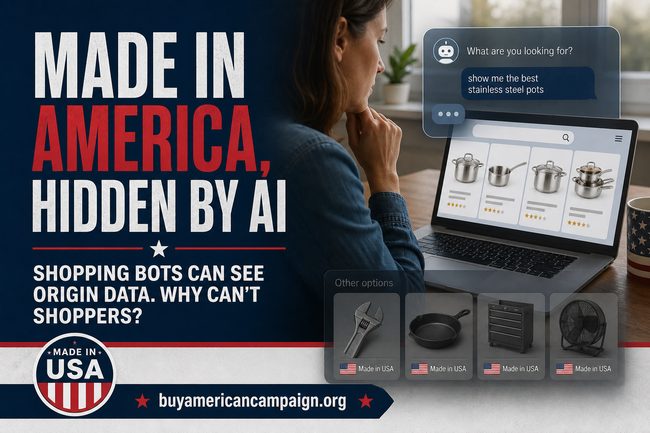
    Made in America hidden by AI shopping chatbots

    A new Columbia University report argues that Made in America is being hidden by AI at the exact moment online retailers are asking shoppers to trust artificial intelligence with more purchasing decisions. The researchers examined AI shopping tools operated by Amazon and Walmart and concluded that the platforms can detect conflicts in country-of-origin information—even when shoppers are not shown those conflicts clearly.

    The 46-page report, Made in America, Hidden by AI, was written by Erie Meyer and Zachary Harris and published through Columbia University’s Center for Law and the Economy. Its findings should concern anyone who tries to support American workers by shopping online.

    What the Columbia Investigation Found

    The researchers tested Amazon’s Alexa for Shopping and Walmart’s Sparky. According to the report, both systems could recognize obvious mismatches—for example, a product advertised with “Made in USA” language while its origin information said “imported” or named another country.

    That matters because an unqualified Made in USA claim is not merely a marketing flourish. Federal standards generally require final assembly and all significant processing to occur in the United States, with all or virtually all components also made and sourced domestically.

    Made in America Hidden by AI Is a Design Problem

    The report’s most troubling conclusion is that this is not simply a technical limitation. The authors say the shopping agents demonstrated access to origin data and the ability to analyze it. Yet the platforms still did not provide shoppers with a straightforward country-of-origin filter.

    The contrast is striking. In one product category examined by the researchers, Amazon offered roughly 269 search filters and Walmart offered almost 300. Country of origin was not among them, even though American-made shoppers routinely identify origin as one of their most important criteria.

    The authors also report an uneven response from Amazon’s assistant: queries seeking products made in several foreign countries returned options, while comparable Made in USA requests could be blocked or refused. The researchers say they were later able to show that relevant American-made results existed inside the system. If accurate, that distinction turns an ordinary search inconvenience into a question about the rules governing what shoppers are allowed to see.

    Browse American-Made Products

    Why Accurate Origin Information Matters

    False or confusing origin claims harm two groups at once. Shoppers may pay a premium believing they are supporting domestic production, while manufacturers that genuinely meet the Made in USA standard lose sales to competitors benefiting from misleading descriptions.

    The report cites polling showing strong demand for domestic products: 71% of Americans report intentionally buying American-made goods, and 65% say they would pay at least 10% more for them. Among shoppers who value American-made products, majorities point to supporting U.S. jobs and strengthening the domestic economy.

    AI Is Becoming the New Store Shelf

    This issue will grow as shopping agents become more influential. Instead of presenting a neutral list of products, an AI assistant can summarize reviews, compare choices, recommend one item over another, and eventually place an order. The algorithm is becoming the shelf, the salesperson, and sometimes the checkout counter.

    Amazon and Walmart also benefit financially from the transactions their systems influence. That creates a legitimate transparency question: Is a chatbot presenting the best answer for the shopper, or the answer that works best for the marketplace?

    The scale makes that question urgent. The report notes that Walmart customers using Sparky spend about 35% more per order, while Amazon has described billions of dollars in sales influenced by agentic shopping. Those figures show that these tools are no longer experimental curiosities. They are becoming commercial gatekeepers with real power to determine which manufacturers are discovered and which products remain invisible.

    Join the Buy American Movement

    What Retail Platforms Should Change

    At minimum, major marketplaces should require sellers to provide standardized origin information, validate obvious inconsistencies, and give shoppers a usable country-of-origin filter. AI recommendations should disclose why products were selected and whether origin claims conflict with other listing data.

    Regulators also need to treat AI-driven recommendations like other advertising and retail conduct. Existing consumer-protection rules do not disappear because a recommendation came from a chatbot rather than a printed label or a store employee.

    What Shoppers Can Do Right Now

    Until marketplaces improve, shoppers should treat “Made in USA” search results as a starting point rather than proof. Check the manufacturer’s own website, read the full origin disclosure, look for specific factory information, and be cautious when a title makes a strong claim that the product details do not support.

    Most importantly, seek out American manufacturers directly. Every purchase made with reliable origin information rewards companies that invest in domestic workers, equipment, suppliers, and communities. AI can make shopping faster, but speed should never come at the expense of truth.

    Whenever possible, choose Made in USA.

    If you like what you see and think this post would be of interest to someone, please share
  • ENZO Olive Oil — How a California Farm Built an American-Made Success Story

    ENZO Olive Oil — How a California Farm Built an American-Made Success Story

    ENZO Olive Oil — How a California Farm Built an American-Made Success Story

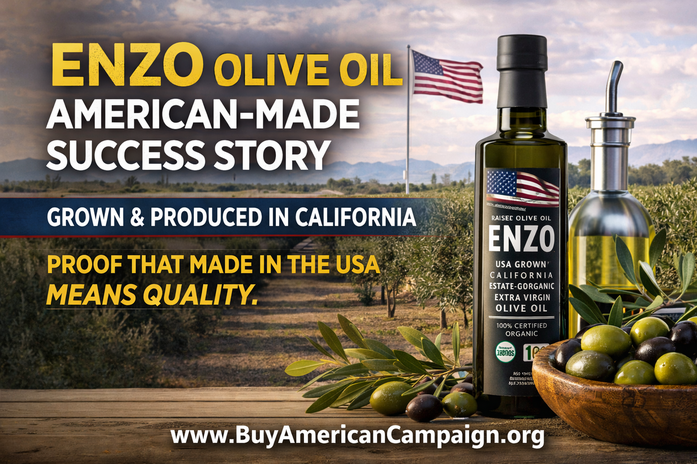
    ENZO Olive Oil American-Made Success StoryWhen people think of premium olive oil, they usually think of Italy, Spain, or Greece. But one California company is changing that perception — and proving that world-class olive oil can be grown, produced, and bottled right here in the United States.

    ENZO Olive Oil, based in California’s Central Valley, has built a reputation for producing high-quality, estate-grown olive oil using a fully integrated American supply chain. From orchard to bottle, every step of the process happens on U.S. soil — a level of control and transparency that sets it apart in a global industry dominated by imports.

    From Almond Farm to Olive Oil Brand

    ENZO is part of the Ricchiuti Family Farms, a multi-generational Sicilian-American farming operation in Madera County, California. The family originally grew almonds but began planting olive trees with the goal of producing a world-class American olive oil.

    That decision was not just about diversification. It was about proving that the United States could produce olive oil on par with the best in the Mediterranean — and do it with full traceability and integrity.

    100% American-Grown and Produced

    Unlike many olive oils on store shelves, which are often blended from multiple countries, ENZO Olive Oil is 100% California-grown. The olives are harvested at peak ripeness and milled quickly to preserve flavor and nutritional value.

    This matters more than most consumers realize. Olive oil quality begins with freshness, and long supply chains can degrade that quality over time. By keeping production local, ENZO delivers a product that is not only traceable but also significantly fresher than imported alternatives.

    Browse American-Made Products

    Quality That Competes on the World Stage

    ENZO Olive Oil has earned recognition in national and international competitions, standing alongside the best producers from Italy, Spain, and beyond. That kind of recognition does not come from cutting corners — it comes from a commitment to doing things right.

    The company focuses on extra virgin olive oil, the highest grade available, and offers varieties that highlight different flavor profiles depending on the olive cultivar and harvest timing.

    Why It Matters

    Choosing an American-made olive oil like ENZO does more than support one company. It supports an entire ecosystem of American agriculture — from the farmworkers who tend the orchards to the local businesses that supply packaging and distribution.

    In an industry where labeling can often be confusing and origins unclear, companies like ENZO offer something different: a product you can trace back to a specific farm, produced by a family that stands behind it.

    Join the Buy American Movement

    A Growing Category for American Producers

    California has become the center of olive oil production in the United States, with a growing number of producers investing in high-density orchards and modern milling technology. ENZO is part of that movement — helping establish American olive oil as a legitimate category in its own right.

    As more consumers look for transparency and quality in their food, brands like ENZO are well-positioned to meet that demand — not by competing on price, but by competing on integrity.

    The Bottom Line

    ENZO Olive Oil is a clear example of what the Buy American movement stands for: choosing quality, supporting local producers, and investing in the strength of American agriculture.

    It also challenges a long-held assumption — that the best olive oil has to come from overseas. ENZO proves that with the right conditions, the right investment, and the right expertise, American producers can compete at the highest level.

    This is not just a success story about olive oil. It is a reminder that American agriculture is capable of producing world-class products — and that supporting those producers strengthens the entire system.

    Help Spread the Word

    If you believe in supporting American-made products, share this article with your friends and family. Together, we can strengthen the Buy American movement — one purchase at a time.

    Follow us: Facebook | Twitter/X | Patreon

  • The Impact Of Buying American

    The Impact Of Buying American

    When this sentence reaches its’ natural conclusion, consider taking a moment to reflect upon the environment in which you currently find yourself. Whether it is your personal bedroom, workplace, or even on the road, the origin of many of the products around you is questionable at best. The reason for this uncertainty stems from the fact that the United States economy is heavily supported by the import of foreign goods and services that often do not require Country of Origin labels. While these goods and services can be of the highest quality they often don’t stack up to similar goods made here in America. You may be asking yourself why that is? The answer is multifaceted but this article will seek to explain the differences between American perceptions towards the quality associated with domestic vs. foreign goods.

    According to the Consumer Reports National Research Center, if Americans were afforded the opportunity to select between a product made in the United States and an identical product made in countries outside of the US, approximately 78 percent of Americans would purchase the product made in America. That is over 250 million people or 6 times the size of California. With that many Americans being in favor of buying American made products, one could safely assume that an America where a greater number of products were made domestically, would be more self-sufficient than it is today.

    The next question you might ask yourself would be how a “Buy American” approach might impact the domestic marketplace. Consider the fact that numerous polls indicate that approximately 60 percent of their respondents would happily pay an increased fee (roughly 10%) on goods manufactured in the United States. This is due, in part, to the overwhelming sense of patriotism associated with the “Buy American” mentality. American consumers are inspired by the fact that they have an opportunity to assist their countrymen, increase job opportunities, and support local business. The gains to our economy wouldn’t end there however, as a recent poll conducted by the Boston Consulting Group indicates that more than half of Chinese consumers would rather “Buy American” than buy Chinese. That speaks highly to the quality of an American made product.

    [bctt tweet=”The Impact Of Buying American” ]

    In addition to the obvious boost to the economy, “Buying American” will also help the rest of the world. It will decrease child labor in foreign countries that often provide subpar working conditions. Thus allowing for these children to grow up with less physical handicaps later in life. Additionally, it would send a message to foreign countries about the value Americans place on human lives, which would in turn cause other countries to reconsider how they treat their people if they would like our business back.

    As this article concludes, you are urged to continue to discover the origins of items in your environment. Investigate their tags, barcode labels, and more. Be curious about where they originated and be inquisitive as to whether there are American made alternatives. If there are not, do not beat yourself up. Know that “Buying American” is a gradual process that takes each of us working in tandem to achieve!

    If you like what you see and think
    this post would be of interest to someone,
    please share
    [apss_share]