When people think about American manufacturing, they usually picture the finished product — a pickup truck, a cast-iron skillet, a can of soda, or an airplane.
Few people think about the raw materials that make those products possible.
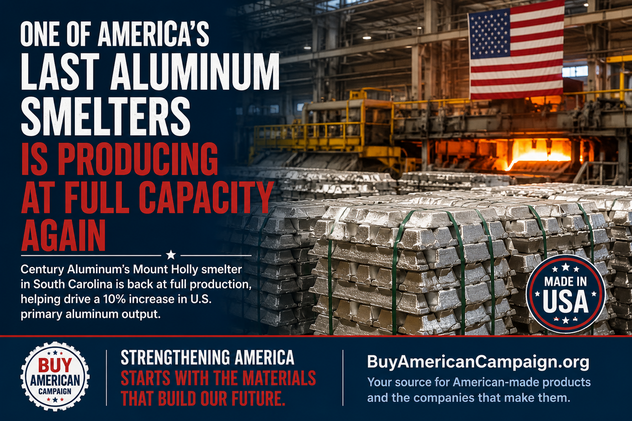
That is why one announcement from South Carolina deserves far more attention than it has received. Century Aluminum’s Mount Holly smelter is running at full capacity for the first time since 2015, and that single restart is lifting U.S. primary aluminum production by roughly 10 percent.
Manufacturing does not begin on an assembly line. It begins much earlier — with the materials everything else is built from.
Why Aluminum Matters
Aluminum is one of the most important industrial metals in the American economy. It shows up in products Americans use every day:
- Beverage cans
- Aluminum foil
- Cookware
- Cars and pickup trucks
- Aircraft
- Electrical transmission lines
- Construction materials
- Boats
- Military equipment
Without a reliable domestic supply of primary aluminum, manufacturers become increasingly dependent on imports for the starting material of all of it.
What Is a Smelter?
Many people assume aluminum comes straight out of a mine. It does not.
Bauxite ore has to be refined into alumina first, and the alumina then goes through enormous smelters where electricity separates pure aluminum from oxygen. These plants are among the most energy-intensive industrial facilities in the world.
They are also extraordinarily expensive to build and very difficult to restart once they have gone cold. That is a large part of why American aluminum-smelting capacity has shrunk so dramatically over the past few decades — and why Mount Holly is now one of only four primary aluminum smelters left operating in the United States.
A Rare Piece of Good News
Century Aluminum has brought the idled portion of its Mount Holly plant in Berkeley County, South Carolina back online, returning the facility to 100 percent production for the first time in more than a decade.
The numbers behind it are concrete. Century invested roughly $50 million in the restart, added about 150 jobs at a plant that now employs more than 600 people, and brought back over 50,000 metric tons of annual capacity. That one restart raises total U.S. primary aluminum output by close to 10 percent.
U.S. Commerce Secretary Howard Lutnick visited the plant on July 27 to mark the milestone alongside South Carolina officials.

Why This Restart Actually Happened
It is worth being precise about the cause, because it was not simply a good year for demand.
Century pointed directly at trade policy. The company titled its own announcement around the benefits of Section 232 tariffs, which were raised to 50 percent on imported aluminum with no exemptions. Those tariffs changed the math on domestic production enough to justify firing the idled potlines back up.
The second ingredient was electricity. Smelters live or die on power costs, and Mount Holly’s capacity had been constrained for years by its power arrangement. Century and Santee Cooper, the state-owned utility that supplies the plant, extended their contract through 2031 to secure the additional power the restart required. Without that agreement, the tariffs alone would not have been enough.
The Part That Still Comes From Overseas
Here is the honest caveat, and it matters if you care about real industrial independence rather than the headline.
A smelter does not make aluminum out of nothing. It needs alumina, which is refined from bauxite ore — and the United States barely produces either one anymore. American alumina refining capacity has collapsed from nearly 5 million tons in 2000 to roughly 600,000 tons today, concentrated in a single remaining refinery in Gramercy, Louisiana. The country imports more than 75 percent of its bauxite and about 71 percent of its alumina, mostly from Jamaica, Brazil, Guyana, and Australia.
So Mount Holly running at full tilt is a genuine win for American jobs and American output. It is not yet an American supply chain. The metal is poured here; the raw material largely is not.
That gap is being worked on. Century has partnered with the startup Brimstone on an effort to build the first domestic mine-to-metal aluminum supply chain, though a full-scale alumina plant is not projected until the 2030s.
Why Domestic Production Matters
For a lot of manufacturers, aluminum is not just another commodity line item. It determines whether they have a stable supply during a disruption.
The past several years have shown how fast global supply chains can seize up — geopolitical conflict, shipping bottlenecks, tariffs, energy shortages. Every ton produced domestically is one more ton an American manufacturer can source without crossing an ocean for it.
It Is About More Than Beverage Cans
When people hear aluminum, they think soda cans. The metal does far more work than that.
The auto industry uses it to cut vehicle weight and improve fuel economy. Aerospace depends on high-strength aluminum alloys. Utilities run aluminum conductors across thousands of miles of transmission line. Defense manufacturers put it in everything from armored vehicles to naval vessels.
Plenty of the American-made products we feature here — cookware, trailers, tools, outdoor gear — trace back to a healthy domestic aluminum industry whether the buyer realizes it or not.
Rebuilding Manufacturing Starts at the Beginning
It is easy to celebrate a new factory that assembles a finished product. It is harder to notice when a raw-material producer quietly restores capacity.
The second one may matter more. A strong industrial base is not built out of assembly plants alone — it needs steel mills, aluminum smelters, chemical producers, foundries, and the whole unglamorous upstream that feeds them. Without those, even a product assembled in the United States is often made of imported material.
The Bottom Line
Mount Holly returning to full production will not solve American aluminum overnight. Four primary smelters is still a thin margin for an economy this size, and the refining side of the industry is thinner still.
But the direction changed, and it changed for reasons that can be repeated. Every increase in domestic production makes the manufacturing base a little harder to disrupt.
Sometimes the biggest manufacturing victories are not the products you see on a store shelf. They are the raw materials that make those products possible in the first place.
Whenever possible, choose Made in USA.
| If you like what you see and think this post would be of interest to someone, please share |