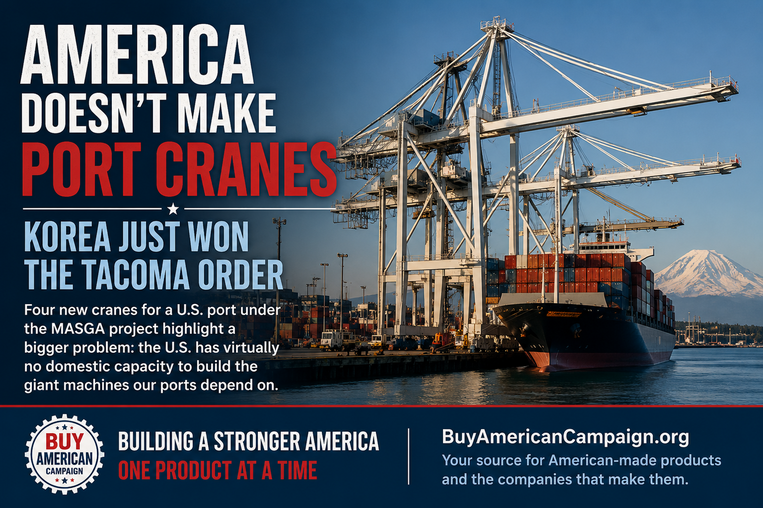
Every day, millions of containers arrive at American ports carrying everything from electronics and clothing to machinery and auto parts. Towering above the ships are the giant cranes that unload them — some of the largest and most complex machines in the world.
Here is something most Americans do not know: the United States has not built one of these cranes in more than thirty years.
That reality came into focus again this week when Washington United Terminals in Tacoma awarded a contract for four new cranes to South Korea’s HD Hyundai Samho. The Korean shipbuilder will design, manufacture, transport, install, and commission the equipment as a turnkey project, with delivery scheduled through 2028.
It is a reminder that while America remains a manufacturing powerhouse in many industries, there are still critical sectors where domestic production has nearly disappeared.
The Machines That Keep Trade Moving
Ship-to-shore cranes are engineering marvels. They stand well over 200 feet tall, with booms that reach across the deck of a container ship, and they lift boxes weighing tens of tons with remarkable precision. Modern ports simply cannot operate without them.
The Tacoma order covers two ship-to-shore quay cranes, which will replace aging units, and two yard cranes that move containers around the terminal. Together they will lift Washington United Terminals’ annual capacity from roughly 590,000 containers to 880,000 and allow the terminal to handle the largest vessels calling on the West Coast.
When a new crane arrives, it is not just another piece of equipment. It is a decades-long investment in the infrastructure that keeps commerce flowing.
How America Lost This Industry
It was not always this way. An American company, PACECO, built the world’s first dedicated ship-to-shore container crane in 1958 and manufactured them in the United States for three decades. Its Gulfport, Mississippi plant closed in 1989. That was the end of domestic production.
Into that gap stepped China’s state-owned Shanghai Zhenhua Heavy Industries, better known as ZPMC. Today ZPMC holds roughly 70 percent of the global container crane market, and federal estimates put its share of the ship-to-shore cranes operating at U.S. ports at close to 80 percent.
That dominance did not happen overnight. As American heavy manufacturing declined and Chinese production expanded, U.S. ports bought imported cranes because there were almost no domestic alternatives left to buy.

Why Port Cranes Became a National Security Concern
In recent years, those purchases became more than an economic question. Modern cranes can be monitored, serviced, and reprogrammed remotely, and federal officials warned that the software and networking built into foreign-made equipment could expose critical infrastructure to interference.
The response has been substantial. An executive order directed action on maritime cyber threats. The U.S. Coast Guard issued Maritime Security Directive 105-4, requiring operators of Chinese-built ship-to-shore cranes to take specific cyber risk management steps. And federal trade officials imposed tariffs of 100 percent on Chinese ship-to-shore cranes and certain cargo handling equipment.
But closing the door on one foreign supplier is not the same thing as rebuilding an American industry.
The Tacoma Order Shows the Gap
The Tacoma contract illustrates the challenge precisely. With Chinese cranes effectively priced out, the work did not go to an American manufacturer. It went to South Korea.
There is another detail worth noting. Washington United Terminals is the U.S. arm of HMM, South Korea’s largest shipping line, and four of the eight quay cranes already standing at its Tacoma berth were also built by HD Hyundai Samho — back in 1999. This capability did not slip away last year. It has been gone for a very long time.
South Korea is one of the few countries left with the industrial base to compete for work this specialized, which is exactly why American ports looking for alternatives keep landing there.

America Is Trying to Rebuild This Industry — It Is Not There Yet
The encouraging part of this story is that the effort is real and underway.
PACECO — the same company that invented the machine in 1958 — announced plans to restart ship-to-shore crane manufacturing in the United States after a thirty-year pause. Konecranes has partnered with American steel suppliers to build up domestic port crane capacity. Federal policy has put real money and real tariffs behind the goal.
But announcements and finished cranes are two different things. When PACECO won an order in September 2025 for two large Portainer cranes bound for the Port of Long Beach, the machines were built in Japan, using American-made components, and shipped here. The domestic restart has been announced. It has not yet produced an American-built crane.
That gap between the announcement and the first machine off the line is the honest state of this industry right now.
Rebuilding an Industry Takes More Than a Factory
Most conversations about American manufacturing focus on things consumers buy — cars, appliances, clothing, tools. Heavy industrial equipment rarely gets the same attention, even though it is the equipment everything else depends on.
An industry like this one requires an entire ecosystem: heavy steel fabrication, precision machining, industrial electrical systems, advanced controls and automation, specialized engineering, skilled welders and fabricators, and assembly facilities big enough to build a structure taller than a twenty-story building.
Once that industrial base disappears, rebuilding it is not as simple as opening a new plant. It takes years of investment, trained workers, a supplier network, and customers willing to place the first orders before the track record exists.
The Bottom Line
The Tacoma crane contract is not bad news. South Korea is a trusted ally with world-class manufacturing, the terminal needed the upgrade, and modernizing American ports is essential work.
But the project points at something larger. America is strengthening domestic manufacturing across many sectors, and in plenty of them that effort is producing new factories and new jobs. In others — like the giant cranes that unload our own imports — the country is still working its way back.
That is the difference between buying American products and rebuilding American industrial capability. One you can do this afternoon. The other takes a decade and a lot of people deciding it matters.
Sometimes the biggest manufacturing stories are not about what we make. They are about what we no longer can — and what it will take to change that.
Whenever possible, choose Made in USA.
| If you like what you see and think this post would be of interest to someone, please share |