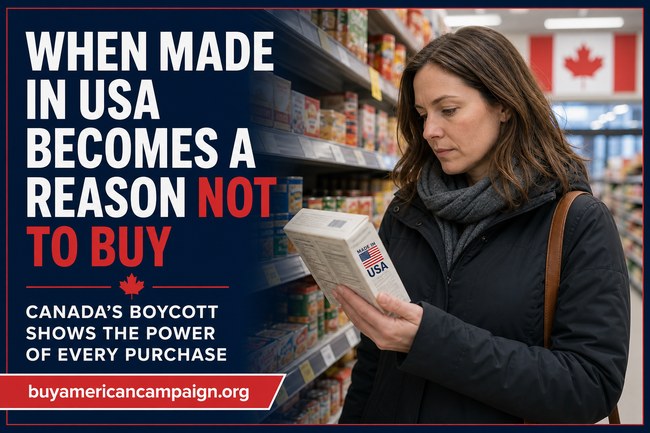
The Canadian boycott of American products has turned three familiar words into a warning label for some shoppers: Made in USA. In grocery aisles across Canada, consumers are checking packages, changing brands and sometimes walking away when the only choice is American.
That should matter to anyone who cares about American manufacturing. The same idea behind the Buy American movement—that ordinary purchases affect real workers—does not stop working when the shopper lives on the other side of the border.
According to recent reporting by The Guardian, a July Angus Reid survey found that 40 percent of Canadian grocery shoppers were actively checking where products came from. Most of those label-checkers were avoiding U.S. products whenever possible.
The Canadian Boycott of American Products Is Personal
This is not simply a government tariff schedule that consumers will never see. Thousands of Canadians have described changing their weekly routines: choosing Canadian-grown food, replacing familiar American brands and reconsidering vacations in the United States.
The emotional intensity is what makes this different from an ordinary trade dispute. People are using purchases to express frustration with the United States, just as many Americans use purchases to express support for domestic workers.
Once a household finds a replacement it likes, that lost sale may not return when the headlines fade. Shopping habits harden quickly. Shelf space, distributor relationships and brand loyalty can take years to win back.
The Label Suddenly Matters
For decades, many companies treated country-of-origin information like fine print. Now it can determine whether a product reaches the checkout counter. Canadian retailers have responded with shelf labels, signs and displays that make locally produced alternatives easier to identify.
That is a lesson worth bringing home. American shoppers routinely say they would prefer to support American workers, but locating genuinely domestic products can be unnecessarily difficult. Clear labeling works because it turns a broad economic belief into a decision someone can make in seconds.
American Workers Feel an Overseas Boycott at Home
Canada is one of the largest customers for American-made goods. When Canadian shoppers stop buying a Wisconsin food product, an Ohio appliance or a Michigan auto part, the economic effect eventually returns to the plant that made it.
The damage is rarely dramatic enough to appear immediately in a factory announcement. It arrives quietly: a Canadian distributor trims an order, a retailer gives more shelf space to a domestic competitor, or a sales forecast no longer justifies adding a second shift. Those decisions eventually reach machinists, packers, truck drivers and suppliers far from the border.
Exports help domestic factories run longer production lines, purchase more material and support more jobs than the U.S. market alone might sustain. Losing even a modest share of Canadian demand can be painful for a smaller manufacturer that spent years building distribution there.
Canada has also announced retaliatory tariffs covering hundreds of American goods, including food, clothing, cosmetics, appliances, paper products and industrial materials. Those duties can make an American product significantly more expensive before a shopper even considers the flag on its package.
Consumer Patriotism Cuts Both Ways
There is an uncomfortable truth here: Americans cannot celebrate consumer patriotism at home and dismiss it as meaningless when Canadians practice it. Both movements rest on the same premise. Where people spend their money influences which communities get the work.
The answer is not to criticize Canadians for checking labels. It is to understand the signal. American manufacturers need competitive products, dependable quality and relationships strong enough to survive political turbulence they did not create.
What American Manufacturers Can Learn
First, origin has become part of a product’s identity. Companies should be precise and transparent about what they make in the United States, where the materials come from and how domestic production supports workers.
Second, manufacturers cannot rely on patriotism alone. A label may earn a first look, but quality, service and value earn the next purchase. The strongest American-made brands give customers practical reasons to remain loyal even when politics changes the mood.
Finally, the boycott demonstrates how quickly millions of small choices become economic pressure. No single shopper closes a production line. But coordinated demand—or coordinated refusal—can alter inventory decisions throughout a supply chain.
A Reminder for American Shoppers
If Canadians can turn country-of-origin checking into a widespread habit, Americans can do the same in support of their own workers. That does not require rejecting every imported product or turning the grocery store into a political battlefield.
It begins with noticing. Read the label, learn which companies still manufacture here and choose the domestic option when it fits your needs and budget. The Canadian boycott is proof that shoppers are not powerless—and that manufacturers pay attention when enough people make the same choice.
The larger lesson is not that neighbors must become enemies. It is that consumer trust is valuable, fragile and difficult to rebuild. American companies that employ American workers deserve trade relationships—and informed customers—that recognize what is at stake.
Whenever possible, choose Made in USA.
| If you like what you see and think this post would be of interest to someone, please share |