Tag: American Workers

  • Made in Fremont: American Startup Tandem PV Opens Next-Gen Solar Factory in California

    Made in Fremont: American Startup Tandem PV Opens Next-Gen Solar Factory in California

    Tandem PV Fremont California perovskite solar factory

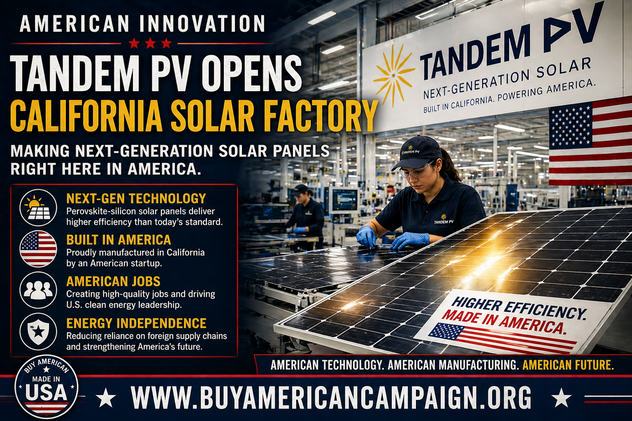
    American solar manufacturing just got a major upgrade in California. On April 21, 2026, Tandem PV cut the ribbon on its brand-new 65,000-square-foot solar factory in Fremont — the first U.S. commercial demonstration plant for next-generation perovskite-silicon tandem solar panels. Former U.S. Energy Secretary Jennifer Granholm, California Energy Commission chair David Hochschild, and Fremont Mayor Raj Salwan were all there for the cutting.

    This isn’t another solar factory churning out the same panels everyone else makes. Tandem PV is doing something genuinely new — manufacturing tandem solar panels with 29.7% efficiency based on internal testing, well above the standard silicon-only panels that have dominated the market for decades. American innovation, American manufacturing, American jobs.

    Why Perovskite-Silicon Matters

    For 20 years, China has dominated global solar manufacturing — not by inventing better technology, but by undercutting prices on commodity silicon panels. The U.S. fell from being the world’s solar leader to a distant third or fourth. Tandem PV’s bet is that the path back isn’t a price war — it’s a technology leap.

    Their perovskite-silicon tandem panels stack two different solar materials on top of each other to capture more of the sun’s energy than either material can on its own. The result: higher efficiency from the same physical footprint — meaning more electricity per acre of solar farm, lower installation costs per watt, and panels that perform better in real-world conditions.

    Inside the Fremont Factory

    The Fremont facility runs 65,000 square feet of state-of-the-art production equipment with approximately 40 megawatts of annual nameplate capacity. That’s the demonstration line. The company has begun producing initial panels and plans to ship them to customers for validation trials later in 2026, with first commercial sales the same year.

    The bigger goal: high-volume manufacturing by 2028, the kind of scale that can actually move the needle on America’s solar supply chain dependence. Fremont is the proof-of-concept. The next factory after this one is the one that goes head-to-head with foreign producers.

    Browse American-Made Products

    $87 Million in Funding, American All The Way

    Tandem PV has raised $87 million in funding from investors who believe in U.S. clean energy manufacturing. Their stated mission is to “restore American leadership in clean energy” — not just produce panels in America, but rebuild the technological lead the U.S. once had in solar before allowing it to slip overseas.

    The company has partnerships across leading U.S. research institutions and supply chain players, and is hiring across engineering, manufacturing, and operations roles in California right now. This is exactly the kind of high-skill American manufacturing job creation that turns a startup into a long-term industry.

    Who Showed Up — and Why It Matters

    The April 21 ribbon-cutting drew serious attention. Former Energy Secretary Jennifer Granholm spoke. David Hochschild, chair of the California Energy Commission, was there. So was Raj Salwan, mayor of Fremont. When that level of policy and political leadership shows up for a solar factory opening, it’s because they understand what’s at stake: domestic manufacturing of strategically important energy technology, on American soil, at American scale.

    The Bigger Solar Picture

    For Buy American to mean anything in solar, U.S. companies need to make panels that are not just American-made, but actually competitive on performance. For two decades, the answer was “we can’t” — foreign producers would always undercut us. Tandem PV is part of a wave of U.S. solar startups proving that wrong by leapfrogging to the next-generation technology.

    Join the Buy American Movement

    If American startups can produce 29.7%-efficient panels at competitive cost on U.S. soil, the calculus changes for every American solar developer, utility, and homeowner. Suddenly “Buy American” in solar isn’t a sacrifice — it’s an upgrade.

    What You Can Do

    If you’re considering solar — rooftop or commercial — ask your installer specifically about American-made panels. Ask about Tandem PV when their commercial product hits the market later this year. The more demand U.S. customers create for U.S.-made panels, the faster companies like Tandem PV can scale up the second factory, the third factory, and the kind of national manufacturing capacity that moves the energy independence needle.

    A 65,000-square-foot factory in Fremont may not sound like the start of a national solar comeback. But the same way a small mill in one town can mark the rebirth of an industry, this one in California is worth watching. American innovation built solar in the first place. American manufacturing can take it back.

    Whenever possible, choose Made in USA.

    If you like what you see and think this post would be of interest to someone, please share
  • $600 Billion: Apple Goes All-In on American Manufacturing

    $600 Billion: Apple Goes All-In on American Manufacturing

    Apple $600 billion American Manufacturing Program

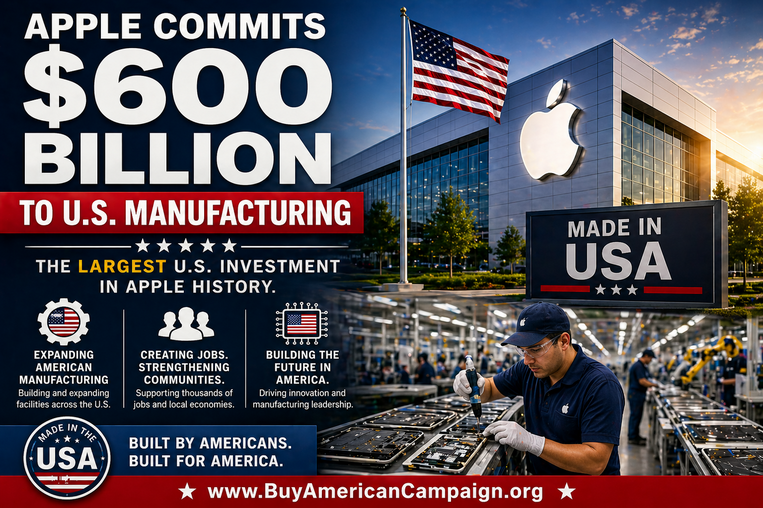
    Apple just made one of the largest American manufacturing commitments in corporate history. The company has raised its U.S. investment plan to a staggering $600 billion over the next four years — money that’s already turning into real factories, real partnerships, and real American jobs.

    Through its newly expanded American Manufacturing Program (AMP), Apple is pulling parts of its global supply chain back to U.S. soil — from the glass on your iPhone to the silicon in your MacBook to the servers powering Apple Intelligence. For a company that built its supply chain around Asia for two decades, this is a major reset. And it’s happening now.

    The Headline Numbers

    Let’s start with the scope of what Apple is actually doing:

    • $600 billion total U.S. investment commitment over four years
    • 20,000 new direct American jobs in R&D, silicon engineering, software, and AI
    • 450,000 supplier and partner jobs already supported across the U.S.
    • 10+ U.S. manufacturing partners including Corning, Texas Instruments, Samsung, Broadcom, Applied Materials, GlobalFoundries, and Amkor

    For perspective: $600 billion is more than the entire annual GDP of Sweden. And Apple is committing that to American manufacturing in just four years.

    iPhone Glass: Made in Kentucky

    One of the most concrete pieces of the program is happening at Corning’s Harrodsburg, Kentucky facility. Apple is investing in turning Harrodsburg into the largest and most advanced smartphone cover glass production site in the world. The plan: every iPhone and every Apple Watch sold globally will have cover glass made in Kentucky.

    Think about that. The screen of every iPhone on Earth — manufactured by American workers in a small town in central Kentucky. That’s the kind of supply chain decision that creates generational manufacturing jobs in communities that have been waiting for them.

    Browse American-Made Products

    AI Servers and Mac mini: Made in Houston

    In Texas, Apple is building a 250,000-square-foot server manufacturing facility in Houston that’s already producing AI servers ahead of schedule. The Houston campus is doubling its footprint to support full mass production starting in 2026.

    And here’s the news that should make every American smile: starting later this year, the Mac mini will be built in Houston. That’s the first time Apple will assemble the product on U.S. soil. A Mac mini sitting on an American desk, designed in Cupertino, assembled in Houston. That’s a sentence we haven’t been able to write very often in the last 25 years.

    Semiconductors: The Real Game

    The most strategically important piece of Apple’s program is what’s happening in chips. The U.S. lost most of its semiconductor manufacturing capacity over the last 30 years. Apple is helping bring it back — not by building chip factories itself, but by being the anchor customer that justifies billions in investment by U.S. chip suppliers.

    • Amkor is breaking ground on a $7 billion semiconductor packaging facility in Peoria, Arizona. Apple will be its first and largest customer.
    • GlobalWafers America is starting production at a new $4 billion silicon wafer plant in Sherman, Texas.
    • Texas Instruments, GlobalFoundries, and Samsung are all expanding U.S. production with Apple commitments behind them.

    This is exactly how reshoring is supposed to work. A massive U.S. customer commits long-term, and that commitment unlocks billions in domestic factory construction. Apple is using its scale the way American industrial giants used to — to build out an American supply chain.

    20,000 New American Jobs

    Apple says it’s creating 20,000 new direct American jobs through the program — not in retail or service, but in the high-skill categories that build economic strength: research and development, silicon engineering, software development, and artificial intelligence. These are the kinds of jobs that pay six figures, train the next generation of American engineers, and keep advanced industrial knowledge in the United States rather than overseas.

    On top of those direct hires, Apple’s broader U.S. operations already support 450,000 supplier and partner jobs. Add in the manufacturing buildout and the number grows from there.

    Join the Buy American Movement

    Why This Matters Beyond Apple

    For decades, the conventional wisdom in Silicon Valley was that hardware manufacturing belonged offshore. The U.S. would design, China would build. American workers would just have to accept that their role in the consumer electronics economy was over.

    Apple is now publicly betting $600 billion that the conventional wisdom was wrong. They’re betting that smart automation, advanced materials, and a skilled American workforce can produce world-class consumer electronics on U.S. soil — and that doing so makes their supply chain more resilient, their products more reliable, and their relationship with American customers stronger.

    If Apple can pull this off — and the early evidence in Kentucky, Texas, and Arizona says they can — it sets a template. Every other major American technology company will face the question: if Apple can manufacture iPhone glass in Kentucky and AI servers in Houston, why can’t we?

    What You Can Do

    If you buy Apple products, know that an increasing share of what’s in that box is now coming from American factories — designed, engineered, and increasingly assembled here. And every dollar spent on a U.S.-made Apple product is a dollar that flows back to a worker in Houston, Harrodsburg, Peoria, Sherman, or Cupertino.

    Apple’s $600 billion commitment isn’t just a tech story or a corporate PR story. It’s an American manufacturing story — the biggest one of the year. And it should be celebrated by anyone who wants to see this country making things again.

    Whenever possible, choose Made in USA.

    If you like what you see and think this post would be of interest to someone, please share
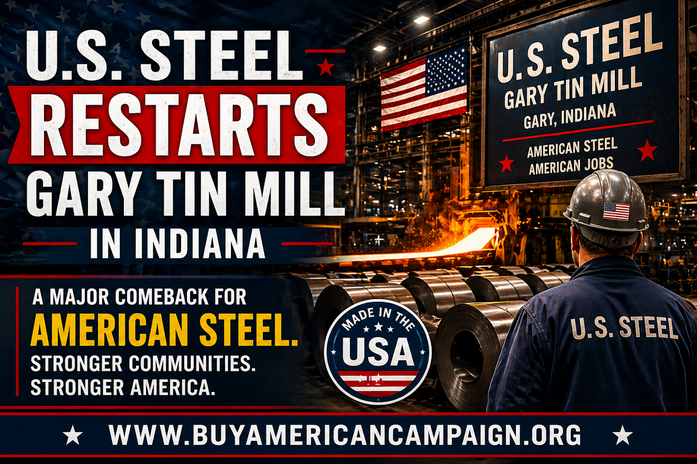
  • American Steel Comeback: U.S. Steel Restarts Gary Tin Mill, Adds 225 Jobs in Indiana

    American Steel Comeback: U.S. Steel Restarts Gary Tin Mill, Adds 225 Jobs in Indiana

    U.S. Steel Gary Tin Mill restart Indiana 225 jobs

    American steel is roaring back to Gary, Indiana. On April 16, 2026, U.S. Steel announced it is restarting the Gary Tin Mill — a facility that was indefinitely idled in 2022 — and bringing 225 American manufacturing jobs back to northwest Indiana. The mill is targeted to be back in operation by early 2027.

    This is exactly the kind of story the Buy American movement was built for. A great American steel facility, shut down by weak demand and foreign competition, getting fired up again to serve American customers with American-made product. Mined, melted, and made in the USA.

    Why the Gary Tin Mill Matters

    If you’ve never thought about where the tin in a soup can comes from, you’re not alone. But it matters — a lot. The Gary Tin Mill produces the kind of tin mill steel used in the most everyday American products imaginable:

    • Food cans for soups, vegetables, and pet food
    • Beverage cans
    • Aerosol cans for everything from spray paint to shaving cream
    • Oil filters for cars and trucks

    When the Gary mill went idle in 2022, American food packagers, farmers, and manufacturers had fewer domestic options to source the steel they needed. That meant more reliance on imports — and more exposure to foreign supply chains for the very containers that hold America’s food supply.

    225 Jobs — and What They Really Mean

    The headline number is 225 jobs. But in northwest Indiana — a region built on steel — those 225 jobs ripple outward. Steelworkers spend their paychecks at local restaurants, hardware stores, and small businesses. Their kids fill local schools. Their union contributions help fund retirement and healthcare for thousands more.

    Browse American-Made Products

    Gary, Indiana built itself around U.S. Steel more than a century ago. When mills shut down, communities suffer. When mills come back, communities come back with them. That’s the story unfolding right now in Lake County.

    “Customers Want Dependable Domestic Supply”

    U.S. Steel President and CEO David B. Burritt put it plainly when announcing the restart:

    “Customers are increasingly focused on securing dependable domestic supply they can count on over the long term. Restarting the Gary Tin Mill positions us to serve that demand, support domestic manufacturing, and strengthen critical U.S. supply chains — including those that help support American farmers and food producers.”

    Read that again. Customers — meaning American food companies, beverage producers, and manufacturers — are actively asking for American-made steel. They’ve lived through the supply chain shocks of the last several years and they want suppliers they can rely on. U.S. Steel is responding to that demand by bringing back capacity it had previously written off.

    $15–$20 Million to Restart, Billions Behind It

    The restart itself is expected to cost between $15 million and $20 million. But that figure understates the broader investment commitment behind Gary Works. Following Nippon Steel’s $15 billion partnership with U.S. Steel finalized in June 2025, Nippon committed $11 billion in total investments in U.S. Steel by 2028 — including roughly $3.1 billion specifically earmarked for Gary Works upgrades.

    That kind of capital pouring into a single American steel complex is significant. Gary Works isn’t just being maintained — it’s being modernized for the next era of American manufacturing.

    Join the Buy American Movement

    The Bigger American Steel Story

    For decades, American steel was treated as a relic — an industry that “couldn’t compete” with cheaper foreign producers. Mill after mill closed. Towns built around steel hollowed out. The U.S. became a net importer of the very material that built our skyscrapers, our bridges, our cars, and our cans.

    That era is finally turning. With smarter trade policy, real investment from partners willing to bet on America, and renewed customer demand for “made here” supply, mills like the Gary Tin Mill are coming back online. This isn’t nostalgia — this is the real, hands-dirty work of rebuilding American industrial capacity, one furnace at a time.

    What You Can Do About It

    The next time you grab a can of soup, a soda, or a can of spray paint off the shelf, look for products packaged by American food and beverage companies. Many of them — Campbell’s, Hormel, Goya, Ball, and others — source domestic tin steel whenever they can. Buying their products is a direct vote for the workers in Gary, Indiana, who are about to get their jobs back.

    This is how it works. Companies bring jobs back when customers ask for American-made. Customers ask for American-made when they understand what’s at stake. And when 225 steelworkers get to clock in at the Gary Tin Mill again, that’s a victory for every American who chose domestic over imported.

    Whenever possible, choose Made in USA.

    If you like what you see and think this post would be of interest to someone, please share
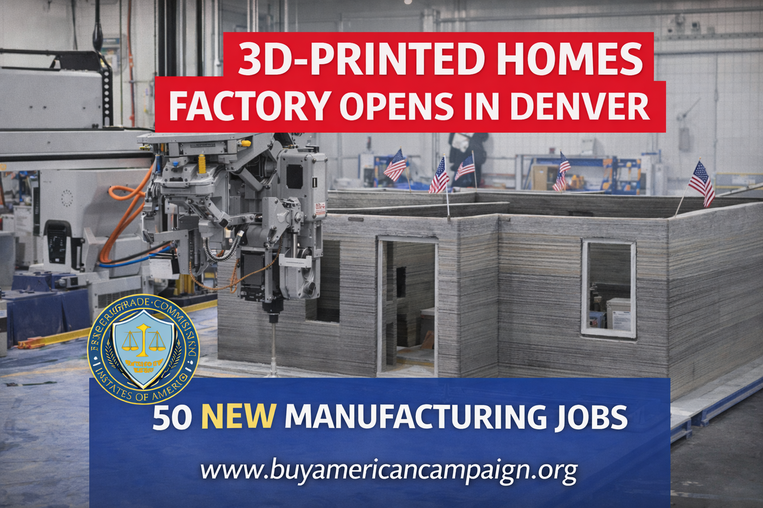
  • Made in Denver: 3D-Printed Home Factory Opens, Aims for 7,000 Houses a Year

    Made in Denver: 3D-Printed Home Factory Opens, Aims for 7,000 Houses a Year

    Azure Printed Homes Denver 3D-printed home factory grand opening

    American manufacturing innovation just moved into Northeast Denver. On April 15, 2026, Azure Printed Homes officially opened its brand-new 25,000-square-foot 3D-printed home factory — with Colorado Governor Jared Polis on hand for the ribbon cutting. The goal is ambitious: up to 7,000 housing units produced every single year, built with recycled American materials, powered by American technology, and assembled by American workers.

    This is what next-generation American manufacturing looks like. And it’s tackling one of the biggest problems this country faces — the housing shortage — with the one tool that has always gotten us out of tight spots: American ingenuity.

    A New Kind of Home Factory

    Azure isn’t a traditional construction company. The company is a vertically integrated housing manufacturer — meaning they control the entire process, from raw material to finished home, under one roof. Their secret sauce is proprietary, large-scale 3D printing technology that lets them build homes faster, more affordably, and with less waste than standard construction.

    Inside the new Denver facility, advanced 3D printers work alongside light-gauge steel fabrication machines from FrameCAD to produce homes that are strong, fire resistant, and built to stand up to harsh weather — exactly the kind of durability Colorado, California, and other Western states need right now.

    Recycled Plastic to Front Door

    Here’s where the story gets even better. Azure’s homes are printed using recycled plastic — turning what would be waste into walls, floors, and structural components. That’s American manufacturing not just bringing jobs home, but making the final product more sustainable than what a foreign factory could deliver.

    Browse American-Made Products

    50 New Manufacturing Jobs in Denver

    The new facility is expected to create at least 50 new manufacturing jobs in the Denver region. Those aren’t abstract numbers. They’re paychecks, families, and the kind of skilled, stable manufacturing work that builds middle-class communities. And because Azure’s operation is integrated under one roof, those jobs span printing, fabrication, quality control, logistics, and skilled trades — a full ecosystem of American manufacturing talent.

    Governor Polis showed up for a reason. When a company opens an American factory of this size, in this state, solving a problem as massive as housing affordability, the economic and political impact is enormous. Colorado is betting that companies like Azure are the future of American industry — and they’re putting state resources behind that bet.

    From Startup to Scale

    Azure Printed Homes was founded in 2022. In just a few years, they’ve already delivered more than 100 homes across the country. That’s not vaporware — that’s real product, real customers, real construction. The Denver factory is the step that takes them from proven concept to national scale.

    At maximum output, 7,000 units per year would represent a serious contribution to the U.S. housing supply. For context, that’s enough homes to shelter a small American city — produced in a single building, year after year, right here on U.S. soil.

    Join the Buy American Movement

    Why This Matters for American Manufacturing

    For decades, the conventional wisdom has been that manufacturing in America can’t compete on price. Azure is challenging that assumption head-on. By combining cutting-edge 3D printing with recycled domestic materials and smart factory design, the company is producing homes at a price point that makes economic sense — without shipping the work overseas.

    That’s the formula that’s going to rebuild American manufacturing across industries. It isn’t about turning back the clock. It’s about using American technology, American capital, and American workers to out-build everyone else, on our own soil, with products that are cheaper, better, and greener than the imports.

    The Bigger Picture

    America has two problems that rhyme: a shrinking manufacturing base and a worsening housing shortage. Azure is taking a real swing at both at the same time. More factories like this one — using American innovation to build American products that solve American problems — is exactly what a Buy American movement should be rooting for.

    If you’re a homebuyer, a city planner, a builder, or just someone who wants to see the country making things again, keep an eye on Azure. The 25,000-square-foot building in Denver isn’t just a factory. It’s a preview of what the next decade of American manufacturing can look like when we stop settling for “good enough” imports and start backing our own people to build something better.

    Whenever possible, choose Made in USA.

    If you like what you see and think this post would be of interest to someone, please share
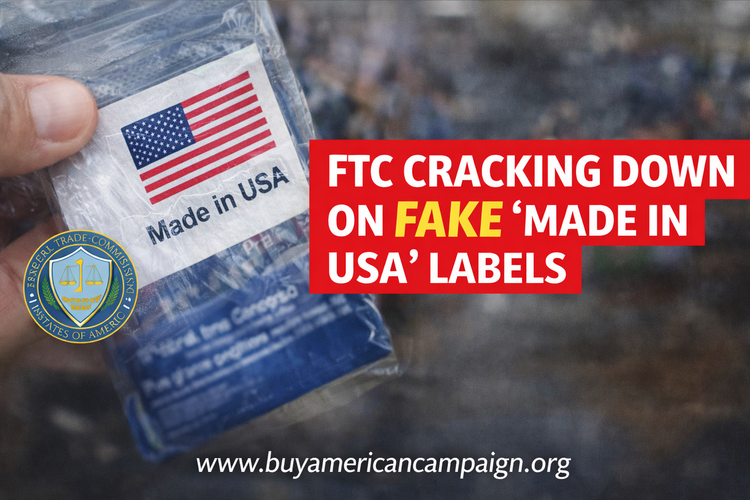
  • FTC Just Cracked Down on Fake “Made in USA” Claims — Including an American Flag Maker

    FTC Just Cracked Down on Fake “Made in USA” Claims — Including an American Flag Maker

    FTC cracks down on fake Made in USA labels

    Every American who has ever flipped over a product looking for “Made in USA” has, at some point, wondered whether the label is actually true. On April 14, 2026, the Federal Trade Commission gave us our clearest answer yet: sometimes it isn’t — and the government is done looking the other way.

    The FTC just announced a sweeping enforcement action against three companies accused of deceiving American consumers with false “Made in the USA” claims. One of them was selling American flags that were actually made in China. If that doesn’t sum up exactly why the Buy American Campaign exists, nothing does.

    Three Companies, Three Violations, One Clear Message

    The FTC’s sweep follows President Trump’s March executive order, “Ensuring Truthful Advertising of Products Claiming to be made in America.” The message from the government is simple: if you put “Made in USA” on your product, you’d better be able to prove it. Here are the three companies that couldn’t.

    Case 1: The American Flag That Wasn’t American

    Americana Liberty LLC and Three Nations LLC were selling patriotic flag display products and related merchandise marketed as “Made in the USA.” According to the FTC’s complaint, those flags — the ones consumers bought specifically to display their pride in American craftsmanship — were actually manufactured in China. The companies agreed to pay $167,740 in penalties and stop the false advertising.

    Think about that for a second. Customers chose these products precisely because they wanted an American-made flag. They paid a premium for that claim. And they were lied to about the one thing that mattered most.

    Browse American-Made Products

    Case 2: TouchTunes Dartboards

    TouchTunes Music Co., a New York-based company that sells electronic dartboards, advertised its products with “Made in the USA” claims that the FTC says were not substantiated. This case is notable because the consumer redress payment — $625,000 — is the largest ever under the FTC’s Made in USA Labeling Rule.

    That number matters. It signals that the FTC isn’t just handing out wrist slaps anymore. Companies that cheat on Made in USA claims are now looking at real financial consequences, and the size of this settlement is a message to every other brand thinking about taking the same shortcut.

    Case 3: Oak Street Bootmakers

    Oak Street Manufacturing, which does business as Oak Street Bootmakers, allegedly claimed its boots, loafers, moccasins, and other footwear were “handcrafted 100%” in the United States. The FTC says the reality was different. Since May 2023, the complaint alleges, the company used a factory in the Dominican Republic to produce the top portion of certain footwear, with outsoles sourced from a factory in Brazil.

    For a brand built on heritage and craftsmanship, that’s a particularly painful allegation. And for the customers who paid premium prices expecting 100% American-made boots, it’s the kind of betrayal that makes people stop trusting labels altogether.

    Why This Crackdown Matters for Honest American Manufacturers

    Here’s what gets lost in most coverage of cases like these: the real victims aren’t just consumers. The biggest losers are the honest American manufacturers who actually make their products here, pay American workers a real wage, source from American suppliers, and compete on a playing field that isn’t supposed to include cheaters.

    When a competitor slaps “Made in USA” on a product they secretly imported, they undercut the legitimate American factory down the road. They pocket the patriotism premium without doing the work. Every enforcement action the FTC brings is a win for the companies doing it the right way — and a reason for consumers to keep rewarding those companies with their dollars.

    Join the Buy American Movement

    How to Protect Yourself as a Shopper

    The FTC’s rule is actually pretty clear. For a product to be labeled “Made in USA” without qualification, it has to be “all or virtually all” made in the United States. That means the final assembly happens here, and all significant parts, processing, and labor come from here too.

    When you’re shopping, a few habits go a long way. Look for specific factory locations, not vague language. A brand that says “Built in Decatur, Alabama” or “Sewn in North Carolina” is telling you something verifiable. A brand that just says “American-designed” or “Proudly American” is leaving itself wiggle room. Check the Buy American Campaign product directory when you’re not sure — the companies listed there have been vetted.

    The Bottom Line

    This enforcement sweep is good news. It means the labels you’re trying to trust are finally being backed up by real consequences for the companies that abuse them. It means honest American manufacturers can compete without being undercut by imposters. And it means your purchase decisions — when you choose a product that’s genuinely Made in USA — carry more weight than ever.

    Keep looking at those labels. Keep asking the questions. And when you find a company doing it right, reward them. That’s how this changes — one honest purchase at a time.

    Whenever possible, choose Made in USA.

    If you like what you see and think this post would be of interest to someone, please share
  • GE Appliances Invests $28 Million in Alabama Plant — And in the Workers Who Build America’s Refrigerators

    GE Appliances Invests $28 Million in Alabama Plant — And in the Workers Who Build America’s Refrigerators

    GE Appliances Decatur Alabama refrigeration plant $28 million investment

    American manufacturing just got another shot in the arm — and this one comes with a refreshing twist. On April 16, 2026, GE Appliances opened the doors of its Decatur, Alabama refrigeration plant to government officials and community leaders to unveil a $28 million investment in state-of-the-art factory upgrades and a brand-new on-site primary care clinic for the workers who build America’s fridges.

    This isn’t a press release about a future promise. The equipment is installed. The clinic is open. And the people on the factory floor in Morgan County — the folks who actually put these appliances together — are already feeling the difference.

    The Biggest Refrigeration Plant in the Country

    If you own a top-freezer refrigerator in the United States, there’s a very good chance it was built in Decatur. GE Appliances’ Morgan County facility is the largest refrigeration manufacturing operation in America, and it produces the single most popular style of fridge sold in the country.

    The plant runs three shifts, which means American workers are clocking in around the clock to keep up with demand. Every fridge that rolls off that line is stamped with something we don’t get to say often enough anymore: Made in America.

    What the $28 Million Actually Bought

    A big portion of the investment went into new, highly automated thermoforming machines. These are the machines that produce the interior plastic liners you see inside the fresh food and freezer compartments of your top-freezer fridge. The upgrade boosts efficiency and expands production capacity across multiple models — meaning the Decatur plant can build more, faster, without cutting corners.

    GE also added new lighting throughout the plant and installed 21 new commercial air-conditioning units to improve the work environment. If you’ve ever worked in a factory without proper cooling, you know that’s not a small thing. It’s a concrete, day-to-day quality-of-life upgrade for the people on the floor.

    Browse American-Made Products

    A Free On-Site Clinic for Workers and Their Families

    Here’s the part that caught our attention. The $28 million also funded a new, state-of-the-art primary care clinic right on the factory grounds — serving GE Appliances employees and their covered family members ages two and up. Managed by healthcare provider CareATC and free to employees on the company health plan, the clinic eliminates a huge barrier that hourly workers everywhere know well: the time, travel, and cost of getting medical care.

    This is the fourth on-site primary care clinic GE Appliances has opened at a U.S. manufacturing site. The others are in Louisville, Kentucky; Selmer, Tennessee; and LaFayette, Georgia. The Decatur location builds on what the company has already seen work at those plants: healthier workers, fewer missed shifts, and a stronger bond between the company and its workforce.

    Part of a Much Bigger American Manufacturing Bet

    The Decatur investment isn’t a one-off. It’s a piece of GE Appliances’ previously announced $3 billion commitment to expand U.S. manufacturing over the next five years. That’s $3 billion flowing into American plants, American suppliers, and American communities — at a time when plenty of companies are still looking overseas.

    For a company whose brand is woven into the history of American households, it’s a statement that matches the legacy. Refrigerators, washers, dryers, ovens — the appliances that made the modern American home possible were built here. GE is doubling down on the idea that they still should be.

    Join the Buy American Movement

    Why Decatur Matters

    Morgan County, Alabama isn’t on a coast. It isn’t on a glossy tech magazine cover. But it is home to a massive American factory that builds a product tens of millions of U.S. households depend on every single day. When GE invests $28 million in a plant like this, the ripple effect touches hourly wages, local suppliers, healthcare providers, small businesses in town, school tax revenue, and the overall sense that manufacturing has a real future in this part of the country.

    It’s the kind of story that rarely makes national headlines, and that’s exactly why it deserves attention. Decatur is one of dozens of American towns where factories are still humming — and where a company’s willingness to reinvest is the difference between a thriving community and a shuttered one.

    A Model Worth Copying

    Modernized equipment that boosts output. Upgrades that make the work environment better. A free clinic that treats the people on the line like the essential workers they are. That’s a blueprint more American manufacturers should be looking at — and one more American consumers should be rewarding with their purchase decisions.

    Next time you’re shopping for a new fridge, take thirty seconds to check where it was built. If it says Decatur, Alabama — you’re buying a product that was made by American hands, in an American factory, for an American home. That’s exactly the kind of vote we all get to cast, every time we open our wallets.

    Whenever possible, choose Made in USA.

    If you like what you see and think this post would be of interest to someone, please share
  • “Product of USA” Label Gets a Reset — What It Means for American Farmers and Consumers

    “Product of USA” Label Gets a Reset — What It Means for American Farmers and Consumers

    USDA Product of USA Label Update

    The United States Department of Agriculture has introduced a new voluntary “Product of USA” label for meat, poultry, and egg products — and it marks a significant shift in how food is labeled in this country.

    For years, the “Product of USA” label has been widely criticized for being misleading. Under previous rules, meat could carry the label even if the animal was raised outside the United States, as long as the product was processed or packaged domestically. That created confusion for consumers and frustration for American farmers competing against imported products.

    The new rule is designed to change that.

    A Clearer Standard for “Product of USA”

    Under the updated guidance from the USDA, companies can only use the “Product of USA” label if the animal was born, raised, slaughtered, and processed entirely within the United States. This creates a much stricter and more transparent definition of what it actually means for a product to be American.

    For consumers, that means the label now carries real meaning. If you see “Product of USA” on meat, poultry, or eggs, it reflects the full lifecycle of production — not just the final step in a processing facility.

    Why This Matters

    This change addresses a long-standing problem. Many shoppers believed they were supporting American agriculture when they purchased products labeled “Product of USA,” only to learn that the animals may have been raised overseas. That disconnect undermined trust and made it harder for consumers to make informed choices.

    For American farmers and ranchers, the issue went even deeper. Domestic producers operate under stricter standards, higher costs, and more regulatory oversight. Competing against imported products that could carry the same label created an uneven playing field.

    The new labeling guidance helps correct that imbalance by giving American producers a clearer way to differentiate their products in the marketplace.

    Browse American-Made Products

    Still Voluntary — But More Meaningful

    It is important to note that the “Product of USA” label remains voluntary. Companies are not required to use it, and many products will continue to be sold without it. However, for those that do choose to use the label, the new standard raises the bar significantly.

    This creates an opportunity for brands that truly source and produce domestically to stand out. It also gives consumers a clearer signal when they want to support American agriculture and American jobs.

    What This Means for the Buy American Movement

    This change aligns directly with the goals of the Buy American movement. Transparency matters. Labels should reflect reality, not marketing loopholes. When consumers choose to buy American, they deserve to know that what they are buying was actually made — or in this case, raised — here.

    The updated “Product of USA” definition moves the market in that direction. It reinforces the idea that where something is made — or in this case, raised — matters.

    Join the Buy American Movement

    The Bigger Picture

    This is not just about labeling. It is about rebuilding trust between producers and consumers. It is about giving American farmers the recognition they have earned. And it is about making it easier for people to support domestic production when they choose to do so.

    In a global marketplace where supply chains are increasingly complex, clarity becomes more valuable. The new USDA guidance is a step toward that clarity.

    The Bottom Line

    The new “Product of USA” label is not a mandate, but it is a meaningful correction. It restores credibility to a label that had lost its impact and gives both producers and consumers a clearer understanding of what “American-made” really means in the food supply.

    For anyone who wants to support American agriculture, this is a step in the right direction. And for the broader Buy American movement, it is a reminder that transparency and accountability are just as important as production itself.

    Whenever possible, choose Made in USA.

    If you like what you see and think this post would be of interest to someone, please share
  • Artemis II Successfully Returned — Built by American Manufacturers Who Delivered

    Artemis II Successfully Returned — Built by American Manufacturers Who Delivered

    Artemis II Successfully Returned - Built by American Manufacturers

    After a 10-day, 695,081-mile journey around the Moon, Artemis II has successfully returned its crew safely to Earth. For the first time in more than 50 years, humans traveled beyond low Earth orbit and came back — proving that the United States not only still has the capability to reach deep space, but to execute a mission of this complexity from start to finish.

    The crew — Reid Wiseman, Victor Glover, Christina Koch, and Jeremy Hansen — completed a mission that demanded perfection from every system on board. And that is exactly what they got. Because behind Artemis II is a nationwide network of American manufacturers who built the components that made this mission possible — and ensured it worked when it mattered most.

    The Spacecraft: Built in Louisiana, Powered by a Nation

    The Orion spacecraft was built by Lockheed Martin at NASA’s Michoud Assembly Facility in New Orleans. But while Lockheed Martin assembled the spacecraft, Orion itself is the result of contributions from companies across the United States — each responsible for highly specialized systems that had to perform flawlessly in deep space.

    This was not a controlled test. This was a full mission under real conditions, and every piece of hardware had to work. The success of Artemis II confirms that it did.

    American-Made Aluminum From West Virginia

    At Constellium in Ravenswood, West Virginia, the highly trained men and women of United Steelworkers Local 5668 produced the Airware aluminum-lithium alloy used “tip to tail” across the entire Artemis II mission. The facility employs more than 1,100 people and is one of the world’s largest aluminum rolled products manufacturing sites, specializing in aerospace-grade materials.

    More than 20 years of research and development went into perfecting this material, which offers lower density, higher stiffness, thermal stability, corrosion resistance, and superior damage tolerance compared to traditional aerospace aluminum. From the rocket’s structure to the spacecraft’s hull, Constellium’s alloy was the foundation that held the entire mission together — and over 695,081 miles of deep space travel, it performed exactly as engineered.

    Life-Saving Engineering from Massachusetts

    In Worcester, Massachusetts, the David Clark Company produced one of the most critical elements of the mission: the Orion Crew Survival System spacesuits. These bright orange suits are far more than protective gear. They are fully integrated life-support systems designed to sustain astronauts for up to six days in the event of an emergency.

    Each suit includes built-in air supply, water, food provisions, and waste management — effectively functioning as a personal survival system in space. The company’s expertise in pressure suits dates back to 1941, including its role in developing suits for X-1 rocket plane test pilots who first broke the sound barrier. That legacy carried forward into Artemis II, where the suits performed exactly as designed.

    Browse American-Made Products

    Precision Controls from Illinois

    In Carpentersville, Illinois, OTTO Engineering manufactured 17 unique switch controls used throughout the Orion spacecraft. These switches are essential interfaces between the crew and the spacecraft’s systems, allowing astronauts to execute commands with precision in an environment where there is no room for error.

    Every interaction during the mission relied on these components functioning perfectly. And they did. As Tom Roeser of OTTO Engineering said, “It’s the American dream. You can, in a little town of Carpentersville 40 miles outside of Chicago, find enough capable talent to design and manufacture products of this complexity.” Artemis II proved that statement true.

    Advanced Materials That Protected the Crew

    Space is unforgiving, and the materials used in spacecraft must be able to withstand extreme threats. McDanel Advanced Materials manufactured every window pane for Orion, engineering them as multi-layered systems capable of protecting the crew from micrometeoroids traveling at high velocity. These windows are not simply for visibility — they are part of the spacecraft’s protective structure.

    At the same time, Elmet Technologies in Euclid, Ohio supplied high-performance materials essential to the spacecraft’s structural integrity and thermal resistance. These materials are engineered to perform under extreme heat, pressure, and radiation, ensuring that Orion could endure the conditions of deep space travel. Their performance during the mission validated years of research and development behind these advanced materials.

    Join the Buy American Movement

    Decades of Manufacturing Excellence in California

    In Sacramento, California, Tecma contributed thousands of components to Artemis II, continuing a legacy that spans 98 space programs. The company’s history includes manufacturing guillotine cutter assemblies for Apollo 11, and that same level of precision and reliability was brought forward into this mission.

    Artemis II is not an isolated achievement. It is the continuation of decades of American manufacturing experience, where companies like Tecma refine their capabilities over time and apply them to increasingly complex challenges. The success of this mission demonstrates that this expertise remains strong and relevant today.

    Inspiring the Next Generation

    For astronaut Christina Koch, Artemis II represents more than a successful mission. It is an opportunity to inspire the next generation of engineers, scientists, and skilled workers. As she emphasized, “The thing I love about the moon is that it’s not just a beacon for exploration and this platform of possibilities for incredible missions like this, but it has benefits. You have everything from innovation, technology development, not only for future missions going deeper into the solar system, but technologies as it comes back to Earth. You have inspiration. A whole generation of people starting this pipeline of STEM workers and manufacturers and operators that are excited to see what you can do when you work hard and come together as a team.”

    That inspiration is grounded in reality. This mission showed that the opportunities still exist — not just in space, but in the factories, labs, and manufacturing floors across the United States where these systems are built.

    The Bottom Line

    Artemis II did not just reach deep space. It returned safely. That outcome required every system, every material, and every component to perform exactly as designed under real-world conditions.

    From West Virginia to Massachusetts, from Illinois to California, American manufacturers delivered. Their work was tested in the harshest environment imaginable — and it held up.

    This mission is proof. Proof that American manufacturing is still capable of building the systems that push humanity forward. Proof that when it matters most, the United States can rely on its own industrial base to deliver results.

    Artemis II is now complete. The crew is home. And the companies that made it possible have once again demonstrated what American manufacturing can do.

    Whenever possible, choose Made in USA.

    If you like what you see and think this post would be of interest to someone, please share
  • Hellwig Products Celebrates 80 Years of American-Made Suspension Excellence

    Hellwig Products Celebrates 80 Years of American-Made Suspension Excellence

    Hellwig Products 80 Years American-Made Suspension

    In an era where many manufacturing companies have moved production overseas, stories like this stand out for a different reason. Hellwig Products — a company that has been building suspension components in the United States for decades — is celebrating 80 years of American-made manufacturing.

    Founded in 1946, Hellwig Products began as a small operation focused on helping truck owners improve load stability and performance. What started as a practical solution for everyday drivers has grown into a well-respected name in the automotive suspension industry — all while keeping its manufacturing roots firmly planted in the United States.

    80 Years of American Manufacturing

    Reaching an 80-year milestone is no small feat in any industry, but especially in manufacturing. Over the past eight decades, the U.S. has seen major shifts — globalization, offshoring, supply chain disruptions, and rapid technological change.

    Through all of it, Hellwig has continued to produce its suspension products domestically. That consistency says a lot about the company’s approach. Rather than chasing short-term cost savings overseas, they’ve focused on maintaining control over quality, production, and engineering right here at home.

    It’s a reminder that American manufacturing doesn’t just survive — it can thrive when companies commit to long-term craftsmanship and innovation.

    Built for Performance, Made in the USA

    Hellwig Products is best known for its high-performance suspension components, including sway bars, helper springs, and load control systems. These products are designed to improve vehicle stability, handling, and safety — particularly for trucks, RVs, and heavy-duty applications.

    But what really sets the company apart is where those products are made. While many competitors have shifted production overseas, Hellwig continues to manufacture in the United States, giving them tighter control over materials, engineering standards, and final product quality.

    That commitment to domestic production also means supporting American jobs — from skilled manufacturing workers to engineers and logistics teams. It’s the kind of ecosystem that strengthens not just one company, but entire communities.

    Browse American-Made Products

    Why Longevity Like This Matters

    There’s something different about a company that’s been around for 80 years. It means they’ve adapted, evolved, and continued to deliver value across multiple generations of customers.

    In manufacturing, longevity often comes down to a few key things: quality, trust, and the ability to innovate without losing your core identity. Hellwig’s continued presence in the market suggests they’ve managed to balance all three.

    It also highlights an important point that often gets overlooked — American manufacturing isn’t just about new startups or policy changes. It’s also about legacy companies that have been quietly building, producing, and improving products for decades.

    A Different Kind of Competitive Advantage

    In today’s global economy, many companies compete primarily on price. That often leads to outsourcing production to lower-cost regions. But companies like Hellwig take a different approach.

    By keeping manufacturing in the U.S., they compete on quality, durability, and performance. Customers who choose their products aren’t just buying a component — they’re investing in reliability and long-term value.

    This kind of positioning matters more than ever. As supply chain disruptions have shown in recent years, relying heavily on overseas production can create vulnerabilities. Domestic manufacturing offers a level of stability and responsiveness that’s hard to replicate.

    Join the Buy American Movement

    What This Means for the Buy American Movement

    At Buy American Campaign, stories like this reinforce a simple idea: American manufacturing is still here — and it’s still capable of producing high-quality, competitive products.

    Hellwig’s 80-year milestone isn’t just a company achievement. It’s a reflection of what’s possible when businesses commit to building products in the United States, investing in their workforce, and maintaining high standards over the long term.

    For consumers, it’s also a reminder that where you spend your money matters. Supporting American-made companies helps sustain jobs, strengthen local economies, and encourage more businesses to keep production here at home.

    Looking Ahead

    As Hellwig Products celebrates 80 years, the question becomes: what’s next? If the past is any indication, the company will continue doing what it has always done — focusing on quality, innovation, and American manufacturing.

    In a time when the conversation around reshoring and domestic production is gaining momentum, companies like Hellwig serve as proof that building in America isn’t just possible — it’s sustainable.

    And that’s exactly the kind of story worth paying attention to.

    Whenever possible, choose Made in USA.

    If you like what you see and think this post would be of interest to someone, please share
  • U.S. Manufacturing Growth Hits 3.5-Year High as Factory Activity Surges

    U.S. Manufacturing Growth Hits 3.5-Year High as Factory Activity Surges

    U.S. Manufacturing Growth 3.5-Year High

    For the first time in years, there’s a measurable shift happening in American industry — and the data is starting to back it up. U.S. manufacturing growth just hit a 3.5-year high, with the ISM Manufacturing PMI rising to 52.7% in March 2026. That’s the strongest reading since mid-2022 and a clear signal that factory activity across the country is picking up real momentum.

    Even more notable, this reading came in slightly above expectations. Economists had forecast a PMI closer to 52.5%, meaning the actual number not only shows expansion but also a modest upside surprise. In a sector that has faced years of uncertainty, that matters.

    And here’s the key point: any PMI reading above 50 indicates expansion. At 52.7, this isn’t just growth — it’s accelerating growth.

    What This Means for U.S. Manufacturing Growth

    The recent surge in U.S. manufacturing growth suggests that something deeper may be happening beneath the surface. For years, policymakers, businesses, and consumers have talked about reshoring — bringing production back to the United States after decades of offshoring. Now, we may be seeing early signs that those efforts are starting to gain traction.

    Factories are getting busier. Orders are increasing. Production lines that were once idle or underutilized are ramping back up. And while this doesn’t mean the U.S. has fully reversed decades of manufacturing decline, it does point to a shift in direction.

    In simple terms: more goods are being made in America today than just a year ago, and the pace of that production is increasing.

    A Strong Signal After Years of Uncertainty

    This data is especially important because it follows a long stretch of mixed or stagnant readings. The manufacturing sector has been navigating a complex environment — rising interest rates, supply chain disruptions, global instability, and shifting consumer demand.

    For much of the past few years, manufacturing growth has been uneven. Some months showed expansion, while others hinted at contraction. That inconsistency made it difficult to determine whether a true recovery was underway.

    Now, with the PMI hitting its highest level in 3.5 years, the picture is becoming clearer. This isn’t just a one-off bounce. It’s part of a broader trend of strengthening activity.

    Major outlets including Bloomberg, Reuters, MarketWatch, and Quartz all reported on the data — and the consensus is consistent: U.S. manufacturing is gaining momentum.

    Browse American-Made Products

    Reshoring and Domestic Investment Are Playing a Role

    One of the most interesting aspects of this story is what’s likely driving the improvement. Over the past few years, there’s been a growing push to bring production closer to home.

    Companies are rethinking their supply chains. Instead of relying heavily on overseas manufacturing, many are exploring domestic alternatives. This shift has been influenced by a combination of factors — geopolitical tensions, shipping disruptions, rising costs abroad, and a renewed focus on national resilience.

    At the same time, investment in American manufacturing has been increasing. Businesses are putting money into new facilities, upgrading equipment, and expanding production capacity. Government incentives and financing programs have also played a role in making these investments more viable.

    All of this contributes to the broader trend we’re seeing now: stronger U.S. manufacturing growth driven by a shift back toward domestic production.

    Not Without Challenges

    That said, the picture isn’t entirely smooth. While manufacturing activity is expanding, there are still real headwinds that could impact how sustainable this growth is.

    One of the biggest concerns right now is rising input costs. Manufacturers are facing higher prices for raw materials, components, and energy. These cost increases can squeeze margins and make it harder to maintain profitability, even as production levels rise.

    In addition, supplier delivery performance has deteriorated. Global tensions continue to disrupt supply chains, leading to delays and uncertainty. Even as companies try to localize production, many still depend on international inputs that can be affected by external factors.

    These challenges don’t erase the progress being made, but they do highlight the complexity of rebuilding a strong and resilient manufacturing base.

    Join the Buy American Movement

    Why This Matters for the Bigger Picture

    At Buy American Campaign, this is exactly the kind of signal we pay attention to. U.S. manufacturing growth isn’t just an economic statistic — it’s a reflection of where products are being made, where jobs are being created, and how resilient our supply chains really are.

    When manufacturing expands in the United States, the benefits tend to extend far beyond the factory floor. It means more job opportunities, stronger local economies, and increased demand for domestic suppliers and services.

    It also means consumers have more opportunities to support American-made products. Every purchase becomes part of a larger cycle — one that either strengthens domestic production or continues to push it overseas.

    The fact that American factories are now busier than they’ve been in years is a meaningful development. It suggests that the conversation around reshoring and buying American is starting to translate into real-world results.

    Momentum Is Building

    The March PMI reading doesn’t guarantee long-term success, but it does indicate that momentum is building. After years of volatility, the manufacturing sector appears to be moving in a more positive direction.

    The question now is whether that momentum can be sustained. Continued investment, stable supply chains, and manageable cost pressures will all play a role in determining what happens next.

    But for now, the takeaway is clear: U.S. manufacturing growth is real, and it’s accelerating. American factories are producing more, hiring more, and contributing more to the economy than they have in recent years.

    That’s not just good news for manufacturers. It’s good news for workers, communities, and anyone who believes in rebuilding America’s industrial strength.

    Whenever possible, choose Made in USA.

    If you like what you see and think this post would be of interest to someone, please share