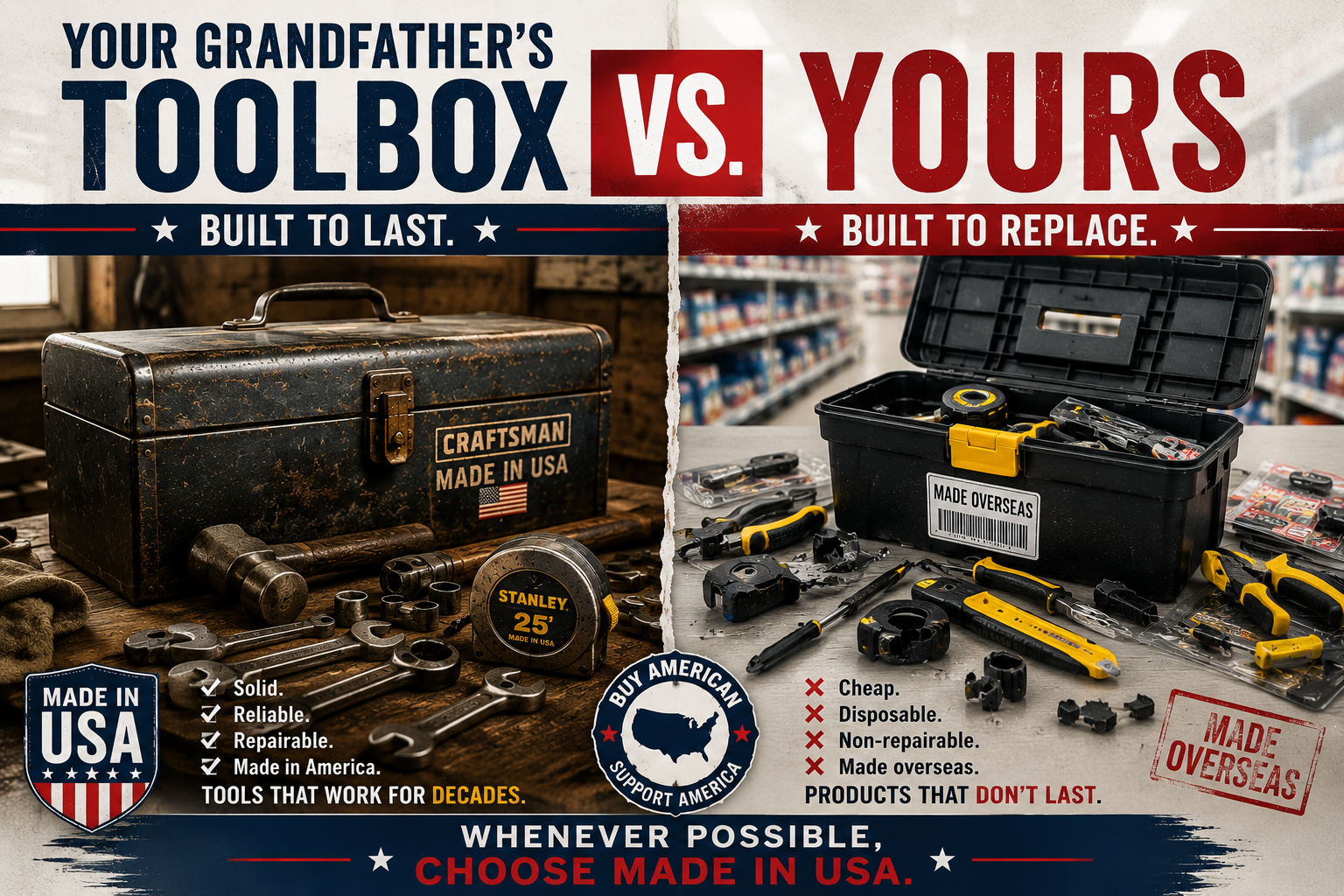
Walk into your grandfather’s garage and you’ll probably still find tools that are older than you are.
Heavy steel wrenches. Old Craftsman sockets. A scarred-up toolbox that has survived decades of work. Maybe an old Stanley tape measure with faded lettering or a drill that somehow still runs perfectly after 40 years.
Most of it was made in America.
Now walk through a modern big-box store.
Plastic packaging. Disposable products. Cheap imports designed to be replaced instead of repaired. Tools that feel lighter, weaker, and somehow temporary before you even open the box.
Somewhere along the way, America stopped building products to last — and most people barely noticed it happening.
We Didn’t Just Lose Factories
People often talk about manufacturing as if it’s only about economics.
Jobs. Tariffs. Trade deficits. Supply chains.
But something deeper disappeared too.
America once had a culture of building things with pride. Products were expected to survive years of real use. Workers took pride in craftsmanship because their names, towns, and reputations were attached to what they made.
When manufacturing left, some of that mindset left with it.
The Era of Disposable Everything
Today, many products are designed around replacement cycles instead of durability.
Phones that can’t be repaired. Appliances that fail after a few years. Cheap tools that snap under pressure. Furniture made from particle board instead of solid wood.
Consumers got trained to accept lower quality because the prices looked cheaper upfront.
But was it actually cheaper?
Your grandfather bought one toolbox that lasted 40 years.
Modern consumers buy replacements over and over again.
“Made in USA” Used to Mean Something
There was a time when “Made in USA” wasn’t just a patriotic slogan. It was shorthand for quality.
American manufacturing earned that reputation through generations of workers who built products meant to survive real-world use.
That reputation helped build some of the most trusted brands in the world.
But over time, many companies realized they could keep the branding while quietly moving production elsewhere.
The logos stayed the same.
The commercials stayed the same.
The factories disappeared.
Americans Still Have a Choice
The good news is that American manufacturing is not dead.
There are still companies building high-quality products here. There are still workers who care deeply about craftsmanship. There are still factories producing tools, boots, cookware, furniture, knives, apparel, and industrial equipment that can last for decades.
But those companies survive only if Americans actually support them.
Every purchase sends a signal about the kind of economy we want to have.
Disposable or durable.
Imported or American-made.
Short-term savings or long-term strength.
Maybe It’s Time to Build Things That Last Again
America built some of the strongest products and most respected industrial brands the world has ever seen.
That capability did not disappear because American workers forgot how to build.
It disappeared because the culture slowly stopped valuing durability, craftsmanship, and domestic production the way it once did.
Maybe it’s time to change that.
Whenever possible, choose Made in USA.
| If you like what you see and think this post would be of interest to someone, please share |