Tag: American Jobs

  • Dan River Mills: When a Factory Was a Town

    Dan River Mills: When a Factory Was a Town

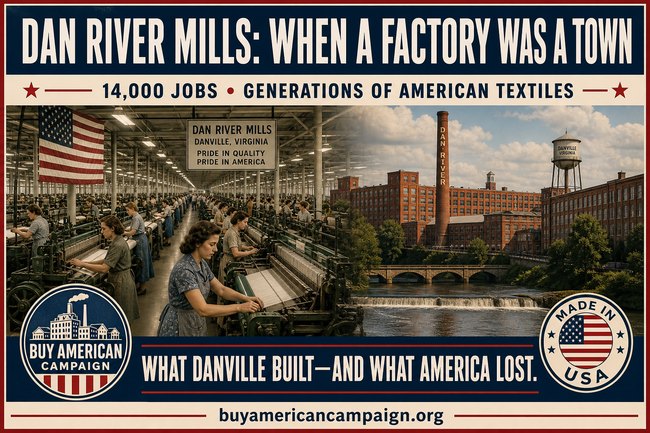
    Historical reconstruction of workers and looms at Dan River Mills

    For generations in Danville, Virginia, Dan River Mills was more than a factory. It was where parents met, where children expected to work, where paychecks filled local stores and where the rhythm of looms helped set the rhythm of an entire town.

    At its wartime peak, Dan River employed about 14,000 people in a city of roughly 40,000. The numbers are remarkable, but they only hint at the mill’s reach. A factory that large did not sit beside the community. It shaped the community.

    A Mill Built Beside the Dan River

    The story began in 1882, when six local men established Riverside Cotton Mills on the banks of the Dan River. Four mills rose during the company’s first decade, powered by a region eager to turn Southern cotton into finished American cloth.

    Riverside merged with the Dan River Power and Manufacturing Company in 1909. By then, annual cloth production had climbed from about 2 million yards in 1884 to more than 78 million yards. Sheetings, ginghams and chambrays carried Danville’s work far beyond Virginia.

    When the Factory Became the Community

    Like many Southern textile companies, Dan River built housing to attract and retain workers. The mill village of Schoolfield included homes, churches, recreation and the everyday relationships that grow when thousands of families share the same employer.

    Company-town life was never simple. Conditions could be harsh, and workers fought difficult battles over wages and control of their jobs. Major strikes in 1930 and 1951 ended in defeat. Still, residents remembered the closeness of a place where work and community were inseparable.
    Browse American-Made Products

    Fourteen Thousand Workers During World War II

    Military orders pushed the mills into extraordinary production during World War II. By 1942, Dan River operated twelve weaving and spinning mills along with dyeing, bleaching, finishing and power plants. Nearly half a million spindles fed the largest textile operation in the region.

    The mill’s 14,000 workers represented more than one out of every three people living in Danvilleβ€”not merely one out of every three workers. After the war, civilian demand kept the company growing. Acquisitions lifted companywide employment above 18,000 by 1956.

    What a Manufacturing Paycheck Multiplies Into

    Every mill job supported more than the person standing at a loom. Wages paid grocers, mechanics, barbers and builders. The company needed suppliers, rail service, maintenance and transportation. Schools and public services depended on an economy anchored by productive work.

    That multiplier is easy to overlook when a factory is reduced to an employment number. In a manufacturing town, the plant’s health becomes visible in storefronts, home values, civic groups and children’s expectations about whether they can build a future close to family.
    Join the Buy American Movement

    The Long Retreat of American Textiles

    Imported textiles began taking market share from American manufacturers in the 1960s. Dan River initially answered with technology and investment, trying to produce more efficiently while keeping its domestic operations competitive.

    By the 1990s and early 2000s, imports from Latin America and Asia were arriving in volumes the domestic industry could not withstand. Employment declined, facilities closed and Dan River entered Chapter 11 bankruptcy reorganization in March 2004.

    The Final Jobs Went Overseas

    Dan River emerged from bankruptcy, but survival was brief. In 2006, an Indian company purchased the business, closed the main mill and transferred the remaining work overseas. Encyclopedia Virginia records the final move as the loss of hundreds of remaining jobs; historical accounts differ on whether the last transfer involved roughly 500 or as many as 1,100 positions.

    The exact final count does not change the outcome. A company that had manufactured American textiles for more than a century no longer made its products in the United States. The brand survived. The production community did not.

    Danville Had to Become Something Else

    The physical landscape changed too. The familiar smokestacks came down in 2008. Former mill property sat vacant or moved toward new uses while Danville worked to rebuild an economy once dominated by textiles and tobacco.

    Today, the former White Mill has become Dan River Falls, a mixed-use redevelopment with residential, office and commercial space. Schoolfield is receiving new investment, and Danville has earned recognition for its comeback. That reinvention deserves respect.

    Redevelopment Is Not the Same as Production

    A restored building can preserve history and create valuable new activity. It cannot recreate the industrial ecosystem that once trained generations, supported suppliers and shipped tangible goods across the country. A casino, apartment or office may reuse a site, but it does different economic work.

    Dan River Mills is not an argument that every old factory should have remained unchanged forever. It is a warning about treating productive capacity as disposable. Once machinery, skills, supplier networks and customer relationships disappear, rebuilding them is far harder than closing a gate.

    Remember the People Behind the Label

    For consumers, Dan River’s story gives a familiar label a human scale. β€œMade in USA” was thousands of people in Danville reporting for shifts, learning trades, raising families and spending wages in the place they called home.

    We cannot reverse every closure. We can decide that the next factory matters before it becomes a memory. Choosing American-made products, asking retailers where goods are produced and supporting companies that invest here are modest actsβ€”but they help keep today’s manufacturing towns from becoming tomorrow’s historical exhibits.

    Whenever possible, choose Made in USA.

    If you like what you see and think this post would be of interest to someone, please share
  • World’s Largest Electric Aircraft Makes Historic First Flight in New York

    World’s Largest Electric Aircraft Makes Historic First Flight in New York

    Made in USA Heart Aerospace X1 electric aircraft taking off in Plattsburgh, New York

    The world’s largest electric aircraft has completed its first flight, and this milestone aircraft was made in the USA. Heart Aerospace’s full-scale X1 demonstrator lifted off from Plattsburgh International Airport in upstate New York on August 12, 2026, turning years of American engineering, manufacturing, ground tests, and regulatory work into 27 minutes of battery-powered flight.

    The aircraft climbed to 1,100 feet while its electric propulsion system delivered more than one megawatt of power. Heart says the electricity used during the flight cost about $5. That figure does not make the X1 a finished airliner, but it gives the aviation industry a striking glimpse of what electric propulsion could eventually mean for regional travel.

    A 25,000-Pound Aircraft Leaves the Ground

    The X1 is not a small experimental plane. It has a 106-foot wingspan, stretches 76 feet from nose to tail, and weighed more than 25,000 pounds at takeoff. That scale is why Heart describes it as the largest battery-electric aircraft ever flown.

    The first mission was deliberately controlled. Conducted under an FAA Special Airworthiness Certificate in the Experimental Category, the test included taxi, takeoff, climb, maneuvering, and landing. The point was not to set a speed or altitude record. It was to begin learning how a clean-sheet electric aircraft of this size behaves in the air.

    Built and Tested in the United States

    Heart Aerospace is headquartered in California, and the X1 program now connects several pieces of American aviation infrastructure. The demonstrator flew from Plattsburgh, New York, after more than a year of collaboration with the FAA. Heart is also developing its first pre-production ES-30 at a pilot manufacturing facility in Los Angeles.

    That matters beyond one airplane. New aircraft programs require engineers, technicians, software specialists, test pilots, suppliers, and manufacturing teams. If hybrid-electric regional aviation reaches commercial service, the industrial opportunity will be measured not only in aircraft sold but in the skilled work required to build, certify, maintain, and improve them.

    Browse American-Made Products

    The World’s Largest Electric Aircraft Is a Testbed

    The X1 itself is not the passenger aircraft Heart plans to sell. It is a technology demonstrator built to validate electric propulsion, aerodynamics, flight controls, structural behavior, battery systems, and the procedures needed to operate an electrified aircraft safely.

    Heart’s commercial goal is the ES-30, a 30-passenger regional aircraft with both electric and hybrid capability. The company lists a planned all-electric range of 125 miles and an extended hybrid range of 500 miles, with a targeted 30-minute charging time. Type certification is currently targeted for 2031, and a pre-production aircraft is expected to begin flight testing in 2028.

    Why Regional Aviation Is the Starting Point

    Batteries still carry far less usable energy per pound than aviation fuel, which makes long-distance electric flight especially difficult. Short regional routes offer a more realistic place to begin. Aircraft can return to charging infrastructure frequently, and many trips connect smaller communities that have lost convenient air service.

    Heart says the ES-30 could reduce operating costs for regional airlines by more than 40 percent. That remains a company projection, not a result proven in commercial service. Still, the X1’s first flight puts real hardware behind the idea and gives engineers flight data that computer models and ground tests cannot fully provide.

    Join the Buy American Movement

    Big Commitments, Bigger Work Ahead

    United Airlines, Air Canada, and JSX are among the carriers that have expressed interest in the ES-30. Heart reports $9.4 billion in customer commitments. Those commitments signal demand, but they do not erase the difficult path between a demonstrator’s first flight and a certified aircraft carrying paying passengers.

    The next several years will involve repeated flight testing, design changes, production development, and close regulatory scrutiny. Range, battery life, charging infrastructure, weight, reliability, and economics all have to work together. Aviation rewards careful progress, and the safest reading of this milestone is not that electric air travel has arrivedβ€”it is that one of its largest experiments is finally airborne.

    A First Flight Worth Watching

    Twenty-seven minutes at 1,100 feet may sound modest next to a conventional airline route. For a newly built 25,000-pound battery-electric aircraft, it is a serious engineering milestone. The X1 took a concept that existed in drawings, simulations, and ground tests and proved that it could take off, maneuver, and land under its own electric power.

    The most encouraging part of the story is not the $5 electricity bill by itself. It is the American engineering and manufacturing ecosystem forming around a new kind of regional aircraft. If Heart can turn what it learns from X1 into a safe and economical ES-30, this first flight could be remembered as an early step toward rebuilding short-haul aviation closer to home.

    That possibility deserves both enthusiasm and patience. Commercial aviation changes slowly because safety has to come first. The X1 has now supplied the proof that matters at this stage: a large battery-electric aircraft designed around new systems can leave an American runway, complete its planned test profile, and return safely with useful data for the next flight.

    Sources: Yahoo Tech/InsideEVs and Heart Aerospace.

    Whenever possible, choose Made in USA.

    If you like what you see and think this post would be of interest to someone, please share
  • SEG Solar Opens 4 GW Texas Factory, Adding Up to 800 Jobs

    SEG Solar Opens 4 GW Texas Factory, Adding Up to 800 Jobs

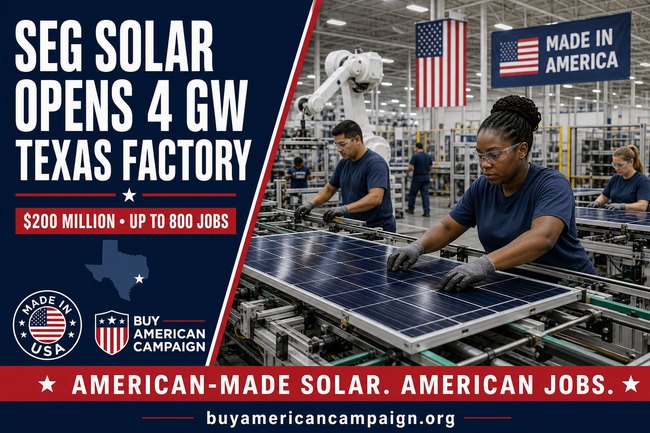
    Workers manufacturing solar panels at SEG Solar's Texas factory

    SEG Solar has opened a new 4-gigawatt solar-panel factory in Tomball, Texas, expanding American manufacturing capacity with an investment of more than $200 million and plans for up to 800 jobs. The August 7 grand opening turned a major expansion promise into an operating facility built to supply solar projects across the United States.

    The nearly 500,000-square-foot plant is SEG Solar’s second U.S. module factory. Together with its first Houston-area operation, it raises the company’s annual domestic module capacity to approximately 6 GWβ€”enough manufacturing scale to matter in a market long dependent on overseas production.

    A 4 GW Texas Solar Factory Moves From Plan to Production

    SEG announced the Tomball project in May and held its grand opening only three months later. Commercial production is expected during the third quarter of 2026, giving the Houston-headquartered company a much larger platform for serving utility, commercial and residential customers.

    The plant is designed for flexibility as solar technology changes. SEG says its production lines can integrate next-generation heterojunction, or HJT, technology, which combines different semiconductor layers to improve panel efficiency and performance.

    Up to 800 American Manufacturing Jobs

    The employment number deserves attention. Up to 800 new jobs could include production operators, maintenance technicians, quality specialists, engineers, logistics workers and supervisors. Those positions create paychecks inside the factory and additional demand for nearby suppliers and local businesses.

    Modern solar manufacturing is highly automated, but it is not workerless. Equipment must be installed, programmed, maintained and improved. Materials have to be tracked, panels inspected and production problems solved by people with practical technical skills.

    Browse American-Made Products

    Why Domestic Solar-Panel Production Matters

    Solar panels are becoming part of America’s essential energy infrastructure. Producing more modules domestically can shorten delivery times, improve traceability and reduce exposure to disruptions that occur when too much of a supply chain is concentrated overseas.

    Domestic manufacturing also keeps more of the value created by new energy projects in American communities. The benefits extend beyond where panels are installed to include the people who assemble, test, package and ship them.

    American-Owned Does Not Mean Every Component Is Domestic

    SEG describes itself as a 100% U.S.-owned manufacturer headquartered in Houston. That is an important distinction, but buyers should still understand the full supply chain. The company assembles modules in Texas while developing upstream ingot and wafer capacity in Indonesia.

    This does not erase the value of American module production. It does show why precise language matters. β€œAmerican-made solar panels” can describe meaningful domestic manufacturing even when some raw materials or components originate elsewhere. The long-term opportunity is to localize more stages of production here.

    Join the Buy American Movement

    A Third Texas Factory Is Already Underway

    SEG is not stopping at 6 GW. The company has broken ground on a third Greater Houston facility planned at approximately 1.15 million square feet, including factory and warehouse space. Construction is projected to finish in March 2027, with commercial production expected in May 2027.

    That third plant would add 4.6 GW of annual capacity and bring SEG’s planned U.S. total to 10.6 GW. It is expected to focus primarily on high-efficiency HJT modules, while SEG is also evaluating American sites for a dedicated solar-cell factory.

    Texas Is Becoming a Manufacturing Center

    The Houston region has long been associated with oil, gas and petrochemicals. Solar manufacturing adds another chapter to that industrial history. The same strengths that support traditional energyβ€”skilled trades, engineering talent, freight networks and large industrial sitesβ€”can also support factories producing newer energy technologies.

    That overlap matters because an energy transition should create durable American work, not simply replace one set of imported products with another. Communities benefit most when investment includes factories, technical training and long-term supplier relationships, not only construction projects.

    Customers Can Strengthen the Domestic Market

    Large developers and commercial buyers influence where manufacturers invest. When purchasers ask where modules are assembled, how components are sourced and what labor supports production, they reward companies that build transparent domestic operations.

    Consumers can ask similar questions when considering rooftop solar. Country-of-origin claims can be complicated, so buyers should request specific information about module assembly and major components. Better questions create stronger incentives for companies to keep moving production closer to home.

    The Bigger Test Is Sustainable Production

    Factory openings generate headlines, but sustained output creates lasting impact. The Tomball plant must ramp safely, meet quality targets, win customer orders and retain its workforce. If it does, the operation can strengthen the case for manufacturing more of America’s energy equipment at home.

    SEG’s expansion is a concrete example of domestic manufacturing responding to real demand. A U.S.-owned company has invested more than $200 million in Texas, opened a major production site and created a path toward hundreds of manufacturing jobs. That is progress worth recognizingβ€”and a reminder that American energy independence also depends on American production capacity.

    Whenever possible, choose Made in USA.

    If you like what you see and think this post would be of interest to someone, please share
  • Nobody Ever Says, “I Wish We Still Made Less”

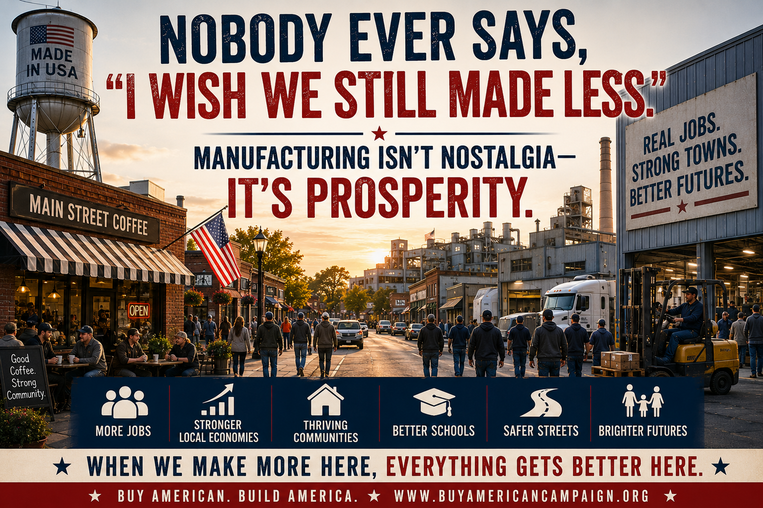
    Nobody Ever Says, “I Wish We Still Made Less”

    A thriving American factory town

    Try a thought experiment.

    Picture a town where a factory just announced it’s hiring 1,000 people.

    The restaurants are packed at lunchtime.
    The coffee shop opens earlier because the first shift starts at six.
    A local contractor hires more workers.
    The hardware store is busier than it’s been in years.
    Young families are buying homes.
    The school is adding classrooms instead of closing them.
    Property values are rising.
    The city is fixing roads instead of postponing repairs.

    Now ask yourself one question.

    Who looks at that town and says, “This is terrible. I wish we still made less.”

    Nobody.

    Because deep down, we already know something we’ve somehow forgotten.

    Manufacturing isn’t nostalgia.
    It’s prosperity.

    We Don’t Celebrate Empty Factories

    People often argue about manufacturing as though it’s some sentimental attachment to the past.

    Old mills.
    Black-and-white photographs.
    Grandpa’s lunchbox.
    Rusty smokestacks.

    But nobody drives past an abandoned factory and thinks,
    “At least imported toasters are cheaper.”

    What they notice is something else.

    The empty parking lot.
    The weeds growing through the pavement.
    The boarded-up storefront across the street.
    The “For Sale” signs that have been there for years.

    Manufacturing isn’t remembered because people are nostalgic.
    It’s remembered because people remember what life was like when the jobs were still there.

    Prosperity Has a Look

    You don’t need an economics degree to recognize a thriving town.
    You know it when you see it.

    The restaurants are full.
    The coffee shop has a line out the door before sunrise.
    Construction crews are building houses instead of demolishing them.
    Kids come back after college because there are careers waiting for them.
    The Little League has enough volunteers.
    The high school doesn’t struggle to keep teachers.
    Main Street has businesses opening instead of closing.

    Nobody describes that place as being “over-industrialized.”
    They call it successful.

    Browse American-Made Products

    Manufacturing Builds Confidence

    There’s something else factories create that never shows up in government statistics.

    Confidence.

    The confidence to buy a home.
    To start a business.
    To raise a family.
    To hire another employee.
    To believe your children might have an even better future than you did.

    Communities don’t thrive because everyone becomes wealthy overnight.
    They thrive because enough people have steady work that they can plan for tomorrow.

    Manufacturing has always been one of the strongest builders of that kind of confidence.

    Every Community Wants One

    Think about the announcements that communities celebrate.

    A new semiconductor plant.
    An aircraft factory.
    A steel mill expanding.
    A battery plant.
    An appliance manufacturer opening another production line.

    Notice what nobody ever celebrates.

    A factory closing.
    A thousand jobs leaving.
    A supplier shutting its doors.
    A community becoming more dependent on products made somewhere else.

    No mayor ever cuts a ribbon for fewer manufacturing jobs.
    No chamber of commerce issues a press release celebrating another empty industrial park.

    When communities compete with one another, what are they trying to attract?

    Factories.

    Not because factories are old-fashioned.
    Because they’re engines of opportunity.

    Join the Buy American Movement

    We Already Know the Answer

    For years we’ve debated whether manufacturing still matters.

    Maybe we’ve been asking the wrong question.

    Instead ask this:

    If a factory announced tomorrow that it was opening in your town, creating 800 good-paying jobs, would anyone complain?

    Would anyone say,
    “I wish they had built it somewhere else.”

    Or would people celebrate?

    Would local businesses prepare for more customers?
    Would young families start looking at houses?
    Would high school graduates think twice before moving away?

    We already know the answer.
    Because we’ve seen it happen.

    More Than What We Make

    Manufacturing isn’t important simply because it produces things.

    It’s important because of what it produces beyond the products.

    Careers.
    Skills.
    Businesses.
    Tax revenue.
    Homeownership.
    Community pride.
    Generational opportunity.

    Those things don’t arrive in shipping containers.
    They grow where people build things together.

    The Question That Answers Itself

    Every time a company announces a new American factory, the headlines are overwhelmingly positive.

    More jobs.
    More investment.
    More opportunity.
    More hope.

    Nobody reads those stories and thinks,
    “This would all be better if we produced less.”

    That’s because manufacturing has never really been about factories.
    It’s about whether a community has the chance to build a future instead of simply consuming one.

    We’ve spent years arguing about where products should be made.
    Perhaps the better question is much simpler.

    If making more things here makes our communities stronger…

    Why would we ever wish to make less?

    Related reading: Every “Made in USA” Label Represents Someone’s Tuesday — the people behind the label.

    Whenever possible, choose Made in USA.

    If you like what you see and think this post would be of interest to someone, please share
  • Foxlink Opens Its First U.S. AI Factory in Fort Worth

    Foxlink Opens Its First U.S. AI Factory in Fort Worth

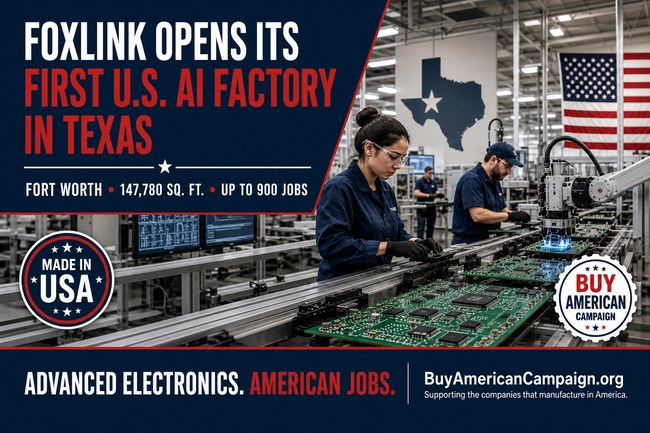
    Foxlink advanced electronics factory in Fort Worth, Texas

    Foxlink has opened its first U.S. AI factory in Fort Worth, Texas, bringing advanced electronics productionβ€”and the potential for roughly 900 jobsβ€”to AllianceTexas. The new operation shows what modern American manufacturing can look like: skilled people working alongside intelligent automation to build critical technology closer to U.S. customers.

    The Taiwanese technology manufacturer officially opened the facility on July 14, 2026. Production is expected to begin in August, turning a 147,780-square-foot building into a North American base for high-precision electronics assembly.

    A New Electronics Factory Starts Production in Texas

    Foxlink selected Alliance Gateway 17 at 4600 Alliance Gateway Freeway for its first North American manufacturing plant. At the opening, the company already had a little more than 50 employees on site, according to local reporting, with the workforce expected to expand as additional customers and production programs come online.

    At full capacity, the facility is projected to support approximately 900 jobs. That is a meaningful number for Fort Worth, but the larger story is the kind of work involved: technically demanding production that has too often been located far from the American companies and consumers who depend on it.

    What Foxlink Will Manufacture in Fort Worth

    The plant will handle printed circuit board assembly, surface-mount technology, final assembly, testing and packaging. These are not cosmetic finishing steps. They are core parts of turning sophisticated components into dependable products ready for customers.

    Foxlink also plans to use AI-driven robotics and intelligent automation throughout the operation. That combination can improve precision, consistency and speed while creating demand for technicians, engineers, equipment specialists, quality professionals and production workers who can keep a highly automated factory running.

    Browse American-Made Products

    Why AllianceTexas Made Sense

    AllianceTexas offers more than available industrial space. The development connects manufacturers to major highways, an intermodal rail facility and Perot Field Fort Worth Alliance Airport. For an electronics producer receiving components and shipping finished goods, that network can reduce delays and make domestic production more competitive.

    Fort Worth also provides access to a large and growing labor market. Foxlink cited the region’s talent, logistics and business environment as reasons for choosing the site. Those practical advantages matter when a company is deciding whether its next factory belongs in the United States.

    Automation and 900 Potential Jobs Can Coexist

    The phrase β€œAI factory” may sound like a building without people. In reality, advanced automation changes the work more than it eliminates the need for workers. Robots can repeat precise motions, but people still install equipment, program systems, solve problems, inspect output, manage materials and improve the process.

    That is why workforce development must be part of the reshoring conversation. Communities that connect manufacturers with technical schools, community colleges and apprenticeship programs give local residents a better chance to qualify for the jobs these investments create.

    Join the Buy American Movement

    An American Manufacturing Winβ€”with an Important Distinction

    Foxlink is a Taiwanese-owned global company, so this is not a story about an American-owned manufacturer. It is still a genuine American manufacturing win because the production, investment and jobs are being placed in Texas. Clear language matters: β€œMade in USA” describes where work happens, not necessarily where a parent company is headquartered.

    Foreign-owned manufacturers employ millions of Americans and can strengthen domestic supply chains when they build here. The goal should be more production capacity on American soil, more opportunities for American workers and more resilience when international shipping or geopolitical events disrupt the flow of essential goods.

    What This Factory Could Mean Beyond Fort Worth

    A single factory will not rebuild the entire electronics supply chain. It can, however, become an anchor. Successful plants attract suppliers, service companies, logistics providers and specialized talent. They also give customers evidence that advanced electronics can be produced competitively in the United States.

    Foxlink’s decision could encourage other manufacturers to examine North Texas and other American regions with strong transportation and workforce networks. Every new operation adds knowledge and capacity that makes the next domestic investment easier.

    The Test Comes Next

    The opening ceremony is the beginning, not the finish line. The real measure will be how quickly production ramps, how many jobs materialize and whether the Fort Worth plant earns additional customer programs. Those results will determine the facility’s long-term impact.

    For now, the direction is encouraging. A global electronics manufacturer chose to put its first North American plant in Texas, begin production in 2026 and build a workforce around advanced manufacturing. That is the kind of concrete investment the Buy American movement should noticeβ€”and the kind consumers can reinforce by choosing products made here whenever possible.

    Whenever possible, choose Made in USA.

    If you like what you see and think this post would be of interest to someone, please share
  • Every “Made in USA” Label Represents Someone’s Tuesday

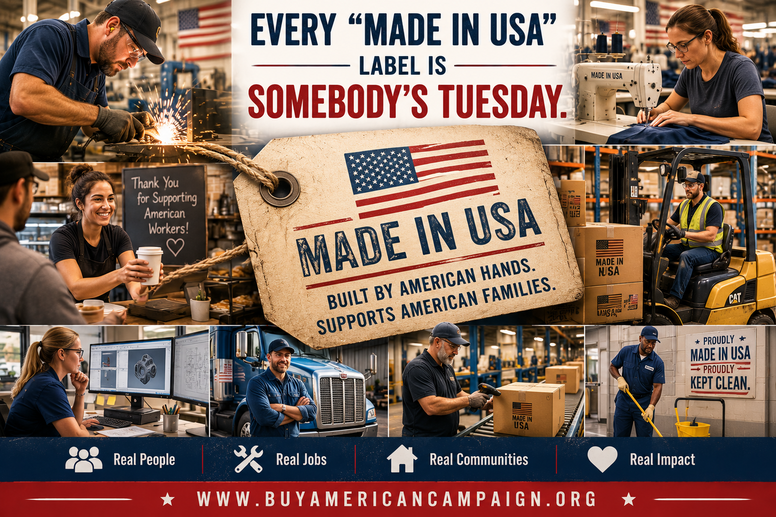
    Every “Made in USA” Label Represents Someone’s Tuesday

    An American manufacturing worker on an ordinary Tuesday

    Turn over almost any product in your home.

    Somewhere on the back, in small print, you’ll find a country of origin.

    Most people glance at it for about two seconds.
    Or not at all.

    But every time you see the words “Made in USA,” you’re looking at something much bigger than a manufacturing label.

    You’re looking at somebody’s Tuesday.

    Before You Woke Up

    Long before you picked up that product, somebody else’s day had already begun.

    The lights came on at the factory before sunrise.
    The first shift clocked in.
    Someone unlocked the front door.
    Someone brewed the first pot of coffee.
    Someone started warming up the machines.
    Forklifts began moving pallets across the warehouse floor.
    Delivery trucks backed into loading docks.

    The work had already started hours before you ever saw the finished product.

    The People You’ll Never Meet

    That label isn’t just talking about a factory.
    It’s talking about people.

    The welder making sparks fly across a workbench.
    The machinist holding tolerances measured in thousandths of an inch.
    The woman answering customer service calls.
    The engineer improving next year’s design.
    The maintenance technician fixing a machine before production stops.
    The shipping clerk printing labels.
    The forklift driver loading tomorrow’s deliveries.
    The janitor sweeping the floor after everyone else has gone home.

    Most of them will never appear in an advertisement.
    You’ll never know their names.

    But their fingerprints are on the product you just bought.

    Browse American-Made Products

    Manufacturing Doesn’t Happen by Magic

    Walk into a store and it’s easy to think products simply appear on shelves.

    They don’t.

    Someone designed them.
    Someone sourced the materials.
    Someone cut the steel.
    Someone stitched the fabric.
    Someone molded the plastic.
    Someone inspected the finished product.
    Someone packed it into a box.
    Someone loaded it onto a truck.
    Someone drove that truck across the country.

    Every product is the end of a story that began weeks — or months — earlier.

    The label is simply the last page.

    Ordinary Days Build Extraordinary Things

    There’s nothing glamorous about most manufacturing work.

    It isn’t usually featured in television shows.
    There are no red carpets.
    No standing ovations.

    It’s people showing up.
    Again.
    And again.
    And again.

    Tuesday looks a lot like Monday.
    Wednesday looks a lot like Tuesday.

    Thousands of ordinary workdays eventually become products trusted for generations.

    The Estwing hammer hanging in your garage.
    The Liberty Tabletop flatware on your dinner table.
    The Darn Tough socks in your hiking boots.
    The Lodge skillet your grandchildren will someday cook with.

    Those products weren’t built by extraordinary moments.
    They were built by ordinary Tuesdays.

    Join the Buy American Movement

    The Label Means Someone Got to Stay

    When you choose an American-made product, you’re doing more than supporting a company.

    You’re helping create another Tuesday.

    Another shift.
    Another paycheck.
    Another family dinner paid for by honest work.
    Another mortgage payment made on time.
    Another Little League registration.
    Another college tuition payment.
    Another retirement contribution.

    It’s easy to think of manufacturing as factories.
    It’s really people building lives.

    A Label Worth Looking At

    We’ve trained ourselves to notice price.
    Sometimes we notice the brand.
    Occasionally we notice the warranty.

    Maybe it’s time we spent another second looking at something else.

    That little label.

    Because it isn’t a slogan.
    It isn’t marketing.
    It isn’t politics.

    It’s evidence.

    Evidence that somewhere in America, while most of us were going about our own Tuesday, someone else was welding.
    Or sewing.
    Or machining.
    Or answering phones.
    Or loading trucks.
    Or sweeping the floor before locking the doors for the night.

    They probably never imagined you’d think about them.
    But you should.

    Because every “Made in USA” label represents somebody’s Tuesday.
    And that’s what you’re really bringing home.

    Related reading: Every Factory Has a Coffee Shop — the businesses that exist because a factory does.

    Whenever possible, choose Made in USA.

    If you like what you see and think this post would be of interest to someone, please share
  • Every Factory Has a Coffee Shop

    Every Factory Has a Coffee Shop

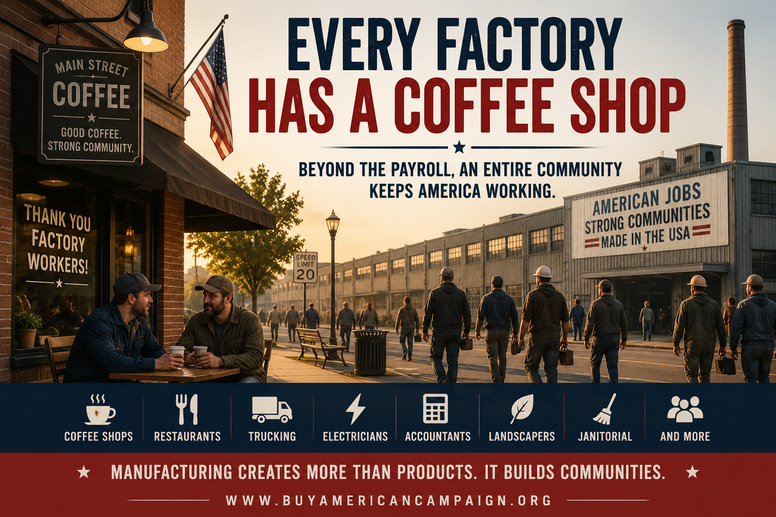
    The coffee shop across from an American factory before dawn

    When people think about a factory, they usually picture the people inside it.

    The machinists.
    The welders.
    The forklift drivers.
    The engineers.
    The people assembling whatever comes off the production line.

    They’re right.
    But they’re also missing most of the story.

    Because every factory has a coffee shop.

    Not literally, perhaps. Sometimes it’s a diner. Sometimes it’s a food truck parked across the street. Sometimes it’s the family-owned café that has opened at 5:30 every morning for the last thirty years because the first shift starts at six.

    Those businesses don’t appear on the factory payroll.
    But they exist because the factory does.

    The First Shift Starts Long Before the Factory Does

    Drive past a manufacturing plant before sunrise.

    The parking lot is filling up.
    So is the coffee shop down the road.

    The waitress already knows half the customers by name.
    The owner knows who takes cream, who drinks it black, and who always grabs an extra breakfast sandwich for the road.

    That business wasn’t created by caffeine.
    It was created by manufacturing.

    One Job Creates Another

    Economists have a name for it.
    They call it the manufacturing multiplier.

    The idea is simple.

    A factory doesn’t just employ the people wearing hard hats inside the building. It creates work for countless others who may never set foot on the production floor.

    The trucking company hauling steel to the plant.
    The local machine shop repairing equipment.
    The electrician replacing a failed motor.
    The plumber fixing a broken water line.
    The accounting firm handling payroll.
    The uniform company washing work clothes.
    The janitorial crew cleaning the offices.
    The landscaper mowing the grounds.
    The restaurant serving lunch.
    The gas station selling fuel.
    The hardware store supplying everything from light bulbs to safety glasses.

    One manufacturing job supports many more jobs beyond the factory gates.

    That’s why manufacturing has always mattered more than its payroll suggests.

    Browse American-Made Products

    The Day the Parking Lot Empties

    When a factory closes, the building usually stays standing.
    At first.

    The lights go out.
    The parking lot empties.
    The sign comes down.

    From a distance, it looks like one business disappeared.
    But that’s not what happened.

    The waitress notices fewer breakfast customers.
    The trucking company loses a contract.
    The electrician gets fewer service calls.
    The restaurant cuts back its hours.
    The landlord struggles to find new tenants.
    The school district collects less in property taxes.
    Little League loses a sponsor.

    The town doesn’t collapse all at once.

    It simply becomes a little quieter.
    Then a little emptier.
    Then someone wonders why the young people keep leaving.

    A Factory Is an Anchor

    Manufacturing plants don’t just make products.
    They anchor communities.

    A factory gives people a reason to buy a home instead of renting.
    To coach Little League.
    To volunteer at the fire department.
    To serve on the school board.
    To open a business.
    To believe they’ll still be there ten years from now.

    That’s how communities are built.
    Not overnight.
    Over generations.

    Join the Buy American Movement

    We Celebrate Ribbon Cuttings. We Forget Everything That Follows.

    When a new factory opens, the headlines usually focus on one number.

    Five hundred jobs.
    One thousand jobs.
    Two thousand jobs.

    Those numbers matter.
    But they’re only the beginning.

    Nobody writes the headline six months later:
    Local diner hires three more servers.

    Or:
    Small accounting firm expands because of new manufacturing clients.

    Or:
    Coffee shop opens a second location near the industrial park.

    Those stories don’t make national news.
    But together, they’re what economic growth actually looks like.

    Buying More Than a Product

    Every time you choose an American-made product, you’re doing more than buying what’s in the box.

    You’re supporting the truck driver who delivered the raw materials.
    The machine operator who shaped them.
    The supplier who manufactured the components.
    The electrician who keeps the production line running.
    The coffee shop owner who unlocks the front door before dawn because the first shift will be stopping in soon.

    Most of those people will never know your name.
    You’ll probably never know theirs.

    But your purchase connects you anyway.

    The Coffee Shop Matters Too

    It’s easy to look at a factory and see a building.
    It’s harder to see the web of businesses and families that depend on it.

    Yet that’s where manufacturing leaves its deepest mark.

    Not only in the products it makes.
    But in the communities it sustains.

    People often ask why manufacturing matters.

    The answer isn’t only found inside the factory.
    Sometimes it’s sitting across the street, pouring coffee at 5:30 in the morning.

    Because every factory has a coffee shop.
    And every community is stronger when both are busy.

    Related reading: Cheap Goods, Expensive Country — what the price tag never shows you.

    Whenever possible, choose Made in USA.

    If you like what you see and think this post would be of interest to someone, please share
  • One of America’s Last Aluminum Smelters Is Producing at Full Capacity Again

    One of America’s Last Aluminum Smelters Is Producing at Full Capacity Again

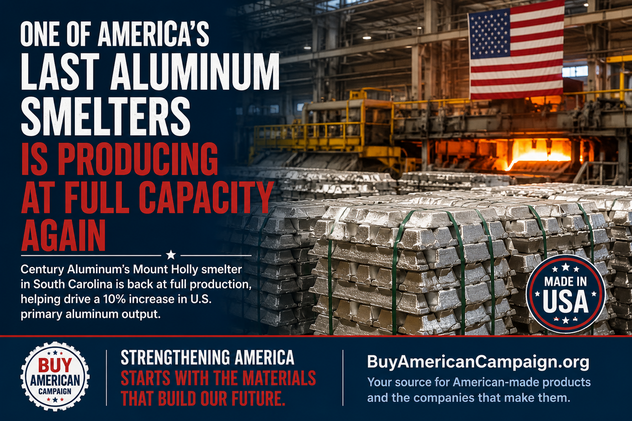
    Molten aluminum production at an American smelter

    When people think about American manufacturing, they usually picture the finished product — a pickup truck, a cast-iron skillet, a can of soda, or an airplane.

    Few people think about the raw materials that make those products possible.

    That is why one announcement from South Carolina deserves far more attention than it has received. Century Aluminum’s Mount Holly smelter is running at full capacity for the first time since 2015, and that single restart is lifting U.S. primary aluminum production by roughly 10 percent.

    Manufacturing does not begin on an assembly line. It begins much earlier — with the materials everything else is built from.

    Why Aluminum Matters

    Aluminum is one of the most important industrial metals in the American economy. It shows up in products Americans use every day:

    • Beverage cans
    • Aluminum foil
    • Cookware
    • Cars and pickup trucks
    • Aircraft
    • Electrical transmission lines
    • Construction materials
    • Boats
    • Military equipment

    Without a reliable domestic supply of primary aluminum, manufacturers become increasingly dependent on imports for the starting material of all of it.

    What Is a Smelter?

    Many people assume aluminum comes straight out of a mine. It does not.

    Bauxite ore has to be refined into alumina first, and the alumina then goes through enormous smelters where electricity separates pure aluminum from oxygen. These plants are among the most energy-intensive industrial facilities in the world.

    They are also extraordinarily expensive to build and very difficult to restart once they have gone cold. That is a large part of why American aluminum-smelting capacity has shrunk so dramatically over the past few decades — and why Mount Holly is now one of only four primary aluminum smelters left operating in the United States.

    A Rare Piece of Good News

    Century Aluminum has brought the idled portion of its Mount Holly plant in Berkeley County, South Carolina back online, returning the facility to 100 percent production for the first time in more than a decade.

    The numbers behind it are concrete. Century invested roughly $50 million in the restart, added about 150 jobs at a plant that now employs more than 600 people, and brought back over 50,000 metric tons of annual capacity. That one restart raises total U.S. primary aluminum output by close to 10 percent.

    U.S. Commerce Secretary Howard Lutnick visited the plant on July 27 to mark the milestone alongside South Carolina officials.

    Browse American-Made Products

    Why This Restart Actually Happened

    It is worth being precise about the cause, because it was not simply a good year for demand.

    Century pointed directly at trade policy. The company titled its own announcement around the benefits of Section 232 tariffs, which were raised to 50 percent on imported aluminum with no exemptions. Those tariffs changed the math on domestic production enough to justify firing the idled potlines back up.

    The second ingredient was electricity. Smelters live or die on power costs, and Mount Holly’s capacity had been constrained for years by its power arrangement. Century and Santee Cooper, the state-owned utility that supplies the plant, extended their contract through 2031 to secure the additional power the restart required. Without that agreement, the tariffs alone would not have been enough.

    The Part That Still Comes From Overseas

    Here is the honest caveat, and it matters if you care about real industrial independence rather than the headline.

    A smelter does not make aluminum out of nothing. It needs alumina, which is refined from bauxite ore — and the United States barely produces either one anymore. American alumina refining capacity has collapsed from nearly 5 million tons in 2000 to roughly 600,000 tons today, concentrated in a single remaining refinery in Gramercy, Louisiana. The country imports more than 75 percent of its bauxite and about 71 percent of its alumina, mostly from Jamaica, Brazil, Guyana, and Australia.

    So Mount Holly running at full tilt is a genuine win for American jobs and American output. It is not yet an American supply chain. The metal is poured here; the raw material largely is not.

    That gap is being worked on. Century has partnered with the startup Brimstone on an effort to build the first domestic mine-to-metal aluminum supply chain, though a full-scale alumina plant is not projected until the 2030s.

    Join the Buy American Movement

    Why Domestic Production Matters

    For a lot of manufacturers, aluminum is not just another commodity line item. It determines whether they have a stable supply during a disruption.

    The past several years have shown how fast global supply chains can seize up — geopolitical conflict, shipping bottlenecks, tariffs, energy shortages. Every ton produced domestically is one more ton an American manufacturer can source without crossing an ocean for it.

    It Is About More Than Beverage Cans

    When people hear aluminum, they think soda cans. The metal does far more work than that.

    The auto industry uses it to cut vehicle weight and improve fuel economy. Aerospace depends on high-strength aluminum alloys. Utilities run aluminum conductors across thousands of miles of transmission line. Defense manufacturers put it in everything from armored vehicles to naval vessels.

    Plenty of the American-made products we feature here — cookware, trailers, tools, outdoor gear — trace back to a healthy domestic aluminum industry whether the buyer realizes it or not.

    Rebuilding Manufacturing Starts at the Beginning

    It is easy to celebrate a new factory that assembles a finished product. It is harder to notice when a raw-material producer quietly restores capacity.

    The second one may matter more. A strong industrial base is not built out of assembly plants alone — it needs steel mills, aluminum smelters, chemical producers, foundries, and the whole unglamorous upstream that feeds them. Without those, even a product assembled in the United States is often made of imported material.

    The Bottom Line

    Mount Holly returning to full production will not solve American aluminum overnight. Four primary smelters is still a thin margin for an economy this size, and the refining side of the industry is thinner still.

    But the direction changed, and it changed for reasons that can be repeated. Every increase in domestic production makes the manufacturing base a little harder to disrupt.

    Sometimes the biggest manufacturing victories are not the products you see on a store shelf. They are the raw materials that make those products possible in the first place.

    Whenever possible, choose Made in USA.

    If you like what you see and think this post would be of interest to someone, please share
  • America Doesn’t Build the Giant Cranes That Keep Our Ports Running

    America Doesn’t Build the Giant Cranes That Keep Our Ports Running

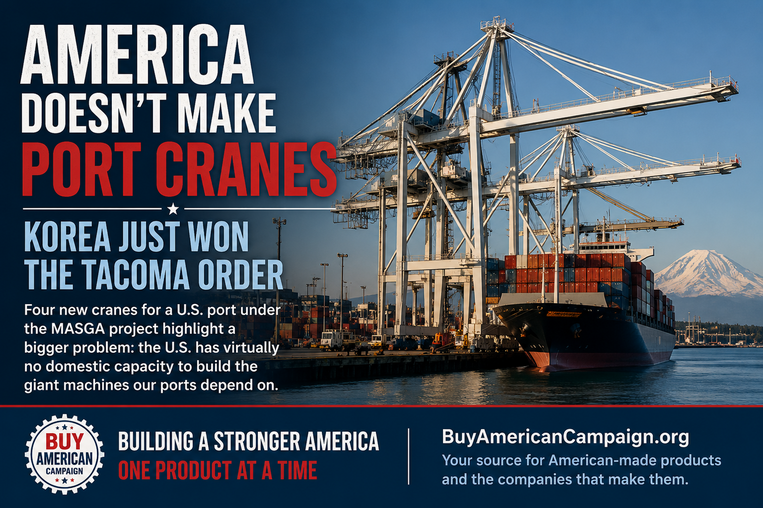
    Giant ship-to-shore container cranes at an American port

    Every day, millions of containers arrive at American ports carrying everything from electronics and clothing to machinery and auto parts. Towering above the ships are the giant cranes that unload them — some of the largest and most complex machines in the world.

    Here is something most Americans do not know: the United States has not built one of these cranes in more than thirty years.

    That reality came into focus again this week when Washington United Terminals in Tacoma awarded a contract for four new cranes to South Korea’s HD Hyundai Samho. The Korean shipbuilder will design, manufacture, transport, install, and commission the equipment as a turnkey project, with delivery scheduled through 2028.

    It is a reminder that while America remains a manufacturing powerhouse in many industries, there are still critical sectors where domestic production has nearly disappeared.

    The Machines That Keep Trade Moving

    Ship-to-shore cranes are engineering marvels. They stand well over 200 feet tall, with booms that reach across the deck of a container ship, and they lift boxes weighing tens of tons with remarkable precision. Modern ports simply cannot operate without them.

    The Tacoma order covers two ship-to-shore quay cranes, which will replace aging units, and two yard cranes that move containers around the terminal. Together they will lift Washington United Terminals’ annual capacity from roughly 590,000 containers to 880,000 and allow the terminal to handle the largest vessels calling on the West Coast.

    When a new crane arrives, it is not just another piece of equipment. It is a decades-long investment in the infrastructure that keeps commerce flowing.

    How America Lost This Industry

    It was not always this way. An American company, PACECO, built the world’s first dedicated ship-to-shore container crane in 1958 and manufactured them in the United States for three decades. Its Gulfport, Mississippi plant closed in 1989. That was the end of domestic production.

    Into that gap stepped China’s state-owned Shanghai Zhenhua Heavy Industries, better known as ZPMC. Today ZPMC holds roughly 70 percent of the global container crane market, and federal estimates put its share of the ship-to-shore cranes operating at U.S. ports at close to 80 percent.

    That dominance did not happen overnight. As American heavy manufacturing declined and Chinese production expanded, U.S. ports bought imported cranes because there were almost no domestic alternatives left to buy.

    Browse American-Made Products

    Why Port Cranes Became a National Security Concern

    In recent years, those purchases became more than an economic question. Modern cranes can be monitored, serviced, and reprogrammed remotely, and federal officials warned that the software and networking built into foreign-made equipment could expose critical infrastructure to interference.

    The response has been substantial. An executive order directed action on maritime cyber threats. The U.S. Coast Guard issued Maritime Security Directive 105-4, requiring operators of Chinese-built ship-to-shore cranes to take specific cyber risk management steps. And federal trade officials imposed tariffs of 100 percent on Chinese ship-to-shore cranes and certain cargo handling equipment.

    But closing the door on one foreign supplier is not the same thing as rebuilding an American industry.

    The Tacoma Order Shows the Gap

    The Tacoma contract illustrates the challenge precisely. With Chinese cranes effectively priced out, the work did not go to an American manufacturer. It went to South Korea.

    There is another detail worth noting. Washington United Terminals is the U.S. arm of HMM, South Korea’s largest shipping line, and four of the eight quay cranes already standing at its Tacoma berth were also built by HD Hyundai Samho — back in 1999. This capability did not slip away last year. It has been gone for a very long time.

    South Korea is one of the few countries left with the industrial base to compete for work this specialized, which is exactly why American ports looking for alternatives keep landing there.

    Join the Buy American Movement

    America Is Trying to Rebuild This Industry — It Is Not There Yet

    The encouraging part of this story is that the effort is real and underway.

    PACECO — the same company that invented the machine in 1958 — announced plans to restart ship-to-shore crane manufacturing in the United States after a thirty-year pause. Konecranes has partnered with American steel suppliers to build up domestic port crane capacity. Federal policy has put real money and real tariffs behind the goal.

    But announcements and finished cranes are two different things. When PACECO won an order in September 2025 for two large Portainer cranes bound for the Port of Long Beach, the machines were built in Japan, using American-made components, and shipped here. The domestic restart has been announced. It has not yet produced an American-built crane.

    That gap between the announcement and the first machine off the line is the honest state of this industry right now.

    Rebuilding an Industry Takes More Than a Factory

    Most conversations about American manufacturing focus on things consumers buy — cars, appliances, clothing, tools. Heavy industrial equipment rarely gets the same attention, even though it is the equipment everything else depends on.

    An industry like this one requires an entire ecosystem: heavy steel fabrication, precision machining, industrial electrical systems, advanced controls and automation, specialized engineering, skilled welders and fabricators, and assembly facilities big enough to build a structure taller than a twenty-story building.

    Once that industrial base disappears, rebuilding it is not as simple as opening a new plant. It takes years of investment, trained workers, a supplier network, and customers willing to place the first orders before the track record exists.

    The Bottom Line

    The Tacoma crane contract is not bad news. South Korea is a trusted ally with world-class manufacturing, the terminal needed the upgrade, and modernizing American ports is essential work.

    But the project points at something larger. America is strengthening domestic manufacturing across many sectors, and in plenty of them that effort is producing new factories and new jobs. In others — like the giant cranes that unload our own imports — the country is still working its way back.

    That is the difference between buying American products and rebuilding American industrial capability. One you can do this afternoon. The other takes a decade and a lot of people deciding it matters.

    Sometimes the biggest manufacturing stories are not about what we make. They are about what we no longer can — and what it will take to change that.

    Whenever possible, choose Made in USA.

    If you like what you see and think this post would be of interest to someone, please share
  • The Best American-Made Flashlights: Maglite, Streamlight & Pelican

    The Best American-Made Flashlights: Maglite, Streamlight & Pelican

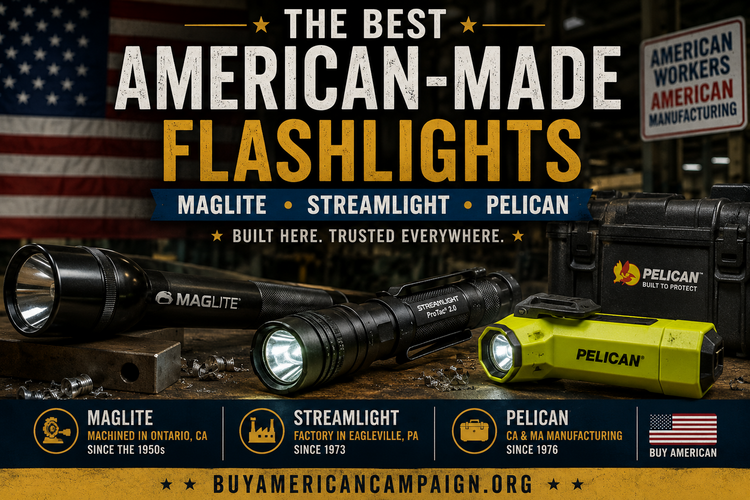
    American-made flashlights from Maglite, Streamlight and PelicanA flashlight is one of the few things you buy hoping you rarely need it β€” and then, when the power goes out or the truck breaks down on a dark shoulder, it becomes the most important object you own. That is exactly why it is worth buying one built by people who put their name on it.

    The good news is that the flashlight aisle is one of the last consumer categories where American manufacturing never really left. While most of the world’s lights are assembled overseas from interchangeable parts, three companies still run real factories on American soil β€” one machining aluminum in Southern California, one running a quarter-million square feet in suburban Philadelphia, one molding cases and building lights in California and Massachusetts.

    If you are searching for the best made in USA flashlight, this guide covers the three brands we can actually verify, what each one does best, and who each one is for. We are not ranking lumens for sport β€” we are ranking companies by what they build, where they build it, and how honest they are about it.

    Honesty matters: not one of these three is 100% American across every SKU. Batteries, bulbs, and electronics move around the globe no matter whose name is on the barrel, and two of these companies openly sell imported lines alongside their domestic ones. We tell you which is which below rather than pretending the gray areas do not exist.

    Best Overall American-Made Flashlight: Maglite

    Maglite is the closest thing this category has to a sure thing. Mag Instrument has machined its flashlights in Ontario, California since Anthony “Tony” Maglica β€” the son of Croatian immigrants β€” started the company in 1955 with a single lathe in a small machine shop. The flashlight that made the name famous arrived in 1979, and more than four decades later the whole line is still cut from solid aircraft-grade aluminum in that same Southern California plant, by more than 800 American workers.

    What separates Maglite from companies that merely finish a product here is vertical integration. Machining, anodizing, and assembly all happen under one roof, and Maglica insisted from the beginning that components be procured domestically rather than shipped in and screwed together. That is a much higher bar than “assembled in USA,” and it is the reason a twenty-year-old Maglite still takes new cells and works.

    The modern lineup has moved well past the incandescent D-cell everyone remembers. The ML300L series delivers real LED output with the same adjustable spot-to-flood twist head, and the Mini Pro and XL models put the same machining quality in a pocketable body. You can browse the current Maglite flashlights in the Buy American Store and see the range for yourself.

    Best For

    • Buyers who want the strongest made-in-USA claim in the category, with no per-model homework
    • Household, glovebox, and emergency-kit lights that will sit unused for years and still work
    • Anyone who values a machined aluminum body and a repairable, serviceable design
    • Gift buying, where “made in California since 1979” is part of the point

    Honest Drawback

    Maglite is not chasing the spec sheet. Tactical brands will sell you more lumens and more programmable modes for the same money, and the classic D-cell bodies are heavy by modern standards. As with any flashlight, consumable parts like batteries and bulbs may be sourced elsewhere β€” what is American-made is the light itself.

    Best for Work and Duty Use: Streamlight

    Streamlight came out of early-1970s engineering work tied to NASA’s space program, where a team built what was then called a handheld “super flashlight.” The company was formally founded in 1973 and put down roots in Eagleville, Pennsylvania, where it still owns and operates a 240,000-square-foot plant employing more than 350 people.

    Fifty years later, Streamlight is what firefighters, electricians, mechanics, and police officers actually carry. The ProTac series is the workhorse β€” genuinely bright, USB-rechargeable in most current versions, and built around a clicky tail switch and programmable modes that you can set once and forget. The Survivor line is purpose-built for firefighters, with a right-angle body that clips to turnout gear. These are tools bought by people whose job depends on them working.

    If you want output and features without leaving American manufacturing entirely behind, the Streamlight work lights in the Buy American Store are where this guide’s value-per-dollar lives.

    Best For

    • Trades, first responders, and anyone who needs a light to survive a job site
    • Buyers who want high lumen output and rechargeable convenience
    • Weapon-mounted and helmet-mounted lighting
    • People willing to check a fact sheet in exchange for more capability per dollar

    Honest Drawback

    Streamlight is mixed-origin, and we say so plainly. Many lights are assembled in the USA at Eagleville β€” some with imported parts β€” while a portion of production is sourced overseas, including from China. Origin varies by SKU. Streamlight does publish the answer: each product’s fact sheet, under the Documentation tab on streamlight.com, discloses that model’s specific origin. Check it before you buy if domestic content is your priority.

    Browse American-Made Products

    Best Light-and-Case System: Pelican

    Pelican was started in 1976 by David and Arline Parker, and it is the rare American company that got famous for the box rather than what goes in it. Its crushproof Protector, Air, Vault, and Storm cases β€” plus the Elite hard coolers β€” are made in the USA at company-owned plants in Torrance, California and South Deerfield, Massachusetts, and MIL-SPEC tested on site.

    The lighting side grew out of the same obsession with sealed, abuse-proof housings. Pelican’s 7000 and 7600 tactical lights and the little 1920 pen light are built to the same submersible, drop-tested standard as the cases, which is why you find them in dive bags, utility trucks, and industrial safety kits rather than in the checkout-lane bin. The 3310 emergency light with photoluminescent housing is a genuinely smart piece of design β€” you can find it in the dark because the shell glows.

    Where Pelican earns its place here is as a system: the light, the case that protects the rest of your kit, and a lifetime guarantee of excellence behind both. Browse the Pelican lights and protective cases in the Buy American Store.

    Best For

    • Wet, dirty, and industrial environments where a light gets dropped and submerged
    • Photographers, divers, and field crews already buying Pelican cases
    • Emergency and safety kits, where the photoluminescent 3310 shines β€” literally
    • Buyers who want a crushproof, US-made case to go with the light

    Honest Drawback

    This is the caveat to read twice. Pelican’s verified American manufacturing covers the hard cases and Elite coolers built in Torrance and South Deerfield. Not every Pelican product is US-made β€” phone cases, soft goods, and some accessories are imported, and the lighting line is not blanket-verified the way the cases are. Buy Pelican for the case with total confidence; for a specific flashlight model, confirm that model’s origin before you check out.

    Featured Flashlights

    One representative light from each brand, with its origin labeled honestly rather than uniformly.

    Streamlight 88085 ProTac HL-X USB 1300-Lumen Tactical LED β—† US plant β€” verify origin by modelShop β†’
    Pelican 7000 Tactical LED Flashlight, Black β—† US case maker β€” verify light origin by modelShop β†’

    Which Flashlight Is Right for You?

    BrandBest ForCompany ProfileShop
    MagliteThe strongest made-in-USA claim; household, truck, and emergency lights built to outlive youView ProfileShop Products
    StreamlightTrades and first responders who need maximum output and rechargeable convenienceView ProfileShop Products
    PelicanWet, rough, industrial use β€” and a crushproof American-made case to carry it inView ProfileShop Products

    Join the Buy American Movement

    Build an American-Made Light Kit

    Most households do not need one perfect flashlight. They need three decent ones in the right places, because the light you cannot reach in the dark is worth nothing. Think in terms of stations rather than a single purchase.

    • The house light β€” a Maglite ML300L D-cell by the breaker panel or under the sink. Long runtime, no charging to forget.
    • The pocket light β€” a Maglite Mini Pro or a compact Streamlight ProTac that lives in a bag, a jacket, or a work belt.
    • The truck light β€” a rechargeable Streamlight ProTac HL-X, mounted where you can find it by feel.
    • The go-bag β€” a Pelican 3310 emergency light in a Pelican case with your documents, batteries, and first-aid kit.

    Built out that way, a kit from these three companies represents about 150 years of combined American manufacturing β€” 1955 in Ontario, California; 1973 in Eagleville, Pennsylvania; 1976 in Torrance, California. Three factories, still running, still hiring, still stamping out parts on this side of the ocean. That is what your money is voting for.

    Ready to Buy American-Made Lighting?

    Browse every flashlight and work light we’ve found from American manufacturers, in one place.

    Shop All American-Made Flashlights β†’

    Explore the brand profiles: Maglite · Streamlight · Pelican

    The Bottom Line

    If you want one flashlight and you want zero homework, buy the Maglite β€” it is machined in California from American parts, and it has been for four decades. If you need serious output for work, buy the Streamlight and take ninety seconds to check the model’s fact sheet. If your gear lives in the mud and the rain, buy Pelican for the case and choose the light with your eyes open. All three keep Americans employed making things, which is more than almost anything else on that shelf can claim.

    Whenever possible, choose Made in USA.

    If you like what you see and think this post would be of interest to someone, please share