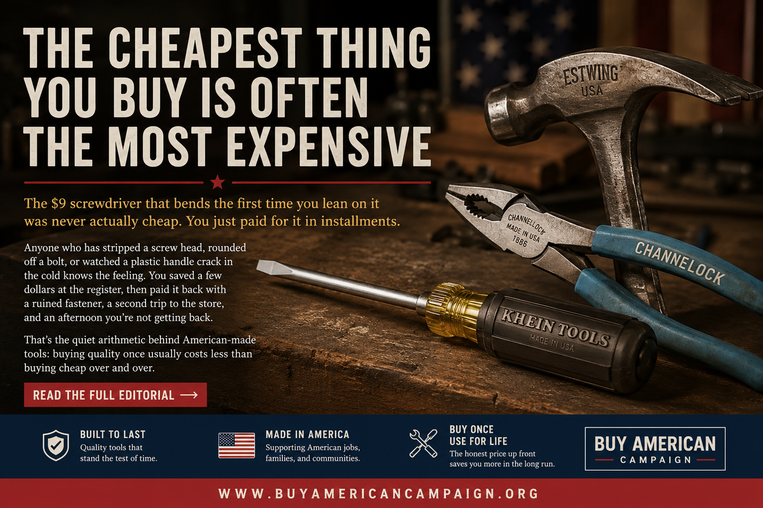
The $9 screwdriver that bends the first time you lean on it was never actually cheap. You just paid for it in installments.
Anyone who has stripped a screw head, rounded off a bolt, or watched a plastic handle crack in the cold knows the feeling. You saved a few dollars at the register, then paid it back with a ruined fastener, a second trip to the store, and an afternoon you are not getting back. That is the quiet arithmetic behind a well-made tool — and one reason American manufacturers that still build for durability deserve a closer look.
The Math Nobody Does at the Register
Price is what you pay one time. Cost is what you pay over the life of the thing. They are not the same number, and only one of them is printed on the tag.
Imagine a $9 screwdriver that needs replacing every eighteen months. Over a decade, you could buy six or seven of them before you count the stripped screws, the return trips, and the work you stopped doing to make them.
A well-made screwdriver costing three times as much only has to last longer than those replacements to become the cheaper purchase. Nothing about that math is complicated. It is just that the register only ever shows you one of the two numbers.
A Novelist Explained This Better Than Most Business Textbooks
In 1993, the British author Terry Pratchett explained this idea in a fantasy novel better than most business textbooks ever have. In Men at Arms, his character Sam Vimes notices that a good pair of leather boots costs fifty dollars and lasts ten years, while cheap boots cost ten dollars and give out after a season or two.
The man who can afford the good boots spends fifty dollars and has dry feet for a decade. The man who cannot spends twice as much across those same ten years and still has wet feet. It became known as the Sam Vimes “Boots” Theory of Socioeconomic Unfairness.
Of course, “buy once” only works when someone can afford the higher price upfront — and Pratchett’s real point was that many people cannot. Nobody buys the disposable tool because they failed to do the arithmetic. They buy it because it is what the wallet allows that day. That is exactly why a durable tool at an honest price matters so much: it is the thing that finally lets someone stop paying twice.
What “Made to Last” Actually Looks Like
Durability is not a marketing word. It is a manufacturing decision, and you can usually see it in how the tool is built.
Take Estwing. In 1923, a Swedish immigrant named Ernest Estwing began forging hammers in Rockford, Illinois around a single idea: make the head and the handle out of one continuous piece of steel. A hammer built that way cannot come apart at the joint, because there is no joint. The weakest point in the tool was designed out of existence rather than warrantied around.
More than a century later, the basic design remains unchanged, and the hammers are still made in Rockford. Estwing warrants its all-steel hammers against failure in normal use — a promise that reflects how confidently the company builds them.
The Companies That Still Build That Way
Channellock has been making pliers in Meadville, Pennsylvania since 1886 — 140 years this year. The company is still run by the fifth generation of the DeArment family, and more than 350 people in that one small city produce over 75 different sizes and types of pliers. Its made-in-USA pliers, wrenches, snips and drivers carry a limited lifetime warranty against defects in materials and workmanship. A warranty like that signals confidence in how the tool was built.
Klein Tools has been at it even longer, since 1857, when a German immigrant named Mathias Klein made his first pair of pliers in Chicago. Its manufacturing headquarters now sits on a hundred acres in Mansfield, Texas, where the company forges pliers, wire strippers, screwdrivers and nut drivers. Which brings us back to where we started: there are still American-made screwdrivers built by people with names and hometowns — and built for more than one difficult afternoon.
The Costs That Never Show Up on the Price Tag
Cheap tools bill you in currencies the receipt never records. The stripped screw you now have to drill out. The job that stopped while you drove back to the store. The knuckles you opened when a handle let go. The drawer full of dead tools you keep meaning to throw away, and the landfill where they eventually go.
And one more line item, the one this campaign exists for: the job that was never created here. Every disposable tool was made somewhere, by someone. The one forged in Meadville or Rockford or Mansfield keeps a paycheck in an American town, in a plant that has been there for generations and intends to stay.
Buy Once, Cry Once
Tradespeople have a saying for this: buy once, cry once. Pay the honest price up front and be finished with it.
Nobody is asking you to replace your whole toolbox tomorrow. But the next time something snaps, bends, or strips, replace it with the last one you will ever have to buy. Choose the hammer forged from a single piece of steel. Choose the pliers from the town that has made them for 140 years. Choose the screwdriver that will still be in the drawer when your kids are borrowing it without asking.
The cheapest thing you buy can become the most expensive. Fortunately, the reverse is often true too.
American-made tools mentioned in this article
Whenever possible, choose Made in USA.
| If you like what you see and think this post would be of interest to someone, please share |