Category: Campaign

  • How Wall Mart Destroyed American Manufacturing

    How Wall Mart Destroyed American Manufacturing

    Within the past few decades, U.S. companies have been moving jobs overseas. Large corporations that employed several thousands of Americans have gradually packed up and relocated offshore.

    Of course, this trend started long before Wal-Mart became a retail superpower. However, there is no doubt that the retail chain has grossly contributed in destroying American manufacturing thereby accelerating the loss of American jobs to countries such as China, India and other low-wage nations.

    Wal-Mart has spent a fortune in recent years on conferences, advertising, and PR promotions in an effort to convince Americans that it cares about the nation. On the periphery, the company’s U.S. manufacturing initiatives appear patriotic enough, but here are some of the ways Wall-Mart has been involved in crippling American manufacturing.

    First of all, Wal-Mart commands control for just one major reason – its purpose which is to bring goods at the lowest possible prices to its customers. The company, therefore, has a clear policy for suppliers – to supply at the lowest possible rate. In order to survive the retailers pricing demands, they lay off workers, close U.S. plants and resort to outsourcing products offshore.

    Join the Buy American Movement

    Secondly, Wal-Mart is America’s largest importer. The retailer has held the position as the U.S. largest importer of goods for several years. Many of the company’s selected U.S. suppliers have continued to import most of their goods such as bicycles and televisions. As for products labeled ‘American-made’ or ‘American-assembled’, these suppliers import a majority of the product’s components.

    Another factor is that the company thrives on low wages. For any of the retailer’s U.S. manufacturing deal to click, extremely low labor is required. American manufacturers have been put in harm’s way because Wal-Mart’s uncompromising demand for lowest rates has driven these suppliers to hunt for lower prices overseas.

    Furthermore, Wal-Mart has destroyed U.S. manufacturing by giving non-American companies direct access to the U.S. market. Wal-Mart is big and centralized; therefore it has the capacity to link oversea suppliers into its digital system. With the company’s global reach, it’s easy to switch to offshore sourcing faster than the traditional norms of retailing.

    Browse American-Made Products

    Americans love ‘Made in America’ and Wal-Mart knows Americans will pay more for it. The retailer is designed to sell more goods at higher profit margins. Americans are willing to pay higher rates to keep their compatriots employed, a recent survey has shown. The retail giant knowing that consumers would prefer goods made in the U.S. has always made sure its product packaging particularly communicates that the products support American jobs, whereas the reverse is the case.

    It seems Wal-Mart is set to apply different tactics in order maintain its dominance in the retail sector and this will continue to affect American manufacturers negatively. The consequence is that quality middle-class jobs will continue to depreciate.

    In order to really rebuild manufacturing in the U.S., Americans need actual manufacturing not just having products assembled in the country. Until American factories resume work, things may get worse. There is a need to get large corporations not to develop too much appetite for money, to think home and become more patriotic.


    If you like what you see and think this post would be of interest to someone, please share
  • How Manufacturing Off Shore Can Hurt Your Business

    How Manufacturing Off Shore Can Hurt Your Business

    Since the early 1980’s American economists and corporate Gurus believed that the United States could survive and be successful by only doing research and innovation and let foreign nations produce our products.

    But what these policymakers are realizing is that if we do not also have a hand in manufacturing those things we create we become dependent on those countries for the very goods we invent.  We no longer are producers, only creators.  Which is why this country went from a $30 billion trade surplus in high-tech products almost two decades ago to over a $46 billion trade deficit today.

    It is believed this wholesale transfer to offshore production has done three things: weakened our own job-creation engine, hindered our ability to rebound from a recession, and eroded middle-class prosperity as there are fewer jobs available.

    Corporations thinking of manufacturing offshore need to consider a few things.  Labor costs is just one side of the equation.  There are other considerations.

    Join the Buy American Movement

    • The cost of moving and setting up facilities on foreign soil
    • Quality control – it estimated only 10% of products manufactured abroad pass
    • Tariffs – New tariffs are being considered to make importing less attractive
    • Losing Customers – There is a mood in this country that we need to regain control over our exports and begin manufacturing again in our own country

    Browse American-Made Products

    Initially US manufacturers thought they had found the panacea to staying competitive but in the end, it is just becoming a quick fix that is helping to destroy the American economy.


    If you like what you see and think this post would be of interest to someone, please share
  • How US Companies Can Prevent Overseas Counterfeiting

    How US Companies Can Prevent Overseas Counterfeiting

    Counterfeiting is a process whereby products are made or distributed under some other company’s name and without permission by that company. Counterfeit goods involve a wide range of industries which may include: clothing, medication, car parts, and electronics.

    Some other products vulnerable to counterfeiting are jewelry, handbags, wallets, computers, shoes, and personal care products. Counterfeiting happens to be a global problem and has been around for years. Unfortunately, use of modern day technology has worsened the already bad situation.

    Nevertheless, all hope is not lost as there are a few steps that U.S companies can take to protect themselves from losing much more money to overseas counterfeiting.

    First, you have to Register Your Trademarks. Trademarks registration is a very important step in protecting your brands. Federal registration will allow you to enforce your trademarks rights anywhere in the United States. Also make sure you register your trademarks in all the countries in which you do business. Foreign registration provides you additional rights and will go a long way preventing the exportation of counterfeit goods that have your trademarks.

    Join the Buy American Movement

    The next important step is to use technology in protecting your goods from being counterfeited. Technology can be expertly applied within the product itself. For instance, in apparels, you may add a seemingly invisible thread that creates a brand-specific pattern that is visible only under certain lighting.

    The next major step, which has often times been overlooked, is to register your trademarks with customs agencies in the United States and other countries in which you do business. The U.S. Department of Customs and Border Protection (CBP) provide an Intellectual Property Rights (IPR) Enforcement program that would help stop the flow of counterfeit goods into the United States.

    Educating your consumers is another important step to take. In order to prevent your consumers from buying counterfeit goods, you will need to make available to them the information necessary to make enlightened purchases. Send them information through your company websites and also partner with other relevant websites to help identify places that sell counterfeit goods and to provide a list of authorized dealers. Inform your consumers how to identify and report counterfeit goods to you or other partners.

    Browse American-Made Products

    Counterfeit goods can cost any company both money and reputation. Taking a few simple steps to protect your brand and also your consumers is worth every effort that will be required to do so. While it might be practically impossible to completely eradicate counterfeiting globally, however, with adequate precautionary measures such as the steps outlined above, U.S. companies can empower themselves to prevent overseas counterfeiting from going overboard.


    If you like what you see and think this post would be of interest to someone, please share
  • Chinese Manufacturing Standards Rated Lowest In The World

    Chinese Manufacturing Standards Rated Lowest In The World

    The recent scandals about poisoned baby milk, contaminated pet food, dangerous toys and other substandard products from China have raised questions about manufacturing standards in China.

    Let’s assume for a minute that you are asking why Chinese firms turn out poor quality products on their own. There are a number of factories in China that will turn out anything you ask them to produce, defaulting to minimum cost and minimum quality unless otherwise specified.

    In just three decades, China has been transformed from one of the world’s poorest nations to the world’s second largest economy. It was probably inevitable that as production grew so would the problems associated with it, at least in the short term. Similarly, it could be argued that China is going through the same quality cycle that occurred during Japan’s post-war development or America’s manufacturing boom in the late 19th century—but in an environment with infinitely more scrutiny.

    Chinese manufacturers will do whatever they need to in order to catch a piece of business, but from there, the relationship often goes downhill, albeit in small steps. “Quality fade”, the quiet and incremental degradation of a product’s quality over time, is one of the more common issues.

    Join the Buy American Movement

    Much of the problem is cultural. Chinese suppliers believe that what an importer doesn’t know can’t hurt him. They change product specifications without asking, and they believe that it is better to beg forgiveness than to ask permission. Quality is seen as a barrier to greater profitability and quality issues are not openly discussed.

    Chinese domestic market consumers generally go for either the best product or the cheapest product.  So if you are not making the best, you are racing to the bottom to make the cheapest.  Chinese consumers are not generally looking at quality; it is assumed that if you want quality, then you buy the best one; otherwise just buy the cheap one.  So, manufacturers are not rewarded for making incrementally better products.

    Factories in China will do anything to please. Prices are famously low and production cycles short. Chinese factories transform what were, in fact, profitless contracts into lucrative relationships. The production cycle is the opposite of the theoretical model of continuous improvement. The innovation inside China factories turns to cutting costs, often in ways that range from unsavory to dangerous. Packaging is cheapened, chemical formulations altered, sanitary standards curtailed, and on and on, in a series of continual product debasements.

    Browse American-Made Products

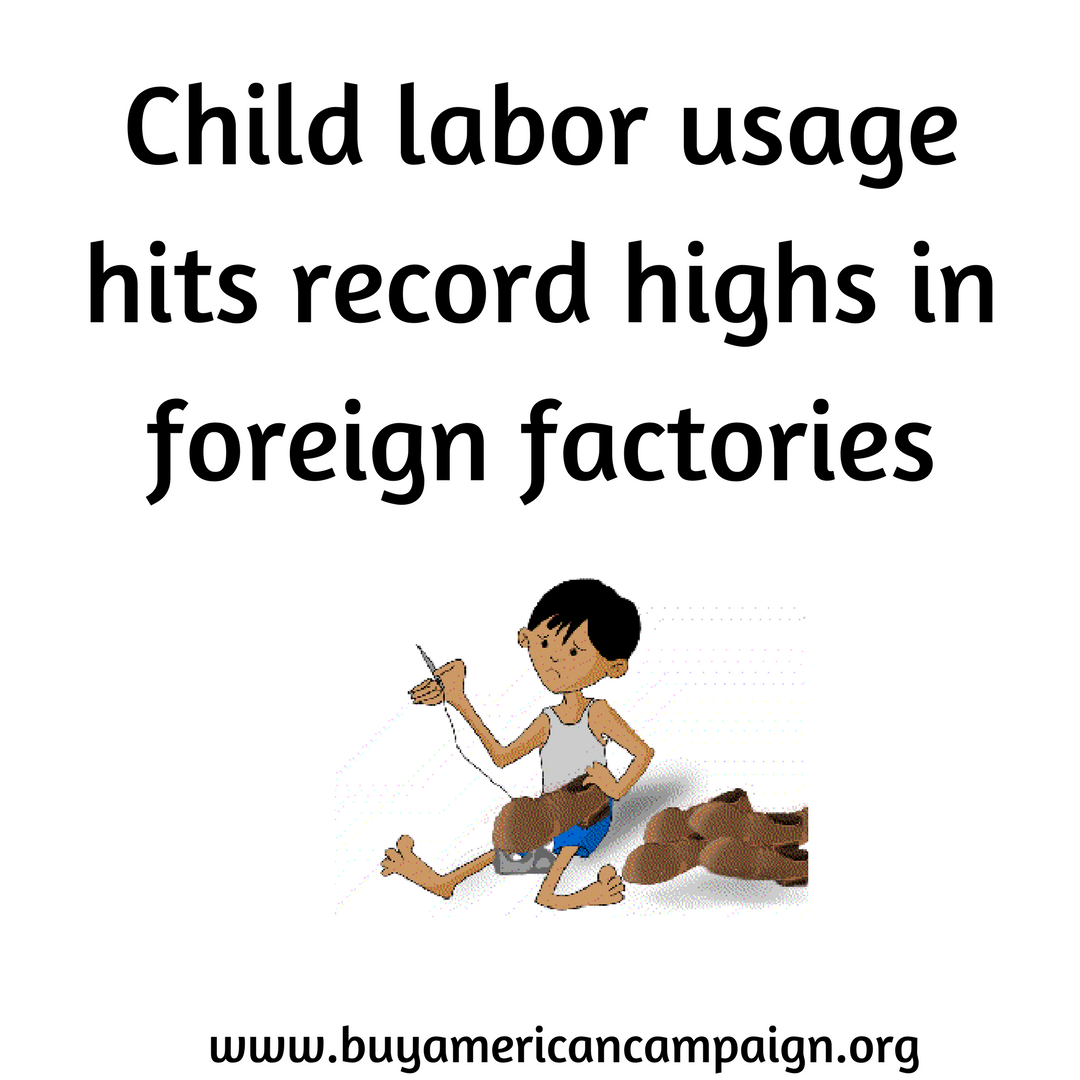
    With lax enforcement of a lot of product safety requirements, many Chinese domestic suppliers become accustomed to cutting corners where possible.  Many manufacturing companies in China do not abide by strict labor laws. Many products are made under humane working conditions and do not meet today’s stringent safety standards. Low pay and child labor are factored into getting products made. This cumulates in producing products of high quality.

    Modern Chinese factories outsourcing work to smaller, grittier, facilities even though this meant forgoing the production benefits from economies of scale. The tiny outfits were in a much better position to skirt environmental controls and safety standards for products and workers.


    If you like what you see and think this post would be of interest to someone, please share
  • Why Overseas Products Are Killing Local Wages

    Why Overseas Products Are Killing Local Wages

    Check the labels on your clothes or the description of any product you buy and you will more often than not see that it was made somewhere other than the US. This is not really big news to anyone who has been paying attention, but what is so alarming here is that many people have now simply accepted that this is the way things are, not to mention how they will stay. What these folks often fail to realize is that the overseas manufacture of products sold in the US had a negative impact on the economy, which includes how much the average person will earn here at home.

    Let’s start things out by talking about why so many products are now made overseas instead of locally. The simple answer is that it is all down to money, as manufacturers know that they can make the same product for a whole lot less overseas than they can at home. This is because the people who work in these countries do so for mere pennies per hour. Why would a company pay someone $7.25 per hour when they can get the same work done for less than a buck an hour?

    Join the Buy American Movement

    Back in the days when manufacturing was big business in the US, it was the middle class who thrived, as there was plenty of work to go around and a living wage to be earned. With those jobs slowly but surely disappearing, the middle class is starting to shrink, with more and more people now forced to take minimum wage jobs just to get by. The problem here is that the minimum wage simply isn’t rising to match the cost of living, which is forcing people to work 2 or 3 jobs in order to make ends meet, and only barely at that.

    There are companies in the US who are devoted to making sure that all of the products that they deliver are made right here at home. This is a truly noble cause that is beginning to gain some traction, but the majority of these companies are small in size. They have a small but dedicated workforce doing a fantastic job, but because of their size and the need to sell products at a price competitive with those made overseas, they cannot afford to pay a great wage to the people that work for them. This is how things will remain until people become a little more patriotic in their shopping habits.

    Browse American-Made Products

    The vast majority of the companies that have moved operations overseas to save a buck are not coming back without a real incentive, which is why we all need to support those who decide to stay in the US and employ their own people. While it may mean having to pay a little extra to get items made in the United States, it’s a worthwhile contribution to the growth of the economy. If we can work together to make the US a manufacturing superpower once again, then perhaps we can help more people earn a wage that require them to only have one job instead of 2 or 3.


    If you like what you see and think this post would be of interest to someone, please share
  • How China Destroyed the US Steel Market

    How China Destroyed the US Steel Market

    We keep hearing about the Chinese government’s steel dumping lately, but the truth of the matter is that China has been dumping not only its excess steel, but also paper, aluminum, glass, rubber, chemicals and other different commodities worldwide for more than a decade now. The majority of steel mills in China are subsidized by the state, the Chinese government, with absolutely no regard for international trade rules, systematically overproducing steel and artificially lowering its price. Currently, China’s steelmaking capacity and production represents the highest capacity in the international market, the US, EU, Japan and Russia all together having no reasonable chance at fair competition. And although the entire world is negatively affected by China’s overproduction of cheap steel, alas, America may be the country that will end up suffering the most, simply because we buy the most.

    Even with all of its public promises to put a damper on its excessive steel production, China keeps exporting over the amount of global steel capacity, forcing mills in the US to close, leaving thousands and thousands of steelworkers without a job, deliberately destroying the lives of thousands of families and entire communities that depend solely on the steel industry to make a decent living and to prosper. Moreover, even at a loss, and even with its debt getting higher and higher due to the costs of the expensive equipment it needs in order to keep overproducing high-end products, China won’t stop its sabotage of the US and European steel markets.

    Join the Buy American Movement

    And this is not only a threat to the US economy, but also to our national security. Steel is quintessential to our military forces, and extremely important in case of potential natural or man-made calamities. If we will end up depending on China to equip our army, or to rebuild our architecture, we will be putting ourselves in an incredibly fragile position. And such an outcome is not one of those worst case scenarios things, it’s what actually will happen if the international steel market keeps to its current course.

    In the United States, we undoubtedly produce the best steel that we could use, steel that is made in cost-efficient mills with the help of the most qualified, competent and able workers. For this reason, we will never be able to overthrow the devastating import surge we see in the US steel industry today, nor to bring down China’s ever-growing production capacity.

    Browse American-Made Products

    Nonetheless, we would still have a fighting chance if Congress and the US Trade Representative were to take drastic, yet necessary, measures. If US law would deem China as unqualifiable in our market economy, and if real steps would be taken in order to stop the unreasonable and immoderate Chinese trade practices, we will be able to help diminish international overcapacity, and restore the need for US-based steel companies.


    If you like what you see and think this post would be of interest to someone, please share
  • 5 Stomach-Turning Chinese Food Production Scandals

    5 Stomach-Turning Chinese Food Production Scandals

    China is considered the world’s big factory due to its low production costs and short production cycles. With a staggering economic and population growth, demand for food has increased dramatically. This puts a strain on China’s resources, which forces some manufacturers to get creative in their food processes. They cut corners by cheapening the packaging, foregoing sanitary standards, and altering chemical formulations. It’s essentially the highest form of product debasement that can have adverse health effects on consumers.

    These 5 disgusting Chinese food production scandals show the extent of trickery and deceit that people are willing to engage in just to earn profits.

    1. Melamine Milk

    Milk was enhanced with melamine in an attempt to increase the protein content of milk. This is like feeding your babies little doses of cyanide. As a result, over 50,000 babies got sick.

    1. Fake Eggs

    It looks like an egg, feels like an egg, tastes like an egg, but it’s not an egg. Fabricated ingredients include gelatin, food coloring, and wax.

    Join the Buy American Movement

    1. Rat Meat

    Rat meat is processed under extremely unsanitary conditions using banned chemicals. They are passed off as beef or lamb to consumers.

    1. Glow-in-the-dark Pork and 40-year old Poultry

    These are expired meats that were left unrefrigerated for decades! The poultry is putrid-smelling rotten meat that is smuggled from unknown locations and treated with crazy amounts of preservatives. The rotten pork is contaminated with phosphorescent bacteria, which gives it a blue glow.

    1. Cement-filled Walnuts

    Empty walnut shells are collected and are filled with paper and concrete. The shells are then glued back together. This is the single worst reason why the price of real walnuts in China is exorbitantly high.

    Browse American-Made Products

    The spate of Chinese food production scandals in recent years should be a cause for concern for countries that trade with China on a large scale. These practices show the total lack of ethical and moral standards of the people engaged in the business. The complete disregard for consumer safety is outrageous and contemptible, to say the least. If they do not care about their own population, who’s to say they wouldn’t extend the same vile practices to their trading partners?

    China is one of the biggest trading partners of the United States. We’d like to believe that the US has safety checks in place to ensure that imported food products coming from China (or any country for that matter) are safe for consumption. Creating awareness of these food production scandals fortifies the belief that the US consumers are better off supporting American-made products.


    If you like what you see and think this post would be of interest to someone, please share
  • How The Trade Deficit Impacts The Nation’s Debt

    How The Trade Deficit Impacts The Nation’s Debt

    If you pay attention to news programs on TV, you have probably heard a lot of talk about the national debt and how it appears to be climbing at an alarming rate. The average American may well be aware that debt levels are not where they need to be, but most probably cannot explain how things got to be the way they are, and what factors played a role in the debt climbing so high. The simple explanation is that the United States continues to spend money that they don’t have, and are forced to borrow, building higher debt levels in the process. Think of it as having a credit card that you continue to use while the credit company continues to increase your spending limit. Before too long, you are deep underwater and in a position where you will never be able to pay off that debt, at least not in a short period of time.

    While not totally responsible for the national debt, the trade deficit certainly plays a role in making the amount that the US owes continue to rise. First of all, let’s take a moment to talk about what the trade deficit is before we get into how it affects the national debt. It is perfectly natural for countries all over the world to engage in trade, as there are products and resources available in other parts of the world that cannot be easily accessed here. The problem here is that we can find ourselves in a position where we are buying more from another country than we are selling to them, which creates a trade deficit.

    Join the Buy American Movement

    The government collects taxes to help fund their expenditures, and when the amount collected falls short, the national debt starts to build. The trade deficit contributes to that debt via a rather circuitous route. When the country gets in a position where they are buying more than they sell to another nation, they need to essentially borrow money to cover the difference. We now find ourselves in a position where other countries in the world have more of our currency than we do, which means they can start to buy American assets or lend us back our own. The more we continue to spend abroad, the bigger the debt and the trade deficit grows, and the more IOU’s we are required to issue to our trade partners.

    Browse American-Made Products

    As mentioned earlier, we are often forced to buy from other nations because they have resources that we do not have here. That said, we have also got into the habit of buying and manufacturing items overseas because it is cheaper to do there than it is here. That creates numerous domestic issues that go beyond the trade deficit and the national debt. Taxes get raised and unemployment rates rise as jobs move overseas. Getting in the habit of buying American products and supporting domestic manufacturers can help shift the trade deficit back in our favor.


    If you like what you see and think this post would be of interest to someone, please share
  • The Intervention Of China in The Economy

    The Intervention Of China in The Economy

    There is not a lot we can do with regards to how governments of countries act. Even with the American government, yes we can complain and protest but there are no guarantees that anything favorable will come of it. The only guaranteed answer to reducing the trade deficit and increasing American manufacturing jobs is, as a people, to start buying products made in the USA.

    If you like what you see and think this post would be of interest to someone, please share
  • Why We Need To Invest In Education

    Why We Need To Invest In Education

    It’s good that companies are investing in the education and training of their employees but more needs to be done by the schools to get people ready for these new opportunities in the manufacturing sector.

    If you like what you see and think this post would be of interest to someone, please share