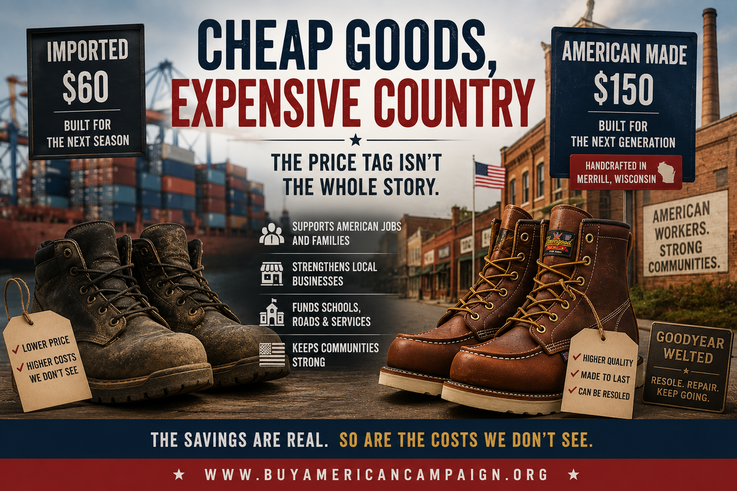
The work boots cost $60 instead of $150.
The savings are real. You can hold them in your hand.
The boots that cost $150 were handcrafted in Merrill, Wisconsin. The $60 pair came from the other side of the world. One might save you money today. The other helps ensure someone still has a job making boots tomorrow.
There’s another difference the price tag doesn’t mention. Many inexpensive imported work boots are difficult or uneconomical to repair, while American-made boots like Thorogood’s Goodyear-welted models can often be resoled and kept in service for years.
One was built for the next season.
The other was built for the next generation.
But there is another bill attached to those boots. You just don’t receive it at the checkout.
It arrives in a town you’ve never visited, where the factory closed twenty years ago. It shows up in the empty storefront on Main Street, the school that stopped replacing retiring teachers, the diner that no longer serves lunch because the second shift disappeared, and the young people who had to leave because there were no good jobs left to stay for.
For forty years, we’ve become very good at counting one side of that ledger.
We’ve almost stopped counting the other.
The Case for Cheap Imports Is Real
Before going any further, it’s worth acknowledging something that too often gets ignored.
The argument for cheap imports is not foolish.
When manufacturing moved overseas, millions of products became less expensive. Clothes, electronics, furniture, appliances, toys, tools — you name it. Economists have long noted that lower-income families often benefit the most from lower prices because they spend a larger share of their income on everyday goods.
That’s real.
If you’re raising a family on a tight budget, saving ninety dollars on a pair of work boots matters.
No honest conversation should pretend otherwise.
But that’s only one side of the equation.
The question isn’t whether the savings exist.
The question is whether they’re the whole story.
What the Price Tag Doesn’t Include
Imagine a factory employing 800 people.
Most people picture the workers inside the building.
What they don’t picture are the businesses that depend on those workers.
The coffee shop where they stop every morning.
The mechanic who services their trucks.
The restaurant where they eat lunch.
The local accounting firm.
The electrician.
The machine shop supplying replacement parts.
The hardware store.
The barber.
The dentist.
Economists call this the manufacturing multiplier. Every manufacturing job supports additional jobs throughout the surrounding community. Researchers debate the exact number, but they agree on the basic point: manufacturing creates far more economic activity than the payroll inside the factory gates.
When the factory closes, those businesses don’t all disappear overnight.
They simply become a little quieter.
Then a little emptier.
Then one day someone notices another “For Lease” sign in the window.
A Factory Is More Than Jobs
Factories don’t just pay workers.
They pay property taxes.
They sponsor Little League teams.
They donate to local charities.
They support volunteer fire departments.
Their employees coach youth sports, serve on school boards, attend church, and shop at local businesses.
A manufacturing plant becomes part of the civic infrastructure of a town.
Take it away, and the community doesn’t simply lose jobs.
It loses stability.
You can’t replace that with a cheaper pair of boots.

The Communities That Never Came Back
For decades, economists assumed displaced manufacturing workers would simply retrain, relocate, and find better opportunities.
Many did.
Many didn’t.
Research into what became known as the “China Shock” found that communities hit hardest by import competition often struggled for years afterward. Employment fell. Labor-force participation declined. Businesses closed. Population shrank.
The adjustment that economic theory predicted would be temporary often became permanent.
Some towns recovered.
Many never fully did.
That doesn’t mean trade is bad.
It means the costs were far greater — and lasted far longer — than many people expected.
The Things That Didn’t Get Cheaper
There’s another part of this conversation that rarely gets mentioned.
Many of the biggest household expenses didn’t become dramatically cheaper because manufacturing moved overseas.
Housing.
Healthcare.
Education.
Insurance.
Energy.
Those continue to consume a growing share of the average family’s income.
Yes, the television costs less than it did twenty-five years ago.
The mortgage doesn’t.
The washing machine might be cheaper.
College isn’t.
The savings were real.
They just weren’t enough to offset everything else.

We Counted the Savings
Imagine a family that saves ninety dollars buying imported work boots.
Good.
That’s ninety dollars they can spend somewhere else.
Now imagine another family whose primary wage earner loses a manufacturing job that paid enough to buy a home, raise children, and retire with dignity.
Those two numbers do not belong in separate conversations.
They belong on the same ledger.
One is visible.
One is hidden.
We’ve spent decades celebrating the first while treating the second as somebody else’s problem.
This Isn’t an Argument Against Trade
America doesn’t need to manufacture everything.
No serious person argues that.
Trade has existed for thousands of years and always will.
Nor is this an argument against other countries succeeding.
Every nation wants good jobs for its people.
So do we.
The real question is whether we’ve become too willing to measure success only by what happens at the cash register.
A country isn’t just a marketplace.
It’s also a place where people need opportunities to build careers, support families, and contribute to their communities.
Those things don’t appear on receipts.
They’re no less valuable because of it.
The Full Ledger
When an American-made product costs a little more, the difference isn’t simply disappearing.
Part of it pays the machinist.
Part of it pays the welder.
Part of it pays the engineer.
Part of it supports the supplier across town.
Part of it helps fund the local school, the roads, and the fire department.
Part of it keeps another American town alive.
That doesn’t mean every imported product is the wrong choice.
It simply means the price tag isn’t the whole story.
For decades, we’ve carefully counted the savings.
Maybe it’s time we counted what those savings cost.
Because the cheapest country to buy from isn’t necessarily the cheapest country to become.
And that’s the number that matters most.
Related reading: The Cheapest Thing You Buy Is Often the Most Expensive — the same argument, measured at the kitchen table instead of the country.
Whenever possible, choose Made in USA.
| If you like what you see and think this post would be of interest to someone, please share |