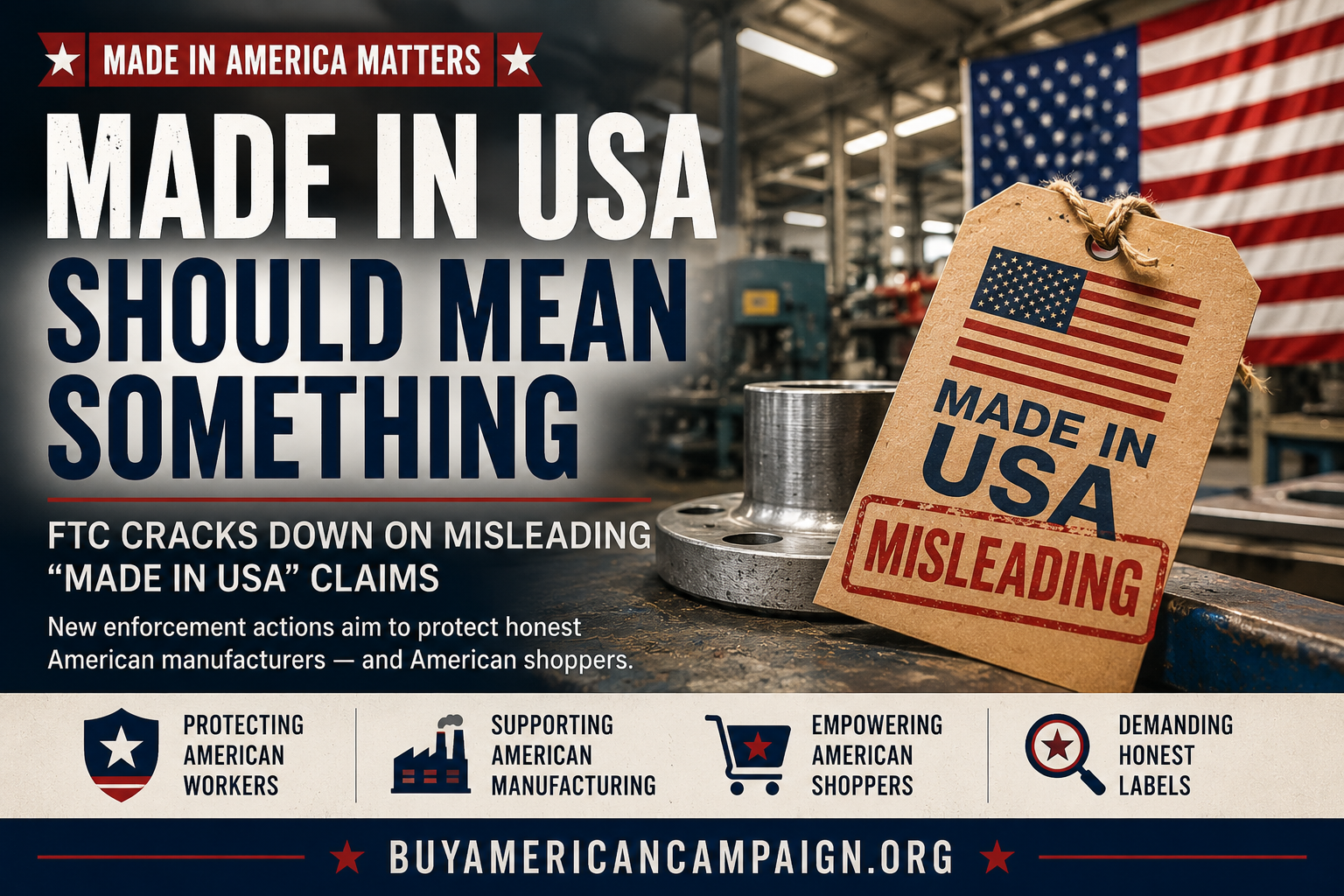
Three little words carry a lot of weight in this country: Made in USA. Shoppers trust them. Manufacturers earn them. And when a company slaps that label on a product that doesn’t deserve it, everybody honest loses. This week, the Federal Trade Commission reminded the marketplace that the label has to mean something — issuing warnings to companies making questionable “Made in USA” claims.
At the Buy American Campaign, this is the kind of story that goes straight to the heart of why we exist. It isn’t about attacking businesses. It’s about protecting the trust that makes “Made in USA” worth anything at all.
What the FTC Actually Requires
Under the FTC’s standard, a product advertised as “Made in USA” without qualification must be “all or virtually all” made in the United States. In plain English: the significant parts, processing, and labor that go into the product need to be American, and the item should contain little to no foreign content.
That’s a high bar — and it’s supposed to be. The FTC’s Made in USA Labeling Rule gives the agency real teeth to pursue companies that use the claim deceptively, including the ability to seek penalties. When the FTC steps in, it’s making sure that businesses which actually invested in domestic manufacturing aren’t undercut by competitors who just print a flag on the box.
Why This Protects Honest Manufacturers
Think about what a genuine “Made in USA” product represents. A company chose to run a factory here. It hired American workers, paid American wages, met American safety and environmental standards, and often paid more to do it right. That commitment shows up in the price — and it should show up on the label.
Now imagine a competitor importing nearly everything, doing minimal finishing work stateside, and stamping “Made in USA” on the result. They get the marketing halo without the cost or the commitment. That’s not just unfair to shoppers — it’s a direct threat to the honest manufacturers who play by the rules. Enforcement levels the playing field.
Why It Protects Shoppers, Too
Most people who seek out American-made products are voting with their wallets on purpose. They want to support American jobs, strengthen domestic supply chains, and know that their money is staying closer to home. A misleading label steals that choice. It turns a values-based purchase into a con.
When the label is trustworthy, everyone benefits: the shopper gets what they paid for, the honest maker gets rewarded, and the whole idea of “buying American” stays credible. Weak enforcement erodes that trust one deceptive product at a time.
This Is Exactly Why We Verify
Here’s where it hits home for us. The reason the Buy American Campaign puts in the work to research and verify where products are actually made is simple: the label alone isn’t always enough. Marketing language can be slippery. “Designed in USA,” “Assembled in USA,” “American brand,” and “Made in USA” are not the same thing — and the differences matter.
We dig into where a company actually manufactures, whether its materials are domestic, and how much of the real work happens on American soil. We’re honest about the gray areas, too — plenty of good companies are American-owned but source some components globally, and we’d rather tell you the truth than oversell a label. Accuracy is the whole point.
Made in USA Is a Promise
At its best, “Made in USA” isn’t a marketing slogan — it’s a promise. A promise that American hands built this, that American families were supported by it, and that the buyer’s dollars backed real domestic production. The FTC’s action is a reminder that promises only hold if someone protects them.
So this isn’t a story about red tape or a company getting in trouble. It’s a story about defending something worth defending. Every time the label is enforced, it gets a little more meaningful — and a little more powerful as a force for American jobs.
If you care about buying American, care about the label being real. Ask questions. Look past the flag graphic to the fine print. And support the companies — and the watchdogs — working to keep “Made in USA” honest. Because when those three words mean exactly what they say, American manufacturing wins.
Whenever possible, choose Made in USA.
| If you like what you see and think this post would be of interest to someone, please share |