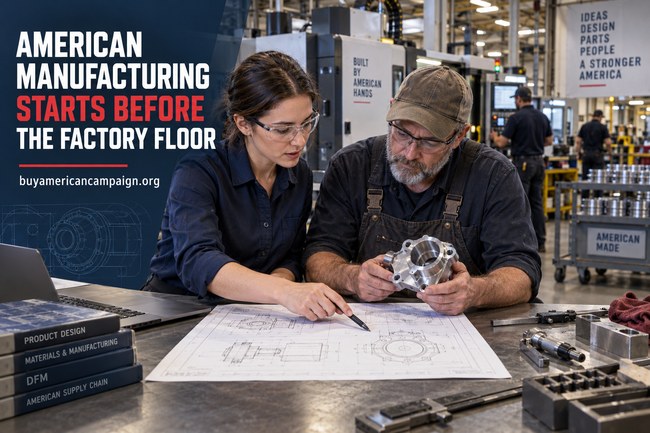
When people picture American manufacturing, they usually picture the factory floor: sparks flying, machines cutting metal, workers assembling products, and finished goods moving down a line. That is the visible part of the story. But by the time a product reaches that floor, many of the decisions that determine where it can be made have already been locked in.
A product becomes practical—or impractical—to build in America at the drawing board. Its materials, tolerances, fasteners, electronics, tooling, repairability, and expected order volume all shape the possible supply chain. If those choices assume one distant supplier with one specialized process, the country-of-origin decision may be made before anyone requests a factory quote.
The Factory Cannot Fix Every Design Decision
American factories can do remarkable work, but they cannot manufacture around a design that ignores available equipment, materials, skills, and economics. A part may require an unnecessary tolerance that drives up inspection time. A housing may use a resin that is difficult to source domestically. A finished product may contain dozens of custom fasteners when a handful of standard parts would do the job.
None of those choices looks like a manufacturing decision in a glossy product presentation. Each one can quietly determine which suppliers are able to bid, how much tooling is needed, whether repairs are possible, and how quickly production can respond when demand changes.
Domestic Suppliers Need a Seat Early
The best time to ask an American supplier for advice is not after the design is frozen. It is while engineers and product teams can still change the design. A good manufacturer may know how to combine two parts into one, replace a difficult material, simplify a machining step, or adjust a tolerance without changing what the product does.
That kind of collaboration is part of a healthy industrial ecosystem. The NIST Manufacturing Extension Partnership works through centers in every state and Puerto Rico to help small and midsize manufacturers improve operations, adopt technology, develop workers, and connect with domestic suppliers. Its work reflects a basic truth: manufacturing strength depends on networks of capable companies, not a few famous final-assembly plants.

Resilience Is Designed In, Too
Supply-chain resilience is often discussed as if it means keeping more inventory in a warehouse. Inventory can help, but resilience also comes from design choices. Can a component be made by more than one qualified supplier? Can a material be substituted without redesigning the whole product? Can a damaged module be replaced, or must the entire product be discarded?
NIST notes that manufacturers operate inside interconnected supply chains and depend on the performance and responsiveness of the companies around them. That is why domestic capability matters. A nearby supplier does more than shorten a shipping route. It can give a designer faster feedback, make smaller production runs practical, and help solve a problem before it becomes a container full of unusable parts.
Repairability Is an Industrial Choice
Products that can be repaired also keep manufacturing knowledge alive. Replaceable bearings, standard screws, available parts, and clear service information create work for machinists, repair shops, parts makers, and technicians long after the original sale.
By contrast, a product sealed shut with proprietary components may be cheap to assemble but expensive to own. When it fails, the customer buys another complete unit and the country loses another chance to maintain the practical skills that support production. Designing for service is not nostalgia. It is one way to keep value, capability, and useful work closer to home.

Buy American Should Start With Buildable American Products
Consumers still have an important role. Demand tells companies that country of origin matters. But manufacturers and brands have a responsibility, too. They should not wait until launch day to discover that their product cannot be made competitively in the United States.
Bring production people into product development. Ask domestic suppliers what they can do before assuming they cannot do it. Use standard materials and components when custom ones add no real value. Design products that can be serviced. Publish where the work happens and explain the limits of every origin claim.
The First Manufacturing Decision
A strong domestic manufacturing base is not created only by opening factories. It is created by sending those factories products they can realistically build, suppliers they can work with, and orders steady enough to justify investment in people and equipment.
The first manufacturing decision is not made when a machine turns on. It is made when someone chooses how the product will be designed, sourced, repaired, and improved. If we want more things made in America, American manufacturing has to be part of that conversation from the beginning. That conversation should begin before the first prototype is built.
Whenever possible, choose Made in USA.
| If you like what you see and think this post would be of interest to someone, please share |