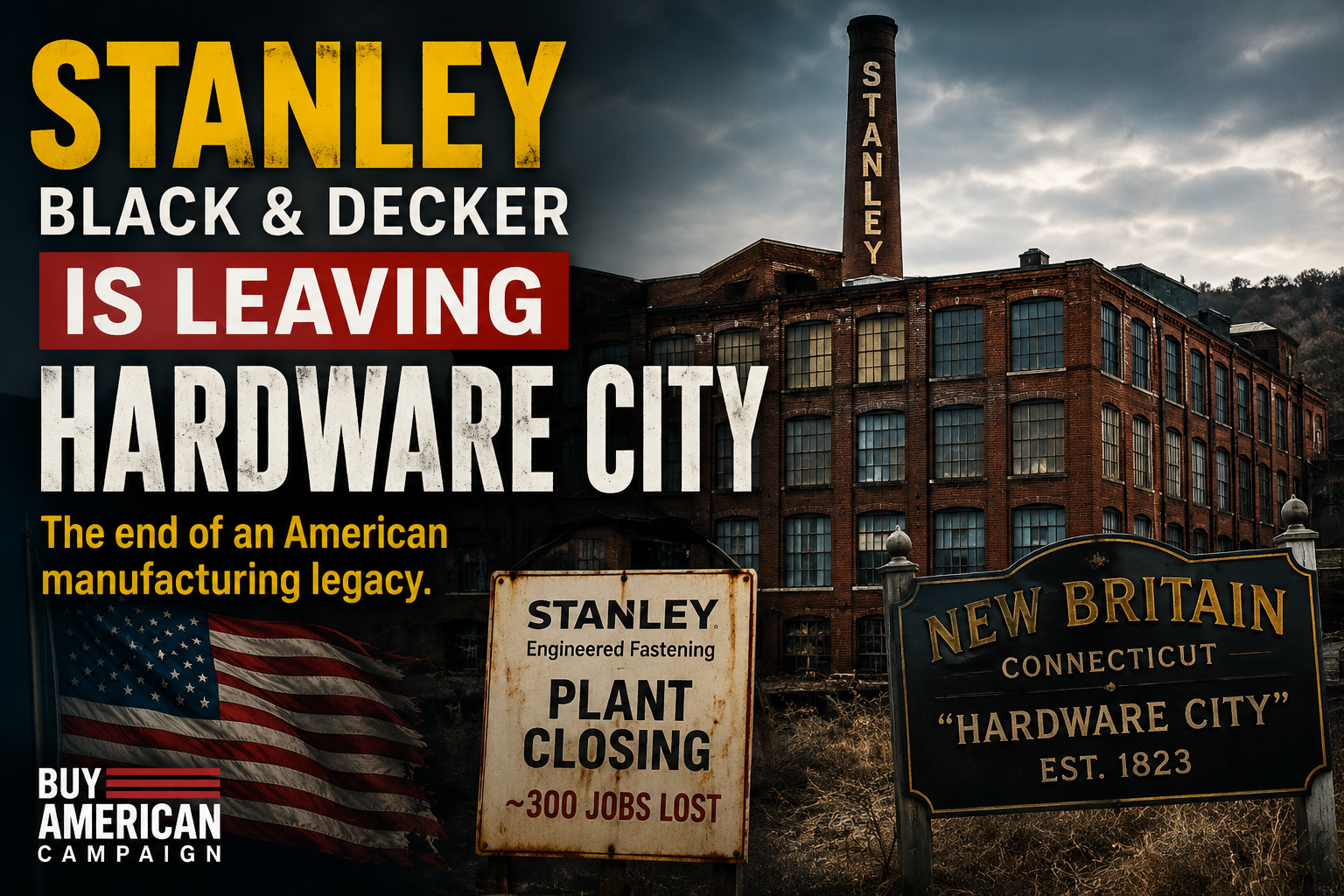
For generations, New Britain, Connecticut was known as “Hardware City.” The nickname wasn’t marketing fluff. It was earned. Factories filled the city. Workers built tools that ended up in garages, workshops, construction sites, and military supply chains across America. The Stanley name wasn’t just headquartered there — it helped define the identity of the entire town.
Now that chapter is ending.
Stanley Black & Decker is shutting down its last manufacturing plant in New Britain, eliminating roughly 300 jobs and effectively ending the company’s manufacturing presence in the very city that made it famous.
And Americans should probably ask themselves an uncomfortable question: what exactly does “American brand” mean anymore if the manufacturing disappears too?
The Town That Built the Brand
Stanley’s roots in New Britain go back nearly 200 years. This was not some temporary warehouse operation or tax-incentive relocation story. This was one of the foundational manufacturing communities of industrial America.
Entire generations of families worked in these factories. Skilled trades were passed from parents to children. Local restaurants, supply shops, contractors, and small businesses all depended on the manufacturing economy that surrounded companies like Stanley.
That is why this closure hits differently. It feels symbolic of something much bigger than one plant shutting down.
The Brand Still Sells American Heritage
Here’s the part that frustrates many Americans: Stanley Black & Decker still benefits enormously from its American identity. The branding, the history, the legacy, the workshop culture — all of that was built by American factory workers over generations.
Consumers still associate Stanley with durability, tradesmen, and American craftsmanship. But the manufacturing footprint tied to that reputation keeps shrinking.
At some point, companies have to decide whether “American heritage” is something they genuinely value or just something they use in advertising campaigns.
Another Warning Sign for American Manufacturing
This story lands at a strange moment in America.
Politicians from both parties are suddenly talking about rebuilding domestic manufacturing. Consumers are becoming more interested in buying American-made products. Companies are talking about reshoring supply chains and reducing dependence on overseas production.
Yet one of America’s most recognizable industrial brands is still walking away from the very manufacturing town most associated with its identity.
That contradiction is exactly why so many Americans have become skeptical. They keep hearing speeches about rebuilding manufacturing while watching iconic factory towns continue to hollow out in real time.
The Uncomfortable Consumer Reality
There is another uncomfortable truth here too: consumers play a role in this.
Americans say they support domestic manufacturing. They say they care about American jobs. They say they want companies to keep production here.
But many shoppers still choose the cheapest option available the moment they stand in the aisle or open Amazon.
Companies notice that behavior. Wall Street notices that behavior too.
And eventually, communities like New Britain pay the price.
This Is Why the Buy American Conversation Matters
The closure of Stanley Black & Decker’s last New Britain plant is not just another business headline. It is a reminder that industrial identity can disappear faster than people think.
Once factories leave, they rarely come back. The workers scatter. The apprenticeship pipelines disappear. The supporting businesses weaken. And eventually the town that once built things becomes a town that mostly remembers building things.
That is why stories like this matter.
Because America cannot keep celebrating manufacturing in speeches while quietly allowing the industrial backbone of entire communities to disappear.
Whenever possible, choose Made in USA.
| If you like what you see and think this post would be of interest to someone, please share |