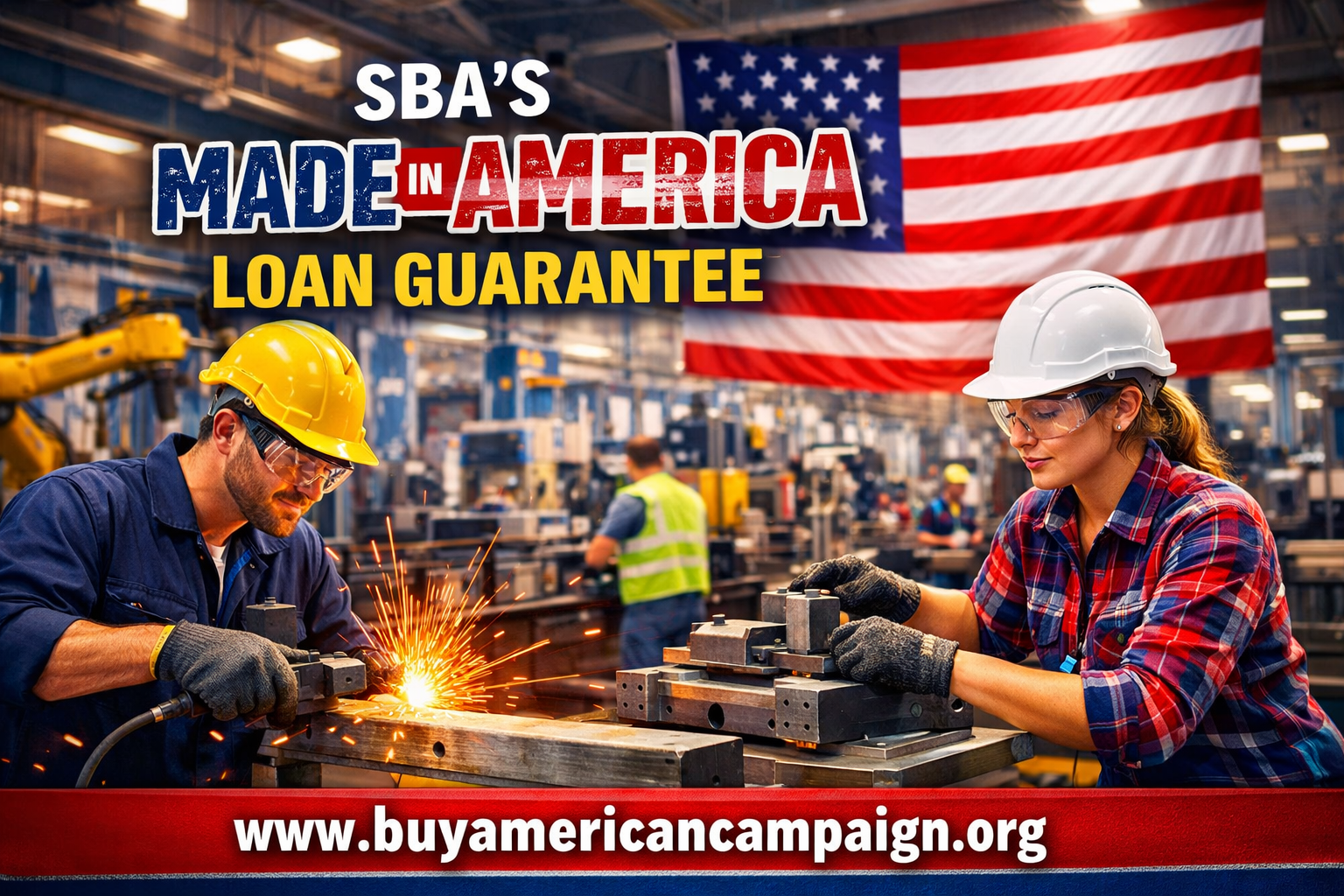
There’s a lot of talk these days about bringing production back home, strengthening supply chains, and rebuilding America’s industrial base. This latest SBA move gives that conversation some real substance. The Made in America loan guarantee program is getting a major expansion, opening the door for more U.S. manufacturers and food supply chain businesses to access the capital they need to grow, modernize, and compete.
Starting May 1, manufacturers across NAICS Sectors 31-33 will become eligible for this expanded support. For small businesses trying to invest in new equipment, improve facilities, build inventory, reduce dependence on foreign adversaries, or even grow through acquisitions, this could be a meaningful opportunity. The SBA is also broadening eligibility under its International Trade Loan program to include more food supply chain businesses, including agriculture, production, and logistics.
Why the Made in America Loan Guarantee Matters
This matters because financing is often one of the biggest barriers standing between a small manufacturer and its next stage of growth. A company may want to buy more advanced machinery, automate part of its process, expand into a larger facility, or bring a supplier relationship back into the United States. But those kinds of moves require capital, and capital can be hard to secure when lenders view manufacturing as expensive, complex, or risky.
That’s where this change becomes important. The SBA increased the government guaranty on these loans to 90%, compared to the standard 75% for regular 7(a) loans. That higher guaranty gives lenders more confidence to say yes. For small businesses, that can mean access to financing that might not have been available otherwise.
And when more American manufacturers can get funded, that doesn’t just help individual companies. It helps local workers, local suppliers, and local communities. It also helps rebuild production capacity here at home instead of continuing to send that capacity overseas.
A Big Deal for Small Manufacturers
One of the most important details in this announcement is who it’s really aimed at: small businesses. According to the SBA, small businesses make up 98% of all manufacturers in America. That’s a huge number, and it tells the real story of American manufacturing. It’s not just giant factories and major corporations. It’s also thousands of smaller operations across the country making parts, components, food products, industrial goods, packaging, tools, and more.
These businesses are often deeply tied to their communities. They hire locally. They create stable jobs. They support regional supply chains. And when they grow, the impact tends to ripple outward. That’s one reason this expansion could matter well beyond the balance sheets of individual companies.
The timing is notable too. Weekly wages in manufacturing surged 5.1% in February, a sign that the sector remains economically important and competitive. Manufacturing jobs have long been associated with strong wages, skill development, and long-term career pathways. Supporting domestic manufacturers is not just about nostalgia or patriotic branding. It’s about backing an industry that still plays a critical role in national prosperity.
What the Funds Can Be Used For
The practical side of this program expansion is what makes it especially interesting. Eligible businesses can use funds for a range of growth and resilience-focused purposes, including:
- Upgrading equipment
- Modernizing facilities
- Diversifying supply chains away from foreign adversaries
- Building inventory
- Expanding operations through acquisitions
That list covers a lot of the real-world challenges American manufacturers are facing right now. Many businesses know they need to improve efficiency or modernize production, but the upfront cost can be a major obstacle. Others want to reduce exposure to overseas suppliers and political instability but need working capital to make that transition possible. In both cases, better financing access can make action possible instead of leaving those plans stuck on paper.
The inclusion of food supply chain businesses is also worth watching. Agriculture, food production, processing, transportation, and logistics all play a major role in domestic resilience. Expanding support in this area recognizes that a strong American supply chain is not just about factories. It includes the systems that move goods from producer to processor to warehouse to shelf.
Domestic Sourcing Gets a Boost
Another notable piece of this broader push is the SBA’s launch of the Make Onshoring Great Again Portal, which connects businesses with more than 1 million domestic suppliers. That may not get as much attention as the financing change, but it could be just as valuable over time.
One of the biggest reasons companies rely on foreign suppliers is simple: finding qualified domestic alternatives can be difficult, slow, and fragmented. A resource that helps businesses identify American supplier options could reduce that friction. When paired with financing support, it creates a more complete strategy. Businesses may be able to both find domestic suppliers and secure the funding needed to shift operations toward them.
The SBA also says it has cut more than $100 billion in red tape. Whether that figure is interpreted broadly or narrowly, the message is clear: the agency wants to present this as a pro-growth, pro-production effort designed to remove obstacles rather than add new ones.
More Than Policy Talk
SBA Administrator Kelly Loeffler summed up the administration’s message this way: “Industrial dominance is essential to our national security and strength. Small businesses make up 98% of all manufacturers in America. This Administration is transforming America into a nation of builders once again, as part of an industrial comeback that is being led by small businesses.”
That language is strong, but the underlying point is hard to ignore. Manufacturing capacity matters. Supply chains matter. The ability to produce goods domestically matters. And small businesses are central to all of it.
At Buy American Campaign, that’s why stories like this stand out. It’s easy to talk about buying American in theory. But if the country is serious about supporting American-made goods, it also has to support the businesses that make them possible. That means access to capital, stronger supplier networks, and policies that help domestic manufacturers scale instead of struggle.
This expansion of the Made in America loan guarantee won’t solve every challenge facing U.S. manufacturing. But it does move in the right direction. It gives small businesses more tools to invest, adapt, and grow here at home. And that’s the kind of step that can help turn the idea of an American manufacturing comeback into something more real.
When more businesses can build in America, source in America, and hire in America, the benefits extend far beyond one loan program. That’s good for workers, good for communities, and good for the long-term strength of the country.
Whenever possible, choose Made in USA.
| If you like what you see and think this post would be of interest to someone, please share |