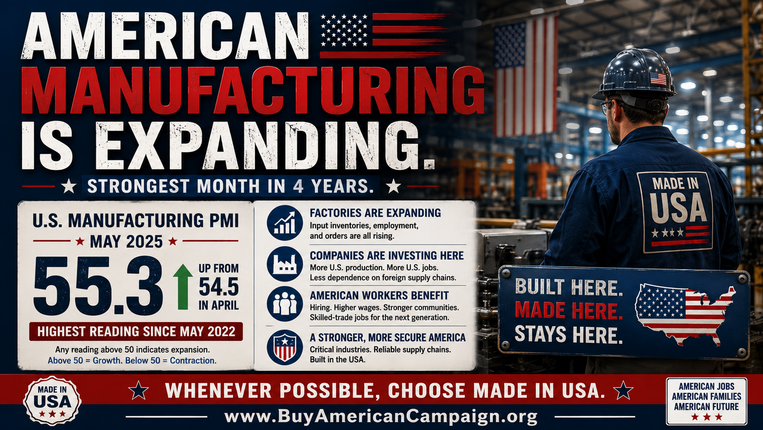
U.S. manufacturing just had its strongest month in four years.
According to S&P Global, the flash U.S. manufacturing purchasing managers’ index rose to 55.3 in May, up from 54.5 in April. That’s the highest reading since May 2022.
Any number above 50 indicates the manufacturing sector is expanding rather than contracting. A reading of 55.3 indicates real, meaningful growth.
For a country that has spent decades being told manufacturing was in permanent decline, that number is significant.
What is Actually Happening Inside U.S. Factories
The expansion was not just one number going up. Several pieces of the manufacturing economy moved in the same direction at the same time:
- Input inventories climbed to an 11-month high
- Manufacturing employment increased
- Output prices rose as factories met growing demand
- Supplier delivery times slowed because so many companies were ramping up orders
That is the picture of an industrial sector under pressure to produce — not one in decline.
Why Companies Are Building Inventory at Home
A big part of what is driving the increase is simple: companies are increasingly stockpiling goods in the United States instead of relying on long international supply chains.
Recent years have made the risks of distant supply chains very clear. Tariffs, geopolitical conflict, shipping disruptions, and rising overseas costs have made many companies rethink how much they depend on foreign production.
The answer for a growing number of them: build more here, source more here, and stockpile more here.

This Did Not Happen by Accident
The current expansion did not appear overnight.
For years, foreign direct investment into the United States has been surging. Major legislation like the CHIPS and Science Act has poured billions into rebuilding semiconductor capacity. Companies like Micron, Intel, TSMC, Samsung, and others have all announced large U.S. manufacturing expansions.
Meanwhile, traditional American industries — steel, appliances, automotive, machinery, agriculture — have been quietly building too.
The narrative of America being unable to manufacture anymore has been slowly unraveling for years. The new PMI data is just another piece of evidence.
The Scale of What Is Possible
Last week, McKinsey published research estimating it would take about 6% of U.S. GDP to build the industrial capacity needed to replace imports of key strategic goods.
That is a massive number. But it is also possible.
America still has the land, the energy resources, the workforce, the universities, the engineering talent, and the financial markets to lead industrial production globally. What it takes is the will to actually do it — from policy makers, business leaders, and consumers.

What This Means for Everyday Americans
A higher PMI is not just an abstract number for economists.
When U.S. factories expand, real things happen in real communities:
- Hiring goes up at local plants
- Wages improve in industrial regions
- Suppliers, contractors, and small businesses around those plants gain new orders
- Skilled-trade jobs become more available for young workers
- Towns that lost factories decades ago start to see momentum again
None of that shows up in a single headline. But it adds up.
The Bigger Picture
One month of strong PMI data does not reverse decades of offshoring.
But it does say something important: the idea that American manufacturing is dead or finished simply is not true. Factories are expanding. Hiring is growing. Investment is flowing in. And companies are increasingly looking at the United States as the place to build instead of the place to import from.
For a country whose industrial story was supposedly over, this looks a lot like a comeback.
Whenever possible, choose Made in USA.
| If you like what you see and think this post would be of interest to someone, please share |