Tag: American Manufacturing

  • America Is Building the Future of Aviation in North Carolina

    America Is Building the Future of Aviation in North Carolina

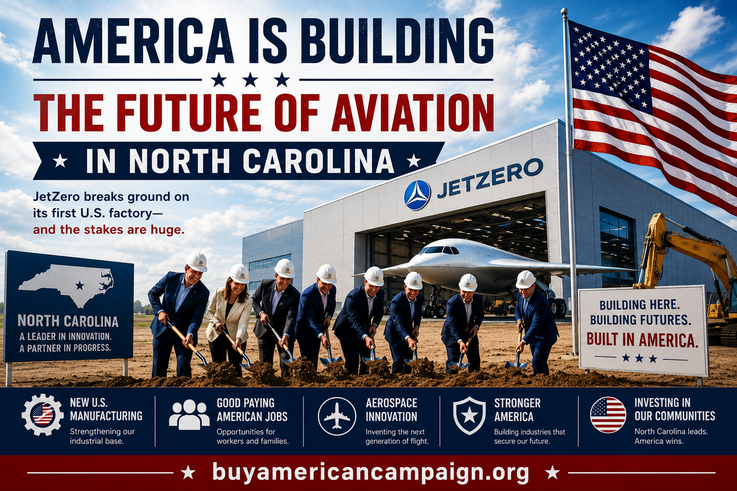
    JetZero Z4 blended-wing aircraft factory groundbreaking in Greensboro, North Carolina

    On June 15, 2026, shovels hit the dirt on more than 600 acres outside Greensboro, North Carolina — and with them, a bet that America can do something it hasn’t done in generations: build an all-new commercial airplane, from scratch, on American soil. JetZero, the aerospace startup behind the radical blended-wing Z4 jet, broke ground on its first manufacturing and final assembly campus, an 8-million-square-foot factory that the company says will become the most advanced aircraft plant of its kind anywhere in the world.

    This is exactly the kind of story the Buy American Campaign exists to celebrate. It isn’t about preserving the past. It’s about American workers inventing the future of an entire industry — and choosing to build it here.

    14,500 Jobs and $4.7 Billion in Investment

    The numbers attached to this project are hard to overstate. JetZero’s Greensboro campus is expected to create 14,500 jobs over the next decade, backed by $4.7 billion in investment that will transform the Triad region of North Carolina. State officials confirmed the deal was supported by the largest state-level incentive package ever offered to a startup in any industry.

    Those aren’t warehouse jobs or temporary construction gigs that vanish when the ribbon is cut. These are skilled, long-term manufacturing and engineering positions — the kind of work that builds a middle class and roots it in a community for decades. For a region that has watched textile and furniture plants close over the years, a 14,500-job aerospace campus is a generational turnaround.

    Construction begins immediately, with hiring expected to ramp in phases as the facility comes online over the next ten years.

    Browse American-Made Products

    What Makes the Z4 Different

    The airplane being built in Greensboro doesn’t look like the tube-and-wing jets we’ve all flown in. The Z4 is a blended-wing body, a design where the fuselage and wings merge into one smooth, lifting shape. The result is an aircraft JetZero says will be up to 50 percent more fuel efficient than today’s comparable jets.

    The Z4 is aimed at what the industry calls the “middle market” — routes that are underserved today. It’s designed to carry about 250 passengers on trips of up to 5,000 nautical miles. If it delivers on its promise, it could reshape how airlines think about everything from fuel costs to cabin layout.

    For the first time in a long time, the most talked-about new shape in commercial aviation is being assembled by American hands, in an American factory.

    A Factory Built in the Digital Age

    The Greensboro plant isn’t just big — it’s smart. JetZero is working with Siemens and Deloitte to build the facility on advanced digital and AI-native platforms. Engineers built a complete digital twin of the entire factory before a single slab of concrete was poured, letting them test layouts, work flows, and production lines in a virtual model first.

    That approach, the company says, will make the Greensboro facility the most efficient and adaptable aircraft plant of its kind in the world. It’s a reminder that “Made in America” in 2026 doesn’t mean old machines and faded glory — it means cutting-edge technology paired with skilled American labor.

    Join the Buy American Movement

    Why This Matters for the Buy American Movement

    We talk a lot about bringing manufacturing back to the United States. Usually that means reshoring production that left, or supporting heritage brands that never moved. JetZero is something different and just as important: a brand-new American industry being born here, instead of overseas.

    It would have been easy — maybe even cheaper in the short term — to chase lower costs abroad. Instead, JetZero chose North Carolina, and North Carolina bet big right back. That’s the kind of partnership between industry, workers, and communities that built American manufacturing in the first place.

    The stakes really are huge. If JetZero succeeds, it won’t just employ 14,500 people — it could prove that the next great leaps in aerospace can and should happen on American soil. And every one of those Z4 jets that rolls out of Greensboro will carry the same quiet message we put behind every product we champion: this was made in the USA.

    America isn’t just preserving manufacturing. We’re inventing whole new industries — and building them right here at home.

    Whenever possible, choose Made in USA.

    If you like what you see and think this post would be of interest to someone, please share
  • The Factory That Sent a Man’s Kids to College

    The Factory That Sent a Man’s Kids to College

    A factory worker whose paycheck sent his kids to college

    The factory wasn’t glamorous. It wasn’t exciting. Nobody got rich working there. But it paid for a house. It paid for Little League. It paid for braces. It paid for college. And for one American family — and millions like it — that was everything.

    Every morning before sunrise, he climbed into the same pickup truck and drove to the same factory he’d worked at for nearly thirty years. The work was hard. The shifts were long. The machines were loud. By the end of the day his back hurt, his hands were sore, and his clothes smelled like oil and steel.

    He Wasn’t There for the Work — He Was There for What It Made Possible

    He wasn’t on that line because he loved the work. He was there because he loved what the work made possible. The factory paycheck covered the mortgage. It kept food on the table. It paid for family vacations that seemed small at the time but became cherished memories later.

    When the kids needed new shoes, the factory paid for them. When braces were needed, the factory paid for them. When a daughter wanted piano lessons and a son wanted to play baseball, the factory paid for those too. And when the college acceptance letters finally arrived, that same factory paycheck helped make those dreams possible.

    He Built Something More Valuable Than Wealth

    Nobody called him wealthy. Nobody wrote articles about him. Nobody interviewed him on television. But year after year, he quietly built something more valuable than wealth: opportunity. His children would have chances he never had. They would walk across college stages carrying degrees he never had the opportunity to earn himself.

    And when people congratulated those graduates, few would think about the sacrifices that made it possible — the overtime shifts, the missed lunches, the early mornings, the years spent standing on concrete floors. But their father knew. And deep down, so did they.

    Browse American-Made Products

    Factories Didn’t Just Make Products. They Made Middle-Class Lives.

    For generations, stories like this played out in towns all across America. Factories didn’t just make appliances, cars, machinery, furniture, steel, or tools. They made middle-class lives. They made homeowners. They made taxpayers.

    They made Little League coaches, church volunteers, PTA members, and proud parents sitting in folding chairs at graduation ceremonies. They created pathways for ordinary families to do extraordinary things.

    The Real Story Was Never in a Spreadsheet

    Today, when people talk about manufacturing, they often focus on economics, trade policy, or quarterly numbers. But the real story was never found in a spreadsheet. It was found in family photo albums. In first homes. In graduation pictures. In wedding photos. In the lives built by people whose names most of us will never know.

    The factory didn’t send a man’s kids to college by itself. A hardworking father did that. A determined mother did that. A family did that. But the factory gave them the opportunity — and for millions of American families, that opportunity changed everything.

    Join the Buy American Movement

    Built on Factory Floors, Not Wall Street

    Millions of Americans didn’t build their wealth on Wall Street. They built it on factory floors. And entire generations rose with them. Every time we choose American-made, we help keep that ladder standing for the next family — the next father in a pickup truck, the next kid who gets to walk across a stage.

    That’s what’s really at stake when we talk about bringing manufacturing home. Not just jobs or numbers, but opportunity — the kind that quietly changes the course of a family for generations.

    Whenever possible, choose Made in USA.

    If you like what you see and think this post would be of interest to someone, please share
  • Grandpa Never Called It “Buy American”

    Grandpa Never Called It “Buy American”

    A grandfather's American-made tools, boots, and truck — buying American before it had a name

    My grandfather never talked about trade deficits. He never debated tariffs. He never argued about globalization. He never even used the phrase “Buy American.” He just did. Not because it was a political statement. Not because someone told him to. To him, it was simply normal.

    The tools in his garage were American-made. The boots by the back door were American-made. The refrigerator in the kitchen was American-made. The car in the driveway was built by American workers. He never stood in a store comparing countries of origin — most of the time, there wasn’t much to compare. Things were made here because that’s where things were made.

    He Never Said It — He Just Lived It

    But there was something deeper than habit at work. My grandfather knew people. He knew the man who worked at the furniture plant. He knew the woman who sewed uniforms at the textile mill. He knew the neighbors at the machine shop across town, and the truck drivers who hauled products to market.

    When someone bought a product, they weren’t supporting an abstract economy. They were supporting people they knew — people they saw at church, people whose kids played baseball with their kids, people who lived down the street. Manufacturing wasn’t a statistic. It was the community.

    One Paycheck, a Whole Community

    When the local factory hired more workers, everybody felt it. The diner got busier. The hardware store sold more supplies. The bowling league gained new members. The town grew stronger.

    And when times were hard, people understood something that often gets forgotten today: a paycheck earned in one factory circulated through an entire community. One manufacturing job supported far more than one family — it helped sustain dozens of businesses and hundreds of livelihoods.

    Browse American-Made Products

    He Understood Connections

    My grandfather never talked about supply chains. But he understood connections. He understood that when neighbors prospered, communities prospered. He didn’t need a chart to see that the dollar he spent at a local business came back around to the people he cared about.

    Somewhere along the way, we started treating products like they simply appeared on store shelves by magic. We stopped asking who made them. Where they came from. What communities depended on them. We became disconnected from the people behind the products.

    Why It Feels Different Today

    Maybe that’s why buying American feels different today. What was once ordinary has become a conscious choice. What was once assumed now requires effort. But the reason behind it hasn’t changed.

    It’s still about people. It’s still about families. It’s still about communities. And it’s still about the belief that the work of American hands matters — that the person who built the thing in your kitchen deserves to be remembered.

    Join the Buy American Movement

    Making It Normal Again

    My grandfather never called it “Buy American.” To him, it wasn’t a movement. It wasn’t a campaign. It wasn’t even a slogan. It was simply how a strong community worked.

    Maybe the goal isn’t to make buying American fashionable again. Maybe the goal is to make it normal again — to get back to a place where supporting the people who make things isn’t a statement, but second nature. We can start with the next thing we buy, and the one after that. That’s how a habit, and a community, gets rebuilt.

    Whenever possible, choose Made in USA.

    If you like what you see and think this post would be of interest to someone, please share
  • Harley-Davidson Is Bringing Production Back to America

    Harley-Davidson Is Bringing Production Back to America

    Harley-Davidson motorcycle production returning to American factories in Pennsylvania and Wisconsin

    For generations, Harley-Davidson has been a rolling symbol of American manufacturing pride. Now the most iconic motorcycle brand in the world is making that pride literal again — by bringing production of its Revolution Max platform back home to the United States.

    On June 9, 2026, the Milwaukee-based company announced it will return machining, powertrain assembly, painting, and final vehicle assembly for its Revolution Max motorcycles to Harley facilities in Pennsylvania and Wisconsin. It’s part of a new strategy the company is calling “Back to the Bricks” — and it reverses years of overseas production.

    An American Icon Comes Home

    Harley-Davidson has built motorcycles in America for 123 consecutive years. That legacy was built by generations of employees — many of them union workers — whose skill defined the brand. In recent years, production of the Revolution Max platform for North America had shifted overseas. This announcement brings it back.

    “For more than a century, Harley-Davidson has invested in American manufacturing, skilled workers, and the communities that build our motorcycles,” the company said in its announcement. “Today, we’re proud to announce another step forward by bringing production of the Revolution Max platform for North America back to the United States.”

    What “Back to the Bricks” Actually Means

    The phrase isn’t just marketing. It refers to the physical work coming back to American soil: precision machining, powertrain (engine) assembly, industrial painting, and final vehicle assembly. These are high-skill manufacturing jobs — the kind that anchor local economies and support union livelihoods.

    The work returns to Harley’s historic facilities in Pennsylvania and Wisconsin, including its York, Pennsylvania plant. Harley expects to manufacture over 100,000 motorcycles out of the York facility in 2027 alone.

    Browse American-Made Products

    Which Motorcycles Are Coming Home

    The Revolution Max platform powers Harley’s modern, performance-focused lineup. Three models are covered by the move: the Pan America adventure bike, the Sportster S power-cruiser, and the Nightster. For riders, that means some of Harley’s newest machines will once again roll off American assembly lines.

    The transition is expected to be complete ahead of the start of Model Year 2028 production in 2027. In other words, this isn’t a someday promise — the work is already in motion.

    Why This Matters Now

    Harley credited shifts in U.S. trade policy and the broader global trade environment with creating new opportunities to invest in domestic manufacturing. Under new CEO Artie Starrs, the company says it’s able to lean further into its American manufacturing footprint and build more motorcycles here at home.

    At a time when a lot of people quietly wonder whether American manufacturing can really come back, a brand this recognizable making this kind of statement carries weight. It’s a tangible, visible example — not a chart, but a motorcycle with “Made in USA” behind it.

    Join the Buy American Movement

    More Than Motorcycles

    Bill Davidson — great-grandson of one of the company’s founders and now a Global Brand Ambassador — put the family’s feelings plainly. “My family has spent generations working in this company, and I’ve seen firsthand the pride, craftsmanship, and hard work that go into building Harley-Davidson motorcycles in America,” he said. “Bringing this work back home is another important step in getting back to the bricks.”

    The move is expected to support dozens of additional American manufacturing and union jobs, backed by a network of more than 500 U.S. dealers. It’s a reminder that behind every “where it’s built” decision are real workers and real communities.

    The Bigger Picture

    Harley-Davidson isn’t alone. From steel to solar to semiconductors, companies are increasingly choosing to build in America again. When a brand as woven into American identity as Harley decides to come home, it sends a message that resonates well beyond the showroom floor: America still builds things — and it still does it well.

    So the next time you hear that unmistakable rumble, remember what’s behind it. A 123-year-old American company, skilled union hands, and a decision to keep the work where the story started.

    Whenever possible, choose Made in USA.

    If you like what you see and think this post would be of interest to someone, please share
  • America Is Building the Factory China Doesn’t Want Us To Have

    America Is Building the Factory China Doesn’t Want Us To Have

    USA Rare Earth's $1.2 billion magnet factory breaking America's dependence on China

    For decades, America has depended on China for one of the most important materials in the modern world: rare earth magnets. These small but mighty components power our fighter jets, our electric vehicles, our wind turbines, and the smartphones in our pockets. And for years, one country has controlled the supply. That’s about to change — and China would rather it didn’t.

    USA Rare Earth has announced a $1.2 billion rare earth metal and magnet manufacturing campus in Cherokee County, South Carolina. When it comes online, it will create nearly 500 high-skill, high-wage American jobs — and begin to loosen China’s grip on a supply chain that touches nearly every part of our economy and our national defense.

    The Hidden Backbone of Modern Life

    Most Americans have never heard of neodymium-iron-boron magnets — known as NdFeB — but they’re everywhere. They’re in the guidance systems of missiles and the motors of electric cars. They’re in MRI machines, robotics, semiconductors, AI hardware, aerospace systems, and clean-energy equipment. If it moves, senses, or computes, there’s a good chance a rare earth magnet is involved.

    Here’s the uncomfortable truth: for years, the United States has produced almost none of them. China refines the vast majority of the world’s rare earth materials and dominates magnet production. That gives a foreign government enormous leverage over American industry and American security.

    Breaking China’s Grip

    This is why USA Rare Earth’s announcement matters so much. The new South Carolina campus is designed to handle the entire process on American soil — electrolysis, metallothermic reduction, strip casting, jet milling, dry pressing, sintering, heat treatment, machining, and coating. In plain terms: turning raw materials into finished, defense-grade magnets right here at home.

    At full scale, the facility is expected to produce 6,400 metric tons of NdFeB magnets and 5,000 metric tons of rare earth metals and alloys every year. That’s not a token gesture. That’s a serious step toward a self-reliant American supply chain.

    Browse American-Made Products

    $1.2 Billion and 490 Jobs in the Upstate

    The plant will rise at Bailey Park in Blacksburg, in South Carolina’s Upstate, and is expected to create roughly 490 jobs when it goes online around 2028. These aren’t just any jobs — they’re high-skill, high-wage positions in advanced manufacturing, the kind that build careers and strengthen entire communities.

    For the families of Cherokee County, this is a $1.2 billion vote of confidence in the American worker. For the rest of the country, it’s proof that we can still build hard things — the things that matter most — within our own borders.

    This Is What Independence Looks Like

    There’s a reason this story stirs something deeper than economics. A nation that can’t make its own magnets can’t fully control its own destiny. Every missile, every fighter jet, every power grid that depends on a foreign supplier is a vulnerability. Bringing this production home isn’t just good business — it’s a matter of national independence.

    This is the factory China would rather we never built. And that, more than anything, is why it deserves our attention and our support.

    Join the Buy American Movement

    Why This Matters for Every American

    You may never hold one of these magnets in your hand, but your life is built on them — your security, your technology, your future. When an American company invests $1.2 billion to make them here, it’s reclaiming a piece of our independence that we never should have given away.

    Stories like this remind us what’s possible when America decides to build again. The more we support companies bringing critical manufacturing home, the harder it becomes for any foreign power to hold our economy hostage. That’s a future worth cheering for — and worth backing with every dollar we spend.

    Whenever possible, choose Made in USA.

    If you like what you see and think this post would be of interest to someone, please share
  • The American Dream Used to Have a Time Clock

    The American Dream Used to Have a Time Clock

    A factory time clock on the wall, symbol of the American Dream built on shift work

    There was a time when a high school graduate could walk into a factory on Monday and start building a middle-class life by Friday. No college degree. No student loans. No six-figure salary. Just a willingness to show up on time, work hard, and learn. For millions of Americans, that was enough.

    The factory whistle blew at the start of the shift. The time clock punched in. And another family started building a future. This is the story of the American Dream that ran on a time clock — and why it is worth fighting to bring back.

    When “You’re Hired” Changed Everything

    The American Dream didn’t begin on Wall Street. For millions of families, it began the moment a factory foreman said three simple words: “You’re hired.” Those two words could change the entire trajectory of a family.

    A man could spend thirty years in the same plant and retire with dignity. A woman could raise a family on a manufacturing paycheck. Parents could send their children to college even if they had never set foot on a campus themselves. American manufacturing didn’t just make products — it made opportunity, and it handed that opportunity to anyone willing to earn it.

    The Work Wasn’t Glamorous — But It Built a Middle Class

    Let’s be honest about what the work actually was. It was loud. Hot. Dirty. Repetitive. Nobody posted pictures of it on social media. Nobody called it a dream job.

    But it did something remarkable. It paid the mortgage. It put food on the table. It bought the family car. It paid for Little League uniforms, piano lessons, braces, and summer vacations. It gave people a chance — and in America, a chance is everything.

    Those paychecks, multiplied across millions of households, built the strongest middle class the world had ever seen. It wasn’t built on slogans. It was built on shift work.

    Browse American-Made Products

    The Factory Was the Heartbeat of the Town

    The factory wasn’t just a building. It was the economic heartbeat of the community. The diner stayed open because factory workers ate breakfast there. The hardware store stayed busy because factory workers shopped there. The barber knew every customer by name because so many of them worked the same shift.

    Entire neighborhoods were built around those opportunities. When the factory thrived, the town thrived. When the factory struggled, everyone felt it — at the lunch counter, at the checkout line, and around the kitchen table.

    When We Stopped Respecting the Work

    Somewhere along the way, we stopped talking about those jobs with the respect they deserved. We started acting as if making things wasn’t important anymore — as if real products could somehow be replaced by spreadsheets and apps.

    But every car, refrigerator, tool, appliance, and piece of machinery still has to be built by someone. Generations of Americans built their lives with steel-toed boots, calloused hands, and a punched time card. Their work created the strongest middle class in history. Their paychecks built homes. Their taxes built schools. Their labor built America.

    Join the Buy American Movement

    Bringing the Time Clock Back

    Here’s the part worth holding onto: that dream isn’t gone. It’s returning, one factory at a time, as companies bring production home and rediscover what American workers can do. Every washing machine, every tool, every appliance built on U.S. soil is another time clock back on the wall — another family with a real shot at the life this country promised.

    And we have more power over that than we think. Every time we choose American-made, we tell a manufacturer that it pays to build here. We turn a foreman’s “You’re hired” into a sentence more Americans get to hear. That is how a comeback happens — not all at once, but one purchase, one job, and one community at a time.

    For a very long time, the American Dream had a time clock hanging on the wall. Let’s put it back where it belongs.

    Whenever possible, choose Made in USA.

    If you like what you see and think this post would be of interest to someone, please share
  • One of America’s Most Iconic Brands Is Bringing Manufacturing Jobs Back Home

    One of America’s Most Iconic Brands Is Bringing Manufacturing Jobs Back Home

    GE Appliances washer and dryer manufacturing returning to Louisville, Kentucky

    There are few names more woven into the fabric of the American home than GE. For generations, families have washed their clothes, chilled their food, and cooked their dinners on appliances stamped with those two letters. So when GE Appliances says it is bringing manufacturing jobs back home, it lands as more than a business headline — it feels like a piece of America returning to where it belongs.

    The company is moving production of a washer-dryer combo, along with a line of front-loading washing machines, from China to a plant it has run since the 1950s in Louisville, Kentucky. About 800 people will report to work building those machines on American soil. For a story about American manufacturing, it doesn’t get much more tangible than that.

    A Comeback Decades in the Making

    This isn’t a one-off publicity move. GE Appliances says it has been steadily reshoring work for more than a decade — pulling production back, line by line, to the United States. The latest announcement adds to a campus in Louisville known as Appliance Park, a sprawling complex that has been a heartbeat of American manufacturing since the Eisenhower era.

    That history matters. The same factory floors that helped build the postwar middle class are once again humming with the promise of steady, skilled work. When a washer rolls off the line in Kentucky instead of arriving in a shipping container from overseas, that’s a paycheck, a family, and a community that benefits right here at home.

    Why Louisville Matters

    Appliance Park isn’t just a building — it’s a symbol. At its peak, it employed tens of thousands of workers and stood as proof that America could build the things its families used every day. Bringing washer and dryer production back to that exact site closes a loop that began when so much of this work drifted overseas.

    Every job placed back on that floor is a vote of confidence in the American worker — a bet that quality, reliability, and pride still mean something in how a product is made.

    Browse American-Made Products

    The Real Cost of Bringing Jobs Home

    Honesty matters in a story like this, and GE Appliances has been candid: reshoring isn’t easy. Interestingly, the company has been owned since 2016 by China’s Haier Group, which has committed to making products in the regions where they are sold. Building in America under that philosophy is the right instinct — but it comes with real hurdles.

    Some of the machinery needed to run these lines still has to be imported, simply because a U.S.-based supplier doesn’t yet exist — which can expose the company to tariffs on the very equipment it needs to build here. And there’s a wage gap to reckon with: similar factory work overseas can pay a fraction of what an American job pays. As Harvard Business School supply chain expert Willy Shih put it, “There are still people moving production offshore because it’s cheaper.”

    That’s exactly why these decisions deserve recognition. Choosing to build in America when the cheaper path runs through another country is a choice rooted in something bigger than the bottom line.

    What It Means for American Workers

    The national numbers tell a sobering backdrop: U.S. factory employment sits around 12.6 million, barely changed in recent years. A comeback won’t happen through one announcement — it happens through hundreds of decisions like this one, each adding jobs that didn’t exist here yesterday.

    There’s also the challenge of the next generation. Analysts note that getting young people excited about factory careers remains tough. Stories like GE Appliances’ help change that picture — reminding young workers that modern manufacturing offers stable, skilled, meaningful careers, not a relic of the past.

    Join the Buy American Movement

    How You Can Help Keep the Momentum Going

    Here’s the part most people forget: companies bring jobs home when Americans show them it pays to. Every time you check a label, ask where something is made, and choose the product built by American hands, you send a signal that ripples all the way back to the factory floor.

    GE Appliances is making a bet on Louisville, on Kentucky, and on the American worker. We can make that bet pay off. When an iconic American name decides to build at home again, the best thank-you we can offer is our support — at the checkout line and beyond.

    Whenever possible, choose Made in USA.

    If you like what you see and think this post would be of interest to someone, please share
  • The Last Factory Whistle

    The Last Factory Whistle

    American factory whistle small town manufacturing community

    There was a time when an entire town could tell the time without looking at a clock.

    At 7:00 in the morning, the factory whistle blew.

    At noon, it blew again.

    And at the end of the day, thousands of workers poured through the gates and headed home to their families.

    The whistle wasn’t just a signal.

    It was the heartbeat of the community.

    The local diner knew when breakfast would be busy.

    The gas station knew when workers would stop in.

    Little League teams knew who their sponsors would be.

    Families knew there would be food on the table.

    More Than a Paycheck

    For generations, factories didn’t just provide jobs.

    They created entire communities.

    Children grew up expecting that one day they might walk through those same factory gates.

    Not because they lacked ambition.

    Because the factory offered something increasingly rare today:

    A path to a good life.

    A single paycheck could support a family.

    A mortgage could be paid.

    A vacation could be taken.

    A future could be planned.

    The work wasn’t always easy.

    The hours weren’t always convenient.

    But there was dignity in building something real.

    At the end of the day, you could point to what you created and say:

    “I helped make that.”

    Browse American-Made Products

    When the Whistle Stopped

    Then, in many towns, the whistle stopped.

    The factory closed.

    Production moved somewhere else.

    The jobs disappeared.

    And slowly, the community changed.

    The diner got quieter.

    The hardware store struggled.

    Young people moved away looking for opportunity.

    School enrollment dropped.

    Main streets emptied.

    What disappeared wasn’t just a factory.

    It was an ecosystem.

    A shared sense of purpose.

    A belief that the next generation might have it a little better than the last.

    Manufacturing Has Always Been About More Than Products

    Today, some people look at manufacturing as if it’s simply another line item in an economic report.

    But anyone who grew up in a factory town knows better.

    Manufacturing has always been about more than products.

    It’s about families.

    It’s about communities.

    It’s about opportunity.

    It’s about pride.

    And perhaps that’s why so many Americans still care so deeply about bringing manufacturing back.

    Not because they’re nostalgic.

    Because they’ve seen what happens when it leaves.

    Join the Buy American Movement

    The Whistle Still Means Something

    Many factory whistles have gone silent.

    But across America, workers are still building.

    Still creating.

    Still proving that manufacturing matters.

    The question is whether future generations will have the same opportunities previous generations once took for granted.

    Because when a factory whistle blows, it doesn’t just signal the start of a shift.

    It signals possibility.

    And that’s worth preserving.

    Whenever possible, choose Made in USA.

    If you like what you see and think this post would be of interest to someone, please share
  • From Trombones to Flutes: The Surprising American Brands Still Making Musical Instruments at Home

    From Trombones to Flutes: The Surprising American Brands Still Making Musical Instruments at Home

    American made musical instruments trombone clarinet flute

    If your kid is starting school band this fall, you are about to discover something most people never think about.

    Almost every beginner instrument sold in America today is made overseas.

    Most student clarinets, flutes, trumpets, and trombones now come from China, Vietnam, Taiwan, or India — even from brands with long American histories.

    But dig a little deeper and you will find something more hopeful.

    The professional instrument lines — the ones used by serious students, college musicians, and symphony performers — are much more likely to still be built in the United States. Some of the most respected names in band and orchestra music still make instruments by hand right here at home.

    Trombones & Trumpets: The American Brass Brands

    The town of Elkhart, Indiana has long been called the “band instrument capital of the world.” Many of the iconic American brass brands either started there or still make instruments there today.

    Getzen Company — Based in Elkhorn, Wisconsin, Getzen has been making trombones since 1946. It remains one of the few major family-owned American brass manufacturers still building instruments domestically. Getzen also produces trumpets and owns Edwards Band Instrument Company, a custom trombone line handcrafted inside the Getzen shop and favored by many professional symphony players.

    Conn-Selmer — One of the largest band and orchestra manufacturers in the United States, Conn-Selmer is the parent of legendary brands including Bach, King, Conn, Holton, Ludwig, Leblanc, and Selmer. Brass production is centered in Elkhart, Indiana, where certain professional and intermediate Bach, Conn, and King trombones and trumpets are still American-made. King trombones are especially well known in jazz circles. The Bach BTB301 student trombone is frequently mentioned as a Made in USA option.

    S.E. Shires — Based in Holliston, Massachusetts, Shires is known for handcrafted professional trombones and trumpets, especially popular with advanced players and orchestral performers.

    Browse American-Made Products

    Woodwinds: A Tougher Hunt

    If you are looking for a 100% American-made beginner clarinet or flute, you will have a hard time. That market is dominated by overseas production now.

    But on the professional and advanced side, several American brands are still making music here at home.

    Clarinets

    Leblanc — Certain advanced models, including the Serenade clarinet, are still made in Elkhart, Indiana.

    Fox Products — Founded in 1949 by former Chicago Symphony bassoonist Hugo Fox, this Indiana company has long handcrafted woodwind instruments in South Whitley. In 2026, Fox entered clarinet manufacturing with the Fox Model 5800. The entire process — aging wood, plating keys, hand-assembly, testing — happens in-house at the Indiana campus, which even offers factory tours.

    Flutes

    Haynes Flutes — Founded in 1888 in Massachusetts, Haynes is considered the oldest flute-making company in the world. Today they continue producing custom professional flutes by hand, using silver, gold, platinum, and other alloys. Each instrument takes months to complete.

    Powell Flutes — Verne Q. Powell built his first flute using silver dollars, watch casings, and spoons. That was 1927. Today, Powell still manufactures its professional flutes in Maynard, Massachusetts.

    Gemeinhardt — While much of Gemeinhardt manufacturing is now global, the headjoint for its standard concert flutes is still made in Elkhart, Indiana.

    Armstrong — A historical note: Armstrong student flute models 102 and 104 were 100% American-made in Elkhart until 2019. Those were the last 100% USA-made student flutes on the market. They have since been replaced with models that source parts overseas and ship them to Elkhart for assembly and testing.

    Join the Buy American Movement

    Why This Matters

    School band is one of those small American traditions that still shapes millions of kids every year.

    Most parents probably never think about where the instrument in their child’s hands actually came from. It is a clarinet. It is a trombone. It works.

    But behind every instrument is a factory somewhere — and that factory either employs American workers or it does not.

    The good news is the American instrument industry is not gone. It is smaller. It is mostly focused on the professional and advanced market now. But the craftsmanship is still here. The factories are still running. People are still hand-assembling flutes in Massachusetts and trombones in Indiana and Wisconsin.

    If your kid sticks with band — or if you are an adult musician upgrading to something serious — there is a real American-made option waiting for you.

    Whenever possible, choose Made in USA.

    If you like what you see and think this post would be of interest to someone, please share
  • U.S. Manufacturing Just Hit a 4-Year High — And It Says Something Bigger About America

    U.S. Manufacturing Just Hit a 4-Year High — And It Says Something Bigger About America

    American manufacturing growth factory expansion four year high 2026

    U.S. manufacturing just had its strongest month in four years.

    According to S&P Global, the flash U.S. manufacturing purchasing managers’ index rose to 55.3 in May, up from 54.5 in April. That’s the highest reading since May 2022.

    Any number above 50 indicates the manufacturing sector is expanding rather than contracting. A reading of 55.3 indicates real, meaningful growth.

    For a country that has spent decades being told manufacturing was in permanent decline, that number is significant.

    What is Actually Happening Inside U.S. Factories

    The expansion was not just one number going up. Several pieces of the manufacturing economy moved in the same direction at the same time:

    • Input inventories climbed to an 11-month high
    • Manufacturing employment increased
    • Output prices rose as factories met growing demand
    • Supplier delivery times slowed because so many companies were ramping up orders

    That is the picture of an industrial sector under pressure to produce — not one in decline.

    Why Companies Are Building Inventory at Home

    A big part of what is driving the increase is simple: companies are increasingly stockpiling goods in the United States instead of relying on long international supply chains.

    Recent years have made the risks of distant supply chains very clear. Tariffs, geopolitical conflict, shipping disruptions, and rising overseas costs have made many companies rethink how much they depend on foreign production.

    The answer for a growing number of them: build more here, source more here, and stockpile more here.

    Browse American-Made Products

    This Did Not Happen by Accident

    The current expansion did not appear overnight.

    For years, foreign direct investment into the United States has been surging. Major legislation like the CHIPS and Science Act has poured billions into rebuilding semiconductor capacity. Companies like Micron, Intel, TSMC, Samsung, and others have all announced large U.S. manufacturing expansions.

    Meanwhile, traditional American industries — steel, appliances, automotive, machinery, agriculture — have been quietly building too.

    The narrative of America being unable to manufacture anymore has been slowly unraveling for years. The new PMI data is just another piece of evidence.

    The Scale of What Is Possible

    Last week, McKinsey published research estimating it would take about 6% of U.S. GDP to build the industrial capacity needed to replace imports of key strategic goods.

    That is a massive number. But it is also possible.

    America still has the land, the energy resources, the workforce, the universities, the engineering talent, and the financial markets to lead industrial production globally. What it takes is the will to actually do it — from policy makers, business leaders, and consumers.

    Join the Buy American Movement

    What This Means for Everyday Americans

    A higher PMI is not just an abstract number for economists.

    When U.S. factories expand, real things happen in real communities:

    • Hiring goes up at local plants
    • Wages improve in industrial regions
    • Suppliers, contractors, and small businesses around those plants gain new orders
    • Skilled-trade jobs become more available for young workers
    • Towns that lost factories decades ago start to see momentum again

    None of that shows up in a single headline. But it adds up.

    The Bigger Picture

    One month of strong PMI data does not reverse decades of offshoring.

    But it does say something important: the idea that American manufacturing is dead or finished simply is not true. Factories are expanding. Hiring is growing. Investment is flowing in. And companies are increasingly looking at the United States as the place to build instead of the place to import from.

    For a country whose industrial story was supposedly over, this looks a lot like a comeback.

    Whenever possible, choose Made in USA.

    If you like what you see and think this post would be of interest to someone, please share