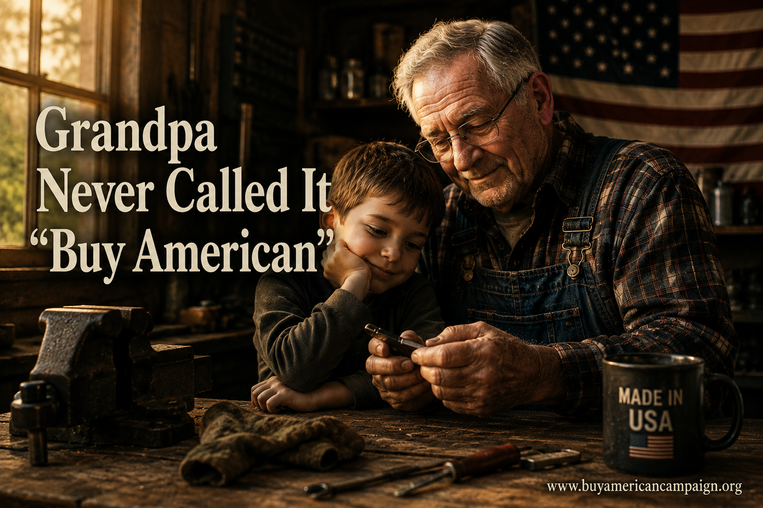
My grandfather never talked about trade deficits. He never debated tariffs. He never argued about globalization. He never even used the phrase “Buy American.” He just did. Not because it was a political statement. Not because someone told him to. To him, it was simply normal.
The tools in his garage were American-made. The boots by the back door were American-made. The refrigerator in the kitchen was American-made. The car in the driveway was built by American workers. He never stood in a store comparing countries of origin — most of the time, there wasn’t much to compare. Things were made here because that’s where things were made.
He Never Said It — He Just Lived It
But there was something deeper than habit at work. My grandfather knew people. He knew the man who worked at the furniture plant. He knew the woman who sewed uniforms at the textile mill. He knew the neighbors at the machine shop across town, and the truck drivers who hauled products to market.
When someone bought a product, they weren’t supporting an abstract economy. They were supporting people they knew — people they saw at church, people whose kids played baseball with their kids, people who lived down the street. Manufacturing wasn’t a statistic. It was the community.
One Paycheck, a Whole Community
When the local factory hired more workers, everybody felt it. The diner got busier. The hardware store sold more supplies. The bowling league gained new members. The town grew stronger.
And when times were hard, people understood something that often gets forgotten today: a paycheck earned in one factory circulated through an entire community. One manufacturing job supported far more than one family — it helped sustain dozens of businesses and hundreds of livelihoods.
He Understood Connections
My grandfather never talked about supply chains. But he understood connections. He understood that when neighbors prospered, communities prospered. He didn’t need a chart to see that the dollar he spent at a local business came back around to the people he cared about.
Somewhere along the way, we started treating products like they simply appeared on store shelves by magic. We stopped asking who made them. Where they came from. What communities depended on them. We became disconnected from the people behind the products.
Why It Feels Different Today
Maybe that’s why buying American feels different today. What was once ordinary has become a conscious choice. What was once assumed now requires effort. But the reason behind it hasn’t changed.
It’s still about people. It’s still about families. It’s still about communities. And it’s still about the belief that the work of American hands matters — that the person who built the thing in your kitchen deserves to be remembered.
Making It Normal Again
My grandfather never called it “Buy American.” To him, it wasn’t a movement. It wasn’t a campaign. It wasn’t even a slogan. It was simply how a strong community worked.
Maybe the goal isn’t to make buying American fashionable again. Maybe the goal is to make it normal again — to get back to a place where supporting the people who make things isn’t a statement, but second nature. We can start with the next thing we buy, and the one after that. That’s how a habit, and a community, gets rebuilt.
Whenever possible, choose Made in USA.
| If you like what you see and think this post would be of interest to someone, please share |