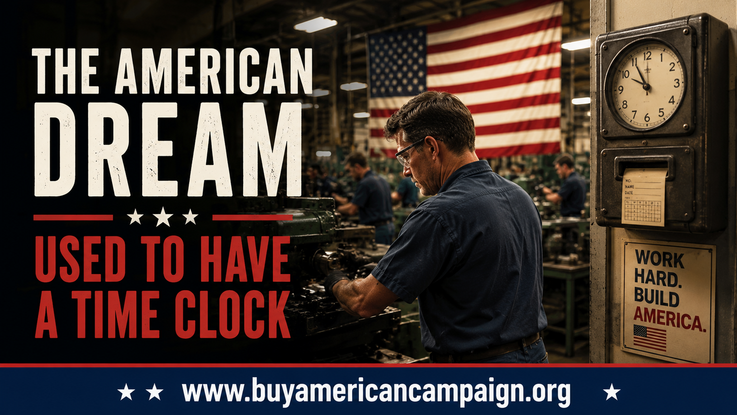
There was a time when a high school graduate could walk into a factory on Monday and start building a middle-class life by Friday. No college degree. No student loans. No six-figure salary. Just a willingness to show up on time, work hard, and learn. For millions of Americans, that was enough.
The factory whistle blew at the start of the shift. The time clock punched in. And another family started building a future. This is the story of the American Dream that ran on a time clock — and why it is worth fighting to bring back.
When “You’re Hired” Changed Everything
The American Dream didn’t begin on Wall Street. For millions of families, it began the moment a factory foreman said three simple words: “You’re hired.” Those two words could change the entire trajectory of a family.
A man could spend thirty years in the same plant and retire with dignity. A woman could raise a family on a manufacturing paycheck. Parents could send their children to college even if they had never set foot on a campus themselves. American manufacturing didn’t just make products — it made opportunity, and it handed that opportunity to anyone willing to earn it.
The Work Wasn’t Glamorous — But It Built a Middle Class
Let’s be honest about what the work actually was. It was loud. Hot. Dirty. Repetitive. Nobody posted pictures of it on social media. Nobody called it a dream job.
But it did something remarkable. It paid the mortgage. It put food on the table. It bought the family car. It paid for Little League uniforms, piano lessons, braces, and summer vacations. It gave people a chance — and in America, a chance is everything.
Those paychecks, multiplied across millions of households, built the strongest middle class the world had ever seen. It wasn’t built on slogans. It was built on shift work.

The Factory Was the Heartbeat of the Town
The factory wasn’t just a building. It was the economic heartbeat of the community. The diner stayed open because factory workers ate breakfast there. The hardware store stayed busy because factory workers shopped there. The barber knew every customer by name because so many of them worked the same shift.
Entire neighborhoods were built around those opportunities. When the factory thrived, the town thrived. When the factory struggled, everyone felt it — at the lunch counter, at the checkout line, and around the kitchen table.
When We Stopped Respecting the Work
Somewhere along the way, we stopped talking about those jobs with the respect they deserved. We started acting as if making things wasn’t important anymore — as if real products could somehow be replaced by spreadsheets and apps.
But every car, refrigerator, tool, appliance, and piece of machinery still has to be built by someone. Generations of Americans built their lives with steel-toed boots, calloused hands, and a punched time card. Their work created the strongest middle class in history. Their paychecks built homes. Their taxes built schools. Their labor built America.
Bringing the Time Clock Back
Here’s the part worth holding onto: that dream isn’t gone. It’s returning, one factory at a time, as companies bring production home and rediscover what American workers can do. Every washing machine, every tool, every appliance built on U.S. soil is another time clock back on the wall — another family with a real shot at the life this country promised.
And we have more power over that than we think. Every time we choose American-made, we tell a manufacturer that it pays to build here. We turn a foreman’s “You’re hired” into a sentence more Americans get to hear. That is how a comeback happens — not all at once, but one purchase, one job, and one community at a time.
For a very long time, the American Dream had a time clock hanging on the wall. Let’s put it back where it belongs.
Whenever possible, choose Made in USA.
| If you like what you see and think this post would be of interest to someone, please share |