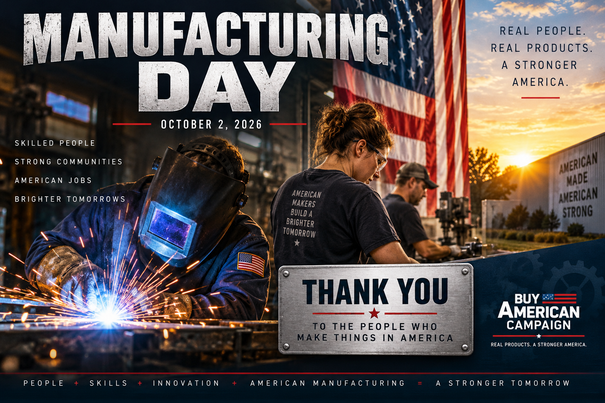
Every year on the first Friday in October, Manufacturing Day gives America an opportunity to recognize an industry that is easy to take for granted.
At the Buy American Campaign, we spend a lot of time talking about American-made products. We research where products are manufactured. We profile companies that make things here. We encourage consumers to look beyond the flag on the package and find out where something was actually made.
But today, we’d like to focus on something more fundamental.
The people who make those products.
American Manufacturing Is About People
Walk through an American factory and you’ll quickly discover that manufacturing isn’t an abstract economic statistic.
It’s people.
It’s the machinist who knows from the sound of a machine that something isn’t quite right.
It’s the welder whose work has to hold when somebody’s safety depends on it.
It’s the technician maintaining equipment that may run around the clock.
It’s the engineer figuring out how to make something stronger, lighter, safer or more efficiently.
It’s the quality-control employee who catches the defect before a product leaves the building.
It’s the person packing the finished product into a box and sending it on its way.
And it’s the owners and managers making the difficult decision to continue manufacturing in America when moving production somewhere cheaper may sometimes look easier on a spreadsheet.
Manufacturing Day is a good day to remember all of them.
Making Things Still Matters
There was a time when manufacturing was simply part of the landscape in communities across America.
Factories employed generations of families. Tool-and-die shops, textile mills, foundries, furniture makers and machine shops supported entire towns. Young people could graduate from high school, learn a skilled trade and build a solid middle-class life.
Much of that manufacturing disappeared.
Some moved overseas. Some companies closed. Some industries changed beyond recognition.
But American manufacturing never disappeared.
Across the country, companies large and small are still making cookware, hand tools, work boots, clothing, machinery, medical equipment, sporting goods, furniture, automotive components, food, household products and thousands of other things.
Some are household names.
Others operate factories most Americans have never heard of.
All of them contribute to something bigger than the product coming off the line.
A Factory Supports More Than a Factory
When an American manufacturer succeeds, the impact extends well beyond its walls.
Manufacturers buy materials and components. They hire trucking companies, electricians, plumbers, engineers, accountants and local contractors. Their employees buy homes, shop locally, eat at restaurants and support other businesses in their communities.
Skills are passed from experienced workers to apprentices.
Suppliers grow alongside their customers.
Communities retain jobs that can’t be performed remotely from another country.
And America retains something that is difficult to rebuild once it disappears: the knowledge of how to make things.
That knowledge matters.
A country that maintains the ability to manufacture isn’t simply preserving jobs. It is preserving skills, infrastructure, supply chains and industrial capability.
Manufacturing Has Changed
The image many people still have of manufacturing is decades out of date.
Today’s factories can include robotics, CNC machining, advanced materials, computer-controlled production, additive manufacturing, automated inspection and sophisticated logistics.
But technology hasn’t eliminated the need for people.
It has changed the skills many manufacturing jobs require.
Modern manufacturing needs machinists, engineers, programmers, maintenance technicians, electricians, production specialists, designers, quality-control professionals and people willing to learn increasingly sophisticated equipment.
That creates an opportunity—particularly for young Americans who may never have considered manufacturing as a career.
Telling young people to “learn a trade” isn’t enough.
They need to see the factories, meet the people doing the work and understand that modern manufacturing can offer a real career and a future.
That’s one of the reasons Manufacturing Day matters.
To America’s Manufacturers: Thank You
Since launching the Buy American Campaign, we’ve had the opportunity to learn about hundreds of American companies.
Some have been manufacturing here for generations.
Others are relatively young businesses that deliberately decided to make their products in America.
We’ve spoken with manufacturers who have corrected information for us, provided photographs, explained their production processes and helped us understand exactly which products they make here.
Those conversations continually remind us that “Made in USA” isn’t just a label.
Behind that label are real people making real decisions about where to manufacture.
So on Manufacturing Day, we’d simply like to say:
Thank you.
Thank you to the companies that continue investing in American production.
Thank you to the employees who show up every day and make it happen.
Thank you to the skilled tradespeople who keep factories operating.
Thank you to the businesses training the next generation.
Thank you to the manufacturers that could have taken an easier route but decided that making things here still matters.
And thank you to the consumers who deliberately look for those products and support the companies behind them.
Our Part Is to Make Them Easier to Find
The Buy American Campaign exists because finding American-made products shouldn’t be difficult.
There are consumers actively looking for products manufactured in this country, and there are companies working every day to make them.
Those two groups should be easier to connect.
That’s what we’re trying to build.
We’ll continue researching American manufacturers, highlighting the companies producing here, asking manufacturers to be clear about where their products are made, and helping consumers discover the choices available to them.
But today isn’t about us.
Today belongs to the people who make things in America.
Happy Manufacturing Day—and thank you for what you do.
Whenever possible, choose Made in USA.
| If you like what you see and think this post would be of interest to someone, please share |