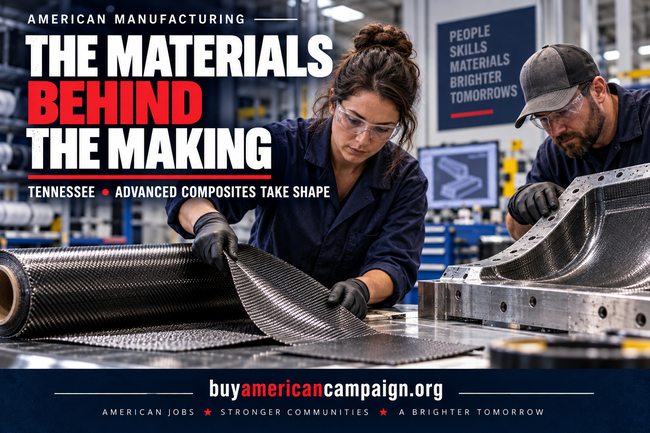
In Louisville, Tennessee, a young manufacturer has opened a facility for work that can be hard to see in a finished product: making and shaping advanced composite materials. Endeavor Composites’ new, roughly 22,000-square-foot operation is a tangible step for a company founded in 2019. It is also a useful reminder that American manufacturing grows through specialized suppliers, not just the factories whose names appear on the final product.
At the ribbon cutting, founder Hicham Ghossein described a path from an interest in space to a company focused on the materials that ambitious industries need. The facility brings fiber preparation, material-forming processes, laboratories, machining and composite curing into one manufacturing setting. That combination matters: research becomes more valuable when a team can test, refine and produce material in a repeatable way.
What the Tennessee Facility Actually Adds
Composites combine materials to achieve properties a single material may not deliver alone. Their use can call for careful control of fibers, resins, heat and forming. Endeavor’s new site is designed to support several steps in that chain, including wet-laid and air-laid production. Those methods help turn prepared fibers into engineered forms that can be developed for specific applications.
The opening is real, but it should be described precisely. A newly opened building and listed capabilities do not, by themselves, tell us how many units are being produced, how many customers have placed orders or how many jobs have been created. The available report does not provide a verified hiring total or investment amount for this expansion. Those outcomes should be assessed as the operation matures.
What can be said now is significant enough: the company has put a larger physical production and development footprint in East Tennessee. It has room to bring technical work closer together and to move ideas through more of the process at one location. For a materials company, that practical capacity is more consequential than a ceremonial ribbon.
Innovation Needs a Place to Become Production
Advanced manufacturing stories often begin with a promising laboratory result. The harder part is making the result reliably, at useful scale and with the quality a customer expects. That requires equipment, technicians, process discipline and the ability to learn from defects. A plant that joins preparation, fabrication and testing can shorten the distance between a promising sample and an actual supply capability.
Endeavor’s development has also involved regional institutions, including the University of Tennessee Research Foundation, Oak Ridge National Laboratory’s Innovation Crossroads program and the Institute for Advanced Composites Manufacturing Innovation. That network is part of the story. Universities and research programs can help a company develop an idea; a manufacturing facility is where that idea must survive the demands of making things consistently.

The Suppliers Behind Familiar Products
When people ask where a product was made, they usually see the final assembly location. The answer is important, but it is not the whole supply chain. Materials, components, tools and industrial services come from other companies, often ones most shoppers have never heard of. A capable domestic composites producer can give manufacturers another potential source of specialized inputs closer to their own operations.
That does not mean every product using Endeavor’s material is automatically made in America. Origin claims belong to specific products and production steps, not to a supplier’s address alone. It does mean that an American manufacturing ecosystem needs firms able to do demanding work before final assembly begins.
The Louisville opening also puts attention on the people behind that work. A technician preparing fibers, a machinist refining tooling and a quality specialist checking a composite all help determine whether an innovative material can become a reliable industrial input. Those jobs may be less visible than a consumer brand, but they are central to making a supply chain function.
There is a regional lesson here, too. Tennessee’s manufacturing future is not limited to attracting a single large household-name employer. Smaller firms can build expertise around materials and processes that other plants need. As they grow, they create reasons for engineers, production workers, researchers and customers to collaborate nearby. That kind of cluster develops gradually; one opening does not prove it has arrived. But a working facility with multiple manufacturing steps under one roof is a credible piece of the foundation.
What to Watch Next
The next chapter will be measured by sustained production, useful customer applications and the quality of the work created. Those details are not established by the facility announcement. The most interesting question is whether Endeavor can turn its expanded capabilities into repeatable manufacturing that other American producers can depend on.

For now, the new Tennessee site represents something worth noticing: a domestic company investing in the less glamorous middle of production, where materials are prepared, processes are improved and specialized knowledge becomes manufacturing capacity. The next generation of American-made products will need that work as much as it needs a final assembly line.
Source: Teknovation’s report from Endeavor Composites’ facility opening (September 25, 2026).
Whenever possible, choose Made in USA.
| If you like what you see and think this post would be of interest to someone, please share |