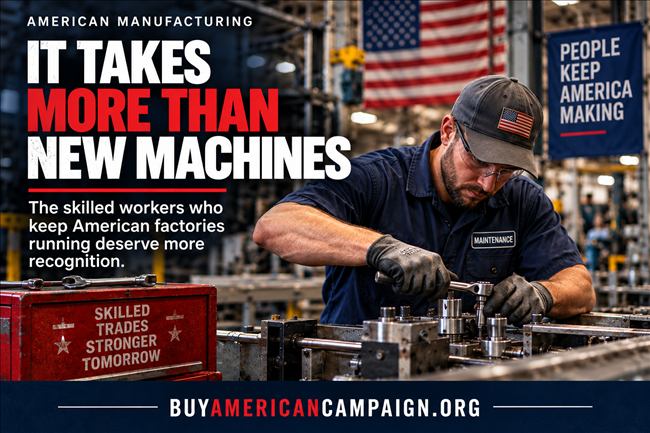
 At a factory in Bethlehem, Pennsylvania, a failed piece of equipment stopped a mirror-production line for weeks. Workers could not simply will the line back to life, and the business lost sales while it stood still. The story of Brey-Krause Manufacturing is a reminder that American factories do not run on announcements. They run because people notice problems, solve them, and keep production dependable long after a ribbon cutting.
We rightly celebrate a plant opening, a major investment, or a new production line. But an existing factory faces a quieter test every day: can it make a good product today, tomorrow, and next year? The industrial maintenance workers who help answer that question deserve far more attention than they receive.
American Factories Need More Than New Machines
Brey-Krause has made commercial and industrial washroom accessories in Bethlehem for generations. According to the National Institute of Standards and Technology, its troublesome mirror line needed more than a quick repair. Pennsylvania’s Manufacturing Extension Partnership helped the company assess the failure, replace key equipment, and plan further improvements as the business could support them.
NIST reports that the project was associated with 15% less downtime, 15% more capacity, a 20% sales increase, and one new job. Those are results from this particular company, not a guarantee that every maintenance project will yield the same figures. What the case shows is the practical value of diagnosing a real bottleneck and investing in the people and equipment needed to overcome it.
A machine can be state of the art on installation day and still need inspection, calibration, cleaning, repairs, and eventually replacement. The decision is not always “keep the old machine” or “buy a new one.” It is to understand what is failing, why it matters, and which fix will leave the plant more capable.
The Skill Behind Every Shift
Imagine a conveyor that begins drifting just enough to slow a packaging line. Or a CNC machine that still runs but makes parts outside tolerance. An operator may be the first to hear a new sound or see a different result. A maintenance technician has to trace the problem through moving parts, controls, materials, and settings—then test the repair before normal production resumes.
The Bureau of Labor Statistics describes industrial machinery mechanics, machinery maintenance workers, and millwrights as people who install, maintain, and repair industrial equipment. Their work can include reading manuals, diagnosing failures, replacing components, adjusting machinery, and checking that a machine runs correctly after repair. That is technical judgment, not just a toolbox.

Automation Makes Reliability More Important
Automation does not remove the need for human expertise. It can make a breakdown more consequential because more steps depend on the same coordinated line. Sensors may help identify a fault, but a trained person still has to decide what the signal means, how to work safely, and whether the equipment is ready to produce a good part again.
In Connecticut, Leggett & Platt Aerospace faced repeated breakdowns in a CNC lathe cell. It worked with its state Manufacturing Extension Partnership center to train maintenance staff and improve how equipment problems were found and addressed. NIST reports that productivity on the focus machine rose by about 22% while downtime fell. Again, that is a reported outcome at one facility, not a universal formula. The human side of the improvement—training, observation, and disciplined follow-through—is the point worth carrying elsewhere.
Passing on Knowledge Takes Time
Some maintenance knowledge lives in a manual. Some lives with the worker who remembers which vibration means a worn bearing, which adjustment changed the scrap rate, and how a machine behaves when the shop is hot. A company cannot preserve that knowledge by buying a sensor alone. Experienced people need time to teach, and new people need real opportunities to learn.
The BLS projects 14% employment growth from 2025 to 2035 for the combined group of industrial machinery mechanics, machinery maintenance workers, and millwrights. The three occupations have different individual outlooks, so that combined figure should not be applied to every job title. It does reinforce a broader reality: factories need skilled people to keep increasingly complex equipment working.
What It Means to Support Production Here
Consumers do not choose a factory’s maintenance schedule. Still, a verifiably American-made product reflects more than final assembly. It represents operators, technicians, quality teams, and managers working to deliver another dependable batch. Repeated demand for products actually made here gives manufacturers a reason to keep investing in those people and capabilities.
That does not mean every product from an American brand is made in the United States, or that every domestic product has an entirely domestic supply chain. Check the origin of the specific item. Choose the U.S.-made option when it meets your needs. Honest buying decisions support real production better than a flag on a package with no clear manufacturing claim.
Celebrate the Factory on an Ordinary Tuesday
A groundbreaking makes a good photograph. The stronger measure of American manufacturing comes later, when the line is running, a problem appears, and someone knows how to solve it. Brey-Krause and Leggett & Platt show different ways that attention to reliability can make an existing plant stronger.
We should want new factories. We should also care for the ones we already have—and recognize the workers whose skill keeps them capable of making the next product. That is how a manufacturing investment becomes more than opening-day news.
Whenever possible, choose Made in USA.
| If you like what you see and think this post would be of interest to someone, please share |