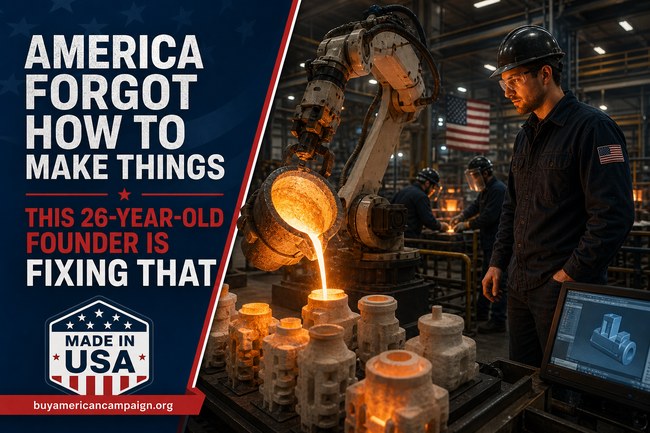
America did not forget how to design aircraft, data centers or advanced energy systems. It forgot how to make many of the unglamorous metal parts that allow those systems to work. At Rangeview’s American foundry in El Segundo, California, 26-year-old founder Cameron Schiller is trying to rebuild that missing capability.
Rangeview is not creating another app that promises to “disrupt manufacturing.” It is melting metal. Its workers combine investment casting, 3D-printed ceramic molds, robotics and software to produce precision parts for aerospace, defense, energy and advanced technology customers.
The company’s story is compelling because it begins with something America has spent decades losing: the neighborhood machine shop. Schiller grew up near the former Lockheed Martin Skunk Works in Southern California, surrounded by the remains of an industrial culture that once built astonishing things close to home.
A Founder Who Wanted to Build Something Physical
Schiller grew up taking things apart, rebuilding rooms and experimenting with machines. He later won a robotics world championship and studied at the University of California, Berkeley, but the conventional technology path did not hold his attention.
Rangeview began in a garage in 2020. According to a recent profile by Pirate Wires, the company is now operating inside an aging brick industrial building where molten metal, robotic arms and young engineers share the floor.
That combination matters. Much of the American technology economy has rewarded people for building software that captures attention or moves information. Rangeview is attracting young technical talent to a harder assignment: moving metal and delivering physical parts.
Why American Foundries Became a Bottleneck
Investment casting is an ancient process with modern consequences. Manufacturers form a detailed mold, pour in molten metal and finish the resulting component to precise specifications. The process can create complex turbine, aircraft and industrial parts that are difficult to machine from a solid block.
Traditional casting often depends on specialized dies and tooling that take months to design, build and qualify. When an older Navy vessel or aircraft needs a replacement part and the original tooling no longer exists, the delay can keep important equipment out of service.
How Rangeview’s American Foundry Works Differently
Rangeview replaces much of that physical tooling with digital files and 3D-printed ceramic molds. The company says its software-defined process can compress the journey from design to a first finished article from months to weeks.
Inside the foundry, an ingot is heated to roughly 2,000 degrees and poured by robotic equipment into a custom mold. Automation handles dangerous, repetitive steps while engineers and production workers monitor the process, improve reliability and prepare it for higher-volume manufacturing.
This is what advanced manufacturing should mean: not a factory without people, but a factory where people use better tools to produce difficult parts safely, consistently and quickly.
The U.S. Navy Needs Parts That No One Makes Anymore
In August, Rangeview announced a major U.S. Navy contract to produce maintenance, repair and overhaul replacement parts. The work addresses a basic readiness problem: sophisticated equipment can be sidelined by a relatively small component that has become slow or impossible to source.
The challenge is larger than one contract. American casting capacity has declined as infrastructure aged, work moved offshore and experienced foundry workers retired without enough younger workers behind them. Rebuilding the capability means preserving knowledge while redesigning the job for a new generation.
A Factory Can Give a Town More Than Paychecks
Schiller’s ambition extends beyond a single Southern California facility. He has spoken about building factories across the American plains and becoming part of a real factory town—a place where the company and community grow together.
That vision is important because manufacturing provides something difficult to measure on a balance sheet. Workers can point to what they made. Families see the plant supporting suppliers, restaurants, schools and skilled careers. A town gains an identity tied to useful work.
Modern foundries should be cleaner, safer and more technologically capable than the plants of the past. But they can still create the same sense of shared purpose that existed when a community knew exactly what it contributed to the country.
Reindustrialization Requires Actual Factories
America has no shortage of manufacturing conferences, strategy papers and software tools. Schiller’s blunt argument is that none of them substitutes for factories that make parts. Reindustrialization ultimately requires furnaces, equipment, materials, trained people and customers willing to place orders.
Rangeview is still a young company, and scaling a foundry is far more difficult than scaling a website. That is exactly why its effort deserves attention. The country needs founders willing to confront physical constraints instead of treating them as someone else’s problem.
If Rangeview succeeds, its most important product may not be a particular turbine component or Navy replacement part. It may be proof that a new generation of Americans can learn to make difficult things again—and build communities around that work.
Whenever possible, choose Made in USA.
| If you like what you see and think this post would be of interest to someone, please share |