

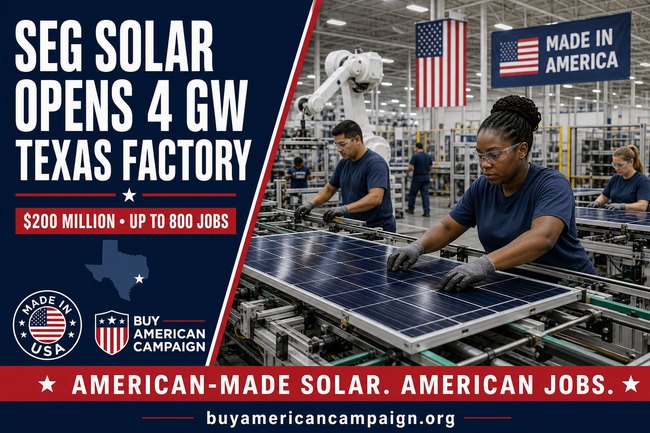
SEG Solar has opened a new 4-gigawatt solar-panel factory in Tomball, Texas, expanding American manufacturing capacity with an investment of more than $200 million and plans for up to 800 jobs. The August 7 grand opening turned a major expansion promise into an operating facility built to supply solar projects across the United States.
The nearly 500,000-square-foot plant is SEG Solar’s second U.S. module factory. Together with its first Houston-area operation, it raises the company’s annual domestic module capacity to approximately 6 GW—enough manufacturing scale to matter in a market long dependent on overseas production.
A 4 GW Texas Solar Factory Moves From Plan to Production
SEG announced the Tomball project in May and held its grand opening only three months later. Commercial production is expected during the third quarter of 2026, giving the Houston-headquartered company a much larger platform for serving utility, commercial and residential customers.
The plant is designed for flexibility as solar technology changes. SEG says its production lines can integrate next-generation heterojunction, or HJT, technology, which combines different semiconductor layers to improve panel efficiency and performance.
Up to 800 American Manufacturing Jobs
The employment number deserves attention. Up to 800 new jobs could include production operators, maintenance technicians, quality specialists, engineers, logistics workers and supervisors. Those positions create paychecks inside the factory and additional demand for nearby suppliers and local businesses.
Modern solar manufacturing is highly automated, but it is not workerless. Equipment must be installed, programmed, maintained and improved. Materials have to be tracked, panels inspected and production problems solved by people with practical technical skills.

Why Domestic Solar-Panel Production Matters
Solar panels are becoming part of America’s essential energy infrastructure. Producing more modules domestically can shorten delivery times, improve traceability and reduce exposure to disruptions that occur when too much of a supply chain is concentrated overseas.
Domestic manufacturing also keeps more of the value created by new energy projects in American communities. The benefits extend beyond where panels are installed to include the people who assemble, test, package and ship them.
American-Owned Does Not Mean Every Component Is Domestic
SEG describes itself as a 100% U.S.-owned manufacturer headquartered in Houston. That is an important distinction, but buyers should still understand the full supply chain. The company assembles modules in Texas while developing upstream ingot and wafer capacity in Indonesia.
This does not erase the value of American module production. It does show why precise language matters. “American-made solar panels” can describe meaningful domestic manufacturing even when some raw materials or components originate elsewhere. The long-term opportunity is to localize more stages of production here.

A Third Texas Factory Is Already Underway
SEG is not stopping at 6 GW. The company has broken ground on a third Greater Houston facility planned at approximately 1.15 million square feet, including factory and warehouse space. Construction is projected to finish in March 2027, with commercial production expected in May 2027.
That third plant would add 4.6 GW of annual capacity and bring SEG’s planned U.S. total to 10.6 GW. It is expected to focus primarily on high-efficiency HJT modules, while SEG is also evaluating American sites for a dedicated solar-cell factory.
Texas Is Becoming a Manufacturing Center
The Houston region has long been associated with oil, gas and petrochemicals. Solar manufacturing adds another chapter to that industrial history. The same strengths that support traditional energy—skilled trades, engineering talent, freight networks and large industrial sites—can also support factories producing newer energy technologies.
That overlap matters because an energy transition should create durable American work, not simply replace one set of imported products with another. Communities benefit most when investment includes factories, technical training and long-term supplier relationships, not only construction projects.
Customers Can Strengthen the Domestic Market
Large developers and commercial buyers influence where manufacturers invest. When purchasers ask where modules are assembled, how components are sourced and what labor supports production, they reward companies that build transparent domestic operations.
Consumers can ask similar questions when considering rooftop solar. Country-of-origin claims can be complicated, so buyers should request specific information about module assembly and major components. Better questions create stronger incentives for companies to keep moving production closer to home.
The Bigger Test Is Sustainable Production
Factory openings generate headlines, but sustained output creates lasting impact. The Tomball plant must ramp safely, meet quality targets, win customer orders and retain its workforce. If it does, the operation can strengthen the case for manufacturing more of America’s energy equipment at home.
SEG’s expansion is a concrete example of domestic manufacturing responding to real demand. A U.S.-owned company has invested more than $200 million in Texas, opened a major production site and created a path toward hundreds of manufacturing jobs. That is progress worth recognizing—and a reminder that American energy independence also depends on American production capacity.
Whenever possible, choose Made in USA.
| If you like what you see and think this post would be of interest to someone, please share |