Author: Buy American Campaign

  • Dan River Mills: When a Factory Was a Town

    Dan River Mills: When a Factory Was a Town

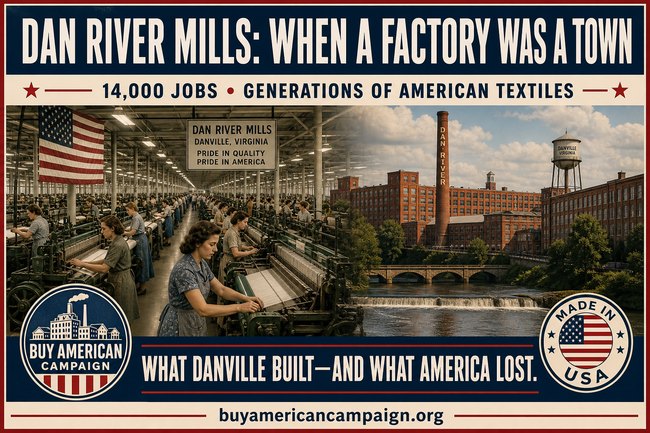
    Historical reconstruction of workers and looms at Dan River Mills

    For generations in Danville, Virginia, Dan River Mills was more than a factory. It was where parents met, where children expected to work, where paychecks filled local stores and where the rhythm of looms helped set the rhythm of an entire town.

    At its wartime peak, Dan River employed about 14,000 people in a city of roughly 40,000. The numbers are remarkable, but they only hint at the mill’s reach. A factory that large did not sit beside the community. It shaped the community.

    A Mill Built Beside the Dan River

    The story began in 1882, when six local men established Riverside Cotton Mills on the banks of the Dan River. Four mills rose during the company’s first decade, powered by a region eager to turn Southern cotton into finished American cloth.

    Riverside merged with the Dan River Power and Manufacturing Company in 1909. By then, annual cloth production had climbed from about 2 million yards in 1884 to more than 78 million yards. Sheetings, ginghams and chambrays carried Danville’s work far beyond Virginia.

    When the Factory Became the Community

    Like many Southern textile companies, Dan River built housing to attract and retain workers. The mill village of Schoolfield included homes, churches, recreation and the everyday relationships that grow when thousands of families share the same employer.

    Company-town life was never simple. Conditions could be harsh, and workers fought difficult battles over wages and control of their jobs. Major strikes in 1930 and 1951 ended in defeat. Still, residents remembered the closeness of a place where work and community were inseparable.

    Browse American-Made Products

    Fourteen Thousand Workers During World War II

    Military orders pushed the mills into extraordinary production during World War II. By 1942, Dan River operated twelve weaving and spinning mills along with dyeing, bleaching, finishing and power plants. Nearly half a million spindles fed the largest textile operation in the region.

    The mill’s 14,000 workers represented more than one out of every three people living in Danville—not merely one out of every three workers. After the war, civilian demand kept the company growing. Acquisitions lifted companywide employment above 18,000 by 1956.

    What a Manufacturing Paycheck Multiplies Into

    Every mill job supported more than the person standing at a loom. Wages paid grocers, mechanics, barbers and builders. The company needed suppliers, rail service, maintenance and transportation. Schools and public services depended on an economy anchored by productive work.

    That multiplier is easy to overlook when a factory is reduced to an employment number. In a manufacturing town, the plant’s health becomes visible in storefronts, home values, civic groups and children’s expectations about whether they can build a future close to family.

    Join the Buy American Movement

    The Long Retreat of American Textiles

    Imported textiles began taking market share from American manufacturers in the 1960s. Dan River initially answered with technology and investment, trying to produce more efficiently while keeping its domestic operations competitive.

    By the 1990s and early 2000s, imports from Latin America and Asia were arriving in volumes the domestic industry could not withstand. Employment declined, facilities closed and Dan River entered Chapter 11 bankruptcy reorganization in March 2004.

    The Final Jobs Went Overseas

    Dan River emerged from bankruptcy, but survival was brief. In 2006, an Indian company purchased the business, closed the main mill and transferred the remaining work overseas. Encyclopedia Virginia records the final move as the loss of hundreds of remaining jobs; historical accounts differ on whether the last transfer involved roughly 500 or as many as 1,100 positions.

    The exact final count does not change the outcome. A company that had manufactured American textiles for more than a century no longer made its products in the United States. The brand survived. The production community did not.

    Danville Had to Become Something Else

    The physical landscape changed too. The familiar smokestacks came down in 2008. Former mill property sat vacant or moved toward new uses while Danville worked to rebuild an economy once dominated by textiles and tobacco.

    Today, the former White Mill has become Dan River Falls, a mixed-use redevelopment with residential, office and commercial space. Schoolfield is receiving new investment, and Danville has earned recognition for its comeback. That reinvention deserves respect.

    Redevelopment Is Not the Same as Production

    A restored building can preserve history and create valuable new activity. It cannot recreate the industrial ecosystem that once trained generations, supported suppliers and shipped tangible goods across the country. A casino, apartment or office may reuse a site, but it does different economic work.

    Dan River Mills is not an argument that every old factory should have remained unchanged forever. It is a warning about treating productive capacity as disposable. Once machinery, skills, supplier networks and customer relationships disappear, rebuilding them is far harder than closing a gate.

    Remember the People Behind the Label

    For consumers, Dan River’s story gives a familiar label a human scale. “Made in USA” was thousands of people in Danville reporting for shifts, learning trades, raising families and spending wages in the place they called home.

    We cannot reverse every closure. We can decide that the next factory matters before it becomes a memory. Choosing American-made products, asking retailers where goods are produced and supporting companies that invest here are modest acts—but they help keep today’s manufacturing towns from becoming tomorrow’s historical exhibits.

    Whenever possible, choose Made in USA.

    If you like what you see and think this post would be of interest to someone, please share
  • World’s Largest Electric Aircraft Makes Historic First Flight in New York

    World’s Largest Electric Aircraft Makes Historic First Flight in New York

    Made in USA Heart Aerospace X1 electric aircraft taking off in Plattsburgh, New York

    The world’s largest electric aircraft has completed its first flight, and this milestone aircraft was made in the USA. Heart Aerospace’s full-scale X1 demonstrator lifted off from Plattsburgh International Airport in upstate New York on August 12, 2026, turning years of American engineering, manufacturing, ground tests, and regulatory work into 27 minutes of battery-powered flight.

    The aircraft climbed to 1,100 feet while its electric propulsion system delivered more than one megawatt of power. Heart says the electricity used during the flight cost about $5. That figure does not make the X1 a finished airliner, but it gives the aviation industry a striking glimpse of what electric propulsion could eventually mean for regional travel.

    A 25,000-Pound Aircraft Leaves the Ground

    The X1 is not a small experimental plane. It has a 106-foot wingspan, stretches 76 feet from nose to tail, and weighed more than 25,000 pounds at takeoff. That scale is why Heart describes it as the largest battery-electric aircraft ever flown.

    The first mission was deliberately controlled. Conducted under an FAA Special Airworthiness Certificate in the Experimental Category, the test included taxi, takeoff, climb, maneuvering, and landing. The point was not to set a speed or altitude record. It was to begin learning how a clean-sheet electric aircraft of this size behaves in the air.

    Built and Tested in the United States

    Heart Aerospace is headquartered in California, and the X1 program now connects several pieces of American aviation infrastructure. The demonstrator flew from Plattsburgh, New York, after more than a year of collaboration with the FAA. Heart is also developing its first pre-production ES-30 at a pilot manufacturing facility in Los Angeles.

    That matters beyond one airplane. New aircraft programs require engineers, technicians, software specialists, test pilots, suppliers, and manufacturing teams. If hybrid-electric regional aviation reaches commercial service, the industrial opportunity will be measured not only in aircraft sold but in the skilled work required to build, certify, maintain, and improve them.

    Browse American-Made Products

    The World’s Largest Electric Aircraft Is a Testbed

    The X1 itself is not the passenger aircraft Heart plans to sell. It is a technology demonstrator built to validate electric propulsion, aerodynamics, flight controls, structural behavior, battery systems, and the procedures needed to operate an electrified aircraft safely.

    Heart’s commercial goal is the ES-30, a 30-passenger regional aircraft with both electric and hybrid capability. The company lists a planned all-electric range of 125 miles and an extended hybrid range of 500 miles, with a targeted 30-minute charging time. Type certification is currently targeted for 2031, and a pre-production aircraft is expected to begin flight testing in 2028.

    Why Regional Aviation Is the Starting Point

    Batteries still carry far less usable energy per pound than aviation fuel, which makes long-distance electric flight especially difficult. Short regional routes offer a more realistic place to begin. Aircraft can return to charging infrastructure frequently, and many trips connect smaller communities that have lost convenient air service.

    Heart says the ES-30 could reduce operating costs for regional airlines by more than 40 percent. That remains a company projection, not a result proven in commercial service. Still, the X1’s first flight puts real hardware behind the idea and gives engineers flight data that computer models and ground tests cannot fully provide.

    Join the Buy American Movement

    Big Commitments, Bigger Work Ahead

    United Airlines, Air Canada, and JSX are among the carriers that have expressed interest in the ES-30. Heart reports $9.4 billion in customer commitments. Those commitments signal demand, but they do not erase the difficult path between a demonstrator’s first flight and a certified aircraft carrying paying passengers.

    The next several years will involve repeated flight testing, design changes, production development, and close regulatory scrutiny. Range, battery life, charging infrastructure, weight, reliability, and economics all have to work together. Aviation rewards careful progress, and the safest reading of this milestone is not that electric air travel has arrived—it is that one of its largest experiments is finally airborne.

    A First Flight Worth Watching

    Twenty-seven minutes at 1,100 feet may sound modest next to a conventional airline route. For a newly built 25,000-pound battery-electric aircraft, it is a serious engineering milestone. The X1 took a concept that existed in drawings, simulations, and ground tests and proved that it could take off, maneuver, and land under its own electric power.

    The most encouraging part of the story is not the $5 electricity bill by itself. It is the American engineering and manufacturing ecosystem forming around a new kind of regional aircraft. If Heart can turn what it learns from X1 into a safe and economical ES-30, this first flight could be remembered as an early step toward rebuilding short-haul aviation closer to home.

    That possibility deserves both enthusiasm and patience. Commercial aviation changes slowly because safety has to come first. The X1 has now supplied the proof that matters at this stage: a large battery-electric aircraft designed around new systems can leave an American runway, complete its planned test profile, and return safely with useful data for the next flight.

    Sources: Yahoo Tech/InsideEVs and Heart Aerospace.

    Whenever possible, choose Made in USA.

    If you like what you see and think this post would be of interest to someone, please share
  • Buying American Isn’t All or Nothing

    Buying American Isn’t All or Nothing

    Shopper comparing American-made and imported products

    Buying American isn’t all or nothing. Yet that is exactly how the choice is often presented: either every item in your home must be made in the USA, or your effort does not count. That impossible standard discourages people who genuinely want to support American workers but still live with budgets, limited options and complicated supply chains.

    A better approach is simpler: make the better choice when a practical American-made option is available. One purchase will not rebuild an industry by itself, but millions of ordinary purchasing decisions can change what retailers stock and where companies invest.

    The Perfect Shopper Does Not Exist

    Most of us own imported phones, appliances, clothing and tools. Some products have few domestic alternatives. Others carry prices that do not fit every household budget. Pretending those realities do not exist turns a useful movement into a purity test.

    The goal should not be to shame someone for the imported products already in a kitchen drawer or garage. The goal is to help that person notice the next opportunity—to choose an American-made pan, pair of work boots, garden hose or bag of pet food when the quality and price make sense.

    Start With What You Buy Repeatedly

    The easiest place to begin is with products purchased again and again. Paper goods, cleaning supplies, food, personal-care products and basic household items create recurring demand. Switching even one regular purchase can support domestic production dozens of times over several years.

    These choices are often less intimidating than replacing an expensive appliance or vehicle. They also build the habit of checking labels, reading company information and asking where a product was actually manufactured.

    Browse American-Made Products

    Choose the Categories That Matter to You

    No household can research everything. Pick two or three categories that match your priorities. A tradesperson might focus on tools and workwear. A parent might start with food, toys or school supplies. Someone furnishing a home might pay closer attention to cookware, mattresses and furniture.

    Concentrating your effort makes the process manageable. It also allows you to learn which claims are meaningful, which companies manufacture domestically and which products merely use patriotic branding while production happens elsewhere.

    Price Matters—and So Does Value

    American-made products sometimes cost more upfront because domestic manufacturers operate under different wage, safety and environmental standards. That price difference is real, and nobody should be judged for choosing what a family can afford.

    When the budget allows, compare value rather than price alone. A durable product that can be repaired or kept for years may cost less over time than several cheaper replacements. Warranty service, replacement parts and dependable customer support also belong in the calculation.

    Join the Buy American Movement

    Ask Better Questions Instead of Demanding Perfection

    “Made in USA” can describe products with different levels of domestic content, and many supply chains cross borders. Consumers should ask where final manufacturing occurs, where major components originate and whether a company is transparent about the answer.

    A product assembled here from some imported parts can still create meaningful American work. It may not represent the strongest possible domestic supply chain, but it can be a step in the right direction. Honest progress deserves recognition alongside continued pressure to localize more production.

    Availability Is Part of the Problem

    Consumers cannot buy products they cannot find. American manufacturers and retailers share responsibility for making origin information visible, maintaining useful inventories and explaining why domestic production may offer better quality or service.

    When a suitable American-made option is unavailable, buying the product you need is not a betrayal of the movement. It is information. Ask the retailer to carry an alternative, contact the brand and keep the category in mind the next time you shop.

    Small Signals Become Market Demand

    Retailers track what sells. Manufacturers watch customer requests, reviews and search behavior. When enough shoppers look for American-made choices, businesses gain a reason to expand production, add a domestic product line or make country-of-origin information easier to find.

    That signal can be strengthened by telling companies why you made a purchase. A short email, product review or social-media comment lets a manufacturer know that domestic production influenced the decision.

    Progress Is a Better Standard Than Purity

    Buying American is not a contest to see who can eliminate every imported item. It is a practical effort to direct more demand toward people who make things here. Someone who changes five purchases this year has done more for domestic manufacturing than someone who gives up because changing fifty felt impossible.

    Look for the label. Check the company. Choose the American-made option when it fits your needs and budget. Then do it again when the next opportunity appears. Better choices, repeated over time, are how habits change—and how markets follow.

    Whenever possible, choose Made in USA.

    If you like what you see and think this post would be of interest to someone, please share
  • Made in America, Hidden by AI: What Shopping Bots Aren’t Showing You

    Made in America, Hidden by AI: What Shopping Bots Aren’t Showing You

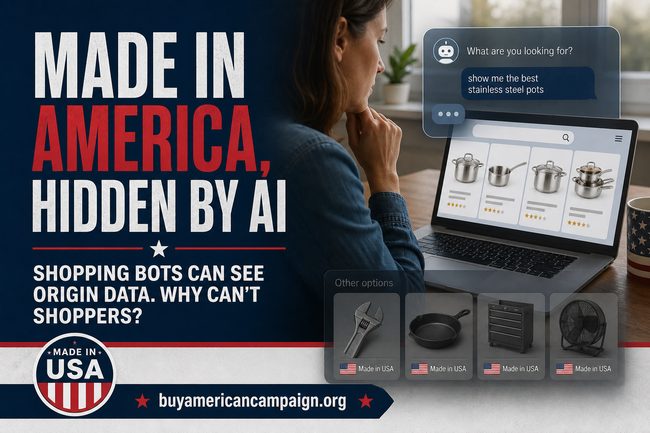
    Made in America hidden by AI shopping chatbots

    A new Columbia University report argues that Made in America is being hidden by AI at the exact moment online retailers are asking shoppers to trust artificial intelligence with more purchasing decisions. The researchers examined AI shopping tools operated by Amazon and Walmart and concluded that the platforms can detect conflicts in country-of-origin information—even when shoppers are not shown those conflicts clearly.

    The 46-page report, Made in America, Hidden by AI, was written by Erie Meyer and Zachary Harris and published through Columbia University’s Center for Law and the Economy. Its findings should concern anyone who tries to support American workers by shopping online.

    What the Columbia Investigation Found

    The researchers tested Amazon’s Alexa for Shopping and Walmart’s Sparky. According to the report, both systems could recognize obvious mismatches—for example, a product advertised with “Made in USA” language while its origin information said “imported” or named another country.

    That matters because an unqualified Made in USA claim is not merely a marketing flourish. Federal standards generally require final assembly and all significant processing to occur in the United States, with all or virtually all components also made and sourced domestically.

    Made in America Hidden by AI Is a Design Problem

    The report’s most troubling conclusion is that this is not simply a technical limitation. The authors say the shopping agents demonstrated access to origin data and the ability to analyze it. Yet the platforms still did not provide shoppers with a straightforward country-of-origin filter.

    The contrast is striking. In one product category examined by the researchers, Amazon offered roughly 269 search filters and Walmart offered almost 300. Country of origin was not among them, even though American-made shoppers routinely identify origin as one of their most important criteria.

    The authors also report an uneven response from Amazon’s assistant: queries seeking products made in several foreign countries returned options, while comparable Made in USA requests could be blocked or refused. The researchers say they were later able to show that relevant American-made results existed inside the system. If accurate, that distinction turns an ordinary search inconvenience into a question about the rules governing what shoppers are allowed to see.

    Browse American-Made Products

    Why Accurate Origin Information Matters

    False or confusing origin claims harm two groups at once. Shoppers may pay a premium believing they are supporting domestic production, while manufacturers that genuinely meet the Made in USA standard lose sales to competitors benefiting from misleading descriptions.

    The report cites polling showing strong demand for domestic products: 71% of Americans report intentionally buying American-made goods, and 65% say they would pay at least 10% more for them. Among shoppers who value American-made products, majorities point to supporting U.S. jobs and strengthening the domestic economy.

    AI Is Becoming the New Store Shelf

    This issue will grow as shopping agents become more influential. Instead of presenting a neutral list of products, an AI assistant can summarize reviews, compare choices, recommend one item over another, and eventually place an order. The algorithm is becoming the shelf, the salesperson, and sometimes the checkout counter.

    Amazon and Walmart also benefit financially from the transactions their systems influence. That creates a legitimate transparency question: Is a chatbot presenting the best answer for the shopper, or the answer that works best for the marketplace?

    The scale makes that question urgent. The report notes that Walmart customers using Sparky spend about 35% more per order, while Amazon has described billions of dollars in sales influenced by agentic shopping. Those figures show that these tools are no longer experimental curiosities. They are becoming commercial gatekeepers with real power to determine which manufacturers are discovered and which products remain invisible.

    Join the Buy American Movement

    What Retail Platforms Should Change

    At minimum, major marketplaces should require sellers to provide standardized origin information, validate obvious inconsistencies, and give shoppers a usable country-of-origin filter. AI recommendations should disclose why products were selected and whether origin claims conflict with other listing data.

    Regulators also need to treat AI-driven recommendations like other advertising and retail conduct. Existing consumer-protection rules do not disappear because a recommendation came from a chatbot rather than a printed label or a store employee.

    What Shoppers Can Do Right Now

    Until marketplaces improve, shoppers should treat “Made in USA” search results as a starting point rather than proof. Check the manufacturer’s own website, read the full origin disclosure, look for specific factory information, and be cautious when a title makes a strong claim that the product details do not support.

    Most importantly, seek out American manufacturers directly. Every purchase made with reliable origin information rewards companies that invest in domestic workers, equipment, suppliers, and communities. AI can make shopping faster, but speed should never come at the expense of truth.

    Whenever possible, choose Made in USA.

    If you like what you see and think this post would be of interest to someone, please share
  • SEG Solar Opens 4 GW Texas Factory, Adding Up to 800 Jobs

    SEG Solar Opens 4 GW Texas Factory, Adding Up to 800 Jobs

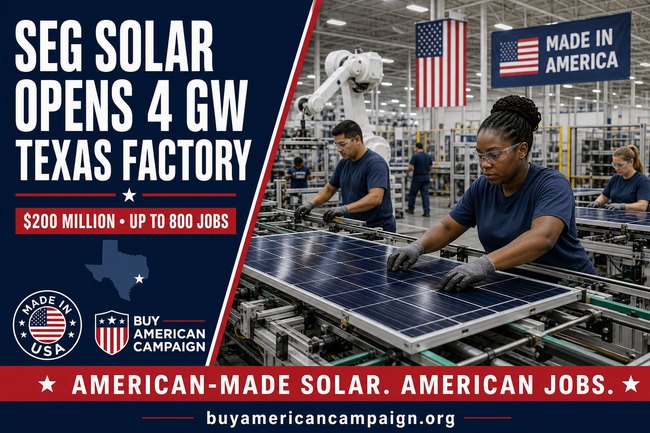
    Workers manufacturing solar panels at SEG Solar's Texas factory

    SEG Solar has opened a new 4-gigawatt solar-panel factory in Tomball, Texas, expanding American manufacturing capacity with an investment of more than $200 million and plans for up to 800 jobs. The August 7 grand opening turned a major expansion promise into an operating facility built to supply solar projects across the United States.

    The nearly 500,000-square-foot plant is SEG Solar’s second U.S. module factory. Together with its first Houston-area operation, it raises the company’s annual domestic module capacity to approximately 6 GW—enough manufacturing scale to matter in a market long dependent on overseas production.

    A 4 GW Texas Solar Factory Moves From Plan to Production

    SEG announced the Tomball project in May and held its grand opening only three months later. Commercial production is expected during the third quarter of 2026, giving the Houston-headquartered company a much larger platform for serving utility, commercial and residential customers.

    The plant is designed for flexibility as solar technology changes. SEG says its production lines can integrate next-generation heterojunction, or HJT, technology, which combines different semiconductor layers to improve panel efficiency and performance.

    Up to 800 American Manufacturing Jobs

    The employment number deserves attention. Up to 800 new jobs could include production operators, maintenance technicians, quality specialists, engineers, logistics workers and supervisors. Those positions create paychecks inside the factory and additional demand for nearby suppliers and local businesses.

    Modern solar manufacturing is highly automated, but it is not workerless. Equipment must be installed, programmed, maintained and improved. Materials have to be tracked, panels inspected and production problems solved by people with practical technical skills.

    Browse American-Made Products

    Why Domestic Solar-Panel Production Matters

    Solar panels are becoming part of America’s essential energy infrastructure. Producing more modules domestically can shorten delivery times, improve traceability and reduce exposure to disruptions that occur when too much of a supply chain is concentrated overseas.

    Domestic manufacturing also keeps more of the value created by new energy projects in American communities. The benefits extend beyond where panels are installed to include the people who assemble, test, package and ship them.

    American-Owned Does Not Mean Every Component Is Domestic

    SEG describes itself as a 100% U.S.-owned manufacturer headquartered in Houston. That is an important distinction, but buyers should still understand the full supply chain. The company assembles modules in Texas while developing upstream ingot and wafer capacity in Indonesia.

    This does not erase the value of American module production. It does show why precise language matters. “American-made solar panels” can describe meaningful domestic manufacturing even when some raw materials or components originate elsewhere. The long-term opportunity is to localize more stages of production here.

    Join the Buy American Movement

    A Third Texas Factory Is Already Underway

    SEG is not stopping at 6 GW. The company has broken ground on a third Greater Houston facility planned at approximately 1.15 million square feet, including factory and warehouse space. Construction is projected to finish in March 2027, with commercial production expected in May 2027.

    That third plant would add 4.6 GW of annual capacity and bring SEG’s planned U.S. total to 10.6 GW. It is expected to focus primarily on high-efficiency HJT modules, while SEG is also evaluating American sites for a dedicated solar-cell factory.

    Texas Is Becoming a Manufacturing Center

    The Houston region has long been associated with oil, gas and petrochemicals. Solar manufacturing adds another chapter to that industrial history. The same strengths that support traditional energy—skilled trades, engineering talent, freight networks and large industrial sites—can also support factories producing newer energy technologies.

    That overlap matters because an energy transition should create durable American work, not simply replace one set of imported products with another. Communities benefit most when investment includes factories, technical training and long-term supplier relationships, not only construction projects.

    Customers Can Strengthen the Domestic Market

    Large developers and commercial buyers influence where manufacturers invest. When purchasers ask where modules are assembled, how components are sourced and what labor supports production, they reward companies that build transparent domestic operations.

    Consumers can ask similar questions when considering rooftop solar. Country-of-origin claims can be complicated, so buyers should request specific information about module assembly and major components. Better questions create stronger incentives for companies to keep moving production closer to home.

    The Bigger Test Is Sustainable Production

    Factory openings generate headlines, but sustained output creates lasting impact. The Tomball plant must ramp safely, meet quality targets, win customer orders and retain its workforce. If it does, the operation can strengthen the case for manufacturing more of America’s energy equipment at home.

    SEG’s expansion is a concrete example of domestic manufacturing responding to real demand. A U.S.-owned company has invested more than $200 million in Texas, opened a major production site and created a path toward hundreds of manufacturing jobs. That is progress worth recognizing—and a reminder that American energy independence also depends on American production capacity.

    Whenever possible, choose Made in USA.

    If you like what you see and think this post would be of interest to someone, please share
  • Foxlink Opens Its First U.S. AI Factory in Fort Worth

    Foxlink Opens Its First U.S. AI Factory in Fort Worth

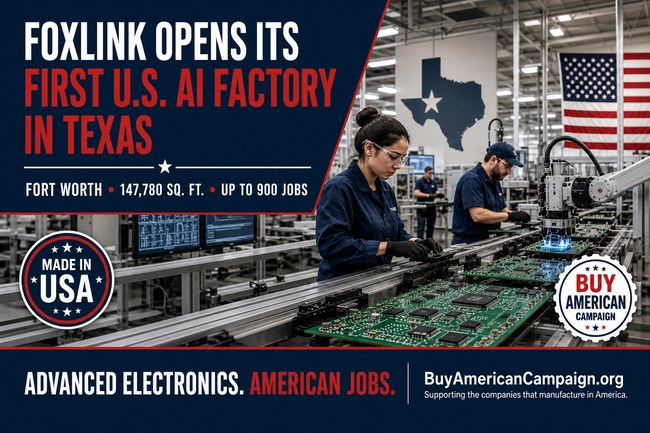
    Foxlink advanced electronics factory in Fort Worth, Texas

    Foxlink has opened its first U.S. AI factory in Fort Worth, Texas, bringing advanced electronics production—and the potential for roughly 900 jobs—to AllianceTexas. The new operation shows what modern American manufacturing can look like: skilled people working alongside intelligent automation to build critical technology closer to U.S. customers.

    The Taiwanese technology manufacturer officially opened the facility on July 14, 2026. Production is expected to begin in August, turning a 147,780-square-foot building into a North American base for high-precision electronics assembly.

    A New Electronics Factory Starts Production in Texas

    Foxlink selected Alliance Gateway 17 at 4600 Alliance Gateway Freeway for its first North American manufacturing plant. At the opening, the company already had a little more than 50 employees on site, according to local reporting, with the workforce expected to expand as additional customers and production programs come online.

    At full capacity, the facility is projected to support approximately 900 jobs. That is a meaningful number for Fort Worth, but the larger story is the kind of work involved: technically demanding production that has too often been located far from the American companies and consumers who depend on it.

    What Foxlink Will Manufacture in Fort Worth

    The plant will handle printed circuit board assembly, surface-mount technology, final assembly, testing and packaging. These are not cosmetic finishing steps. They are core parts of turning sophisticated components into dependable products ready for customers.

    Foxlink also plans to use AI-driven robotics and intelligent automation throughout the operation. That combination can improve precision, consistency and speed while creating demand for technicians, engineers, equipment specialists, quality professionals and production workers who can keep a highly automated factory running.

    Browse American-Made Products

    Why AllianceTexas Made Sense

    AllianceTexas offers more than available industrial space. The development connects manufacturers to major highways, an intermodal rail facility and Perot Field Fort Worth Alliance Airport. For an electronics producer receiving components and shipping finished goods, that network can reduce delays and make domestic production more competitive.

    Fort Worth also provides access to a large and growing labor market. Foxlink cited the region’s talent, logistics and business environment as reasons for choosing the site. Those practical advantages matter when a company is deciding whether its next factory belongs in the United States.

    Automation and 900 Potential Jobs Can Coexist

    The phrase “AI factory” may sound like a building without people. In reality, advanced automation changes the work more than it eliminates the need for workers. Robots can repeat precise motions, but people still install equipment, program systems, solve problems, inspect output, manage materials and improve the process.

    That is why workforce development must be part of the reshoring conversation. Communities that connect manufacturers with technical schools, community colleges and apprenticeship programs give local residents a better chance to qualify for the jobs these investments create.

    Join the Buy American Movement

    An American Manufacturing Win—with an Important Distinction

    Foxlink is a Taiwanese-owned global company, so this is not a story about an American-owned manufacturer. It is still a genuine American manufacturing win because the production, investment and jobs are being placed in Texas. Clear language matters: “Made in USA” describes where work happens, not necessarily where a parent company is headquartered.

    Foreign-owned manufacturers employ millions of Americans and can strengthen domestic supply chains when they build here. The goal should be more production capacity on American soil, more opportunities for American workers and more resilience when international shipping or geopolitical events disrupt the flow of essential goods.

    What This Factory Could Mean Beyond Fort Worth

    A single factory will not rebuild the entire electronics supply chain. It can, however, become an anchor. Successful plants attract suppliers, service companies, logistics providers and specialized talent. They also give customers evidence that advanced electronics can be produced competitively in the United States.

    Foxlink’s decision could encourage other manufacturers to examine North Texas and other American regions with strong transportation and workforce networks. Every new operation adds knowledge and capacity that makes the next domestic investment easier.

    The Test Comes Next

    The opening ceremony is the beginning, not the finish line. The real measure will be how quickly production ramps, how many jobs materialize and whether the Fort Worth plant earns additional customer programs. Those results will determine the facility’s long-term impact.

    For now, the direction is encouraging. A global electronics manufacturer chose to put its first North American plant in Texas, begin production in 2026 and build a workforce around advanced manufacturing. That is the kind of concrete investment the Buy American movement should notice—and the kind consumers can reinforce by choosing products made here whenever possible.

    Whenever possible, choose Made in USA.

    If you like what you see and think this post would be of interest to someone, please share