Reach into your medicine cabinet. Pick up any prescription bottle. Now flip it over and look at the country of origin. There’s a very good chance the active ingredient was made overseas — in India, in China, or somewhere along a supply chain you can’t trace. That has been the uncomfortable reality of American pharmaceutical manufacturing for the last twenty years. Until now.
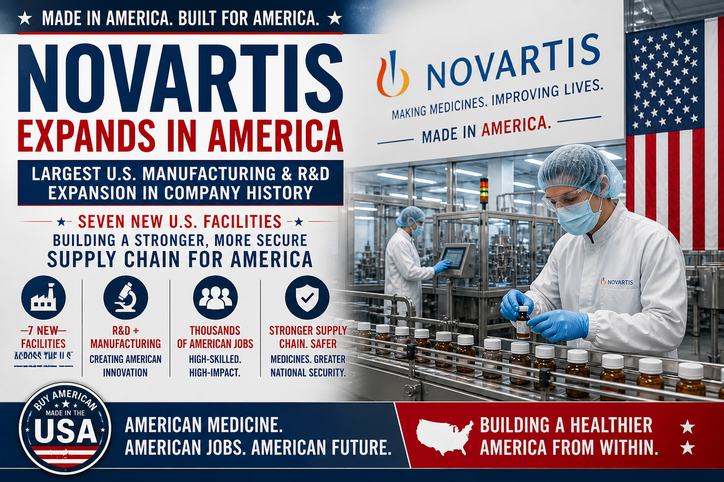
This week, Novartis — one of the largest pharmaceutical companies on Earth — officially finalized the location of its seventh and final new U.S. manufacturing and research site. That marks the completion of the largest American expansion in the company’s 130-year history. Seven new facilities. All on U.S. soil. All staffed by American workers. All dedicated to making medicines for Americans, right here at home.
This is the kind of headline that sounds boring until you understand what it actually fixes.
Why Pharmaceutical Reshoring Is a National Security Story
For decades, the United States quietly handed over the production of its most essential medicines — antibiotics, blood pressure drugs, insulin, chemotherapy ingredients — to factories on the other side of the planet. The math made sense to accountants. It made no sense to anyone who lived through the COVID drug shortages, watched cancer patients ration their chemo because a Chinese factory shut down, or stood in a pharmacy aisle in 2024 looking at empty shelves where amoxicillin used to be.
When the pills aren’t made here, the supply chain isn’t ours. And when the supply chain isn’t ours, neither is the safety net.
What Novartis is doing — committing seven new American facilities in a single coordinated push — isn’t just a corporate press release. It’s the largest single move toward American drug independence by any pharmaceutical company in a generation.
Seven Sites. One Goal. American Medicine.
Novartis announced the broader expansion last year, committing to build out a wave of new U.S. manufacturing and R&D facilities. The seventh site, locked in this week, completes the plan. Each location combines drug production capability with research-and-development work — meaning the company isn’t just bottling pills here, it is doing the science here.
That distinction matters. Lots of foreign pharma firms operate U.S. distribution centers. Far fewer operate U.S. R&D labs. Novartis is doing both, in the same buildings, in seven locations across the country. That’s how you build a domestic industry — not by importing finished pills, but by importing the entire pipeline that creates them.
The Jobs Behind the Pills
Pharmaceutical plants are not assembly lines. They are some of the most demanding manufacturing environments on the planet — clean rooms, sterile fill lines, biotech reactors, packaging suites that have to pass FDA inspection on a moment’s notice. The people who staff those facilities are highly skilled, well-paid, and almost impossible to outsource: chemical engineers, microbiologists, quality-control technicians, validation specialists, machine operators trained on equipment that costs more than most houses.
Each new Novartis site means hundreds of those jobs created or expanded. Not call centers. Not warehouse jobs that disappear in a downturn. Real, durable, technical-trade careers, in American towns, building real American medicine.
This Is What “Bringing It Home” Actually Looks Like
Politicians talk about pharmaceutical reshoring constantly. Tariff threats, executive orders, congressional hearings. Most of it is talk. What Novartis just did is the opposite: it is bricks, mortar, payroll, and a ribbon-cutting on the seventh of seven new U.S. facilities. No more announcements left to make. The plan is done. The plants are getting built.
What It Means for the Bottle in Your Medicine Cabinet
It will take years for the full effect to filter through to your local pharmacy shelf. New plants don’t ship product overnight; FDA validation alone is a multi-year process. But the long arc is unmistakable. More medicine made here means fewer Americans waiting on a supply chain that runs through Mumbai or Shanghai. It means hospitals that don’t have to ration chemotherapy because a foreign factory caught fire. It means your kid’s antibiotic is on the shelf when she needs it.
And it means that when you flip over the bottle and look at the country of origin, there’s a growing chance you’re going to see four little letters that mean something: USA.
Seven sites. One goal. Bringing our medicine back to American soil. That’s a story worth a headline.
Whenever possible, choose Made in USA.
| If you like what you see and think this post would be of interest to someone, please share |