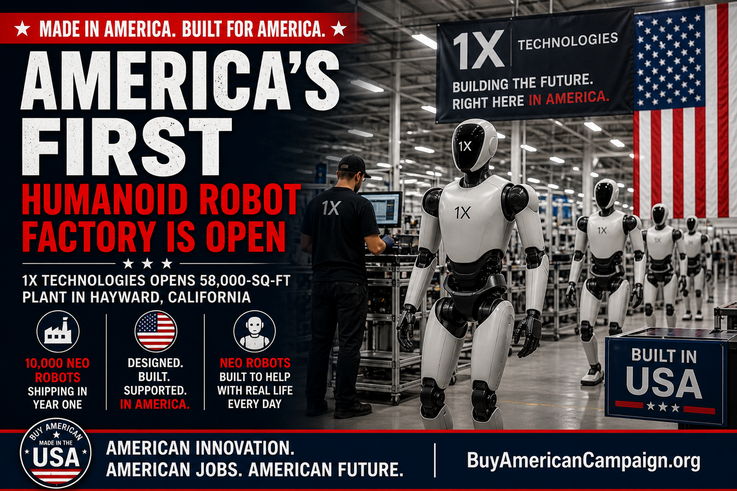
There’s a 58,000-square-foot building in Hayward, California, where the future is being bolted together one humanoid at a time. Inside, technicians walk between assembly stations where five-foot-six robots called NEO are taking shape — limbs attached, sensors calibrated, software loaded. It’s the first vertically integrated American humanoid robot factory, and as of this week, it’s officially open for business.
The company behind it, 1X Technologies, says it plans to ship 10,000 NEO robots out of those doors in the next twelve months. Each one designed in the United States. Each one built in the United States. Each one shipped to a real American customer who pre-ordered the robot they want walking around their kitchen.
That sentence — “shipped to an American customer” — is the part that should make you stop and re-read it. This is not a prototype lab. This is not a Chinese-built robot wearing a U.S. logo. This is a fleet of humanoid robots, manufactured here, sold here, supported here.
Why “Vertically Integrated” Is a Bigger Deal Than It Sounds
You hear “Made in America” thrown around a lot. Sometimes it means a Chinese-built product that got its sticker slapped on in Texas. The 1X NEO is the opposite end of that spectrum.
Vertically integrated means 1X designs and manufactures the actuators, the joints, the control boards, the housings, and the software — virtually everything that goes into a NEO — under its own roof. There is no factory in Shenzhen quietly making the hard parts. There is no shell game with country-of-origin labels. The hands that screw NEO’s torso together work in Hayward, on an American payroll, in an American building.
That matters because robotics has been one of the most aggressively offshored industries on Earth. China alone produces more industrial robots each year than the rest of the world combined. For a U.S. startup to plant a flag and say “we will build the entire machine here” is, frankly, a dare. And 1X just took that dare.
The OpenAI Connection Changes Everything
1X isn’t doing this on its own. The company is backed by OpenAI — yes, the same OpenAI behind ChatGPT — which sees humanoid robots as the natural place AI eventually lives. That partnership puts NEO in a completely different league than the dancing robot videos you might have seen on YouTube.
NEO is being designed to do laundry. To unload a dishwasher. To carry groceries from the car. The kind of work that ordinary Americans do with their hands every single day. And starting in 2026, that work might be done by a machine your neighbor bought, charged in their garage, and trained over a weekend. Built in California. Powered by American AI.

What 10,000 Robots in One Year Actually Means
Ten thousand units in year one is not a press-release number. It is a real, hard production target — and it puts 1X among the most ambitious humanoid programs anywhere on the planet. For comparison: most competing robotics startups are still measuring deliveries in the dozens. Tesla’s Optimus has been “coming next year” for several years now.
If 1X actually ships 10,000 NEO robots over the next twelve months, the United States will have done something every other country has claimed they were going to do first: stand up a working consumer-humanoid-robot industry. On American soil. With American workers. From an American factory. Not next decade. This year.
The Main Street Story Hidden Inside the Headline
A 58,000-square-foot facility doesn’t run itself. Production engineers, machinists, electricians, supply-chain managers, software testers, quality-control specialists — every one of those jobs sits in Hayward instead of overseas. And vertical integration creates a ripple effect through the local supply base: machine shops that feed parts to the line, logistics firms that handle outbound shipping, recruiters that staff the floor.
This is what reshoring actually looks like when it works. Not a press conference. Not a memorandum of understanding. A building, a payroll, and a product that ships.
Why This Moment Matters Beyond One Factory
For two decades, the conventional wisdom was that the United States couldn’t compete in advanced electronics manufacturing. Too expensive. Too slow. Too far behind. That wisdom has been losing ground for a while — Intel and TSMC putting up chip fabs in Arizona, GE Appliances bringing dishwashers back to Kentucky, Lockheed Martin expanding aerospace plants from Texas to Florida — but the 1X factory feels like a different kind of moment.
This isn’t reshoring an old industry. This is starting a brand-new one, on the ground floor, in California instead of Shenzhen. The next decade of humanoid robotics could very plausibly be written by an American company, in an American factory, shipping to American homes. That is a story worth paying attention to.
And it is only Day One.
Whenever possible, choose Made in USA.
| If you like what you see and think this post would be of interest to someone, please share |