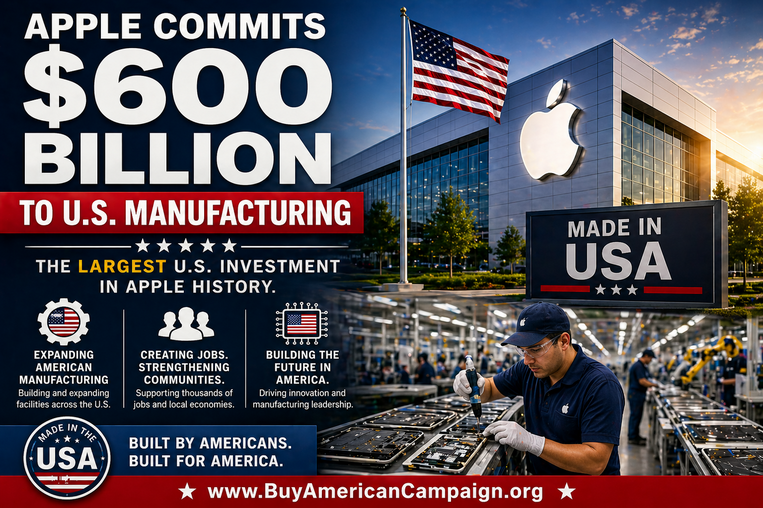
Apple just made one of the largest American manufacturing commitments in corporate history. The company has raised its U.S. investment plan to a staggering $600 billion over the next four years — money that’s already turning into real factories, real partnerships, and real American jobs.
Through its newly expanded American Manufacturing Program (AMP), Apple is pulling parts of its global supply chain back to U.S. soil — from the glass on your iPhone to the silicon in your MacBook to the servers powering Apple Intelligence. For a company that built its supply chain around Asia for two decades, this is a major reset. And it’s happening now.
The Headline Numbers
Let’s start with the scope of what Apple is actually doing:
- $600 billion total U.S. investment commitment over four years
- 20,000 new direct American jobs in R&D, silicon engineering, software, and AI
- 450,000 supplier and partner jobs already supported across the U.S.
- 10+ U.S. manufacturing partners including Corning, Texas Instruments, Samsung, Broadcom, Applied Materials, GlobalFoundries, and Amkor
For perspective: $600 billion is more than the entire annual GDP of Sweden. And Apple is committing that to American manufacturing in just four years.
iPhone Glass: Made in Kentucky
One of the most concrete pieces of the program is happening at Corning’s Harrodsburg, Kentucky facility. Apple is investing in turning Harrodsburg into the largest and most advanced smartphone cover glass production site in the world. The plan: every iPhone and every Apple Watch sold globally will have cover glass made in Kentucky.
Think about that. The screen of every iPhone on Earth — manufactured by American workers in a small town in central Kentucky. That’s the kind of supply chain decision that creates generational manufacturing jobs in communities that have been waiting for them.

AI Servers and Mac mini: Made in Houston
In Texas, Apple is building a 250,000-square-foot server manufacturing facility in Houston that’s already producing AI servers ahead of schedule. The Houston campus is doubling its footprint to support full mass production starting in 2026.
And here’s the news that should make every American smile: starting later this year, the Mac mini will be built in Houston. That’s the first time Apple will assemble the product on U.S. soil. A Mac mini sitting on an American desk, designed in Cupertino, assembled in Houston. That’s a sentence we haven’t been able to write very often in the last 25 years.
Semiconductors: The Real Game
The most strategically important piece of Apple’s program is what’s happening in chips. The U.S. lost most of its semiconductor manufacturing capacity over the last 30 years. Apple is helping bring it back — not by building chip factories itself, but by being the anchor customer that justifies billions in investment by U.S. chip suppliers.
- Amkor is breaking ground on a $7 billion semiconductor packaging facility in Peoria, Arizona. Apple will be its first and largest customer.
- GlobalWafers America is starting production at a new $4 billion silicon wafer plant in Sherman, Texas.
- Texas Instruments, GlobalFoundries, and Samsung are all expanding U.S. production with Apple commitments behind them.
This is exactly how reshoring is supposed to work. A massive U.S. customer commits long-term, and that commitment unlocks billions in domestic factory construction. Apple is using its scale the way American industrial giants used to — to build out an American supply chain.
20,000 New American Jobs
Apple says it’s creating 20,000 new direct American jobs through the program — not in retail or service, but in the high-skill categories that build economic strength: research and development, silicon engineering, software development, and artificial intelligence. These are the kinds of jobs that pay six figures, train the next generation of American engineers, and keep advanced industrial knowledge in the United States rather than overseas.
On top of those direct hires, Apple’s broader U.S. operations already support 450,000 supplier and partner jobs. Add in the manufacturing buildout and the number grows from there.

Why This Matters Beyond Apple
For decades, the conventional wisdom in Silicon Valley was that hardware manufacturing belonged offshore. The U.S. would design, China would build. American workers would just have to accept that their role in the consumer electronics economy was over.
Apple is now publicly betting $600 billion that the conventional wisdom was wrong. They’re betting that smart automation, advanced materials, and a skilled American workforce can produce world-class consumer electronics on U.S. soil — and that doing so makes their supply chain more resilient, their products more reliable, and their relationship with American customers stronger.
If Apple can pull this off — and the early evidence in Kentucky, Texas, and Arizona says they can — it sets a template. Every other major American technology company will face the question: if Apple can manufacture iPhone glass in Kentucky and AI servers in Houston, why can’t we?
What You Can Do
If you buy Apple products, know that an increasing share of what’s in that box is now coming from American factories — designed, engineered, and increasingly assembled here. And every dollar spent on a U.S.-made Apple product is a dollar that flows back to a worker in Houston, Harrodsburg, Peoria, Sherman, or Cupertino.
Apple’s $600 billion commitment isn’t just a tech story or a corporate PR story. It’s an American manufacturing story — the biggest one of the year. And it should be celebrated by anyone who wants to see this country making things again.
Whenever possible, choose Made in USA.
| If you like what you see and think this post would be of interest to someone, please share |