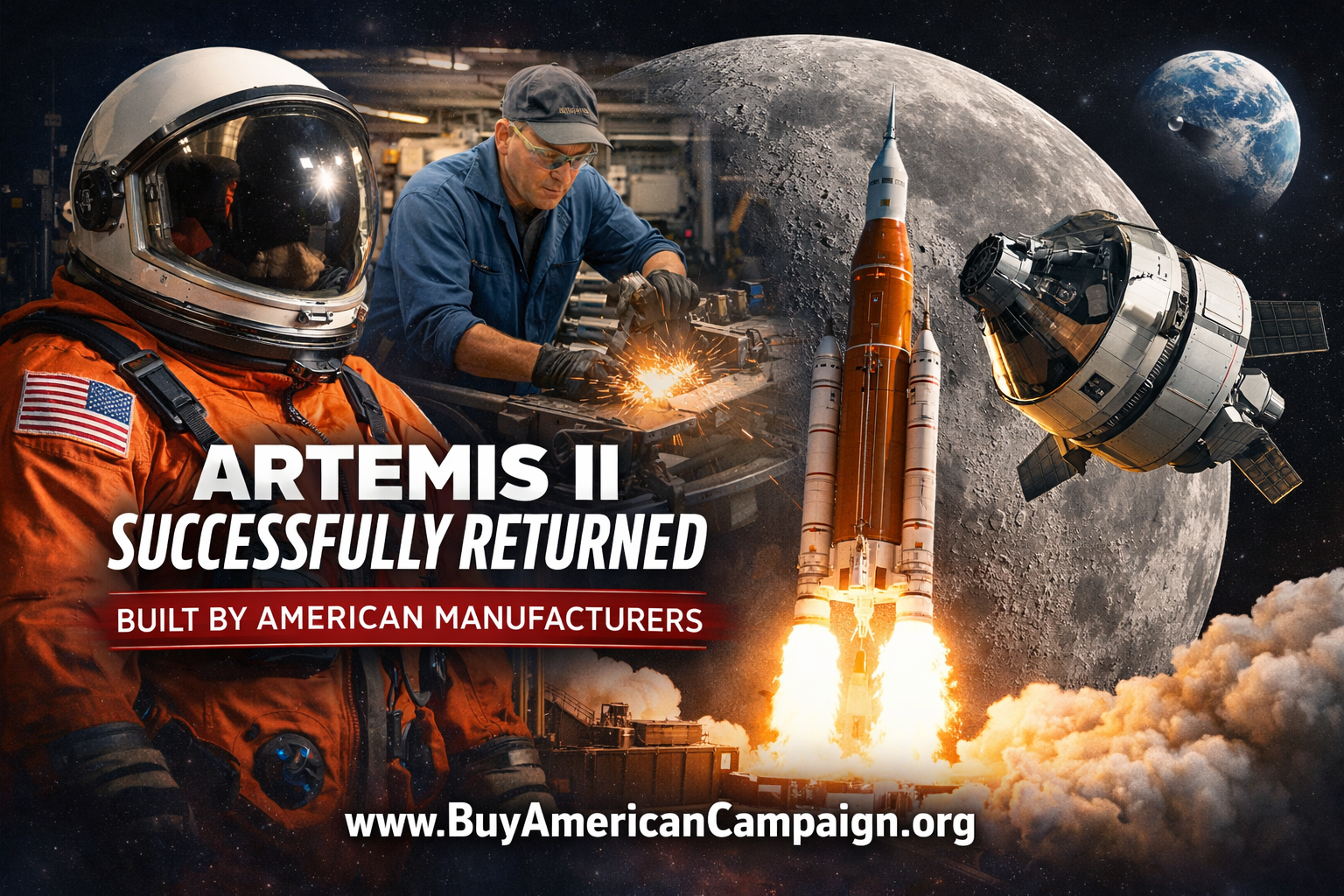
After a 10-day, 695,081-mile journey around the Moon, Artemis II has successfully returned its crew safely to Earth. For the first time in more than 50 years, humans traveled beyond low Earth orbit and came back — proving that the United States not only still has the capability to reach deep space, but to execute a mission of this complexity from start to finish.
The crew — Reid Wiseman, Victor Glover, Christina Koch, and Jeremy Hansen — completed a mission that demanded perfection from every system on board. And that is exactly what they got. Because behind Artemis II is a nationwide network of American manufacturers who built the components that made this mission possible — and ensured it worked when it mattered most.
The Spacecraft: Built in Louisiana, Powered by a Nation
The Orion spacecraft was built by Lockheed Martin at NASA’s Michoud Assembly Facility in New Orleans. But while Lockheed Martin assembled the spacecraft, Orion itself is the result of contributions from companies across the United States — each responsible for highly specialized systems that had to perform flawlessly in deep space.
This was not a controlled test. This was a full mission under real conditions, and every piece of hardware had to work. The success of Artemis II confirms that it did.
American-Made Aluminum From West Virginia
At Constellium in Ravenswood, West Virginia, the highly trained men and women of United Steelworkers Local 5668 produced the Airware aluminum-lithium alloy used “tip to tail” across the entire Artemis II mission. The facility employs more than 1,100 people and is one of the world’s largest aluminum rolled products manufacturing sites, specializing in aerospace-grade materials.
More than 20 years of research and development went into perfecting this material, which offers lower density, higher stiffness, thermal stability, corrosion resistance, and superior damage tolerance compared to traditional aerospace aluminum. From the rocket’s structure to the spacecraft’s hull, Constellium’s alloy was the foundation that held the entire mission together — and over 695,081 miles of deep space travel, it performed exactly as engineered.
Life-Saving Engineering from Massachusetts
In Worcester, Massachusetts, the David Clark Company produced one of the most critical elements of the mission: the Orion Crew Survival System spacesuits. These bright orange suits are far more than protective gear. They are fully integrated life-support systems designed to sustain astronauts for up to six days in the event of an emergency.
Each suit includes built-in air supply, water, food provisions, and waste management — effectively functioning as a personal survival system in space. The company’s expertise in pressure suits dates back to 1941, including its role in developing suits for X-1 rocket plane test pilots who first broke the sound barrier. That legacy carried forward into Artemis II, where the suits performed exactly as designed.

Precision Controls from Illinois
In Carpentersville, Illinois, OTTO Engineering manufactured 17 unique switch controls used throughout the Orion spacecraft. These switches are essential interfaces between the crew and the spacecraft’s systems, allowing astronauts to execute commands with precision in an environment where there is no room for error.
Every interaction during the mission relied on these components functioning perfectly. And they did. As Tom Roeser of OTTO Engineering said, “It’s the American dream. You can, in a little town of Carpentersville 40 miles outside of Chicago, find enough capable talent to design and manufacture products of this complexity.” Artemis II proved that statement true.
Advanced Materials That Protected the Crew
Space is unforgiving, and the materials used in spacecraft must be able to withstand extreme threats. McDanel Advanced Materials manufactured every window pane for Orion, engineering them as multi-layered systems capable of protecting the crew from micrometeoroids traveling at high velocity. These windows are not simply for visibility — they are part of the spacecraft’s protective structure.
At the same time, Elmet Technologies in Euclid, Ohio supplied high-performance materials essential to the spacecraft’s structural integrity and thermal resistance. These materials are engineered to perform under extreme heat, pressure, and radiation, ensuring that Orion could endure the conditions of deep space travel. Their performance during the mission validated years of research and development behind these advanced materials.

Decades of Manufacturing Excellence in California
In Sacramento, California, Tecma contributed thousands of components to Artemis II, continuing a legacy that spans 98 space programs. The company’s history includes manufacturing guillotine cutter assemblies for Apollo 11, and that same level of precision and reliability was brought forward into this mission.
Artemis II is not an isolated achievement. It is the continuation of decades of American manufacturing experience, where companies like Tecma refine their capabilities over time and apply them to increasingly complex challenges. The success of this mission demonstrates that this expertise remains strong and relevant today.
Inspiring the Next Generation
For astronaut Christina Koch, Artemis II represents more than a successful mission. It is an opportunity to inspire the next generation of engineers, scientists, and skilled workers. As she emphasized, “The thing I love about the moon is that it’s not just a beacon for exploration and this platform of possibilities for incredible missions like this, but it has benefits. You have everything from innovation, technology development, not only for future missions going deeper into the solar system, but technologies as it comes back to Earth. You have inspiration. A whole generation of people starting this pipeline of STEM workers and manufacturers and operators that are excited to see what you can do when you work hard and come together as a team.”
That inspiration is grounded in reality. This mission showed that the opportunities still exist — not just in space, but in the factories, labs, and manufacturing floors across the United States where these systems are built.
The Bottom Line
Artemis II did not just reach deep space. It returned safely. That outcome required every system, every material, and every component to perform exactly as designed under real-world conditions.
From West Virginia to Massachusetts, from Illinois to California, American manufacturers delivered. Their work was tested in the harshest environment imaginable — and it held up.
This mission is proof. Proof that American manufacturing is still capable of building the systems that push humanity forward. Proof that when it matters most, the United States can rely on its own industrial base to deliver results.
Artemis II is now complete. The crew is home. And the companies that made it possible have once again demonstrated what American manufacturing can do.
Whenever possible, choose Made in USA.
| If you like what you see and think this post would be of interest to someone, please share |