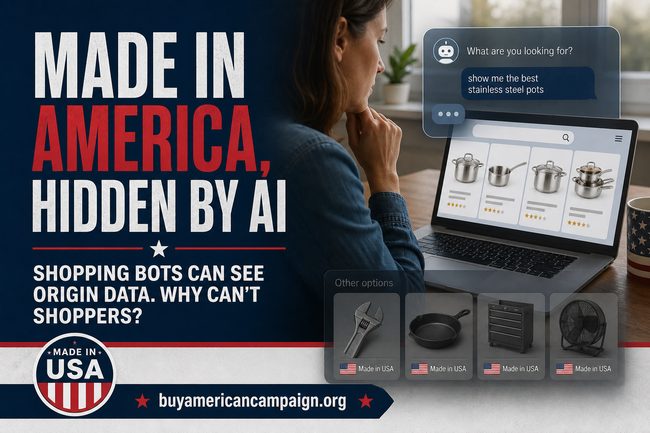
A new Columbia University report argues that Made in America is being hidden by AI at the exact moment online retailers are asking shoppers to trust artificial intelligence with more purchasing decisions. The researchers examined AI shopping tools operated by Amazon and Walmart and concluded that the platforms can detect conflicts in country-of-origin information—even when shoppers are not shown those conflicts clearly.
The 46-page report, Made in America, Hidden by AI, was written by Erie Meyer and Zachary Harris and published through Columbia University’s Center for Law and the Economy. Its findings should concern anyone who tries to support American workers by shopping online.
What the Columbia Investigation Found
The researchers tested Amazon’s Alexa for Shopping and Walmart’s Sparky. According to the report, both systems could recognize obvious mismatches—for example, a product advertised with “Made in USA” language while its origin information said “imported” or named another country.
That matters because an unqualified Made in USA claim is not merely a marketing flourish. Federal standards generally require final assembly and all significant processing to occur in the United States, with all or virtually all components also made and sourced domestically.
Made in America Hidden by AI Is a Design Problem
The report’s most troubling conclusion is that this is not simply a technical limitation. The authors say the shopping agents demonstrated access to origin data and the ability to analyze it. Yet the platforms still did not provide shoppers with a straightforward country-of-origin filter.
The contrast is striking. In one product category examined by the researchers, Amazon offered roughly 269 search filters and Walmart offered almost 300. Country of origin was not among them, even though American-made shoppers routinely identify origin as one of their most important criteria.
The authors also report an uneven response from Amazon’s assistant: queries seeking products made in several foreign countries returned options, while comparable Made in USA requests could be blocked or refused. The researchers say they were later able to show that relevant American-made results existed inside the system. If accurate, that distinction turns an ordinary search inconvenience into a question about the rules governing what shoppers are allowed to see.
Why Accurate Origin Information Matters
False or confusing origin claims harm two groups at once. Shoppers may pay a premium believing they are supporting domestic production, while manufacturers that genuinely meet the Made in USA standard lose sales to competitors benefiting from misleading descriptions.
The report cites polling showing strong demand for domestic products: 71% of Americans report intentionally buying American-made goods, and 65% say they would pay at least 10% more for them. Among shoppers who value American-made products, majorities point to supporting U.S. jobs and strengthening the domestic economy.
AI Is Becoming the New Store Shelf
This issue will grow as shopping agents become more influential. Instead of presenting a neutral list of products, an AI assistant can summarize reviews, compare choices, recommend one item over another, and eventually place an order. The algorithm is becoming the shelf, the salesperson, and sometimes the checkout counter.
Amazon and Walmart also benefit financially from the transactions their systems influence. That creates a legitimate transparency question: Is a chatbot presenting the best answer for the shopper, or the answer that works best for the marketplace?
The scale makes that question urgent. The report notes that Walmart customers using Sparky spend about 35% more per order, while Amazon has described billions of dollars in sales influenced by agentic shopping. Those figures show that these tools are no longer experimental curiosities. They are becoming commercial gatekeepers with real power to determine which manufacturers are discovered and which products remain invisible.
What Retail Platforms Should Change
At minimum, major marketplaces should require sellers to provide standardized origin information, validate obvious inconsistencies, and give shoppers a usable country-of-origin filter. AI recommendations should disclose why products were selected and whether origin claims conflict with other listing data.
Regulators also need to treat AI-driven recommendations like other advertising and retail conduct. Existing consumer-protection rules do not disappear because a recommendation came from a chatbot rather than a printed label or a store employee.
What Shoppers Can Do Right Now
Until marketplaces improve, shoppers should treat “Made in USA” search results as a starting point rather than proof. Check the manufacturer’s own website, read the full origin disclosure, look for specific factory information, and be cautious when a title makes a strong claim that the product details do not support.
Most importantly, seek out American manufacturers directly. Every purchase made with reliable origin information rewards companies that invest in domestic workers, equipment, suppliers, and communities. AI can make shopping faster, but speed should never come at the expense of truth.
Whenever possible, choose Made in USA.
| If you like what you see and think this post would be of interest to someone, please share |