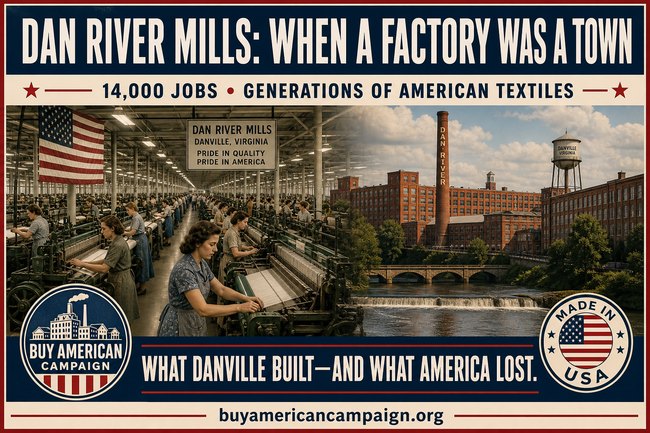
For generations in Danville, Virginia, Dan River Mills was more than a factory. It was where parents met, where children expected to work, where paychecks filled local stores and where the rhythm of looms helped set the rhythm of an entire town.
At its wartime peak, Dan River employed about 14,000 people in a city of roughly 40,000. The numbers are remarkable, but they only hint at the mill’s reach. A factory that large did not sit beside the community. It shaped the community.
A Mill Built Beside the Dan River
The story began in 1882, when six local men established Riverside Cotton Mills on the banks of the Dan River. Four mills rose during the company’s first decade, powered by a region eager to turn Southern cotton into finished American cloth.
Riverside merged with the Dan River Power and Manufacturing Company in 1909. By then, annual cloth production had climbed from about 2 million yards in 1884 to more than 78 million yards. Sheetings, ginghams and chambrays carried Danville’s work far beyond Virginia.
When the Factory Became the Community
Like many Southern textile companies, Dan River built housing to attract and retain workers. The mill village of Schoolfield included homes, churches, recreation and the everyday relationships that grow when thousands of families share the same employer.
Company-town life was never simple. Conditions could be harsh, and workers fought difficult battles over wages and control of their jobs. Major strikes in 1930 and 1951 ended in defeat. Still, residents remembered the closeness of a place where work and community were inseparable.

Fourteen Thousand Workers During World War II
Military orders pushed the mills into extraordinary production during World War II. By 1942, Dan River operated twelve weaving and spinning mills along with dyeing, bleaching, finishing and power plants. Nearly half a million spindles fed the largest textile operation in the region.
The mill’s 14,000 workers represented more than one out of every three people living in Danville—not merely one out of every three workers. After the war, civilian demand kept the company growing. Acquisitions lifted companywide employment above 18,000 by 1956.
What a Manufacturing Paycheck Multiplies Into
Every mill job supported more than the person standing at a loom. Wages paid grocers, mechanics, barbers and builders. The company needed suppliers, rail service, maintenance and transportation. Schools and public services depended on an economy anchored by productive work.
That multiplier is easy to overlook when a factory is reduced to an employment number. In a manufacturing town, the plant’s health becomes visible in storefronts, home values, civic groups and children’s expectations about whether they can build a future close to family.
The Long Retreat of American Textiles
Imported textiles began taking market share from American manufacturers in the 1960s. Dan River initially answered with technology and investment, trying to produce more efficiently while keeping its domestic operations competitive.
By the 1990s and early 2000s, imports from Latin America and Asia were arriving in volumes the domestic industry could not withstand. Employment declined, facilities closed and Dan River entered Chapter 11 bankruptcy reorganization in March 2004.
The Final Jobs Went Overseas
Dan River emerged from bankruptcy, but survival was brief. In 2006, an Indian company purchased the business, closed the main mill and transferred the remaining work overseas. Encyclopedia Virginia records the final move as the loss of hundreds of remaining jobs; historical accounts differ on whether the last transfer involved roughly 500 or as many as 1,100 positions.
The exact final count does not change the outcome. A company that had manufactured American textiles for more than a century no longer made its products in the United States. The brand survived. The production community did not.
Danville Had to Become Something Else
The physical landscape changed too. The familiar smokestacks came down in 2008. Former mill property sat vacant or moved toward new uses while Danville worked to rebuild an economy once dominated by textiles and tobacco.
Today, the former White Mill has become Dan River Falls, a mixed-use redevelopment with residential, office and commercial space. Schoolfield is receiving new investment, and Danville has earned recognition for its comeback. That reinvention deserves respect.
Redevelopment Is Not the Same as Production
A restored building can preserve history and create valuable new activity. It cannot recreate the industrial ecosystem that once trained generations, supported suppliers and shipped tangible goods across the country. A casino, apartment or office may reuse a site, but it does different economic work.
Dan River Mills is not an argument that every old factory should have remained unchanged forever. It is a warning about treating productive capacity as disposable. Once machinery, skills, supplier networks and customer relationships disappear, rebuilding them is far harder than closing a gate.
Remember the People Behind the Label
For consumers, Dan River’s story gives a familiar label a human scale. “Made in USA” was thousands of people in Danville reporting for shifts, learning trades, raising families and spending wages in the place they called home.
We cannot reverse every closure. We can decide that the next factory matters before it becomes a memory. Choosing American-made products, asking retailers where goods are produced and supporting companies that invest here are modest acts—but they help keep today’s manufacturing towns from becoming tomorrow’s historical exhibits.
Whenever possible, choose Made in USA.
| If you like what you see and think this post would be of interest to someone, please share |