
Try a thought experiment.
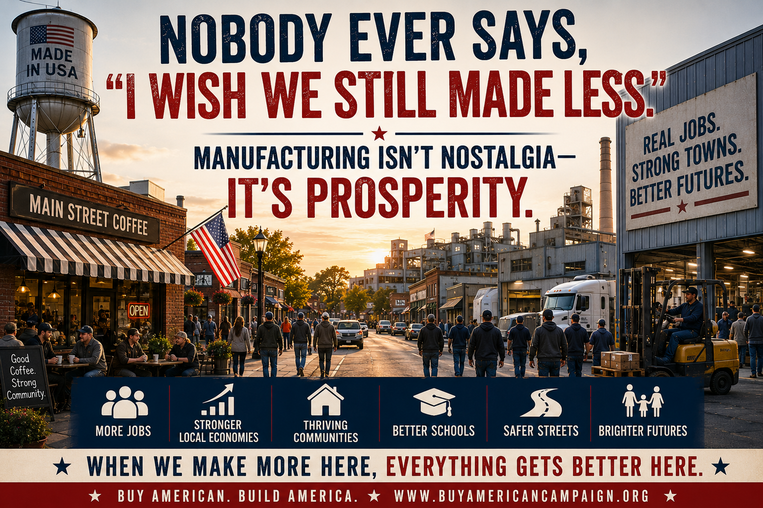
Picture a town where a factory just announced it’s hiring 1,000 people.
The restaurants are packed at lunchtime.
The coffee shop opens earlier because the first shift starts at six.
A local contractor hires more workers.
The hardware store is busier than it’s been in years.
Young families are buying homes.
The school is adding classrooms instead of closing them.
Property values are rising.
The city is fixing roads instead of postponing repairs.
Now ask yourself one question.
Who looks at that town and says, “This is terrible. I wish we still made less.”
Nobody.
Because deep down, we already know something we’ve somehow forgotten.
Manufacturing isn’t nostalgia.
It’s prosperity.
We Don’t Celebrate Empty Factories
People often argue about manufacturing as though it’s some sentimental attachment to the past.
Old mills.
Black-and-white photographs.
Grandpa’s lunchbox.
Rusty smokestacks.
But nobody drives past an abandoned factory and thinks,
“At least imported toasters are cheaper.”
What they notice is something else.
The empty parking lot.
The weeds growing through the pavement.
The boarded-up storefront across the street.
The “For Sale” signs that have been there for years.
Manufacturing isn’t remembered because people are nostalgic.
It’s remembered because people remember what life was like when the jobs were still there.
Prosperity Has a Look
You don’t need an economics degree to recognize a thriving town.
You know it when you see it.
The restaurants are full.
The coffee shop has a line out the door before sunrise.
Construction crews are building houses instead of demolishing them.
Kids come back after college because there are careers waiting for them.
The Little League has enough volunteers.
The high school doesn’t struggle to keep teachers.
Main Street has businesses opening instead of closing.
Nobody describes that place as being “over-industrialized.”
They call it successful.

Manufacturing Builds Confidence
There’s something else factories create that never shows up in government statistics.
Confidence.
The confidence to buy a home.
To start a business.
To raise a family.
To hire another employee.
To believe your children might have an even better future than you did.
Communities don’t thrive because everyone becomes wealthy overnight.
They thrive because enough people have steady work that they can plan for tomorrow.
Manufacturing has always been one of the strongest builders of that kind of confidence.
Every Community Wants One
Think about the announcements that communities celebrate.
A new semiconductor plant.
An aircraft factory.
A steel mill expanding.
A battery plant.
An appliance manufacturer opening another production line.
Notice what nobody ever celebrates.
A factory closing.
A thousand jobs leaving.
A supplier shutting its doors.
A community becoming more dependent on products made somewhere else.
No mayor ever cuts a ribbon for fewer manufacturing jobs.
No chamber of commerce issues a press release celebrating another empty industrial park.
When communities compete with one another, what are they trying to attract?
Factories.
Not because factories are old-fashioned.
Because they’re engines of opportunity.
We Already Know the Answer
For years we’ve debated whether manufacturing still matters.
Maybe we’ve been asking the wrong question.
Instead ask this:
If a factory announced tomorrow that it was opening in your town, creating 800 good-paying jobs, would anyone complain?
Would anyone say,
“I wish they had built it somewhere else.”
Or would people celebrate?
Would local businesses prepare for more customers?
Would young families start looking at houses?
Would high school graduates think twice before moving away?
We already know the answer.
Because we’ve seen it happen.
More Than What We Make
Manufacturing isn’t important simply because it produces things.
It’s important because of what it produces beyond the products.
Careers.
Skills.
Businesses.
Tax revenue.
Homeownership.
Community pride.
Generational opportunity.
Those things don’t arrive in shipping containers.
They grow where people build things together.
The Question That Answers Itself
Every time a company announces a new American factory, the headlines are overwhelmingly positive.
More jobs.
More investment.
More opportunity.
More hope.
Nobody reads those stories and thinks,
“This would all be better if we produced less.”
That’s because manufacturing has never really been about factories.
It’s about whether a community has the chance to build a future instead of simply consuming one.
We’ve spent years arguing about where products should be made.
Perhaps the better question is much simpler.
If making more things here makes our communities stronger…
Why would we ever wish to make less?
Related reading: Every “Made in USA” Label Represents Someone’s Tuesday — the people behind the label.
Whenever possible, choose Made in USA.
| If you like what you see and think this post would be of interest to someone, please share |