Tag: American made products

  • Buying American Isn’t All or Nothing

    Buying American Isn’t All or Nothing

    Shopper comparing American-made and imported products

    Buying American isn’t all or nothing. Yet that is exactly how the choice is often presented: either every item in your home must be made in the USA, or your effort does not count. That impossible standard discourages people who genuinely want to support American workers but still live with budgets, limited options and complicated supply chains.

    A better approach is simpler: make the better choice when a practical American-made option is available. One purchase will not rebuild an industry by itself, but millions of ordinary purchasing decisions can change what retailers stock and where companies invest.

    The Perfect Shopper Does Not Exist

    Most of us own imported phones, appliances, clothing and tools. Some products have few domestic alternatives. Others carry prices that do not fit every household budget. Pretending those realities do not exist turns a useful movement into a purity test.

    The goal should not be to shame someone for the imported products already in a kitchen drawer or garage. The goal is to help that person notice the next opportunity—to choose an American-made pan, pair of work boots, garden hose or bag of pet food when the quality and price make sense.

    Start With What You Buy Repeatedly

    The easiest place to begin is with products purchased again and again. Paper goods, cleaning supplies, food, personal-care products and basic household items create recurring demand. Switching even one regular purchase can support domestic production dozens of times over several years.

    These choices are often less intimidating than replacing an expensive appliance or vehicle. They also build the habit of checking labels, reading company information and asking where a product was actually manufactured.
    Browse American-Made Products

    Choose the Categories That Matter to You

    No household can research everything. Pick two or three categories that match your priorities. A tradesperson might focus on tools and workwear. A parent might start with food, toys or school supplies. Someone furnishing a home might pay closer attention to cookware, mattresses and furniture.

    Concentrating your effort makes the process manageable. It also allows you to learn which claims are meaningful, which companies manufacture domestically and which products merely use patriotic branding while production happens elsewhere.

    Price Matters—and So Does Value

    American-made products sometimes cost more upfront because domestic manufacturers operate under different wage, safety and environmental standards. That price difference is real, and nobody should be judged for choosing what a family can afford.

    When the budget allows, compare value rather than price alone. A durable product that can be repaired or kept for years may cost less over time than several cheaper replacements. Warranty service, replacement parts and dependable customer support also belong in the calculation.

    Join the Buy American Movement

    Ask Better Questions Instead of Demanding Perfection

    “Made in USA” can describe products with different levels of domestic content, and many supply chains cross borders. Consumers should ask where final manufacturing occurs, where major components originate and whether a company is transparent about the answer.

    A product assembled here from some imported parts can still create meaningful American work. It may not represent the strongest possible domestic supply chain, but it can be a step in the right direction. Honest progress deserves recognition alongside continued pressure to localize more production.

    Availability Is Part of the Problem

    Consumers cannot buy products they cannot find. American manufacturers and retailers share responsibility for making origin information visible, maintaining useful inventories and explaining why domestic production may offer better quality or service.

    When a suitable American-made option is unavailable, buying the product you need is not a betrayal of the movement. It is information. Ask the retailer to carry an alternative, contact the brand and keep the category in mind the next time you shop.

    Small Signals Become Market Demand

    Retailers track what sells. Manufacturers watch customer requests, reviews and search behavior. When enough shoppers look for American-made choices, businesses gain a reason to expand production, add a domestic product line or make country-of-origin information easier to find.

    That signal can be strengthened by telling companies why you made a purchase. A short email, product review or social-media comment lets a manufacturer know that domestic production influenced the decision.

    Progress Is a Better Standard Than Purity

    Buying American is not a contest to see who can eliminate every imported item. It is a practical effort to direct more demand toward people who make things here. Someone who changes five purchases this year has done more for domestic manufacturing than someone who gives up because changing fifty felt impossible.

    Look for the label. Check the company. Choose the American-made option when it fits your needs and budget. Then do it again when the next opportunity appears. Better choices, repeated over time, are how habits change—and how markets follow.

    Whenever possible, choose Made in USA.

    If you like what you see and think this post would be of interest to someone, please share
  • ENZO Olive Oil — How a California Farm Built an American-Made Success Story

    ENZO Olive Oil — How a California Farm Built an American-Made Success Story

    ENZO Olive Oil — How a California Farm Built an American-Made Success Story

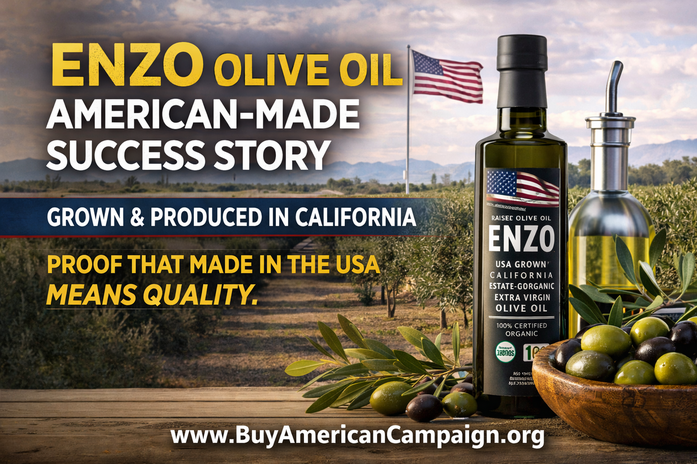
    ENZO Olive Oil American-Made Success StoryWhen people think of premium olive oil, they usually think of Italy, Spain, or Greece. But one California company is changing that perception — and proving that world-class olive oil can be grown, produced, and bottled right here in the United States.

    ENZO Olive Oil, based in California’s Central Valley, has built a reputation for producing high-quality, estate-grown olive oil using a fully integrated American supply chain. From orchard to bottle, every step of the process happens on U.S. soil — a level of control and transparency that sets it apart in a global industry dominated by imports.

    From Almond Farm to Olive Oil Brand

    ENZO is part of the Ricchiuti Family Farms, a multi-generational Sicilian-American farming operation in Madera County, California. The family originally grew almonds but began planting olive trees with the goal of producing a world-class American olive oil.

    That decision was not just about diversification. It was about proving that the United States could produce olive oil on par with the best in the Mediterranean — and do it with full traceability and integrity.

    100% American-Grown and Produced

    Unlike many olive oils on store shelves, which are often blended from multiple countries, ENZO Olive Oil is 100% California-grown. The olives are harvested at peak ripeness and milled quickly to preserve flavor and nutritional value.

    This matters more than most consumers realize. Olive oil quality begins with freshness, and long supply chains can degrade that quality over time. By keeping production local, ENZO delivers a product that is not only traceable but also significantly fresher than imported alternatives.

    Browse American-Made Products

    Quality That Competes on the World Stage

    ENZO Olive Oil has earned recognition in national and international competitions, standing alongside the best producers from Italy, Spain, and beyond. That kind of recognition does not come from cutting corners — it comes from a commitment to doing things right.

    The company focuses on extra virgin olive oil, the highest grade available, and offers varieties that highlight different flavor profiles depending on the olive cultivar and harvest timing.

    Why It Matters

    Choosing an American-made olive oil like ENZO does more than support one company. It supports an entire ecosystem of American agriculture — from the farmworkers who tend the orchards to the local businesses that supply packaging and distribution.

    In an industry where labeling can often be confusing and origins unclear, companies like ENZO offer something different: a product you can trace back to a specific farm, produced by a family that stands behind it.

    Join the Buy American Movement

    A Growing Category for American Producers

    California has become the center of olive oil production in the United States, with a growing number of producers investing in high-density orchards and modern milling technology. ENZO is part of that movement — helping establish American olive oil as a legitimate category in its own right.

    As more consumers look for transparency and quality in their food, brands like ENZO are well-positioned to meet that demand — not by competing on price, but by competing on integrity.

    The Bottom Line

    ENZO Olive Oil is a clear example of what the Buy American movement stands for: choosing quality, supporting local producers, and investing in the strength of American agriculture.

    It also challenges a long-held assumption — that the best olive oil has to come from overseas. ENZO proves that with the right conditions, the right investment, and the right expertise, American producers can compete at the highest level.

    This is not just a success story about olive oil. It is a reminder that American agriculture is capable of producing world-class products — and that supporting those producers strengthens the entire system.

    Help Spread the Word

    If you believe in supporting American-made products, share this article with your friends and family. Together, we can strengthen the Buy American movement — one purchase at a time.

    Follow us: Facebook | Twitter/X | Patreon

  • New Crackdown on Fake ‘Made in USA’ Labels Is a Win for American Shoppers

    New Crackdown on Fake ‘Made in USA’ Labels Is a Win for American Shoppers

    New crackdown on fake Made in USA labels protects American shoppers and manufacturers

    If you’ve ever picked up a product labeled “Made in USA” and wondered whether it really was, you’re not alone. For years, some companies have slapped American-made claims on products that were largely manufactured overseas — misleading consumers and undercutting the honest businesses doing things the right way.

    That’s about to get harder to get away with. On March 13, Executive Order 14392 was signed into law, titled “Ensuring Truthful Advertising of Products Claiming to be Made in America.” The order directs federal agencies to increase enforcement of fraudulent origin claims and holds companies accountable when they misrepresent where their products are actually made.

    This matters because trust is the foundation of the Buy American movement. When shoppers choose American-made goods, they’re making a deliberate decision to support domestic jobs, local communities, and stronger supply chains. But that decision only works if the labels are honest. Every fake “Made in USA” tag is a broken promise — it takes money out of the pockets of real American manufacturers and puts it into the hands of companies willing to cut corners.

    Join the Buy American Movement

    The scope of the problem is bigger than most people realize. The FTC’s existing “Made in USA” rule requires that a product be “all or virtually all” made in the United States to carry that label. But enforcement has been inconsistent, and some companies — particularly online sellers — have exploited the gaps. Products assembled from mostly foreign components, or simply packaged domestically, have been marketed as American-made with little consequence. The new order aims to close those loopholes by directing multiple agencies to coordinate enforcement and increase scrutiny on companies making these claims.

    For American manufacturers who genuinely produce their goods here, this is welcome news. They’ve been competing on an uneven playing field against companies that undercut them on price by manufacturing overseas while falsely claiming domestic origins. Stronger enforcement levels that field and rewards companies that invest in American workers and facilities.

    Browse American-Made Products

    As consumers, we hold real power in this equation. Every purchase is a vote for the kind of economy we want. When you take a moment to verify that a product is truly made in America — checking labels, researching brands, and supporting companies with transparent supply chains — you’re not just buying a product. You’re investing in American jobs, American communities, and an economy built on honesty. The new enforcement push makes that easier, but our buying choices are what make it matter.

    If you like what you see and think this post would be of interest to someone, please share
  • False! Why Overseas Products Aren’t Always Cheaper

    False! Why Overseas Products Aren’t Always Cheaper

    Buying cheap items is easy. Every store or stand is overloaded with ridiculously cheap foreign products. We understand why there are such prices, of course,  rapid offshore production and massive amounts unthinkingly force the cost down. This incredible multitude of goods means that, as always, there are people who hope to take advantage of the consumers. With millions of products manufactured overseas, it has become harder to distinguish good products from those that are just expensive.

    However, quality matters because it will save you from buying a new one in the coming years. Products created using traditional techniques are perfect examples here. Some slogans express the same idea: if you become lazy and spend very little, you will end up spending more at the end. This is the case of products that are made some years ago by craft people, but today is almost entirely produced in mass.

    To do this requires more thought than you might think. It’s easy to get caught up in purchasing the so-called cheapest products (overseas products),  as long as you keep “saving money” in your mind. Regrettably, buying cheap can result in spending more in the long run, whether it’s in the form of maintenance or replacement costs when you may be required to repurchase the same cheap product over again. This is the time when it’s reasonable to spend a bit more money and free yourself from running into unnecessary costs if you really want to save money and invest in quality.

    [bctt tweet=”False! Why Overseas Products Aren’t Always Cheaper” ]

    Think of something like leather, for example. You can frequent any shopping mall around and stumble over several leather products form overseas. Most of these overseas products will not be real leather, and many of them will not be formed with the concept of real quality. You need a real, leather gear for that. There are two important factors to consider when making a purchase decision: whether you are buying a pair of jeans or a set of electronic products: Cost and quality. It could be easy to cut corners where you think it’s an unimportant purchase and go only for the price or blow out your budget on quality because you think you should.

    The problem we face as a consumer every time we make a purchase is bigger than a dollar saved, or how easy it is to find. With a little effort, and sometimes, spending a bit more, you can have an impact on the country you call home and the world in which you live in. Most of these products have at least one company where it is manufactured in the United States. Do some research and buy American. Your dollars will buy more than a good material, and will also affect the world around you. Therefore, as you head to the store, think about precisely what you want to purchase – cheaper overseas products with a superficial background or a quality product from America. Then, choose American made -it’s worth it!

    If you like what you see and think
    this post would be of interest to someone,
    please share
    [apss_share]
  • The Hidden Social Costs Of Buying Overseas Products

    The Hidden Social Costs Of Buying Overseas Products

    Although, this article intends to deal with the hidden social costs of buying overseas products, in the quest to encourage American consumers to buy American made products, it is also important to note that it is quite impossible for the consumers to buy American made products if the manufacturers themselves are going overseas for production.

    Hence, this article would emphasize more on manufacturers going overseas to manufacture products.

    Effects Of Manufacturing Overseas

    American manufacturers declare that going overseas is their only option if they are to remain competitive against foreign business competitors. It’s either overseas production or no production at all. As powerful as this matter in hand appears to be, it doesn’t hold up well in light of various basic facts.

    To start with, a growing number of U.S organizations are responding to the import threat by bettering their competitive position at home. They really are very much convinced that setting up long-term competitive advantage involves a dedication to a different way of carrying out business—not just a shortsighted attack on labor overhead.

    Overseas production is not the only alternative designed for organizations under competitive siege. It is indeed, an awful alternative for many organizations. Managers should be aware that overseas production is not all roses and labor cost savings. Before they make the move, they need to possess a better image of where they’re going. They need to realize that there are a number of powerful factors not to go overseas.

    [bctt tweet=”The Hidden Social Costs Of Buying Overseas Products” ]

    It is accepted that organizations can often reduce costs on labor and materials by buying or producing overseas, but some other costs, some not so glaring, may possibly offset the profits. Overseas production in most cases requires larger inventories, for instance, and also, increased managerial costs. Products made overseas are much less likely to meet up with specifications; as a result, good quality costs could be much higher, such as increased transportation costs and tariffs and don’t leave behind the cost of training foreign workers also.

    It takes a longer period of time to get products from an overseas location; therefore companies operating overseas are slower to react to changing market demands, which as well has its price. In 1984, several big U.S retailers were stranded with large inventories of imported products they had placed an order for the year before when a slowdown in consumer spending was nowhere in view.

    All these expenses seem apparent but companies seldom take them into consideration when coming up with the overseas production decision. Based on a study commissioned by the National Tooling and Machining Association, American tool and die manufacturers usually disregard these “hidden” costs of overseas production. Yet based on the study, these costs typically add 5% to 15% to the overseas vendors’ offer price for shipping and delivery, 3% for extra documents and communications, 5% to 10% for additional stock and up to as high as 35% for unforeseeable modifications.

    If you like what you see and think
    this post would be of interest to someone,
    please share
    [apss_share]

    Some other costs are much less direct; shifting several production operations overseas may prevent the organization from taking advantage of economies of scale at home and even overseas. The effects can be extremely devastating in the course of a recession. Going overseas may also result in under-utilization of existing production capacity and eventually, plant closings and layoffs.

    Ultimately, organizations that move outside the United States could lose important customers who may move to some other U.S based suppliers. Italian chip manufacturer, Dynamit Nobel Silicon is among the overseas manufacturers that established a factory in the U.S to be nearer to its American customers. The managing director explained the decision by declaring that “the distance between Italy and California is such that people would not like to enjoy any more than 10% of their demands from us.”

    Conclusion

    Offshore manufacturers should take the above points into consideration and invest in the U.S. That way, American consumers would have difficulty in buying overseas products and would be left with no other choice than to buy the American made products which will consequently help to build and maintain a stable, growth-oriented American workforce and economy.

  • Here’s why American made products last longer (and cost you less in the long run)

    Here’s why American made products last longer (and cost you less in the long run)

    Most Americans given a choice between foreign made products and similar ones made in the USA would rather buy the American made products. This is because we could always trust and have confidence in them.  There is also a natural need to value the products made in your country no matter what country you are from.

    In order to achieve a continued economic recovery, the US requires a consumer-oriented commitment to buying made in American products. It is possible for industrial development in America to top the box in the rescue of the economy.

    This new orientation will not only sustain American manufacturing jobs but also expand overwhelmingly the employment sector bringing about massive reduction to unemployment, help American businesses stay in business, and further increase greatly the tax base to take care of our natural benefits such as Social Security and Medicare.

    Americans should buy American made products because these products not only last longer but will also cost you less in the long run. Products made in America are well-made, high in safety standards and, more often than not, more reliable. The top notch quality and safety control system obtainable in the US is second to none.

    [bctt tweet=”Here’s why American made products last longer (and cost you less in the long run)” ]

    While it is true that we all have a need for some foreign made goods such as, computer chips, electronics, or fashion because of the availability and relatively fair prices, there are several other goods which are simply badly constructed. A number of these substandard products are made with only one intention in mind and that is price – a low price to beat the competition.

    It is so pathetic that cheap products are delivered without ever paying attention to the details, quality, and finesse. On the other hand, if you pick up a particular foreign made product which has a Made-in-America alternative with a 20% higher rate, you’d find out that the latter would outlive the former in greater proportions. That saves everyone money in the long run.

    A good example is vending machines. An American manufactured vending machine has components that are made with metal parts, which ought to add longevity to the machines life. This is not so with its foreign counterpart which has components of plastic parts and it is a fact that plastic parts do break down after a while. In the long run, you could spend more money on frequent servicing of the machine.

    If you like what you see and think
    this post would be of interest to someone,
    please share
    [apss_share]

    When you have a choice, it is safer and more economical to buy American. There is no better time than today to start. Refusal to buy American made products will not only cost you more in the long run but to a large extent contribute to economic problems which affect everyone.

    If you desire quality goods for your home, office, or leisure; if you long for a decrease in layoffs or want to help stop it from happening, buy American made products. It will surely last longer and cost you less. It will also help keep the companies operating, and in the long run, help keep the economy strong. And when the economy is strong and stable, everyone benefits.

    Can you think of other reasons to be buying American made products?