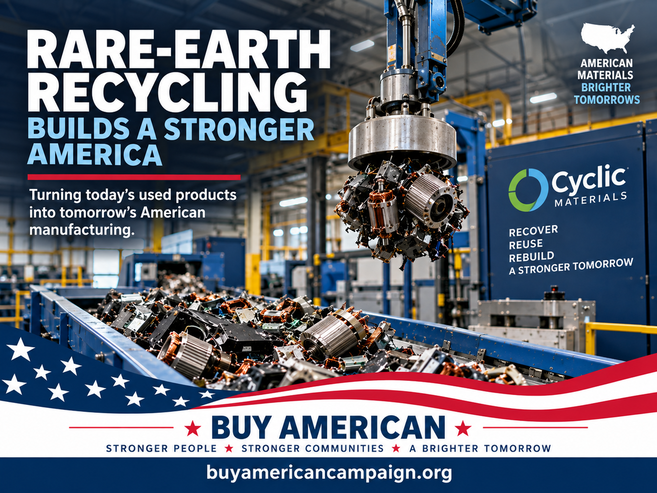
America cannot build a durable manufacturing base if it remains dependent on distant suppliers for the materials inside modern products. That is why a new factory in Mesa, Arizona, matters well beyond its walls. Cyclic Materials has opened what the company and the Arizona Commerce Authority describe as America’s first commercial-scale facility dedicated to automated rare-earth magnet recycling.
The 144,000-square-foot plant represents an investment of more than $30 million and is expected to create more than 25 jobs initially. Its larger importance is capacity: the facility is designed to process up to 25,000 metric tons of magnet-bearing end-of-life products every year. Those products can include electric motors, hard drives and other equipment whose useful materials too often leave the country or disappear into ordinary scrap streams.
Rare Earths Are Hidden Inside Everyday Technology
The phrase “rare earths” sounds remote, but the materials are embedded in technologies Americans use and manufacture every day. Permanent magnets containing rare-earth elements help power vehicles, robotics, electronics, medical equipment, wind turbines, data-center hardware and defense systems. They make compact motors stronger and more efficient.
The supply chain, however, remains concentrated outside the United States. That creates a vulnerability for manufacturers even when final assembly happens here. A company can have workers, tooling and customers ready, yet still face delays or price shocks if a critical material is unavailable. Domestic mining and refining are part of the answer, but recovering material already circulating inside used products can add supply faster while reducing waste.
The Mesa Plant Turns Old Products Into New Inputs
Cyclic’s Mesa operation uses its MagCycle technology to mechanically separate magnets from end-of-life products. The process also recovers copper, aluminum and steel. Its rare-earth magnet concentrate, sold as Mag-Xtract, becomes a feedstock for the company’s broader recovery system rather than the end of the process.
That distinction matters. Recycling only strengthens manufacturing when recovered material reaches a usable specification and returns to production. Cyclic says more than 7,000 metric tons of feedstock had already arrived in Mesa before the grand opening, processing is underway, and the first commercial shipments to U.S. customers are expected later in September.

A Circular Supply Chain Can Be a Domestic Supply Chain
Recycling is often discussed only as an environmental practice. For critical materials, it is also an industrial strategy. Every motor or hard drive processed domestically is a potential source of material that does not have to be purchased from a geographically concentrated overseas market. It gives American manufacturers another pathway to the inputs they need.
It can also create a network effect. Electronics recyclers and manufacturers need dependable destinations for scrap. Recovery facilities need reliable volumes of feedstock. Refiners and magnet makers need consistent material. When those links operate in the same country, each investment makes the next one more practical. Cyclic has already announced a South Carolina campus intended to combine magnet recovery with rare-earth refining on one site.
The Speed of the Build Is Part of the Story
The Mesa facility was completed 17 months after it was announced. Large industrial projects often take years to permit, finance, equip and commission. Bringing commercial processing online in less than a year and a half shows that domestic capacity can move quickly when a proven need, available site, financing and local support align.
One plant will not solve America’s rare-earth dependence. Its initial job count is modest, and mechanical separation is only one stage in a long supply chain. The honest measure is whether Mesa operates reliably, ships material that customers can use, attracts more feedstock and helps downstream recovery and manufacturing expand. Those results matter more than the ribbon cutting.

American Manufacturing Needs the Materials Behind the Label
Consumers usually see a finished product and a country-of-origin label. Behind that label is a deeper chain of materials, components, machinery and specialized knowledge. A product assembled in America is more secure when more of that chain also exists here. Critical-material recycling helps move the country in that direction.
Buying American-made products remains part of the equation because factories need customers. But demand alone is not enough. America must also invest in the industrial systems that recover valuable materials, refine them and return them to manufacturers. Mesa is a practical example of what that work looks like: used products arrive, useful materials are separated, and a domestic supply begins again.
Keep the Material—and the Capability—Here
The best supply chain is not always a straight line from a new mine to a new product. Sometimes it is a circle that keeps yesterday’s equipment from becoming tomorrow’s shortage. America’s rare-earth challenge is large, but the Mesa facility adds something concrete: commercial capacity operating now, with room to scale.
If the United States wants to lead in advanced manufacturing, it must secure the materials those industries require. Recovering rare-earth magnets already inside the country is one of the fastest, most practical places to start.
Sources: Cyclic Materials facility announcement; Arizona Commerce Authority; and U.S. Department of Commerce, International Trade Administration.
Whenever possible, choose Made in USA.
| If you like what you see and think this post would be of interest to someone, please share |