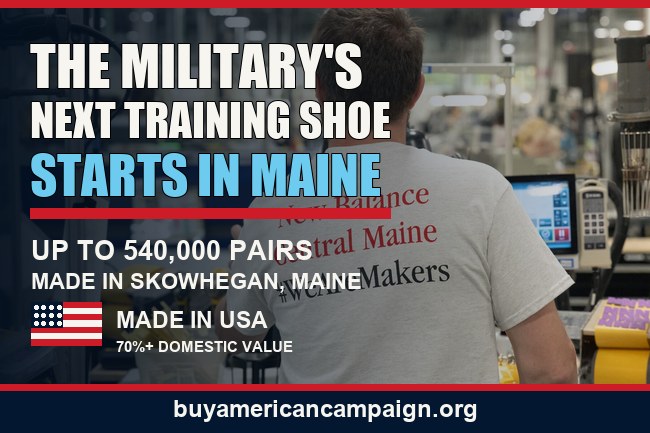
Before a new recruit takes the first demanding steps of basic training, somebody has to make the shoes. Beginning in early 2027, many of those recruits will receive American-made military shoes produced by New Balance workers in Skowhegan, Maine.
The company announced September 18 that the Defense Logistics Agency awarded it a three-year contract to provide the MADE in USA 0430 athletic shoe to recruits entering the Army, Navy, Air Force and Marine Corps. According to Senator Susan Collins’ office, the government could purchase as many as 540,000 pairs, with a minimum of 22,000 pairs per year.
An American-Made Military Shoe Is More Than a Uniform Item
A training shoe is easy to overlook. It is not a fighter jet, a ship or a vehicle. But it is issued to people who will run, march and train in it every day, and the ability to manufacture that shoe domestically depends on a chain of skills, machinery, materials and suppliers that can disappear if demand disappears.
That is why this contract matters beyond the number of pairs ordered. It connects a predictable customer with an operating American factory. A minimum annual purchase gives workers and managers something every manufacturer needs: enough visibility to plan production, retain skills and justify continued investment.
The 0430 Will Be Built in Skowhegan
The shoe’s name—pronounced “zero-four-thirty”—refers to the early wake-up calls familiar to military recruits. New Balance says the model was developed specifically for basic training and will be produced at its Central Maine factory in Skowhegan.
New Balance owns five athletic-footwear factories in New England. The company also makes an important qualification about its origin claim: its MADE U.S. footwear contains a domestic value of 70% or more, and those products represent only a limited portion of its U.S. sales. That disclosure matters. Buying from an American brand is not automatically the same as buying an American-made product, so consumers still need to check the specific model.
Public Purchasing Can Preserve Industrial Capability
The contract also illustrates the practical purpose of domestic-purchasing rules. For years, military recruits could receive an allowance for athletic shoes instead of being issued footwear sourced through the same domestic-preference framework used for other uniform items. Congress changed that treatment through the 2017 defense authorization process, allowing American manufacturers to compete for recruit footwear purchases under the Berry Amendment.
New Balance received a previous $17.3 million military footwear contract in 2018. The new award is not simply a symbolic return to “Made in USA.” It is another real order moving through an existing plant, where production knowledge has to be maintained between contracts rather than recreated after it has been lost.
The range between the contract’s annual minimum and its potential maximum also deserves careful wording. The government is not promising to buy all 540,000 pairs. What it is creating is a three-year opportunity with a defined floor and room for substantially greater production if military demand requires it.
A Factory Depends on Repeated Decisions
Factories rarely survive because of one announcement. They survive because customers repeatedly choose the products those factories can make. A large government contract can anchor production, but everyday commercial demand also determines whether companies have a reason to maintain American lines, train new workers and develop the next domestic model.
This is especially important in footwear, an industry in which much of the production base moved offshore decades ago. Keeping even part of that capability in New England means keeping people who understand cutting, stitching, forming, assembly, quality control and the specialized equipment behind modern athletic shoes.
The Honest Version of “Made in USA” Is Stronger
The 70% domestic-value disclosure should not be treated as a reason to dismiss the accomplishment. It should be treated as useful information. Domestic manufacturing is not strengthened by pretending supply chains are simpler than they are. It is strengthened when companies state what is made here, where it is made and how much American production is actually involved.
That transparency lets buyers reward the specific products that support domestic work. It also establishes a measurable starting point from which companies can increase American content when materials, components and capacity become available.
A Purchase Order Is a Vote for Production
The first pairs delivered under this contract will go to military recruits, not retail shelves. Even so, the lesson applies to all of us. Domestic manufacturing grows when American-made products are not merely praised but purchased.
A contract that may reach 540,000 pairs tells a factory that its work has a future. Consumer purchases send the same message on a smaller scale. Check the country-of-origin label, look for model-specific disclosures and choose the American-made option when it meets your needs. Each decision helps give American workers another reason to keep making the next pair here.
Whenever possible, choose Made in USA.
| If you like what you see and think this post would be of interest to someone, please share |